How do IoT sensors and connectivity improve production efficiency?
Complete IoT guide • Sensor connectivity & production efficiency
IoT Sensors & Connectivity:
Show Efficiency SimulatorIoT sensors and connectivity transform manufacturing by providing real-time visibility into production processes, enabling predictive maintenance, optimizing workflows, and reducing waste. These technologies create intelligent, responsive manufacturing systems that adapt to changing conditions and optimize performance.
Key benefits include continuous monitoring, data-driven decision making, automated responses to equipment issues, and enhanced quality control. IoT connectivity enables seamless communication between machines, systems, and personnel, creating an integrated manufacturing ecosystem.
IoT sensor applications:
- Condition Monitoring: Real-time equipment health tracking
- Process Optimization: Continuous workflow improvement
- Predictive Maintenance: Preventing unplanned downtime
- Quality Control: Real-time defect detection
Successful implementation requires strategic sensor placement, robust connectivity infrastructure, and data analytics capabilities.
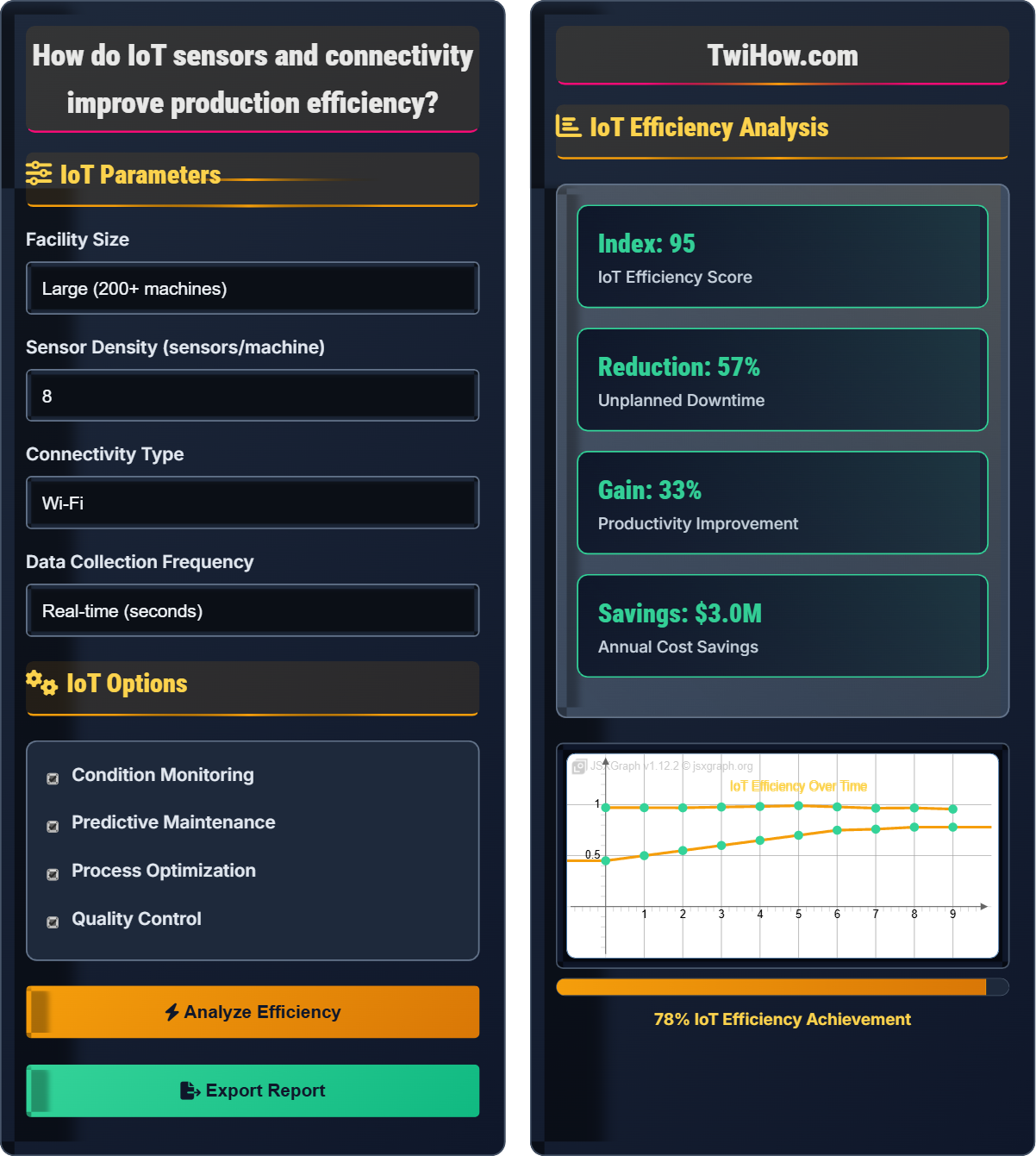
IoT Parameters
IoT Options
IoT Efficiency Analysis
| Sensor Type | Deployment | Impact | ROI |
|---|---|---|---|
| Temperature | 100% | High | 35% |
| Vibration | 85% | High | 42% |
| Pressure | 70% | Medium | 28% |
| Flow | 60% | Medium | 25% |
| Quality | 90% | High | 38% |
Real-time Monitoring Visualization
Sensor Network Flow
IoT Sensors & Connectivity Explained
IoT sensors are intelligent devices that collect data from manufacturing equipment and processes, transmitting this information wirelessly to centralized systems for analysis. These sensors enable real-time monitoring, predictive analytics, and automated responses that optimize production efficiency.
IoT efficiency follows a systematic approach:
Framework components include:
- Data Collection: Gathering real-time information from sensors
- Connectivity: Reliable transmission of data to systems
- Analytics: Processing data for actionable insights
- Response: Automated or manual actions based on insights
- Optimization: Continuous improvement of processes
Common IoT sensors in manufacturing:
- Temperature Sensors: Monitor equipment and environmental conditions
- Vibration Sensors: Detect mechanical issues and wear patterns
- Pressure Sensors: Monitor hydraulic and pneumatic systems
- Flow Sensors: Track material and fluid movement
- Quality Sensors: Detect defects and measure product parameters
- Position Sensors: Track equipment and product positioning
- Real-time Visibility: Continuous monitoring of production processes
- Predictive Maintenance: Prevent equipment failures before they occur
- Process Optimization: Data-driven improvements to workflows
- Quality Control: Immediate detection of defects and issues
- Cost Reduction: Lower maintenance and operational costs
- Energy Efficiency: Optimized energy consumption patterns
Efficiency Metrics & IoT Assessment
- Select sensors based on specific application requirements
- Ensure reliable connectivity and data transmission
- Implement robust cybersecurity measures
- Integrate with existing manufacturing systems
Sensor-Specific Efficiency Profiles
IoT Sensors & Efficiency Quiz
Which sensor type is most critical for predictive maintenance of rotating machinery?
Vibration sensors are most critical for predictive maintenance of rotating machinery. They detect mechanical issues like imbalance, misalignment, bearing wear, and looseness before they cause equipment failure. Vibration analysis is the foundation of predictive maintenance programs for rotating equipment.
The answer is B) Vibration sensors.
Rotating machinery has specific failure modes that manifest as vibration patterns. Vibration sensors can detect these patterns early, allowing for planned maintenance before catastrophic failure. This is why vibration monitoring is the cornerstone of predictive maintenance for motors, pumps, fans, and other rotating equipment.
Predictive Maintenance: Maintenance based on equipment condition
Vibration Analysis: Monitoring mechanical vibrations to detect issues
Rotating Machinery: Equipment with moving parts that rotate
• Vibration sensors detect mechanical issues early
• Rotating equipment requires vibration monitoring
• Predictive maintenance prevents failures
• Install vibration sensors on all critical rotating equipment
• Use multiple vibration sensors for comprehensive monitoring
• Combine with temperature sensors for better insights
• Relying only on temperature sensors
• Not monitoring all critical rotating equipment
• Ignoring vibration baseline data
Explain the importance of connectivity infrastructure for IoT sensor effectiveness and describe different connectivity options for manufacturing environments.
Importance of Connectivity: IoT sensors generate valuable data, but this data is useless without reliable connectivity to transmit it to analytical systems. Connectivity enables real-time monitoring, remote access, and integration with enterprise systems.
Connectivity Options:
• Wi-Fi: High bandwidth, suitable for data-intensive applications
• Ethernet: Most reliable, wired connection with high security
• Cellular: Flexible, good for remote or mobile applications
• Mesh Networks: Self-healing, extends coverage in large facilities
• Bluetooth: Low-power, short-range applications
• Industrial Protocols: Specialized protocols for harsh environments
Connectivity is the backbone of IoT systems. Without reliable data transmission, sensors become isolated islands of information. The choice of connectivity technology depends on factors like bandwidth requirements, reliability needs, environmental conditions, and security requirements.
Connectivity Infrastructure: Network systems for data transmission
Bandwidth: Data transmission capacity
Reliability: Consistent data transmission without interruption
• Connectivity must match data requirements
• Consider environmental factors
• Security is critical for industrial networks
• Use redundant connections for critical applications
• Consider edge computing for high-bandwidth sensors
• Implement network segmentation for security
• Underestimating bandwidth requirements
• Not considering environmental conditions
• Ignoring network security
A manufacturing facility installs IoT sensors on 100 critical machines at a cost of $50,000 per machine ($5M total). The system reduces unplanned downtime by 60%, and the facility experiences $2M in annual downtime costs. Additionally, it increases productivity by 15% on a $20M annual production value. Calculate the first-year ROI and payback period.
Downtime Cost Savings:
$2M × 60% = $1.2M annually
Productivity Gain Value:
$20M × 15% = $3M annually
Total Annual Benefit:
$1.2M + $3M = $4.2M
First-Year ROI:
($4.2M ÷ $5M) × 100 = 84% ROI
Payback Period:
$5M ÷ $4.2M = 1.19 years (approximately 14 months)
The IoT investment achieves an 84% ROI in the first year with a payback period of 14 months.
This calculation demonstrates the significant financial benefits of IoT implementations. The combination of reduced downtime costs and increased productivity creates substantial returns that often justify the initial investment within the first year of operation.
ROI: Return on Investment (gain divided by cost)
Payback Period: Time to recover initial investment
Unplanned Downtime: Unexpected equipment failures
• IoT investments often have quick payback periods
• Multiple benefit streams contribute to ROI
• Benefits compound over time
• Calculate multiple benefit streams
• Consider indirect benefits
• Account for productivity improvements
• Only counting direct cost savings
• Not including productivity gains
• Ignoring secondary benefits
You're designing an IoT sensor network for a production line with 50 machines. Identify the key sensors needed for each machine and explain how you would ensure reliable data transmission and processing.
Key Sensors per Machine:
• Temperature Sensors: Motor, bearing, and process temperature monitoring
• Vibration Sensors: Mechanical condition monitoring
• Pressure Sensors: Hydraulic/pneumatic system monitoring
• Flow Sensors: Coolant and lubrication flow monitoring
• Current Sensors: Electrical consumption monitoring
Reliable Data Transmission:
• Install redundant network connections
• Use industrial-grade networking equipment
• Implement edge computing for critical real-time decisions
• Establish data backup and recovery procedures
• Use industrial protocols designed for manufacturing environments
Effective IoT sensor networks require comprehensive monitoring of critical parameters while ensuring reliable data transmission. The design must consider both the specific needs of each machine type and the overall network architecture for optimal performance.
Sensor Network: Interconnected sensors for monitoring
Edge Computing: Processing data closer to source
Industrial Protocols: Communication standards for manufacturing
• Monitor critical parameters for each machine
• Ensure network reliability and redundancy
• Use appropriate industrial protocols
• Start with critical machines
• Use wireless for hard-to-reach locations
• Implement network segmentation
• Not monitoring all critical parameters
• Using consumer-grade networking equipment
• Not planning for network expansion
How do IoT sensors improve quality control in manufacturing?
IoT sensors improve quality control by enabling real-time defect detection and immediate process adjustments. Quality sensors can detect deviations from specifications immediately, allowing for instant corrections before defective products are produced in large quantities.
The answer is B) Through real-time defect detection and process adjustment.
IoT quality sensors provide continuous monitoring of product parameters, detecting defects as they occur rather than after production is complete. This enables immediate corrective actions, reducing waste and improving overall quality while maintaining production efficiency.
Real-time Monitoring: Continuous data collection and analysis
Defect Detection: Identifying quality issues during productionProcess Adjustment: Immediate corrections to maintain quality
• Real-time detection prevents batch defects
• Immediate corrections maintain efficiency
• Quality sensors work with production systems
• Place sensors at critical quality points
• Use multiple sensor types for comprehensive monitoring
• Integrate with automated correction systems
• Not placing sensors at critical quality points
• Not integrating with correction systems
• Using only post-production quality checks
FAQ
Q: What is the typical cost of implementing IoT sensors in a manufacturing facility?
A: IoT implementation costs vary significantly:
Sensor Costs: $20-500 per sensor depending on type and capability
Connectivity: $50-200 per device annually for cellular/data plans
Infrastructure: $10,000-100,000 for gateways and networking equipment
Software: $50-500 per device monthly for cloud platforms
Implementation: 20-30% of hardware costs for installation and setup
Total costs range from $50,000 for small pilot projects to millions for enterprise-wide deployments.
Q: How do IoT sensors handle harsh industrial environments?
A: Industrial IoT sensors are designed for harsh environments:
Environmental Ratings: IP67/IP68 ratings for dust and water resistance
Temperature Range: Operating from -40°C to 125°C
Vibration Resistance: Designed to withstand mechanical shock
Electromagnetic Immunity: Protected from electrical interference
Industrial Protocols: Use protocols designed for manufacturing environments
Specialized sensors are available for extreme conditions like high temperatures, corrosive environments, and explosive atmospheres.