Data Privacy and IP Protection in Connected Manufacturing
Complete security guide • Step-by-step explanations
Manufacturing Security:
Show Security CalculatorConnected manufacturing systems face unique challenges in protecting sensitive data and intellectual property. With IoT devices, cloud platforms, and distributed networks, manufacturers must implement comprehensive security strategies that protect data privacy while safeguarding proprietary designs and processes.
Key security concepts:
- Data Encryption: Protecting data in transit and at rest
- Access Controls: Limiting who can access sensitive information
- IP Protection: Safeguarding proprietary designs and processes
- Compliance: Meeting regulatory requirements
Modern manufacturing security combines traditional cybersecurity practices with specialized protocols for industrial environments, ensuring that connected systems remain secure while maintaining operational efficiency.
Security Assessment Parameters
Security Measures
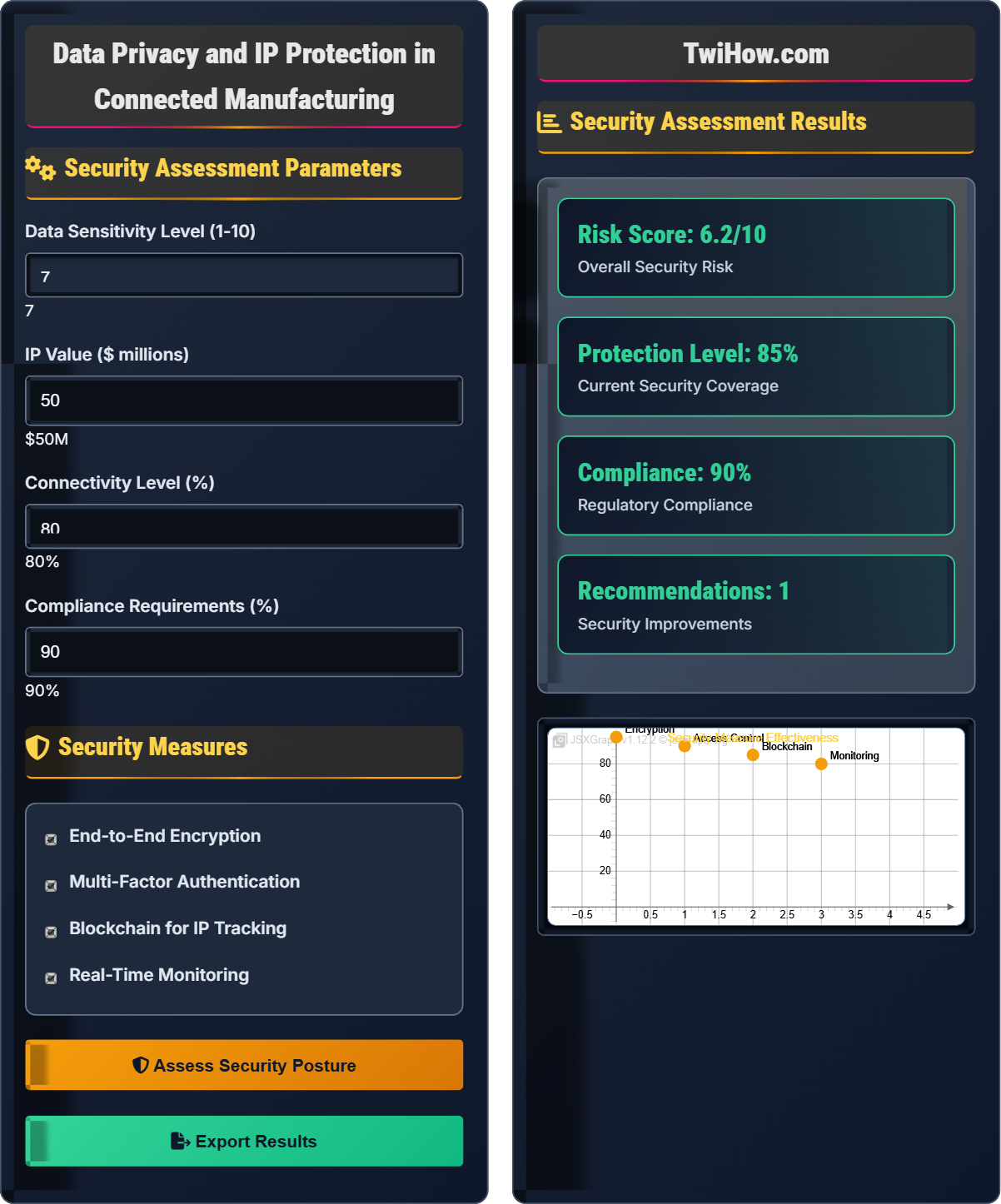
Security Assessment Results
| Security Measure | Implementation | Effectiveness | Priority |
|---|---|---|---|
| Encryption | Yes | 95% | High |
| Access Control | Yes | 90% | High |
| Blockchain | Yes | 85% | Medium |
| Monitoring | Yes | 80% | High |
• Risk: 70%
• Impact: $2M
• Mitigation: 95%
• Risk: 60%
• Impact: $5M
• Mitigation: 85%
• Risk: 40%
• Impact: $1M
• Mitigation: 90%
Data Privacy and IP Protection in Connected Manufacturing
Manufacturing data privacy involves protecting sensitive information generated by connected systems, including production data, quality metrics, intellectual property, and employee information. In connected manufacturing environments, data flows between machines, sensors, cloud platforms, and external partners, creating multiple attack vectors that must be secured.
Key privacy considerations include:
- Personal Data: Employee records, biometric data, access logs
- Production Data: Manufacturing processes, quality metrics, yield data
- Proprietary Information: Designs, formulas, process parameters
- Customer Data: Orders, specifications, delivery information
Intellectual property protection in connected manufacturing involves safeguarding proprietary designs, processes, and innovations from unauthorized access, copying, or theft. This includes protecting CAD files, manufacturing recipes, process parameters, and trade secrets that provide competitive advantages.
Where:
- IP Value: Monetary value of intellectual property
- Threat Probability: Likelihood of security incidents
- Protection Level: Effectiveness of security measures
- Recovery Capability: Ability to restore operations after incidents
Key technologies for data privacy and IP protection in connected manufacturing:
- Encryption: End-to-end encryption for data in transit and at rest
- Access Control: Multi-factor authentication and role-based permissions
- Blockchain: Immutable records for IP tracking and verification
- Zero Trust: Verify every connection and transaction
- AI/ML: Anomaly detection and threat prediction
- Secure APIs: Protected interfaces for system integration
- GDPR: European data protection regulation
- ISO 27001: Information security management standard
- NIST Cybersecurity Framework: Industrial cybersecurity guidelines
- IEC 62443: Industrial automation and control systems security
- SOC 2: Service organization controls for data security
Security Fundamentals
Data privacy, intellectual property protection, encryption, access control, compliance frameworks.
Security Risk = (IP Value × Threat Probability) / (Protection Level × Recovery Capability)
Where Security Risk = overall risk score, IP Value = monetary value of intellectual property.
- Never store unencrypted sensitive data
- Implement least-privilege access controls
- Maintain audit trails for all access
Applications
Smart factory security, IP protection in supply chains, data privacy in IoT networks.
- Aerospace design protection
- Automotive IP security
- Pharmaceutical data privacy
- Electronics manufacturing security
- Operational technology security
- Legacy system integration
- Vendor relationship management
- Employee training requirements
Security Learning Quiz
Which encryption standard is most commonly used for protecting sensitive data in connected manufacturing systems?
AES (Advanced Encryption Standard) is the most widely adopted encryption standard for protecting sensitive data in connected manufacturing systems. It provides strong security with 128-bit, 192-bit, or 256-bit keys and is approved by NIST for government and commercial use.
DES is outdated and insecure, RSA is primarily used for key exchange, and MD5 is a hash function, not an encryption algorithm.
The answer is B) AES (Advanced Encryption Standard).
Understanding encryption standards is crucial for manufacturing security. AES is preferred because it offers excellent security-to-performance ratios and is efficient enough for real-time industrial applications. In connected manufacturing, data must be encrypted both in transit (between devices and cloud) and at rest (stored on servers and devices).
AES: Advanced Encryption Standard, symmetric encryption algorithm
Encryption: Converting data into coded format to prevent unauthorized access
Data at Rest: Data stored on devices, databases, or servers
• Use AES-256 for highest security
• Encrypt data both in transit and at rest
• Regularly update encryption keys
• Implement hardware-based encryption when possible
• Use separate keys for different data types
• Regularly rotate encryption keys
• Using outdated encryption algorithms
• Encrypting only data in transit, not at rest
• Storing encryption keys with encrypted data
Explain how blockchain technology can be used to protect intellectual property in connected manufacturing systems. Include specific examples of how blockchain ensures authenticity and prevents IP theft.
Blockchain for IP Protection:
1. Immutable Records: Blockchain creates tamper-proof timestamps for design files, patents, and manufacturing processes, establishing proof of creation and ownership.
2. Smart Contracts: Automated contracts can manage licensing agreements, royalty payments, and usage rights for shared IP between manufacturers.
3. Supply Chain Transparency: Track IP usage across the supply chain, ensuring authorized parties only access proprietary information.
4. Decentralized Verification: Multiple nodes verify the authenticity of IP claims, preventing disputes over ownership.
Example: A manufacturer creates a new design and stores its hash on the blockchain. Later, if someone claims ownership, the blockchain timestamp proves original creation date. Smart contracts can automatically execute licensing terms when other manufacturers want to use the IP.
Blockchain technology provides unique advantages for IP protection in manufacturing by creating an immutable, decentralized record system. Unlike traditional centralized databases, blockchain cannot be altered by any single party, making it ideal for proving IP ownership in collaborative manufacturing environments where multiple parties may have access to sensitive information.
Blockchain: Distributed ledger technology with cryptographic security
Smart Contract: Self-executing contract with terms directly written into code
Immutable: Cannot be changed or deleted once recorded
• Store only hashes, not actual IP files
• Regularly update blockchain security protocols
• Combine blockchain with traditional IP protection methods
• Use hybrid models for maximum security
• Establish clear governance for blockchain networks
• Storing entire IP files on public blockchains
• Not understanding blockchain scalability limits
• Neglecting to plan for governance structures
A manufacturing company has an annual revenue of $500 million and estimates that their IP is worth $100 million. They are considering investing in security measures to protect their connected manufacturing systems. If they decide to allocate 1.5% of IP value to security investments, calculate the annual security budget. If they implement encryption (40% of budget), access controls (30%), monitoring (20%), and blockchain (10%), how much is allocated to each measure?
Annual Security Budget:
Security Budget = IP Value × Allocation Percentage
Security Budget = $100,000,000 × 0.015 = $1,500,000
Budget Allocation:
Encryption: $1,500,000 × 0.40 = $600,000
Access Controls: $1,500,000 × 0.30 = $450,000
Monitoring: $1,500,000 × 0.20 = $300,000
Blockchain: $1,500,000 × 0.10 = $150,000
Verification: $600,000 + $450,000 + $300,000 + $150,000 = $1,500,000 ✓
This calculation demonstrates how companies should proportionally allocate security budgets based on IP value. The example shows a common allocation strategy where the most critical security measures (encryption and access controls) receive larger portions of the budget. This approach ensures comprehensive protection while prioritizing the most impactful security measures.
Security Budget: Funds allocated to protect information assets
ROI (Return on Investment): Benefit gained from security investments
Cost-Benefit Analysis: Evaluation of security investment effectiveness
• Allocate 1-3% of IP value to security
• Prioritize high-impact security measures
• Regularly review and adjust allocations
• Conduct regular risk assessments to adjust allocations
• Consider insurance as part of security strategy
• Balance prevention and detection investments
• Allocating insufficient funds to security
• Focusing only on prevention, not detection
• Not regularly reviewing budget allocations
A manufacturing company wants to implement a zero trust security model for their connected systems. Describe the key components of a zero trust architecture and explain how it addresses data privacy and IP protection challenges in connected manufacturing environments.
Key Components of Zero Trust Architecture:
1. Identity Verification: Every user, device, and application must be authenticated before accessing resources
2. Micro-Segmentation: Divide network into small segments to limit lateral movement of threats
3. Least Privilege Access: Grant minimal permissions necessary for specific tasks
4. Continuous Monitoring: Real-time monitoring of all network activities
5. Device Trust: Verify device integrity before granting access
Addressing Manufacturing Challenges:
• Data Privacy: Prevents unauthorized access to sensitive production data
• IP Protection: Limits exposure of proprietary designs and processes
• Compliance: Ensures access is logged and auditable for regulatory requirements
• Operational Continuity: Maintains security without disrupting production processes
Zero trust architecture is particularly effective in manufacturing environments because it assumes no implicit trust based on location or network position. In connected manufacturing, where IoT devices, cloud services, and external vendors interact with critical systems, zero trust ensures that every connection is verified and monitored, significantly reducing the risk of data breaches and IP theft.
Zero Trust: Security model that trusts nothing by default
Micro-Segmentation: Dividing network into smaller, isolated segments
Least Privilege: Granting minimum necessary permissions
• Verify identity before granting access
• Monitor all activities continuously
• Segment critical systems from general networks
• Start with critical assets and expand gradually
• Use behavioral analytics for anomaly detection
• Implement strong device management policies
• Trying to implement zero trust all at once
• Not properly segmenting legacy systems
• Neglecting to train staff on new processes
Which compliance framework specifically addresses cybersecurity for industrial automation and control systems?
IEC 62443 is the international standard specifically designed for cybersecurity in industrial automation and control systems (IACS). It provides a comprehensive framework for securing operational technology (OT) environments, which are prevalent in manufacturing settings.
While ISO 27001 is a general information security framework, IEC 62443 addresses the unique challenges of industrial environments including real-time operational requirements and safety considerations.
The answer is B) IEC 62443.
Industrial environments have different security requirements than traditional IT systems. IEC 62443 recognizes that manufacturing systems must balance security with operational continuity and safety. The standard addresses the unique architecture of industrial networks, including SCADA systems, PLCs, and HMIs, which are not covered by general IT security frameworks.
IEC 62443: International standard for industrial cybersecurity
OT (Operational Technology): Hardware and software for industrial operations
IACS: Industrial Automation and Control Systems
• Use IEC 62443 for industrial systems
• Integrate with IT security frameworks
• Consider operational continuity in security
• Align IEC 62443 with ISO 27001 for comprehensive coverage
• Regularly assess OT security posture
• Plan for secure system updates and patches
• Applying IT security frameworks to OT systems
• Neglecting operational technology security
• Not considering safety implications of security measures
FAQ
Q: How do manufacturers balance operational efficiency with security in connected systems?
A: Balancing operational efficiency with security requires a risk-based approach:
1. Defense in Depth: Layer security controls without impacting critical operations
2. Segmentation: Isolate critical systems while maintaining connectivity for monitoring
3. Real-Time Monitoring: Detect security events without disrupting production
4. Automated Responses: Use AI to respond to threats without human intervention
The key is implementing security measures that enhance rather than hinder operational visibility and control.
Q: What legal considerations should manufacturers address when protecting IP in connected systems?
A: Legal considerations for IP protection in connected manufacturing include:
Patent Protection: Ensure connected systems don't inadvertently disclose patentable processes
Trade Secret Safeguards: Implement measures to maintain confidentiality of proprietary processes
Data Privacy Laws: Comply with regulations like GDPR that may affect how manufacturing data is handled
Contractual Agreements: Establish clear IP ownership and usage rights with vendors and partners
Cybersecurity Standards: Meet industry standards to demonstrate reasonable care in IP protection