Legacy System Integration in Manufacturing
Complete guide to Industry 4.0 digital transformation • Step-by-step explanations
System Integration:
Show Integration CalculatorLegacy system integration presents significant challenges for manufacturers seeking to implement Industry 4.0 technologies. This comprehensive guide explores proven strategies, technologies, and methodologies for successfully bridging old and new systems while maintaining operational continuity and maximizing return on investment.
Key integration concepts:
- Middleware Solutions: Bridging incompatible systems
- API Development: Enabling system communication
- Data Migration: Transferring information securely
- Hybrid Architectures: Combining old and new technologies
Modern integration approaches leverage cloud technologies, microservices, and containerization to create flexible, scalable solutions that preserve existing investments while enabling digital transformation.
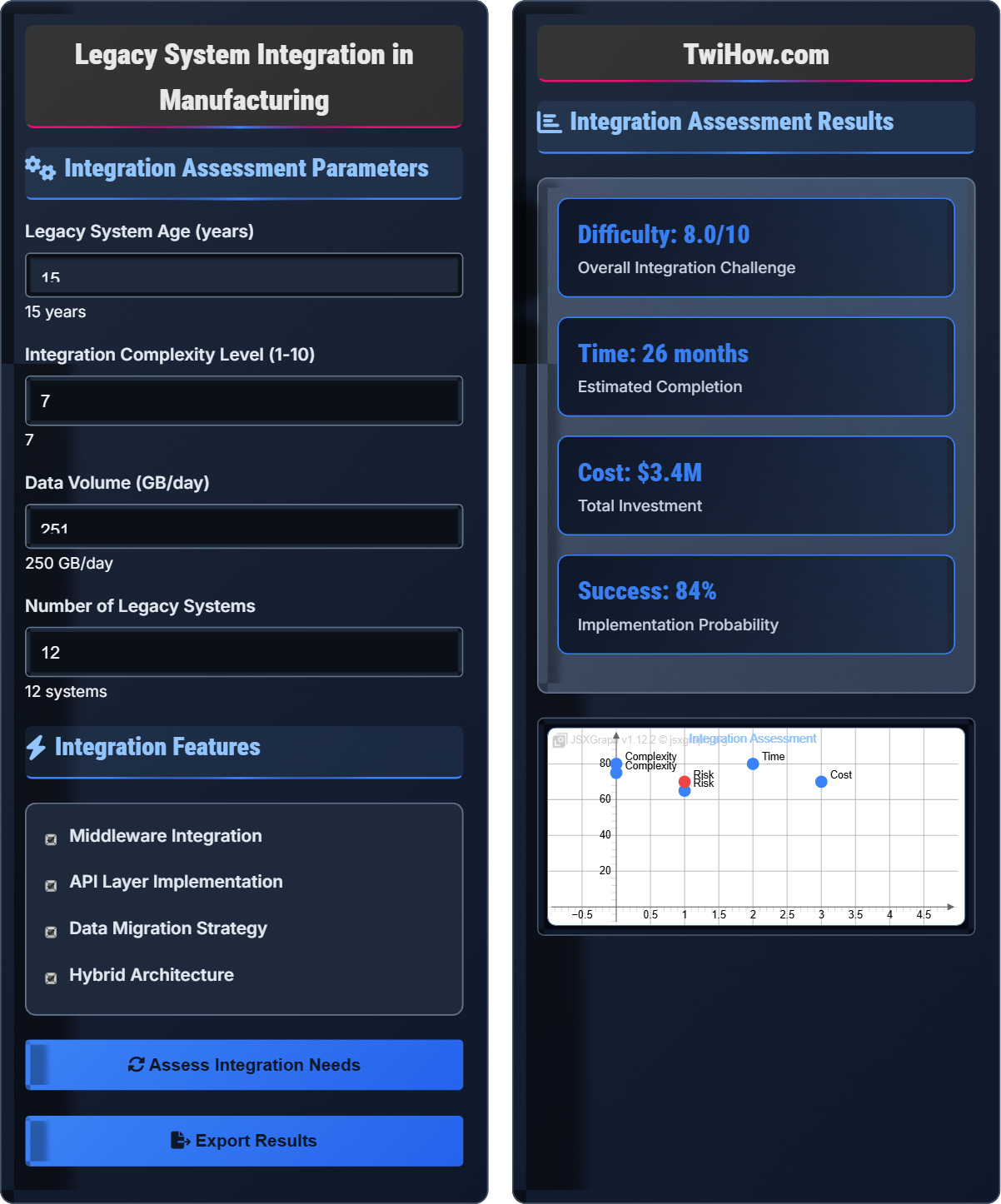
Integration Assessment Parameters
Integration Features
Integration Assessment Results
| Challenge Area | Severity | Impact | Priority |
|---|---|---|---|
| Data Compatibility | High | 90% | High |
| System Communication | Medium | 75% | High |
| Security Concerns | High | 85% | High |
| Operational Disruption | Low | 40% | Medium |
• System analysis
• Data mapping
• Risk evaluation
• Architecture planning
• Middleware selection
• Security protocols
• Phased rollout
• Testing & validation
• Training & support
Legacy System Integration in Manufacturing
Legacy system integration is the process of connecting older, established manufacturing systems with newer Industry 4.0 technologies to create a unified, efficient operational environment. This involves connecting systems that may use different protocols, data formats, and communication standards while maintaining operational continuity.
Key integration challenges include:
- Protocol Incompatibility: Different communication standards and data formats
- Security Vulnerabilities: Older systems may lack modern security features
- Data Silos: Information trapped in isolated systems
- Operational Continuity: Maintaining production during integration
- Skills Gap: Limited expertise in legacy technologies
The complexity of legacy system integration can be quantified using various factors that affect the overall difficulty and resource requirements of the project.
Where:
- System Age: Average age of legacy systems (years)
- System Count: Number of systems to integrate
- Data Volume: Daily data flow between systems (GB)
- Available Resources: Budget and personnel allocation
- Technical Expertise: Team experience with legacy systems
Technologies that enable effective legacy system integration:
- Enterprise Service Bus (ESB): Centralized middleware for system communication
- API Gateways: Secure entry points for system interactions
- Message Queues: Asynchronous communication between systems
- Data Lakes: Centralized repositories for integrated data
- Containerization: Isolated environments for legacy applications
- Cloud Services: Scalable platforms for integration
- Phased Integration: Gradual system-by-system integration
- Hybrid Architecture: Coexistence of legacy and modern systems
- Wrapper Pattern: Encapsulating legacy functionality
- Service-Oriented Architecture: Breaking systems into services
- Microservices: Decomposing monolithic applications
- Event-Driven Architecture: Real-time system communication
Integration Fundamentals
Legacy system integration, middleware, API, data migration, system compatibility, Industry 4.0.
Integration Complexity = (System Age × System Count × Data Volume) / (Available Resources × Technical Expertise)
Where Integration Complexity = overall integration difficulty rating, System Age = average age of legacy systems.
- Always maintain operational continuity during integration
- Validate all data transformations thoroughly
- Implement comprehensive security measures
Applications
ERP integration, MES connectivity, SCADA modernization, PLC communication, database consolidation.
- Automotive manufacturing systems
- Chemical process control
- Pharmaceutical quality systems
- Steel mill automation
- Regulatory compliance requirements
- Production uptime requirements
- Security and access controls
- Staff training and change management
Integration Learning Quiz
What is the primary benefit of using middleware for legacy system integration?
The primary benefit of middleware is facilitating communication between incompatible systems. Middleware acts as a bridge that translates protocols, formats, and communication methods between different systems, enabling them to work together despite architectural differences.
Middleware doesn't replace legacy systems but rather enables them to communicate with modern systems, preserving existing investments while enabling integration.
The answer is B) Facilitating communication between incompatible systems.
Middleware serves as an abstraction layer that hides the complexity of different system interfaces. It provides a common platform for systems to communicate, regardless of their underlying technologies, protocols, or data formats. This is particularly valuable in manufacturing environments where systems from different eras and vendors must work together seamlessly.
Middleware: Software that connects different applications and systems
Protocol Translation: Converting communication formats between systems
System Integration: Connecting different systems to work together• Middleware preserves legacy investments
• Provides standardized communication interfaces
• Enables gradual system modernization
• Choose middleware that supports required protocols
• Plan for scalability and performance
• Consider security implications
• Assuming middleware solves all integration issues
• Not considering performance impacts
• Failing to plan for security requirements
Explain how API development facilitates legacy system integration and describe the specific steps required to implement an effective API strategy for connecting older systems with modern platforms.
How API Development Facilitates Integration:
1. Abstraction Layer: APIs provide a standardized interface that shields modern systems from the complexities of legacy architectures.
2. Protocol Translation: APIs convert legacy communication protocols to modern standards (REST, SOAP).
3. Data Format Conversion: APIs transform data between legacy formats and modern JSON/XML structures.
4. Security Enhancement: APIs add authentication, authorization, and encryption layers to legacy systems.
Steps for API Strategy Implementation:
• System Analysis: Map legacy system capabilities and data structures
• API Design: Create RESTful endpoints that match legacy system functions
• Development: Build wrapper APIs that interface with legacy systems
• Security Implementation: Add OAuth, JWT, or other authentication methods
• Documentation: Create comprehensive API documentation for developers
• Testing: Validate API functionality and performance under load
• Deployment: Implement API gateway for centralized management
APIs act as translators between legacy and modern systems, converting requests and responses between different formats and protocols. They provide a clean, standardized interface that allows modern applications to interact with legacy systems as if they were modern services. This approach preserves existing investments while enabling modern integration patterns.
API (Application Programming Interface): Interface for system communication
REST: Representational State Transfer architectural style
SOAP: Simple Object Access Protocol
• Design APIs to match legacy system capabilities
• Implement proper error handling
• Ensure API performance meets requirements
• Start with read-only APIs to minimize risk
• Implement rate limiting to protect legacy systems
• Use caching to improve performance
• Not considering legacy system performance limits
• Failing to implement proper security
• Not documenting APIs adequately
A manufacturing company has 8 legacy systems that are 12 years old, with an average data flow of 150 GB per day. Their integration complexity is rated at 6 out of 10. Based on industry standards, the base cost is $100,000 per system plus $500 per GB of daily data flow. Additional complexity adds 20% to the base cost. Calculate the total estimated integration cost and determine the break-even time if the integration saves $80,000 annually.
Base Cost Calculation:
System Cost = 8 systems × $100,000 = $800,000
Data Cost = 150 GB × $500 = $75,000
Base Cost = $800,000 + $75,000 = $875,000
Complexity Adjustment:
Additional Cost = $875,000 × 0.20 = $175,000
Total Estimated Cost = $875,000 + $175,000 = $1,050,000
Break-even Calculation:
Annual Savings = $80,000
Break-even Time = $1,050,000 ÷ $80,000 = 13.125 years
Conclusion: Total integration cost is $1,050,000 with a break-even time of approximately 13 years.
This calculation demonstrates the significant investment required for legacy system integration. The complexity factor substantially increases costs, highlighting the importance of careful planning and realistic budgeting. The long break-even period indicates that integration benefits often extend beyond immediate cost savings to include operational improvements, compliance benefits, and competitive advantages.
Integration Cost: Total expense of connecting systems
Break-even Time: Period to recover initial investment
Cost-Benefit Analysis: Evaluation of investment returns
• Consider both direct and indirect costs
• Factor in complexity adjustments
• Account for ongoing maintenance costs
• Include training and change management costs
• Plan for unexpected complexity
• Consider phased implementation to reduce risk
• Underestimating complexity costs
• Not accounting for ongoing maintenance
• Ignoring training and transition costs
A manufacturing company wants to containerize their legacy systems to facilitate integration with modern platforms. Describe the benefits and challenges of this approach, and provide a step-by-step implementation plan for containerizing legacy manufacturing applications.
Benefits of Containerization:
1. Isolation: Each legacy application runs in its own container, preventing conflicts with other systems.
2. Portability: Containers can run on any system with container runtime, enabling cloud migration.
3. Scalability: Multiple instances of legacy applications can be deployed as needed.
4. Simplified Management: Containers provide consistent deployment and management across environments.
Challenges of Containerization:
• Legacy applications may not be designed for containerized environments
• Persistent data storage requires special consideration
• Network configuration may be complex for legacy systems
• Licensing issues with older software in containerized environments
Implementation Plan:
• Assessment: Evaluate legacy applications for containerization feasibility
• Dependency Mapping: Identify all system dependencies and external connections
• Container Configuration: Create Dockerfiles for each application
• Orchestration Setup: Configure Kubernetes or Docker Swarm for management
• Networking: Set up secure communication between containers and external systems
• Storage: Configure persistent storage for data preservation
• Testing: Validate functionality and performance in containerized environment
Containerization provides a modern approach to running legacy applications by encapsulating them with all their dependencies. This approach enables legacy systems to benefit from modern DevOps practices while preserving their functionality. However, careful planning is required to address the unique characteristics of legacy applications in containerized environments.
Containerization: Packaging applications with their dependencies
Docker: Containerization platform
Kubernetes: Container orchestration system
• Validate containerization feasibility first
• Plan for persistent data storage
• Ensure security compliance
• Start with non-critical applications first
• Use volume mounts for persistent data
• Implement proper logging and monitoring
• Not planning for persistent storage
• Ignoring network security requirements
• Failing to test thoroughly in containerized environment
Which integration pattern is most appropriate for connecting a legacy mainframe system with modern cloud applications?
The API wrapper pattern is most appropriate for connecting legacy mainframe systems with modern cloud applications. This pattern involves creating a modern API layer that wraps the legacy system's functionality, providing a clean, standardized interface for cloud applications to consume.
The API wrapper provides security, data transformation, and protocol translation while preserving the legacy system's core functionality. It's more reliable and maintainable than alternatives like screen scraping or direct database access.
The answer is C) API wrapper pattern.
The API wrapper pattern creates a modern facade for legacy systems, hiding their complexity while exposing standardized interfaces. This approach allows modern cloud applications to interact with legacy systems as if they were modern services, enabling seamless integration while preserving existing investments. The pattern provides security, scalability, and maintainability benefits over direct integration methods.
API Wrapper: Modern interface for legacy system functionality
Mainframe: Large-scale legacy computing system
Facade Pattern: Hiding complexity behind simplified interface
• Use API wrappers for secure system communication
• Implement proper error handling
• Ensure performance meets requirements
• Implement caching to improve performance
• Use asynchronous processing for heavy operations
• Plan for scalability and monitoring
• Direct database connections bypass security
• Screen scraping is fragile and unreliable
• File-based integration lacks real-time capabilities
FAQ
Q: How do you ensure data integrity during legacy system integration?
A: Ensuring data integrity requires multiple approaches:
1. Data Validation: Implement checksums, data type validation, and range checks at integration points
2. Transaction Management: Use ACID transactions to ensure data consistency across systems
3. Logging and Auditing: Track all data transformations and system interactions
4. Backup and Recovery: Maintain backups of both legacy and modern systems during integration
5. Gradual Rollout: Implement integration in phases with extensive testing at each stage
6. Real-time Monitoring: Monitor data flow and integrity continuously
Q: What are the key financial considerations for legacy system integration projects?
A: Key financial considerations include:
Upfront Investment: Middleware, API development, and system upgrades (typically $500K-$5M for medium-sized implementations)
Operational Costs: Ongoing maintenance, support, and licensing fees
ROI Timeline: Most projects show positive ROI within 2-5 years
Opportunity Costs: Benefits of improved efficiency, reduced downtime, and competitive advantage
Risk Mitigation: Costs avoided through improved compliance and reduced operational risks
Staff Training: Investment in training personnel on new integrated systems
Typical payback periods range from 2-4 years depending on implementation scope and operational benefits.