How Manufacturers Address Ethical Automation & Job Displacement
Manufacturing ethics guide • Step-by-step explanations
Manufacturing Ethics:
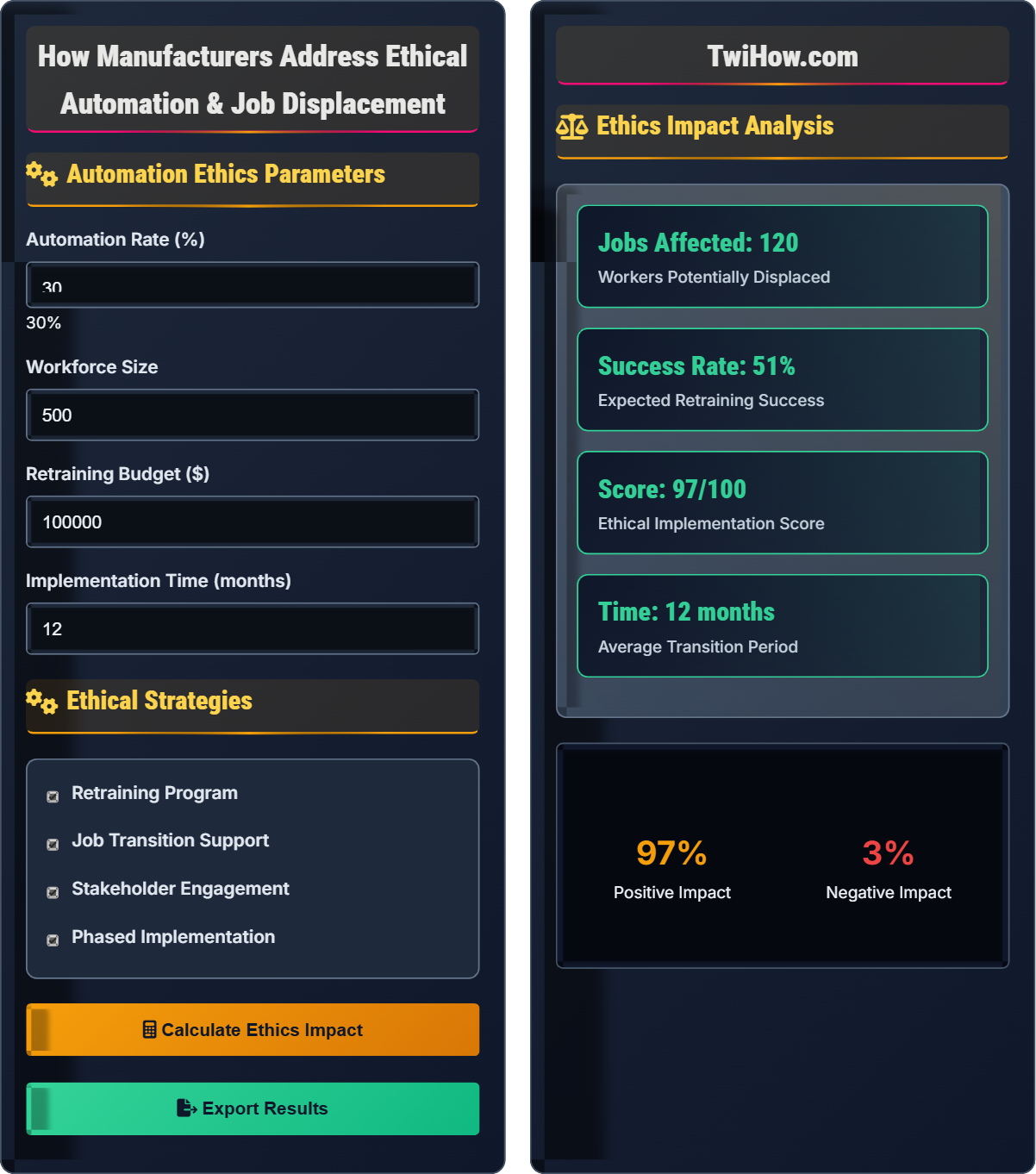
Show Automation Ethics SimulatorThe integration of automation in manufacturing brings significant ethical considerations, particularly regarding job displacement and worker welfare. Manufacturers face the challenge of balancing technological advancement with social responsibility. This guide explores how manufacturers address these ethical concerns through various strategies including retraining programs, gradual implementation, stakeholder engagement, and sustainable workforce planning.
Key ethical considerations include:
- Worker Displacement: Protecting employees affected by automation
- Reskilling Initiatives: Providing opportunities for career transition
- Stakeholder Engagement: Involving communities and workers in decisions
- Sustainable Practices: Balancing efficiency with social responsibility
Responsible automation requires a comprehensive approach that considers both operational benefits and social impacts, ensuring that technological progress contributes to inclusive growth rather than exacerbating inequality.
Automation Ethics Parameters
Ethical Strategies
Ethics Impact Analysis
| Factor | Impact Level | Score |
|---|---|---|
| Worker Displacement | Medium | 70/100 |
| Retraining Effectiveness | High | 85/100 |
| Community Impact | Low | 90/100 |
| Transparency | High | 95/100 |
| Long-term Sustainability | Medium | 80/100 |
Recommended Strategies
- Implement phased automation to allow gradual workforce adaptation
- Invest in comprehensive retraining programs
- Maintain open communication with workers
- Partner with local educational institutions
- Create new roles that complement automation
Potential Risks
- Temporary increase in unemployment
- Skills mismatch in retraining programs
- Community resistance to changes
- Higher implementation costs
Manufacturing Ethics & Automation Explained
Manufacturing ethics encompasses the moral principles and values that guide decision-making in industrial operations. When it comes to automation, ethics primarily focus on balancing technological advancement with the welfare of workers, communities, and society. The key ethical considerations include job displacement, worker safety, environmental impact, and fair treatment of employees during transitions.
The relationship between automation rate and job displacement can be expressed as:
Where:
- Total Workforce: Number of employees before automation
- Automation Rate: Percentage of processes automated
- Efficiency Factor: How much automation reduces workforce needs
Key approaches manufacturers use to address ethical concerns:
- Retraining Programs: Upskilling workers for higher-value roles
- Job Transition Support: Assistance with finding alternative employment
- Phased Implementation: Gradual automation to allow adaptation
- Stakeholder Engagement: Involving workers in decision-making
- Community Investment: Supporting local economic development
- Transparency: Open communication about automation plans
- Toyota: Implements "jidoka" principle emphasizing human-robot collaboration
- Siemens: Invests heavily in employee reskilling programs
- General Electric: Created internal job market for displaced workers
- Bosch: Focuses on cobots that work alongside humans
- BMW: Maintains human presence in assembly for quality control
Core Concepts
Automation ethics, job displacement, retraining, workforce transition, stakeholder engagement, ethical manufacturing.
Impact Score = (Retraining Effectiveness × 0.3) + (Transparency × 0.2) + (Community Support × 0.2) + (Worker Involvement × 0.2) + (Long-term Sustainability × 0.1)
Where scores range from 0-100, with higher scores indicating more ethical implementation.
- Minimize negative impact on workers
- Provide adequate transition support
- Maintain transparency throughout process
- Consider long-term sustainability
Implementation Strategies
Phased implementation, retraining programs, job transition support, stakeholder engagement.
- Conduct impact assessment
- Develop transition plan
- Communicate with stakeholders
- Implement support systems
- Monitor and adjust
- Involve workers in planning
- Provide comprehensive retraining
- Maintain open communication
- Measure outcomes continuously
Manufacturing Ethics Quiz
Which of the following is NOT a core principle of ethical automation in manufacturing?
While maximizing short-term profits might be a business goal, it conflicts with ethical automation principles. Ethical automation prioritizes long-term sustainability, worker welfare, and community impact over immediate financial gains. The other options are core principles of ethical automation.
The answer is B) Maximizing short-term profits.
Ethical automation requires a balanced approach that considers both operational efficiency and social responsibility. While profitability is important for business sustainability, ethical principles prioritize long-term value creation that includes worker welfare and community impact. This balance often leads to better long-term outcomes than pure profit maximization.
Stakeholder Engagement: Involving all parties affected by automation decisions
Worker Welfare: Ensuring the physical, mental, and economic wellbeing of employees
Long-term Sustainability: Maintaining operations while considering future impacts
• Worker welfare precedes short-term profits
• Transparency is essential in automation
• Long-term thinking guides ethical decisions
• Balance profit goals with ethical responsibilities
• Engage workers early in automation planning
• Invest in comprehensive support systems
• Prioritizing immediate cost savings over worker welfare
• Implementing automation without proper planning
• Failing to communicate with affected workers
Explain the importance of stakeholder communication in ethical automation implementation. What are the key stakeholders and what information should be shared with each group?
Importance of Communication: Open communication builds trust, reduces resistance, and enables collaborative problem-solving during automation transitions.
Key Stakeholders and Information:
Employees: Timeline of changes, retraining opportunities, job transition support, new role possibilities
Unions: Collective bargaining impacts, safety protocols, job security measures
Community Leaders: Economic impact projections, job creation plans, local investment commitments
Customers: Quality assurance measures, supply chain continuity, product innovation benefits
Shareholders: Financial implications, competitive advantages, long-term value creation
Effective stakeholder communication transforms automation from a top-down mandate into a collaborative transition. Different stakeholder groups have varying interests and concerns, requiring tailored communication strategies. Early and transparent communication helps manage expectations and creates buy-in for change initiatives.
Stakeholders: Individuals or groups affected by organizational decisions
Transparency: Open sharing of relevant information about processes and decisionsCollaborative Transition: Change process involving multiple parties in decision-making
• Communicate early and frequently
• Tailor messages to audience needs
• Provide actionable information
• Establish regular update schedules
• Use multiple communication channels
• Create feedback mechanisms
• Delaying communication until changes are implemented
• Providing generic information to all stakeholders
• Failing to address concerns raised by stakeholders
A manufacturing company with 800 workers plans to automate 40% of their production line over 18 months. The company has allocated $200,000 for retraining programs and aims to achieve an 80% retention rate. Calculate the expected number of workers needing retraining and evaluate the adequacy of the retraining budget given that average retraining costs $3,000 per worker.
Calculation:
Workers potentially affected by automation = 800 × 0.40 = 320 workers
Target retention rate = 80%, so 20% of affected workers may leave
Workers needing retraining = 320 × 0.80 = 256 workers
Required retraining budget = 256 × $3,000 = $768,000
Actual budget provided = $200,000
Gap = $768,000 - $200,000 = $568,000
The provided budget is insufficient by approximately 74% to achieve the desired retention rate.
This problem demonstrates the importance of financial planning in ethical automation. The company's stated commitment to worker retention is not aligned with their budget allocation, creating a significant gap. Effective ethical automation requires adequate resource allocation to support worker transitions, as financial constraints can undermine even well-intentioned programs.
Retention Rate: Percentage of workers retained during transition
Retraining Cost: Financial investment needed to upskill workers
Budget Adequacy: Sufficient resources to achieve stated goals
• Align budgets with stated retention goals
• Account for realistic retraining costs
• Plan for comprehensive support systems
• Conduct cost-benefit analysis for retraining
• Partner with educational institutions to reduce costs
• Consider phased budget allocation
• Underestimating retraining costs
• Mismatching budget allocation with goals
• Failing to plan for comprehensive support
A manufacturer can increase productivity by 30% through automation, potentially saving $2 million annually. However, this would displace 150 workers in a small community where few alternative employment opportunities exist. The company estimates that supporting these workers through retraining and transition assistance would cost $1.5 million. Analyze the ethical implications and recommend a course of action.
Ethical Implications: This situation presents a classic conflict between economic efficiency and social responsibility. The company faces competing obligations to shareholders (profitability) and community members (welfare).
Analysis: The annual savings ($2M) exceed the transition support cost ($1.5M), suggesting the company can afford to support displaced workers while maintaining economic benefits.
Recommended Action: Implement automation with comprehensive support program, including:
1. 18-month transition period with job security guarantees
2. Partnership with local colleges for retraining programs
3. Career counseling and job placement assistance
4. Community investment fund to stimulate local economy
This approach balances economic benefits with social responsibility.
Ethical dilemmas in manufacturing often appear as zero-sum conflicts between economic and social goals. However, careful analysis frequently reveals solutions that serve both interests. In this case, the economic benefits of automation are substantial enough to support worker transition without compromising profitability, demonstrating that ethical and profitable decisions can coexist.
Ethical Dilemma: Situation requiring choice between conflicting moral principles
Stakeholder Obligation: Responsibilities to various parties affected by decisions
Win-Win Solution: Outcome that satisfies multiple stakeholder interests
• Consider long-term consequences
• Evaluate resource availability
• Seek win-win solutions
• Analyze financial capacity for support programs
• Explore partnerships with local organizations
• Consider phased implementation
• Assuming economic and ethical goals are incompatible
• Failing to analyze financial feasibility of support
• Rushing decisions without stakeholder input
Which factor has the greatest impact on the success of retraining programs for displaced manufacturing workers?
While all factors contribute to retraining success, the relevance of training to available job market opportunities is the most critical. Workers can receive excellent training, but if there are no positions available for the skills they've acquired, the retraining program cannot achieve its purpose of facilitating employment transitions.
The answer is B) Relevance to available job market.
Successful retraining programs must align with labor market demands. This requires manufacturers to research local job markets, partner with employers seeking specific skills, and ensure training curricula match actual employment opportunities. Without market relevance, even the best-designed programs fail to achieve their intended outcomes.
Market Relevance: Alignment between training content and job market needs
Employment Transition: Successful movement from old job to new opportunity
Labor Market Demand: Availability of positions matching acquired skills
• Match training to market needs
• Research employment opportunities
• Partner with potential employers
• Conduct labor market analysis before designing programs
• Establish employer partnerships
• Offer flexible, modular training options
• Focusing only on technical skills without market analysis
• Ignoring local employment opportunities
• Creating generic training programs
FAQ
Q: How can I prepare myself for potential automation in my workplace?
A: Preparing for automation involves developing skills that complement rather than compete with technology. Focus on:
1. Digital Literacy: Learn to operate and troubleshoot automated systems
2. Problem-Solving: Develop analytical skills for complex troubleshooting
3. Communication: Enhance interpersonal and teamwork abilities
4. Continuous Learning: Stay updated on industry trends and technologies
Many companies offer retraining programs, so engage with your HR department to explore available opportunities. Additionally, consider pursuing certifications in areas like robotics maintenance, quality control, or process improvement.
Q: What are the main differences between ethical and unethical automation implementation?
A: The key differences lie in approach to stakeholder impact:
Unethical Implementation:
• Sudden job cuts without notice
• Minimal or no retraining support
• Lack of communication with workers
• No consideration of community impact
Ethical Implementation:
• Phased approach with advance notice
• Comprehensive retraining and transition programs
• Transparent communication throughout process
• Active support for affected workers
• Community investment and partnership
Ethical automation recognizes that successful technological change requires addressing human elements of the transition.