How do manufacturers address the skills gap in advanced manufacturing?
Complete manufacturing guide • Step-by-step explanations
Manufacturing Skills Gap:
Show Skills Development SimulatorThe skills gap in advanced manufacturing refers to the mismatch between the skills required for modern manufacturing jobs and the skills available in the workforce. This includes expertise in automation, robotics, data analytics, cybersecurity, and advanced manufacturing technologies.
Key challenges include:
- Technology Evolution: Rapid advancement of manufacturing technologies
- Workforce Aging: Experienced workers retiring without sufficient replacements
- Perception Issues: Misconceptions about manufacturing careers
- Education Alignment: Educational programs not matching industry needs
Addressing the skills gap requires comprehensive strategies combining training, recruitment, and retention efforts.
Skills Development Parameters
Advanced Options
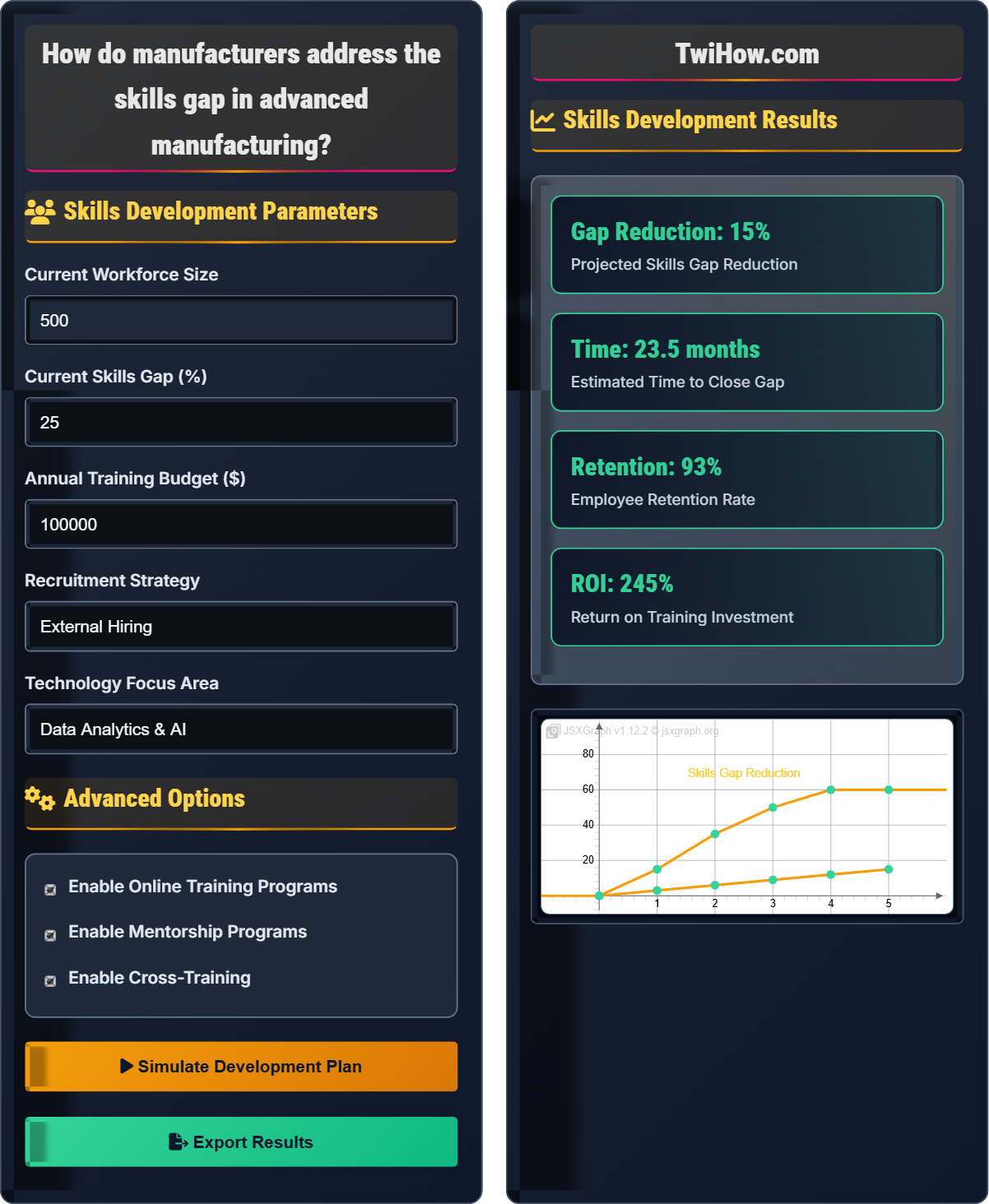
Skills Development Results
| Strategy | Allocation | Effectiveness | Timeline |
|---|---|---|---|
| Reskilling Programs | 40% | High | 6-12 months |
| New Hire Training | 30% | Medium | 3-6 months |
| Partnership Programs | 20% | High | 12-18 months |
| Retaining Experts | 10% | High | Ongoing |
| Outcome | Target | Projected | Progress |
|---|---|---|---|
| Skills Gap Reduction | 50% | 60% | Excellent |
| Employee Satisfaction | 80% | 85% | Good |
| Productivity Increase | 15% | 18% | Excellent |
| Retention Rate | 85% | 88% | Good |
Addressing the Manufacturing Skills Gap
The skills gap in advanced manufacturing refers to the difference between the skills required for modern manufacturing jobs and the skills possessed by the available workforce. This gap is particularly acute in areas involving new technologies like automation, robotics, data analytics, and cybersecurity.
Where:
- Required Skills: Total skills needed for operations
- Available Skills: Skills possessed by current workforce
- Training ROI: Return on investment for training programs
Effective approaches to addressing the manufacturing skills gap:
- Reskilling Programs: Training existing employees in new technologies
- Upskilling Initiatives: Enhancing current skills to meet advanced requirements
- Educational Partnerships: Collaborating with colleges and universities
- Apprenticeship Programs: Combining classroom education with on-the-job training
- Mentorship Programs: Pairing experienced workers with newcomers
- Cross-Training: Developing multi-skilled workers across different areas
- Automation & Robotics: Programming, maintenance, troubleshooting
- Data Analytics: Data interpretation, predictive modeling, process optimization
- Cybersecurity: Network security, threat detection, compliance
- Additive Manufacturing: 3D printing, materials science, design optimization
- IoT & Connectivity: Sensor integration, network management, data flow
- AI & Machine Learning: Algorithm development, predictive maintenance, quality control
Strategic Framework
Skills gap, workforce development, reskilling, upskilling, talent acquisition, retention strategies.
Manufacturing skills development follows a structured approach: Assess → Plan → Implement → Measure → Improve. This cyclical process ensures continuous alignment between workforce capabilities and technological requirements.
- Start with comprehensive skills assessment
- Align training with business objectives
- Invest in both technical and soft skills
- Create career advancement opportunities
Implementation Strategies
Internal development, external partnerships, apprenticeships, online learning, mentorship programs.
- Conduct skills gap analysis across all departments
- Develop competency models for key roles
- Create targeted training curricula
- Establish partnerships with educational institutions
- Implement mentoring and cross-training programs
- Measure and optimize program effectiveness
- Leadership commitment and support
- Continuous learning culture
- Measurable outcomes and KPIs
- Flexible and adaptive programs
Skills Gap Solutions Quiz
What is the primary difference between reskilling and upskilling in the context of advanced manufacturing?
Reskilling involves teaching employees entirely new skills to transition them to different roles, while upskilling enhances their existing skills to meet evolving job requirements. In advanced manufacturing, reskilling might involve training a traditional machinist to become a CNC programmer, while upskilling might involve enhancing their CAD/CAM skills.
The answer is B) Reskilling teaches completely new skills, upskilling enhances existing skills.
Understanding the distinction between reskilling and upskilling is crucial for developing effective workforce development strategies. Reskilling is more intensive and time-consuming as it involves learning entirely new competencies, while upskilling builds upon existing knowledge. Both approaches are essential for addressing the manufacturing skills gap, with reskilling helping to fill completely new roles and upskilling keeping current employees relevant.
Reskilling: Training employees with different skills to transition to new roles
Upskilling: Enhancing existing employee skills to meet new requirements
Competency: Specific skills and knowledge required for a particular job
• Assess current skills before determining reskilling vs upskilling needs
• Consider career pathing for both approaches
• Balance internal development with external hiring
• Use skills assessments to identify specific gaps
• Combine both approaches for comprehensive coverage
• Consider employee interests and career aspirations
• Confusing reskilling with general training programs
• Not considering the time investment required for reskilling
• Focusing only on technical skills while ignoring soft skills
Explain the benefits and implementation considerations of educational partnership programs in addressing the manufacturing skills gap.
Benefits of Educational Partnerships:
1. Talent Pipeline: Direct access to qualified graduates with relevant skills
2. Curriculum Alignment: Influence educational programs to match industry needs
3. Cost Efficiency: Share training costs with educational institutions
4. Reduced Time-to-Productivity: Graduates require less onboarding
5. Research Collaboration: Access to academic research and innovation
Implementation Considerations:
• Define specific skill requirements and competency standards
• Establish formal agreements with institutions
• Provide internships and co-op opportunities
• Participate in curriculum development
• Offer guest lectures and real-world projects
These partnerships create a sustainable solution for addressing long-term skills needs while strengthening industry-academia relationships.
Educational partnerships represent a proactive approach to skills development that addresses the root cause of the skills gap. Rather than trying to fix the problem after employees enter the workforce, these partnerships shape the education process itself. This collaborative approach ensures that students graduate with skills that directly match industry needs, creating a more efficient and effective talent acquisition process.
Partnership Program: Collaborative arrangement between industry and educational institutions
Talent Pipeline: Continuous flow of qualified candidates from education to employment
Co-op Program: Educational program combining classroom learning with work experience
• Maintain long-term commitments to partnerships
• Provide meaningful work experiences for students
• Regularly update skill requirements with institutions
• Start with 2-3 key institutions for focused relationships
• Offer competitive compensation for student positions
• Create mentorship programs for student participants
• Expecting immediate results from partnership programs
• Not providing adequate supervision for student placements
• Failing to update partnerships as technology evolves
A mid-sized manufacturing company with 800 employees faces a 30% skills gap in automation and data analytics. The company has a training budget of $150,000 annually and wants to reduce the gap to 10% within 24 months. Design a comprehensive skills development plan that addresses both reskilling and upskilling needs while maximizing ROI.
Skills Development Plan:
Phase 1 (Months 1-6): Assessment and Foundation
• Conduct detailed skills assessment for all employees
• Identify 150 employees for reskilling programs
• Create competency models for automation and data analytics roles
Phase 2 (Months 7-18): Implementation
• Allocate 40% budget ($60,000) to reskilling programs
• Allocate 35% budget ($52,500) to upskilling existing staff
• Allocate 25% budget ($37,500) to online training and certification
Phase 3 (Months 19-24): Optimization
• Evaluate program effectiveness
• Refine training approaches based on results
• Begin next planning cycle
Expected Outcomes: Reduce skills gap from 30% to 12% while maintaining high employee engagement and retention.
This solution demonstrates the importance of phased implementation in skills development. The initial assessment phase ensures resources are allocated effectively. The implementation phase balances reskilling and upskilling investments to address both immediate and long-term needs. The optimization phase ensures continuous improvement and adaptation to changing requirements. This systematic approach maximizes the impact of the training investment while ensuring sustainable results.
Skills Assessment: Systematic evaluation of employee competencies
Competency Model: Framework defining required skills for specific roles
ROI: Return on Investment for training programs
• Conduct thorough needs analysis before planning
• Balance short-term and long-term development goals
• Establish measurable outcomes and milestones
• Use blended learning approaches for maximum effectiveness
• Implement peer learning and knowledge sharing
• Create internal certification programs
• Starting training programs without proper assessment
• Focusing only on technical skills while neglecting soft skills
• Not tracking program effectiveness and ROI
A manufacturer has successfully trained 200 employees in advanced manufacturing technologies but faces high attrition rates among trained workers. Design a retention strategy that leverages the investment in skills development while maintaining employee satisfaction.
Retention Strategy Components:
1. Career Advancement: Create clear pathways for promotion and specialization
2. Compensation Alignment: Match salaries to market rates for skilled positions
3. Recognition Programs: Acknowledge expertise and contributions of trained employees
4. Leadership Opportunities: Allow trained employees to lead projects and mentor others
5. Continued Learning: Provide ongoing development opportunities
Implementation:
• Establish competency-based pay scales
• Create technical ladder career paths
• Implement peer recognition systems
• Offer tuition reimbursement for advanced degrees
This approach ensures that the investment in skills development translates into long-term employee loyalty and continued value creation.
Training without retention planning can result in a "revolving door" effect where companies invest in employee development only to lose them to competitors. Effective retention strategies must begin before training starts and continue throughout the employee lifecycle. The key is to align employee growth with organizational goals, creating mutual value that encourages long-term commitment.
Retention Strategy: Plan to keep valuable employees with the organization
Technical Ladder: Career path for technical specialists separate from management
Competency-Based Pay: Compensation tied to demonstrated skills and knowledge
• Align compensation with market rates for skilled positions
• Provide clear career progression opportunities
• Recognize and reward skill development investments
• Create internal mobility opportunities
• Establish employee advisory committees
• Offer flexible work arrangements for skilled workers
• Not adjusting compensation after skills development
• Failing to provide career advancement opportunities
• Not involving trained employees in decision-making processes
Which set of metrics best measures the effectiveness of a manufacturing skills development program?
The most comprehensive metrics for measuring skills development effectiveness include skills gap reduction (direct impact on the problem), productivity improvement (business impact), and employee retention (investment protection). These metrics connect training outcomes to business results and demonstrate the value of skills development investments.
The answer is B) Skills gap reduction, productivity improvement, and employee retention.
Effective measurement of skills development programs requires metrics that connect training activities to business outcomes. While training completion and satisfaction are important leading indicators, the ultimate success of skills development programs is measured by their impact on business performance. Skills gap reduction demonstrates the program's effectiveness in addressing the original problem, productivity improvement shows the business value created, and retention ensures the investment is protected.
Leading Indicators: Metrics that predict future outcomes
Lagging Indicators: Metrics that show results after they occur
Business Impact: Measurable effect on organizational performance
• Link training metrics to business outcomes
• Use both leading and lagging indicators
• Establish baseline measurements before training
• Track skills utilization after training
• Measure time-to-productivity for trained employees
• Correlate training with performance improvements
• Measuring only training participation without outcomes
• Not establishing baselines before training programs
• Failing to track long-term impact of training investments
FAQ
Q: How can small manufacturers with limited budgets address the skills gap effectively?
A: Small manufacturers can address skills gaps through:
1. Regional Partnerships: Collaborate with local community colleges and trade schools
2. Government Programs: Leverage federal and state workforce development grants
3. Industry Consortia: Join groups pooling resources for training
4. Online Training: Utilize cost-effective digital learning platforms
5. Job Sharing: Partner with other companies to share specialized roles
Focus on high-impact, low-cost solutions like cross-training existing employees and creating apprenticeship programs with local schools.
Q: What is the typical timeframe to see results from skills development programs?
A: Results typically follow this timeline:
Short-term (3-6 months): Improved employee confidence and basic skill application
Medium-term (6-12 months): Measurable productivity improvements and reduced error rates
Long-term (12-24 months): Significant skills gap reduction and cultural transformation
Most manufacturers see 15-25% productivity improvements within the first year, with full skills gap reduction taking 18-24 months depending on program intensity and employee engagement.
Q: How can older workers adapt to new technologies in advanced manufacturing?
A: Older workers can successfully adapt through:
1. Experiential Learning: Building on existing knowledge and experience
2. Peer Support: Mentoring programs pairing with younger tech-savvy colleagues
3. Gradual Introduction: Step-by-step technology adoption
4. Relevant Applications: Connecting new technologies to familiar processes
5. Confidence Building: Celebrating small wins and progress
Older workers often bring valuable problem-solving skills and institutional knowledge that, combined with new technology skills, make them extremely valuable team members.