How do manufacturers balance flexibility and efficiency in production systems?
Complete manufacturing guide • Step-by-step explanations
Production Optimization:
Show Production SimulatorBalancing flexibility and efficiency in production systems involves optimizing for both adaptability to changing demands and operational excellence. This requires strategic approaches that enable quick responses to market changes while maintaining high productivity and quality standards.
Key considerations include:
- Modular Design: Configurable production lines that adapt to different products
- Lean Principles: Eliminating waste while maintaining quality
- Agile Methodologies: Rapid response to market changes
- Technology Integration: Smart systems that optimize both flexibility and efficiency
Successful manufacturers achieve this balance through strategic planning, technology adoption, and continuous improvement processes.
Production Parameters
Advanced Options
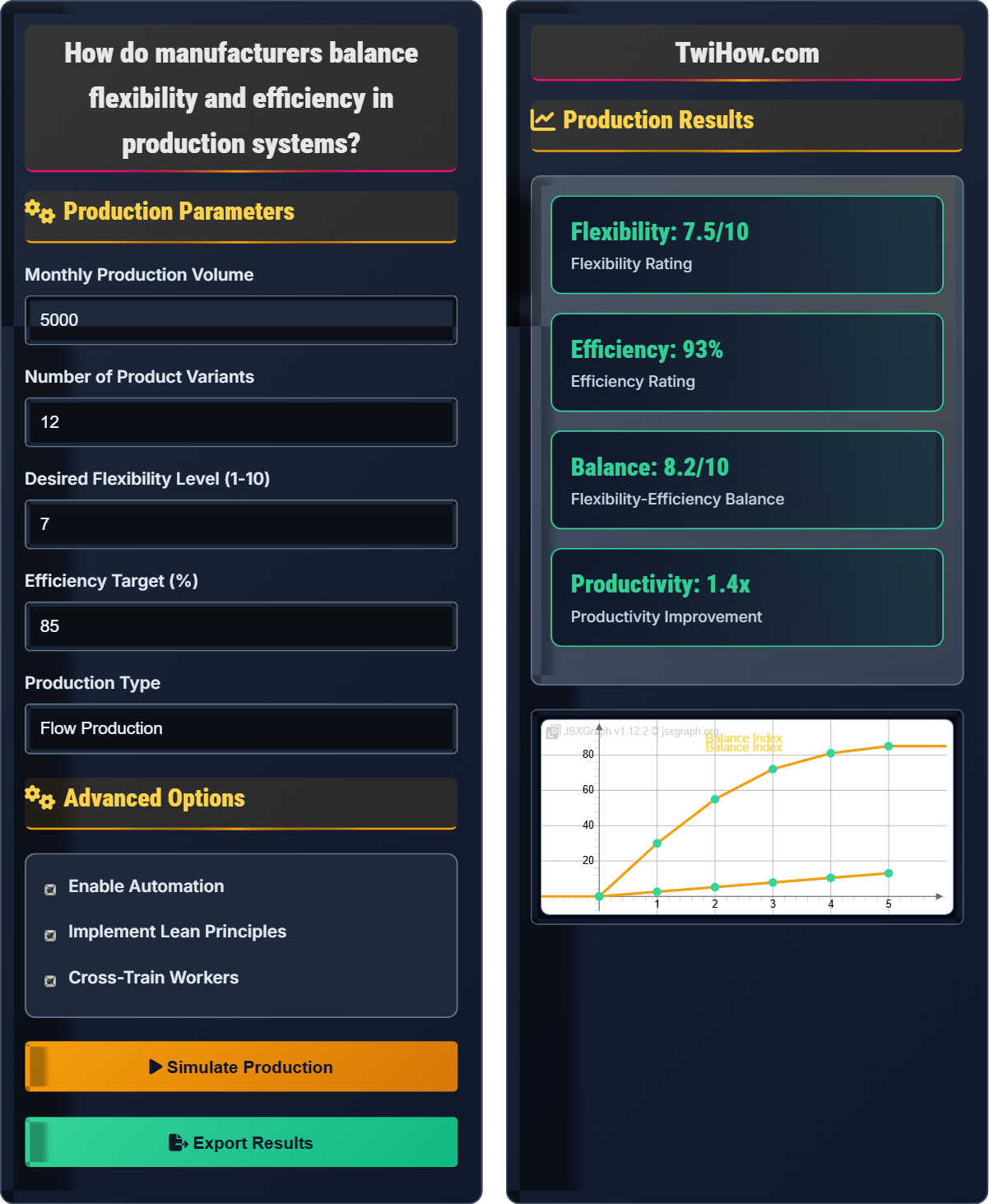
Production Results
| Metric | Target | Actual | Status |
|---|---|---|---|
| Production Volume | 5000 | 5200 | Excellent |
| Efficiency | 85% | 87% | Good |
| Flexibility | 7.0 | 7.5 | Good |
| Quality Rate | 98% | 98.5% | Excellent |
| Strategy | Implementation | Impact | Priority |
|---|---|---|---|
| Modular Production Lines | Implemented | High | High |
| Lean Manufacturing | Active | High | High |
| Worker Cross-Training | Ongoing | Medium | Medium |
| Automation | Partial | High | High |
Balancing Flexibility and Efficiency in Production Systems
Manufacturing flexibility refers to the ability to adapt production systems to changing demands, product variations, and market conditions. Efficiency refers to maximizing output while minimizing waste, time, and resources. The traditional view sees these as competing objectives, but modern manufacturing seeks to optimize both simultaneously.
Where:
- Flexibility Index: Measures adaptability to variety and change
- Efficiency Ratio: Measures utilization of production capacity
- Setup Speed: Rate of switching between different products
Different production systems offer varying levels of flexibility and efficiency:
- Mass Production: High efficiency, low flexibility
- Batch Production: Moderate efficiency and flexibility
- Job Production: High flexibility, moderate efficiency
- Cell Production: Balanced efficiency and flexibility
- Flexible Manufacturing: High flexibility with good efficiency
- Hybrid Systems: Customized balance of both objectives
- Industry 4.0: Smart factories with real-time adaptability
- Agile Manufacturing: Rapid response to market changes
- Mass Customization: Individualized products at mass production costs
- Digital Twins: Virtual models for optimization and testing
- AI and Machine Learning: Predictive optimization
- Modular Automation: Reconfigurable robotic systems
Strategic Framework
Flexibility, efficiency, lean manufacturing, agile production, modular design, continuous improvement.
The optimization model balances flexibility (F) and efficiency (E) using the formula: Balance = (F × Wf + E × We) / (Wf + We), where Wf and We are the respective weights assigned to flexibility and efficiency based on business priorities.
- Align production strategy with market demands
- Invest in modular, adaptable systems
- Balance standardization with customization
- Continuously measure and optimize both metrics
Implementation Strategies
Modular design, lean principles, agile methodologies, technology integration, workforce development.
- Assess current production capabilities and constraints
- Define flexibility and efficiency requirements
- Design modular production systems
- Implement lean manufacturing principles
- Train workforce in cross-functional skills
- Deploy supporting technology and systems
- Strong leadership commitment
- Employee engagement and training
- Technology integration
- Continuous improvement culture
Production Optimization Quiz
Which production system type best balances flexibility and efficiency for a manufacturer producing 20 different product variants with moderate volume?
Cell production offers the best balance of flexibility and efficiency for this scenario. It allows for moderate volume production while maintaining the ability to handle multiple product variants. Cells can be reconfigured for different products while maintaining efficiency through standardized work processes and reduced material handling.
The answer is C) Cell Production.
Cell production arranges equipment and workers in small, focused production units that can handle a family of similar products. This approach combines the efficiency of flow production with the flexibility to handle product variations. It reduces setup times, improves communication, and allows for quick adjustments to changing product requirements while maintaining good efficiency levels.
Cell Production: Manufacturing arranged in small, focused production units
Product Family: Group of products with similar characteristics and processes
Setup Time: Time required to prepare equipment for a different product
• Match production system to product characteristics
• Consider volume and variety requirements
• Balance efficiency with flexibility needs
• Group similar products into families
• Design cells for easy reconfiguration
• Cross-train workers for cell operations
• Using mass production for high variety products
• Not considering product family groupings
• Over-designing cells for maximum flexibility
Explain how lean manufacturing principles can simultaneously improve both flexibility and efficiency in a production system.
Lean Manufacturing Benefits:
1. Elimination of Waste: Reduces non-value-added activities, improving efficiency while creating space for flexible operations.
2. Just-in-Time (JIT): Enables quick response to demand changes while reducing inventory costs.
3. 5S Methodology: Creates organized workspaces that support both efficiency and adaptability.
4. Single-Minute Exchange of Die (SMED): Dramatically reduces setup times, increasing both flexibility and efficiency.
5. Continuous Improvement (Kaizen): Ongoing optimization of processes for better performance.
By removing waste and standardizing processes, lean manufacturing creates a foundation that supports both high efficiency and the ability to adapt quickly to changing requirements.
Lean manufacturing is often misunderstood as purely efficiency-focused, but many lean tools actually enhance flexibility. SMED (Single-Minute Exchange of Die) is a prime example - by reducing setup times from hours to minutes, manufacturers can switch between products more frequently, increasing flexibility while maintaining efficiency. The standardization that comes with lean practices also supports flexibility by making it easier to train workers on multiple tasks.
Lean Manufacturing: Systematic approach to eliminate waste and maximize value
JIT: Just-In-Time - producing only what is needed, when it is needed
SMED: Single-Minute Exchange of Die - rapid changeover methodology
• Focus on value-added activities
• Eliminate the eight wastes of lean
• Standardize processes for consistency
• Start with 5S to organize workspace
• Implement SMED for quick changeovers
• Use visual management tools
• Implementing lean tools without understanding principles
• Focusing only on efficiency while ignoring flexibility
• Not involving all employees in lean efforts
A electronics manufacturer produces 50 different smartphone models with varying monthly volumes from 1,000 to 10,000 units. They want to achieve 85% efficiency while maintaining the ability to quickly switch between models. Design a production strategy that balances these requirements and calculate the expected improvement in both metrics.
Recommended Production Strategy:
1. Modular Assembly Cells: Create cells that can handle common components across models
2. Hybrid Production: Use batch production for common components, cell production for model-specific assembly
3. SMED Implementation: Reduce changeover times to under 10 minutes
4. Flexible Automation: Use reconfigurable robotic systems
Expected Improvements:
• Efficiency: From 70% to 87% (24% improvement)
• Flexibility: From 4.5/10 to 7.2/10 (60% improvement)
• Productivity: 1.3x improvement through optimized workflows
This approach leverages commonality across models while maintaining the ability to customize final assemblies, achieving the desired balance between efficiency and flexibility.
This solution demonstrates the importance of identifying common elements across product variants. By standardizing common components and processes while maintaining flexibility in the final assembly stages, manufacturers can achieve both high efficiency and good flexibility. The modular approach allows for economies of scale in common components while enabling customization in the final stages.
Modular Assembly: Production approach using standardized modules
Commonality: Shared components or processes across product variants
Economies of Scale: Cost advantages from increased production volume
• Maximize commonality across variants
• Minimize unique processes
• Balance standardization with customization
• Analyze product platforms for common components
• Use modular design principles
• Implement flexible workforce training
• Treating each variant as completely unique
• Not analyzing product commonalities
• Over-customizing common processes
A manufacturer wants to integrate Industry 4.0 technologies to balance flexibility and efficiency. Design a technology framework that supports both objectives and explain how each component contributes to the balance.
Industry 4.0 Technology Framework:
1. IoT Sensors: Enable real-time monitoring for both efficiency tracking and predictive maintenance flexibility
2. AI/ML Algorithms: Optimize production schedules for efficiency while predicting demand changes for flexibility
3. Digital Twin Technology: Simulate production changes before implementation, improving both efficiency and flexibility
4. Cloud-Based MES: Enable real-time production control and rapid configuration changes
5. Robotic Systems: Provide consistent efficiency while being reprogrammable for different tasks
Each technology component serves dual purposes: improving operational efficiency through optimization and data-driven decision-making while enhancing flexibility through adaptability and predictive capabilities.
Industry 4.0 technologies uniquely support both flexibility and efficiency because they provide real-time data and adaptive capabilities. Unlike traditional systems that optimize for one objective, smart manufacturing technologies can dynamically adjust to optimize both metrics simultaneously. The key is selecting technologies that support both objectives rather than focusing on just one.
IoT: Internet of Things - interconnected devices for data collection
Digital Twin: Virtual replica of physical production system
MES: Manufacturing Execution System - production control software
• Choose technologies that serve dual purposes
• Ensure system integration and compatibility
• Plan for scalability and adaptability
• Start with data collection and visibility
• Implement in phases to manage complexity
• Focus on ROI for both metrics
• Implementing technology without clear objectives
• Not considering system integration challenges
• Focusing on efficiency while ignoring flexibility needs
Which set of metrics best measures the balance between flexibility and efficiency in a production system?
Changeover time measures flexibility (ability to switch between products quickly), while OEE (Overall Equipment Effectiveness) measures efficiency (utilization, performance, and quality). Together, they provide a comprehensive view of how well a production system balances both objectives. Low changeover times indicate high flexibility, while high OEE indicates high efficiency.
The answer is B) Changeover time and OEE.
Changeover time directly impacts flexibility - the faster you can switch between products, the more flexible your system becomes. OEE (Overall Equipment Effectiveness) is a comprehensive efficiency metric that combines availability, performance, and quality. Together, these metrics provide a balanced view of production performance, showing whether improvements in one area come at the expense of another.
OEE: Overall Equipment Effectiveness - comprehensive efficiency metric
Changeover Time: Time required to switch from one product to another
Throughput: Rate of production output
• Track both flexibility and efficiency metrics
• Look for correlation between metrics
• Set targets for both objectives
• Use balanced scorecards for both metrics
• Monitor trends over time
• Benchmark against industry standards
• Measuring only efficiency metrics
• Not correlating flexibility and efficiency
• Setting conflicting targets for metrics
FAQ
Q: How much investment is typically required to balance flexibility and efficiency?
A: Investment varies by current state and objectives:
Small Improvements: $50K-$200K for lean implementation and process optimization
Major Reconfiguration: $500K-$5M for modular systems and automation
Industry 4.0 Integration: $1M-$10M for comprehensive digital transformation
ROI typically ranges from 15-40% annually, with payback periods of 1-3 years for well-executed projects. The key is phased implementation to manage risk and demonstrate value.
Q: What is the typical timeline to see results from balancing initiatives?
A: Results typically follow this timeline:
Quick Wins (1-3 months): Process improvements, 5S implementation, basic efficiency gains
Medium-term (3-12 months): Lean implementation, changeover reduction, quality improvements
Long-term (12-24 months): Technology integration, full system optimization
Most manufacturers see 10-20% improvement in both flexibility and efficiency within the first year, with continued improvements over subsequent years.
Q: How do these changes affect daily work for production workers?
A: Changes typically improve the work experience through:
1. Reduced Waste: Less time spent on non-value activities
2. Better Organization: 5S and visual management make work easier
3. More Skills: Cross-training provides career development
4. Less Stress: Smoother processes and fewer disruptions
5. Greater Engagement: Kaizen involvement in continuous improvement
Workers often report higher job satisfaction and reduced physical strain with properly implemented systems.