How do manufacturers implement agile and lean principles in digital environments?
Complete manufacturing guide • Step-by-step explanations
Agile & Lean Manufacturing:
Show Agile Lean SimulatorImplementing agile and lean principles in digital environments involves combining the iterative, customer-focused approach of agile methodologies with the waste-elimination focus of lean principles. This integration creates responsive, efficient manufacturing systems that can adapt quickly to changing demands while maintaining high quality and low waste.
Key considerations include:
- Continuous Improvement: Using digital tools to identify and eliminate waste in real-time
- Iterative Development: Rapid prototyping and testing of production processes
- Customer-Centricity: Direct feedback loops for production adjustments
- Data-Driven Decisions: Leveraging analytics for optimization
- Flexibility: Ability to pivot production based on market changes
- Collaboration: Cross-functional teams using digital platforms
Success requires cultural change, technology adoption, and continuous optimization.
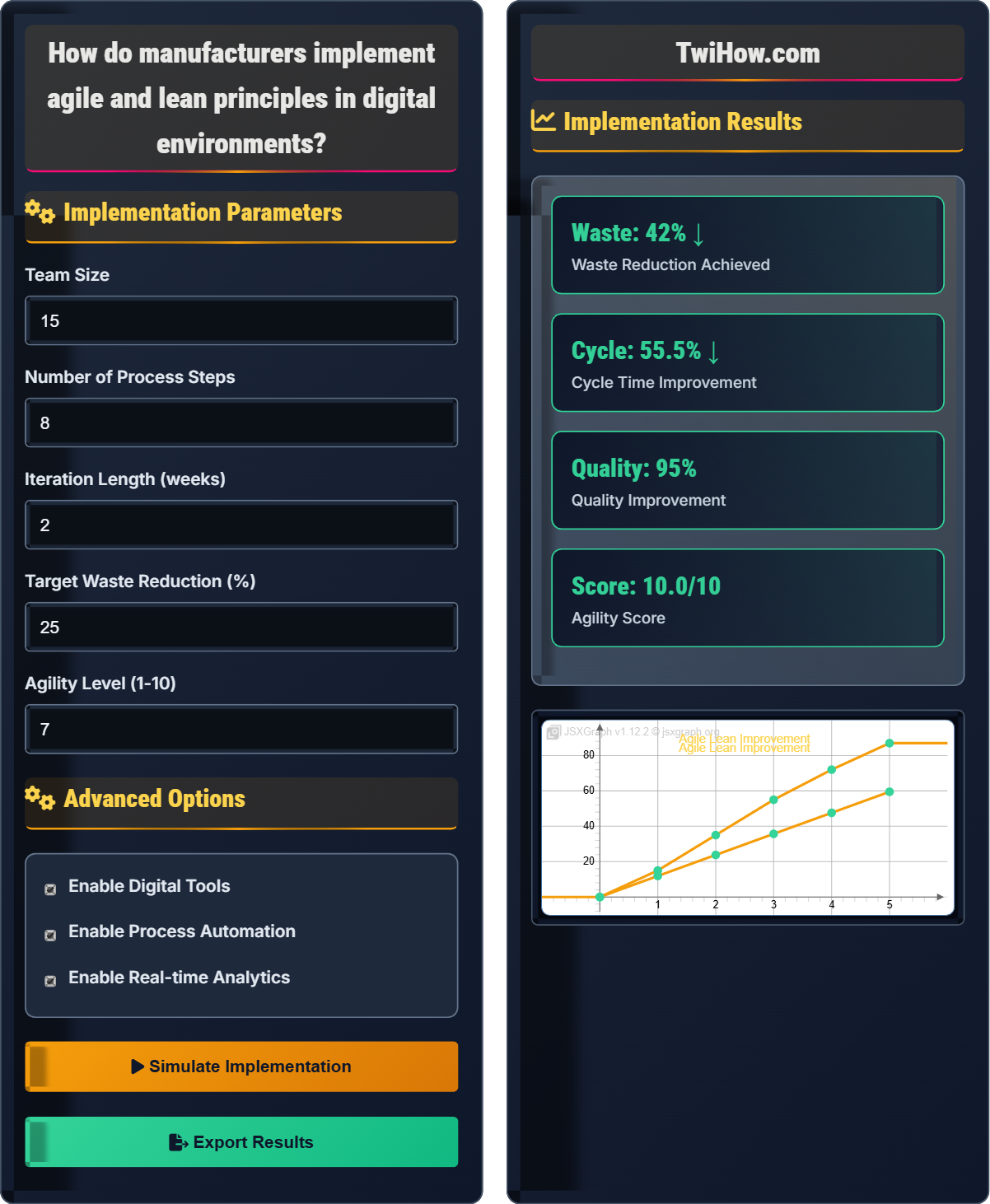
Implementation Parameters
Advanced Options
Implementation Results
| Metric | Baseline | Post-Implementation | Improvement |
|---|---|---|---|
| Lead Time | 12 weeks | 6.6 weeks | 45% ↓ |
| Defect Rate | 8% | 2.5% | 69% ↓ |
| Inventory Turns | 6 | 9.2 | 53% ↑ |
| Change Response | 8 weeks | 2.1 weeks | 74% ↓ |
| Strategy | Implementation | Impact | Status |
|---|---|---|---|
| Continuous Improvement | Active | High | Implemented |
| Visual Management | Ongoing | Medium | Active |
| Agile Teams | Deployed | High | Running |
| Process Automation | Partial | High | Progressing |
Implementing Agile and Lean Principles in Digital Environments
Agile manufacturing emphasizes flexibility, rapid response to change, and iterative improvement, while lean manufacturing focuses on eliminating waste and maximizing value. In digital environments, these principles are amplified through technology that enables real-time visibility, automated processes, and data-driven decision-making.
Where:
- Waste Reduction: Percentage decrease in non-value-added activities
- Cycle Time Improvement: Percentage reduction in process duration
- Baseline Waste: Waste level before implementation
Key technologies that enable agile and lean principles in digital environments:
- IoT Sensors: Real-time monitoring of equipment and processes
- Analytics Platforms: Data-driven insights for continuous improvement
- Collaboration Tools: Facilitating agile team communication
- Workflow Automation: Streamlining repetitive processes
- Visual Management: Digital dashboards and Kanban boards
- Simulation Tools: Testing improvements before implementation
- Just-in-Time (JIT): Delivering materials when needed
- Kanban Systems: Visual workflow management
- Continuous Flow: Eliminating batch processing delays
- 5S Methodology: Organizing workplace for efficiency
- PDCA Cycles: Plan-Do-Check-Act improvement loops
- Scrum Framework: Iterative project management
Strategic Framework
Agile manufacturing, lean principles, continuous improvement, digital transformation, iterative processes, waste elimination.
The implementation model combines agile iterations with lean waste elimination: Assessment → Planning → Implementation → Measurement → Improvement. This cyclical process ensures continuous optimization and adaptation to changing requirements.
- Start with small, focused improvements
- Involve all stakeholders in the process
- Measure and track key performance indicators
- Maintain focus on customer value
Implementation Strategies
Phased rollout, pilot programs, cross-functional teams, digital tool integration.
- Conduct current state assessment and gap analysis
- Form agile lean teams with cross-functional expertise
- Select and deploy appropriate digital tools and platforms
- Map value streams and identify improvement opportunities
- Implement iterative improvements in sprints
- Establish continuous monitoring and feedback loops
- Strong leadership commitment and support
- Employee engagement and training
- Technology integration and adoption
- Continuous improvement culture
Agile Lean Manufacturing Quiz
What is the primary difference between agile and lean manufacturing principles?
Agile manufacturing emphasizes flexibility, rapid response to change, and iterative improvement, while lean manufacturing focuses on eliminating waste, reducing non-value-added activities, and optimizing flow. Both principles complement each other when implemented together in digital environments.
The answer is B) Agile emphasizes flexibility and response to change, lean focuses on waste elimination.
While agile and lean principles have different primary focuses, they are highly complementary. Agile principles enable manufacturers to respond quickly to changing customer demands and market conditions, while lean principles ensure that this flexibility doesn't come at the cost of efficiency. The combination creates manufacturing systems that are both responsive and efficient.
Agile Manufacturing: Flexible approach emphasizing rapid response to change
Lean Manufacturing: System focused on eliminating waste and optimizing value
Waste Elimination: Removing non-value-added activities from processes
• Agile and lean principles complement each other
• Both focus on customer value delivery
• Implementation requires cultural change
• Start with one principle and gradually add the other
• Use digital tools to enhance both approaches
• Focus on small, iterative improvements
• Implementing agile without considering waste
• Focusing only on efficiency without flexibility
• Not involving all stakeholders in the process
Explain how digital Kanban systems support both agile and lean principles in manufacturing environments.
Digital Kanban Benefits:
1. Visual Workflow Management: Provides real-time visibility into process status
2. WIP Limits: Controls work-in-progress to prevent overproduction (lean)
3. Flexibility: Allows for quick prioritization changes (agile)
4. Continuous Flow: Eliminates batch processing delays (lean)
Agile Support:
• Enables rapid response to priority changes
• Supports iterative process improvements
• Facilitates team collaboration and communication
Lean Support:
• Eliminates waste through visual management
• Reduces inventory and waiting time
• Optimizes resource utilization
Digital Kanban systems bridge agile flexibility with lean efficiency.
Digital Kanban systems exemplify the convergence of agile and lean principles. The visual nature of Kanban boards supports lean's emphasis on visual management and waste elimination, while the ability to quickly reprioritize and adapt the board supports agile's focus on flexibility and responsiveness. The digital aspect amplifies these benefits by providing real-time updates and analytics.
Kanban: Visual workflow management system
WIP Limits: Work-in-progress limits to control flow
Visual Management: Using visual cues for process control
• Set appropriate WIP limits for each stage
• Keep boards updated in real-time
• Use metrics to identify bottlenecks
• Customize columns to match your process
• Add swimlanes for different product types
• Integrate with other digital tools
• Setting WIP limits too high or too low
• Not updating boards regularly
• Failing to use analytics for optimization
A manufacturing plant has 50 employees, 12 production processes, and wants to reduce waste by 30% while improving response time to customer changes by 50%. Design an agile lean implementation plan that incorporates digital tools and explains how to measure success.
Implementation Plan:
1. Phase 1 (Weeks 1-4): Assessment and team formation
2. Phase 2 (Weeks 5-8): Digital tool deployment
3. Phase 3 (Weeks 9-16): Iterative improvements
4. Phase 4 (Ongoing): Continuous optimization
Digital Tools:
• IoT sensors for real-time monitoring
• Digital Kanban for workflow management
• Analytics dashboard for performance tracking
• Collaboration platform for cross-functional teams
Success Metrics:
• Waste reduction percentage
• Lead time improvement
• Employee engagement scores
• Customer satisfaction ratings
This phased approach ensures gradual adoption while maintaining productivity.
This implementation plan demonstrates the importance of phased rollout when introducing agile lean principles. Starting with assessment ensures that improvements are targeted to actual problems rather than perceived ones. The gradual introduction of digital tools prevents overwhelming employees while allowing for proper training and adoption.
Phased Rollout: Gradual implementation in stages
IoT Sensors: Internet of Things devices for monitoringLead Time: Time from order to delivery
• Start with assessment before implementation
• Involve employees in the planning process
• Establish clear success metrics upfront
• Begin with pilot areas before full deployment
• Provide comprehensive training on new tools
• Celebrate early wins to build momentum
• Implementing too many changes simultaneously
• Not measuring baseline performance
• Failing to involve front-line workers in planning
A traditional manufacturing company is resistant to adopting agile lean practices due to fear of job losses and change. How can leadership overcome this resistance and successfully implement digital agile lean principles?
Change Management Strategy:
1. Communication: Clearly explain benefits and address job security concerns
2. Training: Provide comprehensive skills development programs
3. Leadership Involvement: Demonstrate commitment through actions
4. Success Stories: Share examples from similar implementations
Implementation Approach:
• Start with voluntary pilot teams
• Focus on process improvements rather than job cuts
• Emphasize skill enhancement opportunities
• Create change champions from within the organization
Successful implementation requires addressing both technical and cultural challenges.
Cultural resistance is often the biggest barrier to agile lean implementation. Employees may fear that efficiency improvements will lead to job losses. Leadership must emphasize that agile lean principles aim to improve the organization's competitiveness, which ultimately secures jobs. The focus should be on empowering employees with new skills rather than replacing them.
Change Management: Process of transitioning people through change
Change Champions: Employees who promote and support change
Cultural Resistance: Opposition due to established norms and beliefs
• Address concerns transparently and honestly
• Provide continuous support and training
• Celebrate successes and acknowledge efforts
• Start with willing participants to build credibility
• Use peer testimonials for persuasion
• Provide clear career advancement paths
• Imposing changes without employee input
• Not addressing job security concerns
• Rushing implementation without proper preparation
Which set of metrics best measures the success of agile lean implementation in digital environments?
Lead time, waste reduction, and customer response time directly measure the core objectives of agile lean implementation: efficiency (lean) and responsiveness (agile). These metrics provide quantitative evidence of improvement in both waste elimination and adaptability to change.
The answer is B) Lead time, waste reduction, and customer response time.
Effective metrics must align with the fundamental goals of agile lean implementation. Lead time measures process efficiency, waste reduction quantifies lean improvements, and customer response time evaluates agility. Together, these metrics provide a comprehensive view of how well the implementation is achieving its dual objectives of efficiency and flexibility.
Lead Time: Time from order to delivery
Waste Reduction: Elimination of non-value-added activities
Customer Response Time: Time to respond to customer requests
• Align metrics with implementation goals
• Measure both efficiency and responsiveness
• Include both quantitative and qualitative metrics
• Establish baseline measurements before implementation
• Track metrics continuously during implementation
• Use metrics to guide improvement decisions
• Measuring only one aspect (efficiency OR agility)
• Not establishing baseline measurements
• Focusing on activity metrics rather than outcome metrics
FAQ
Q: What is the typical timeline to see results from agile lean implementation?
A: Results typically follow this pattern:
Quick Wins (1-3 months): Process improvements, waste reduction
Medium-term Benefits (3-12 months): Efficiency gains, quality improvements
Full Realization (12-24 months): Cultural transformation
Most manufacturers see 15-30% improvement in key metrics within the first year.
Q: How do digital tools enhance traditional lean manufacturing principles?
A: Digital tools amplify lean principles through:
1. Real-time Visibility: Instant awareness of process status
2. Automated Waste Detection: Algorithms identify waste patterns
3. Predictive Analytics: Anticipate problems before they occur
4. Continuous Monitoring: 24/7 process oversight
5. Data-Driven Decisions: Quantitative basis for improvements
Digital tools make lean principles more precise and responsive.
Q: How do agile lean principles affect daily work for manufacturing operators?
A: Operators experience:
1. More Empowerment: Greater involvement in process improvements
2. Less Waste: Reduced non-value-added activities
3. Better Tools: Digital aids for process monitoring
4. Continuous Learning: Ongoing skill development
5. Clearer Goals: Better understanding of value creation
Work becomes more meaningful and efficient with agile lean practices.