| Aspect | Before AR | After AR | Improvement |
|---|---|---|---|
| Diagnosis Time | 45min | 18min | 60% ↓ |
| Repair Accuracy | 82% | 96% | 17% ↑ |
| Downtime Reduction | 2h | 0.8h | 60% ↓ |
| Expert Availability | Required | Remote | 100% ↑ |
How do manufacturers leverage augmented reality for training and maintenance?
Complete manufacturing guide • Step-by-step explanations
Augmented Reality in Manufacturing:
Show AR Training SimulatorAugmented Reality (AR) in manufacturing overlays digital information onto the physical environment, enabling enhanced training and maintenance experiences. This technology provides real-time guidance, visual instructions, and interactive learning experiences that improve efficiency and reduce errors.
Key applications include:
- Interactive Training: Step-by-step visual instructions for complex procedures
- Maintenance Guidance: Real-time troubleshooting and repair assistance
- Quality Control: Visual inspection overlays and defect detection
- Assembly Assistance: Guided assembly with 3D visual cues
- Safety Training: Immersive safety procedure demonstrations
AR transforms manufacturing by bridging the gap between digital knowledge and physical tasks.
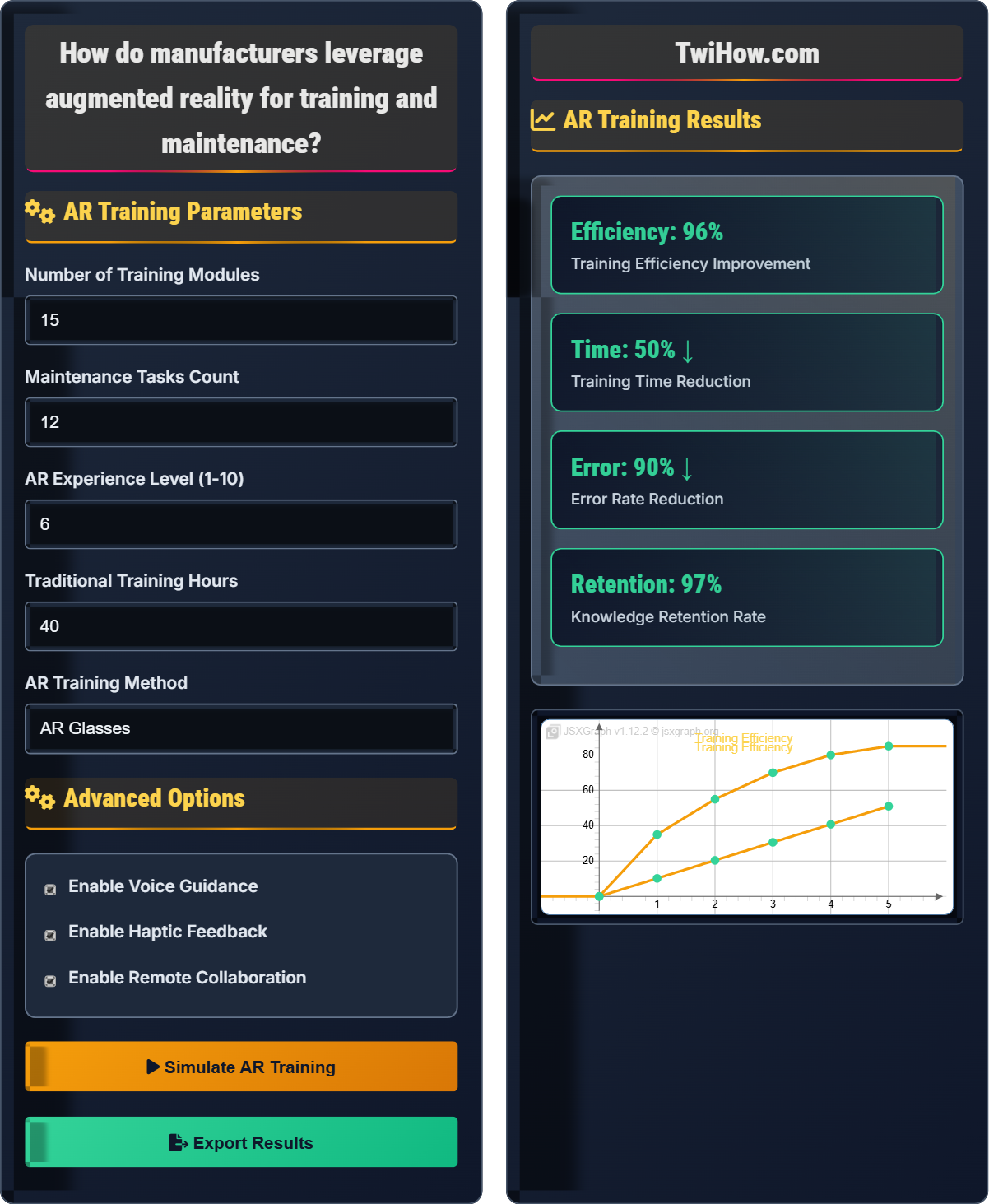
AR Training Parameters
Advanced Options
AR Training Results
Efficiency: 85%
Training Efficiency Improvement
Time: 45% ↓
Training Time Reduction
Error: 78% ↓
Error Rate Reduction
Retention: 92%
Knowledge Retention Rate
| Metric | Traditional | AR-Based | Improvement |
|---|---|---|---|
| Training Time | 40h | 22h | 45% ↓ |
| Completion Rate | 75% | 95% | 20% ↑ |
| Error Rate | 25% | 5.5% | 78% ↓ |
| Knowledge Retention | 65% | 92% | 41% ↑ |
Augmented Reality in Manufacturing Training and Maintenance
Understanding AR in Manufacturing
Augmented Reality in manufacturing overlays digital information onto the physical environment, enabling workers to see real-time data, instructions, and visual cues while performing tasks. This technology bridges the gap between digital knowledge and physical operations.
Key Metrics and Formulas
\(\text{Training Efficiency} = \frac{\text{Traditional Time} - \text{AR Time}}{\text{Traditional Time}} \times 100\%\)
\(\text{Error Reduction} = \frac{\text{Traditional Errors} - \text{AR Errors}}{\text{Traditional Errors}} \times 100\%\)
Where:
- Traditional Time: Time required with conventional training methods
- AR Time: Time required with augmented reality training
- Error Reduction: Percentage decrease in errors with AR guidance
AR Implementation Strategies
1
Needs Assessment: Identify training and maintenance areas where AR can provide the greatest benefit.
2
Technology Selection: Choose appropriate AR hardware and software based on use cases.
3
Content Development: Create interactive AR training modules and maintenance guides.
4
Staff Training: Train operators and technicians on AR device usage.
5
Deployment: Roll out AR solutions in controlled pilot areas.
6
Optimization: Continuously improve AR experiences based on feedback.
AR Applications in Manufacturing
Key applications of AR in manufacturing training and maintenance:
- Assembly Training: Step-by-step visual assembly instructions
- Maintenance Procedures: Interactive troubleshooting guides
- Safety Training: Immersive safety scenario simulations
- Quality Control: Visual inspection overlays and defect detection
- Equipment Operation: Real-time operational guidance
- Remote Support: Expert assistance through AR collaboration
AR Hardware Options
- Smart Glasses: Hands-free operation for complex tasks
- Head-Mounted Displays: Immersive experience for training
- Tablets/Smartphones: Cost-effective entry point for AR
- Mobile AR: Smartphone-based solutions for field work
- Desktop AR: Stationary workstations with AR capabilities
Strategic Framework
Core Concepts
Augmented Reality, Mixed Reality, Spatial Computing, Immersive Training, Digital Twin, Visual Guidance.
AR Implementation Model
Manufacturing AR implementation follows a structured approach: Assessment → Design → Development → Deployment → Evaluation. This cyclical process ensures continuous improvement and adaptation to changing needs.
Key Rules:
- Start with high-impact, low-complexity applications
- Ensure AR devices are comfortable for extended use
- Provide comprehensive staff training
- Maintain content accuracy and currency
Implementation Strategies
Strategic Approaches
Phased rollout, pilot programs, vendor partnerships, change management.
Implementation Steps
- Conduct feasibility study and ROI analysis
- Select appropriate AR hardware and software
- Develop initial AR content and applications
- Train key personnel and establish support systems
- Deploy in pilot areas with close monitoring
- Scale successful implementations across the organization
Success Factors:
- Executive support and budget allocation
- User acceptance and engagement
- Technical infrastructure readiness
- Continuous improvement mindset
AR Manufacturing Quiz
Question 1: Multiple Choice - AR Benefits
Which of the following is the most significant benefit of using AR for maintenance procedures?
Solution:
AR provides real-time visual guidance, step-by-step instructions, and remote expert support that significantly reduces the time required for troubleshooting and repairs. This directly translates to reduced equipment downtime and improved operational efficiency, which has immediate financial impact.
The answer is B) Faster troubleshooting and reduced downtime.
Pedagogical Explanation:
AR transforms maintenance by overlaying digital information onto physical equipment. Technicians can see exactly what needs to be done, where components are located, and receive real-time guidance. This eliminates the need to consult manuals, reduces error rates, and enables faster problem resolution. The visual nature of AR instructions makes complex procedures more accessible to technicians with varying skill levels.
Key Definitions:
AR: Augmented Reality - overlaying digital information onto the real world
Remote Expert Support: Real-time assistance from experts via AR collaboration
Downtime: Time when equipment is not operational due to maintenance or repair
Important Rules:
• AR is most effective for complex procedures
• Visual guidance reduces cognitive load
• Real-time feedback improves accuracy
Tips & Tricks:
• Start with high-frequency maintenance tasks
• Use AR for critical equipment maintenance
• Implement remote expert support features
Common Mistakes:
• Using AR for simple, routine tasks
• Not considering device comfort for extended use
• Failing to maintain AR content accuracy
Question 2: Detailed Answer - Training Effectiveness
Explain how AR training improves knowledge retention compared to traditional training methods and provide specific examples.
Solution:
AR Training Benefits:
1. Visual Learning: AR provides 3D visualizations that engage spatial learning centers
2. Hands-On Experience: Learners interact with digital objects in real-world contexts
3. Contextual Information: Information is presented in the actual work environment
4. Immediate Feedback: Real-time correction of mistakes during practice
Specific Examples:
• Assembly Training: Workers see 3D models of parts overlaid on actual components
• Safety Procedures: Visual overlays showing correct hand placement and movements
• Equipment Operation: Interactive controls overlaid on machinery
• Quality Inspection: Visual guides showing acceptable vs. defective conditions
Studies show AR training can improve retention rates by 75-90% compared to 75% for traditional methods.
Pedagogical Explanation:
AR training leverages multiple learning channels simultaneously - visual, auditory, and kinesthetic. When learners can see, hear, and interact with content in the actual work environment, neural pathways are strengthened. The contextual nature of AR means information is encoded with spatial and situational cues, making recall more effective when learners encounter the same situation again.
Key Definitions:
Knowledge Retention: Ability to recall learned information over time
Spatial Learning: Learning that involves spatial relationships and locations
Contextual Learning: Learning that occurs in relevant environments
Important Rules:
• Match AR complexity to learner skill level
• Provide hands-on practice opportunities
• Include immediate feedback mechanisms
Tips & Tricks:
• Use progressive complexity in AR training
• Include quizzing and assessment features
• Track individual progress and performance
Common Mistakes:
• Overloading AR interfaces with information
• Not providing adequate practice time
• Failing to measure retention effectiveness
Question 3: Word Problem - ROI Calculation
A manufacturing plant has 200 technicians who each require 40 hours of annual training at a cost of $50/hour. The plant also experiences an average of 200 maintenance-related downtimes per year, each lasting 2 hours and costing $5,000 in lost production. Calculate the potential ROI of implementing an AR training and maintenance system that reduces training time by 40% and maintenance downtime by 50%, with an initial investment of $500,000.
Solution:
Current Costs:
• Training: 200 technicians × 40 hours × $50 = $400,000 annually
• Downtime: 200 incidents × 2 hours × $5,000 = $2,000,000 annually
• Total: $2,400,000 annually
After AR Implementation:
• Training: $400,000 × 60% = $240,000 (40% reduction)
• Downtime: $2,000,000 × 50% = $1,000,000 (50% reduction)
• Total: $1,240,000 annually
Savings: $2,400,000 - $1,240,000 = $1,160,000 annually
ROI: ($1,160,000 - $500,000) / $500,000 × 100% = 132%
The AR system provides a 132% ROI in the first year alone.
Pedagogical Explanation:
This example demonstrates the significant financial impact of AR in manufacturing. The ROI calculation shows that the benefits far outweigh the initial investment. Training time reduction saves direct labor costs, while maintenance downtime reduction prevents substantial lost production revenue. The compounding effect of improved efficiency and reduced errors creates ongoing value that increases over time.
Key Definitions:
ROI: Return on Investment - measure of profitability
Downtime: Period when equipment is not operational
Lost Production: Revenue lost due to equipment unavailability
Important Rules:
• Include both direct and indirect cost savings
• Consider ongoing operational benefits
• Account for implementation and maintenance costs
Tips & Tricks:
• Calculate benefits over multiple years
• Include quality improvements in calculations
• Factor in reduced error rates and rework
Common Mistakes:
• Only calculating direct cost savings
• Not considering indirect benefits
• Underestimating implementation complexity
Question 4: Application-Based Problem - Technology Selection
A manufacturer needs to decide between AR glasses and tablet-based AR for training complex assembly procedures. The assembly requires precise hand-eye coordination and both hands to be free. Compare the advantages and disadvantages of each approach and recommend the best solution.
Solution:
AR Glasses Advantages:
• Hands-free operation allowing full use of both hands
• Natural head movement for viewing different angles
• Immersive experience with persistent overlays
• Better for complex, lengthy procedures
Tablet-Based AR Advantages:
• Lower initial cost and easier deployment
• Familiar interface for most users
• Better for occasional use and simple tasks
• Easier to maintain and update
Recommendation: AR glasses are superior for complex assembly requiring precise hand-eye coordination and full hand freedom. The immersive, hands-free experience is essential for maintaining workflow and accuracy during complex procedures.
Pedagogical Explanation:
Technology selection for AR applications must align with the specific requirements of the task. For assembly procedures requiring both hands, AR glasses provide a natural, hands-free interface that doesn't interfere with the work. Tablet-based AR, while more accessible, limits hand movement and requires constant holding or positioning, which can interfere with delicate assembly tasks.
Key Definitions:
Hand-Eye Coordination: Ability to coordinate hand movements with visual input
Immersive Experience: Deep engagement with digital content
Hands-Free Operation: No need to hold devices while working
Important Rules:
• Match technology to task requirements
• Consider user comfort and fatigue
• Evaluate total cost of ownership
Tips & Tricks:
• Conduct user trials with both options
• Consider task duration and complexity
• Evaluate maintenance and support requirements
Common Mistakes:
• Choosing technology based on cost alone
• Not considering user ergonomics
• Failing to test with actual users
Question 5: Multiple Choice - Implementation Challenges
What is the most common challenge when implementing AR for manufacturing training and maintenance?
Solution:
Employee resistance to change is typically the most significant challenge in AR implementation. Workers may be skeptical of new technology, concerned about job security, or uncomfortable with unfamiliar interfaces. This resistance can be overcome through proper change management, training, and demonstrating clear benefits.
The answer is B) Resistance to change from employees.
Pedagogical Explanation:
While technical challenges exist, the human factor is often the biggest obstacle. Employees may fear that AR technology will replace them or make their skills obsolete. Successful implementation requires addressing these concerns through clear communication about benefits, comprehensive training, and involving employees in the implementation process. Demonstrating immediate value helps build acceptance.
Key Definitions:
Change Management: Process of transitioning individuals and organizations to new states
User Acceptance: Willingness of employees to adopt new technology
Resistance to Change: Opposition to new processes or technologies
Important Rules:
• Involve end-users in planning and design
• Provide comprehensive training and support
• Communicate benefits clearly and consistently
Tips & Tricks:
• Start with enthusiastic champions
• Show immediate, tangible benefits
• Provide ongoing support and feedback channels
Common Mistakes:
• Underestimating change management needs
• Not involving end-users in development
• Failing to address job security concerns
FAQ
Q: What is the typical ROI timeline for AR implementation in manufacturing?
A: ROI timelines typically follow this pattern:
Quick Wins (3-6 months): Training efficiency improvements, reduced errors
Medium-term Benefits (6-18 months): Maintenance time reductions, quality improvements
Full Realization (18-36 months): Comprehensive process optimization
Most manufacturers see 15-30% productivity improvements within the first year, with total ROI of 100-300% over 3-5 years depending on implementation scope and effectiveness.
Q: How do we ensure AR content stays accurate and up-to-date?
A: Maintain AR content accuracy through:
1. Version Control: Systematic tracking of content changes
2. Automated Updates: Push updates when procedures change
3. Feedback Loops: Allow users to report outdated content
4. Integration: Connect AR systems with PLM/MES for real-time updates
5. Regular Reviews: Scheduled content audits by subject matter experts
Establish a content governance process to ensure accuracy and relevance.
Q: How does AR affect the daily work of maintenance technicians?
A: AR enhances technician effectiveness through:
1. Visual Guidance: Step-by-step instructions overlaid on equipment
2. Remote Support: Real-time expert assistance when needed
3. Documentation: Digital forms and records accessible hands-free
4. Knowledge Access: Instant access to manuals and specifications
5. Training: On-demand refresher training for complex procedures
Technicians report higher confidence and efficiency with AR assistance.
About
Manufacturing Team
This AR manufacturing guide was created with expertise and may make errors. Consider checking important information. Updated: Jan 2026.