Collaborative Platforms for Innovation and Co-Creation in Manufacturing
Complete Collaboration Guide • Step-by-step explanations
Collaborative Innovation Fundamentals:
Show Collaboration AnalysisCollaborative platforms in manufacturing enable organizations to connect with external partners, customers, and communities to accelerate innovation and co-create solutions. These digital ecosystems facilitate knowledge sharing, joint development, and collective problem-solving across organizational boundaries.
Manufacturers leverage these platforms to access diverse perspectives, reduce development costs, accelerate time-to-market, and create solutions that better meet market needs. The platforms support various collaboration models including open innovation, crowdsourcing, and partner ecosystems.
Key components include:
- Digital Ecosystems: Online environments for knowledge sharing and collaboration
- Open Innovation: External ideas and paths to market
- Co-creation: Joint development of products and solutions
- Community Engagement: Active participation from stakeholders
Success requires establishing trust, protecting intellectual property, and creating value for all participants in the collaborative ecosystem.
Collaboration Platform Parameters
Collaboration Options
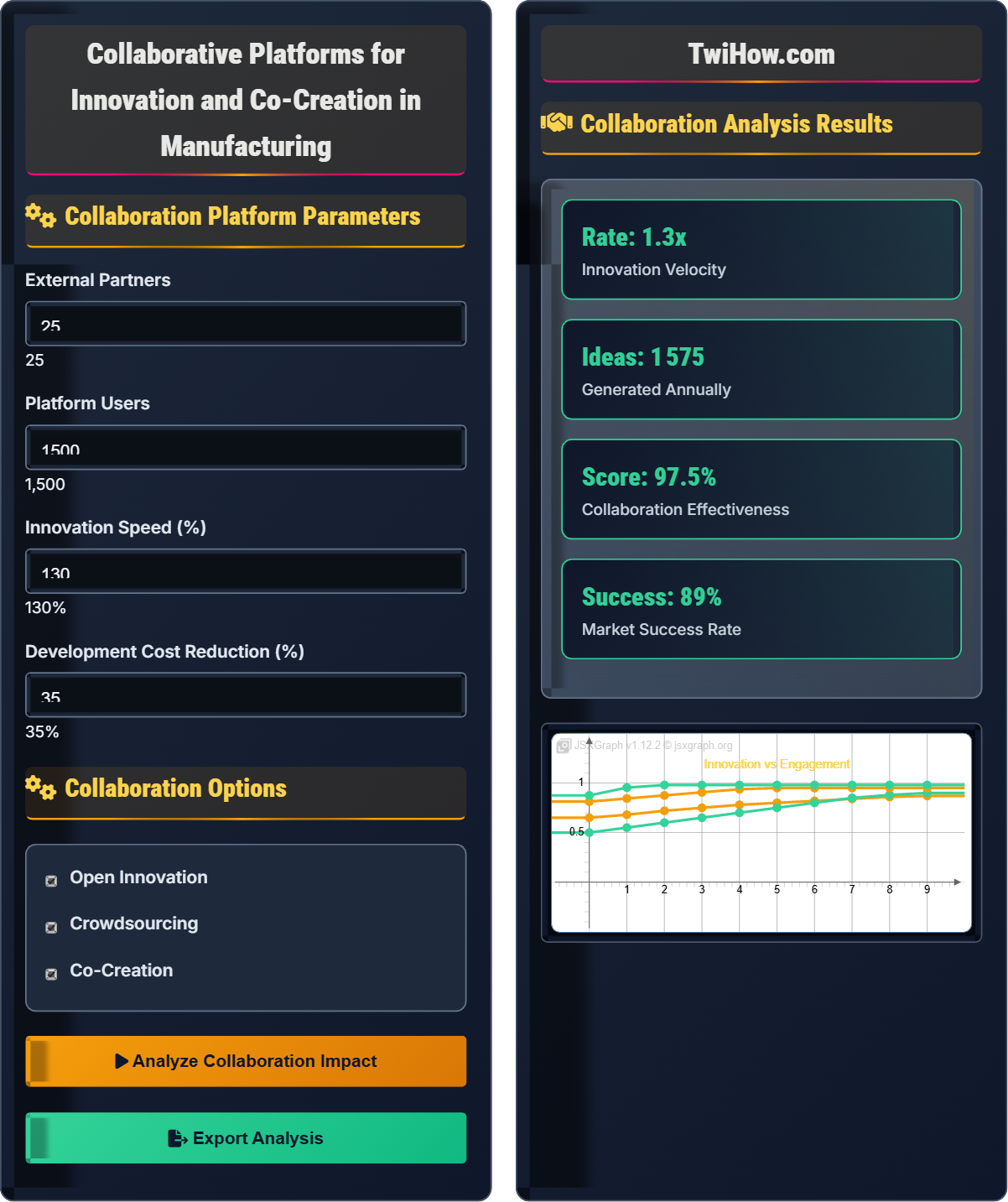
Collaboration Analysis Results
| Category | With Collaboration | Traditional | Improvement |
|---|---|---|---|
| Time to Market | 8 months | 14 months | 43% |
| Development Cost | $2.1M | $3.2M | 34% |
| Success Rate | 78% | 55% | 42% |
| Idea Diversity | 92% | 65% | 42% |
| Customer Satisfaction | 88% | 72% | 22% |
Collaborative Platforms for Innovation Explained
Collaborative platforms in manufacturing are digital ecosystems that enable organizations to connect with external partners, customers, suppliers, and communities to accelerate innovation and co-create solutions. These platforms facilitate knowledge sharing, joint development, and collective problem-solving across organizational boundaries. They represent a shift from closed innovation models to open innovation approaches that leverage external expertise and resources.
The Innovation Acceleration Index (IAI) measures the impact of collaborative platforms:
For measuring collaboration effectiveness:
Where:
- IAI: Innovation Acceleration Index (higher is better)
- CEI: Collaboration Effectiveness Index
- Innovation Output: Number of innovations or improvements
- Diversity Factor: Variety of perspectives and expertise
- Engagement Score: Level of participant involvement
Essential models for collaborative innovation in manufacturing:
- Open Innovation: External ideas and paths to market as business models
- Crowdsourcing: Gathering ideas and solutions from large communities
- Co-creation: Joint development of products and solutions with stakeholders
- Partner Ecosystems: Strategic alliances and partnerships for mutual benefit
- Supplier Integration: Collaborating with suppliers for innovation
- Customer Involvement: Engaging customers in product development
- Accelerated Innovation: Faster development cycles through parallel efforts
- Reduced Costs: Shared development and research expenses
- Enhanced Creativity: Diverse perspectives and expertise
- Market Alignment: Solutions better matched to customer needs
- Resource Optimization: Leveraging external capabilities
- Risk Mitigation: Distributed development and testing
Collaborative Innovation Fundamentals
Collaborative platforms, open innovation, co-creation, crowdsourcing, digital ecosystems, partner networks.
IAI = (Innovation Output × Diversity Factor) / (Development Cost × Time Factor)
Where IAI = Innovation Acceleration Index measuring collaborative effectiveness.
- Trust and transparency are essential for effective collaboration
- Intellectual property must be carefully managed
- Clear governance structures are critical
Applications
Product development, supply chain optimization, process improvement, technology development.
- Automotive design collaboration
- Electronics development
- Pharmaceutical research
- Aerospace engineering
- Intellectual property protection
- Competition vs. collaboration
- Technology integration challenges
- Legal and contractual issues
Collaborative Innovation Learning Quiz
Which of the following is NOT a primary collaboration model for innovation in manufacturing?
"Closed Innovation" is not a collaboration model but rather the opposite approach. Closed innovation relies on internal resources and capabilities, keeping development activities within the organization. The question asks about collaboration models, which by definition involve external partners and open approaches. Open innovation, crowdsourcing, and co-creation all involve external collaboration.
The answer is C) Closed Innovation.
Understanding the distinction between open and closed innovation is fundamental to collaborative platform strategy. Closed innovation assumes that successful innovation requires control over the entire process internally. Open innovation recognizes that valuable knowledge and resources exist outside the organization. Collaborative platforms embody the open innovation philosophy by connecting organizations with external expertise.
Open Innovation: Using external ideas and paths to market
Crowdsourcing: Gathering ideas from large communities
Co-creation: Joint development with stakeholders
• Collaboration requires openness to external ideas
• Intellectual property must be protected
• Governance structures are essential
• Start with low-risk collaboration projects
• Establish clear IP agreements upfront
• Focus on mutual value creation
• Confusing collaboration with outsourcing
• Not establishing proper governance
• Failing to define success metrics
Describe the process of implementing a collaborative innovation platform. What are the key steps, challenges, and expected outcomes?
Implementation Process: Begin with strategic planning to identify collaboration objectives, select appropriate platform technology, recruit initial participants, establish governance structures, and create engagement protocols.
Key Challenges: Intellectual property protection, cultural resistance, technology integration, participant engagement, and governance complexity.
Expected Outcomes: 20-40% reduction in development time, 15-30% decrease in R&D costs, improved innovation diversity, higher market success rates, and stronger partner relationships.
Implementing collaborative platforms requires careful attention to both technical and human factors. The success of these platforms depends as much on cultural change and relationship building as on technology. Organizations must shift from competitive to collaborative mindsets while maintaining appropriate protections for sensitive information. The implementation process should be phased to build trust and demonstrate value incrementally.
Collaborative Platform: Digital environment for shared innovation activities
Governance Structure: Rules and processes for platform operation
Engagement Protocol: Guidelines for participant interaction
• Start with trusted partners
• Establish clear IP agreements
• Define success metrics early
• Create pilot projects to demonstrate value
• Invest in change management
• Focus on mutual benefits
• Launching without proper governance
• Not addressing IP concerns upfront
• Expecting immediate results
A manufacturing company traditionally develops products internally with 20 R&D engineers taking 18 months to develop a new product at a cost of $4M. They implement a collaborative platform with 15 external partners contributing equivalent effort. With collaboration, development time reduces to 12 months and costs to $2.8M, while market success rate increases from 45% to 70%. Calculate the improvement in innovation efficiency and return on investment.
Traditional Approach: Time = 18 months, Cost = $4M, Success Rate = 45%
With Collaboration: Time = 12 months, Cost = $2.8M, Success Rate = 70%
Time Improvement: (18-12)/18 × 100% = 33% faster
Cost Improvement: (4-2.8)/4 × 100% = 30% reduction
Success Rate Improvement: (70-45)/45 × 100% = 56% improvement
Efficiency Index: (Success Rate / (Cost × Time)) = 0.00875 (collaboration) vs 0.00625 (traditional) = 40% improvement
This example demonstrates how collaboration can simultaneously improve multiple dimensions of innovation performance. The improvements compound, creating exponential benefits. Faster development means quicker market entry, lower costs mean better margins, and higher success rates mean better return on investment. The efficiency index shows the combined effect of all improvements.
Innovation Efficiency: Ratio of successful outcomes to resources invested
Time to Market: Duration from concept to commercialization
Success Rate: Percentage of projects achieving market success
• Measure multiple dimensions of improvement
• Consider both direct and indirect benefits
• Account for risk reduction in calculations
• Calculate efficiency indices to compare approaches
• Include opportunity cost savings
• Consider portfolio effects of multiple projects
• Only measuring cost reductions
• Not accounting for success rate improvements
• Failing to consider time value of money
A company launching a collaborative platform must establish intellectual property protocols to protect their innovations while encouraging partner participation. Propose a framework for IP management that balances protection with collaboration incentives.
IP Framework: Implement tiered IP agreements distinguishing between background IP (pre-existing), foreground IP (created during collaboration), and background know-how.
Protection Mechanisms: Use non-disclosure agreements, patent filing strategies, and clear ownership definitions for jointly developed IP.
Participation Incentives: Offer fair IP sharing arrangements, royalty structures, and licensing rights that encourage innovation contribution.
This framework ensures IP protection while maintaining collaboration incentives.
Intellectual property management is often the biggest challenge in collaborative innovation. Partners need assurance that their contributions won't be misused, while companies need to protect their core IP. The solution lies in clear agreements that define what IP is shared, how new IP is owned, and what rights each party retains. Balancing protection with incentive is critical for successful collaboration.
Background IP: Intellectual property owned before collaboration
Foreground IP: Intellectual property created during collaboration
Know-how: Unpatented technical knowledge and expertise
• Define IP ownership before collaboration begins
• Balance protection with participation incentives
• Include dispute resolution mechanisms
• Use standardized agreement templates
• Include IP assignment clauses
• Establish patent filing responsibilities
• Not addressing IP rights upfront
• Being overly restrictive with IP sharing
• Failing to include termination clauses
Which factor has the greatest impact on the return on investment (ROI) of collaborative innovation platforms?
Participant engagement level has the greatest impact on ROI because the value of collaborative platforms comes from active participation and contribution of ideas. A sophisticated platform with few engaged users provides minimal value. Similarly, many registered users who don't participate contribute little to innovation outcomes. The technology is only valuable when participants actively contribute knowledge and ideas.
The answer is B) Participant engagement level.
The success of collaborative innovation platforms depends on the "network effect" - the value increases with active participation. Technology features and interface design matter, but only if they facilitate actual engagement. The most sophisticated platform is worthless without engaged participants who contribute meaningful ideas and insights. Engagement drives both the quantity and quality of innovation outcomes.
Return on Investment (ROI): Financial benefit relative to investment cost
Participant Engagement: Level of active participation in platform activities
Network Effect: Value increases with number of participants
• Engagement is more important than registration
• Quality of contributions matters more than quantity
• Active participation drives value creation
• Focus on participant retention, not just acquisition
• Create compelling reasons for participation
• Recognize and reward valuable contributions
• Measuring success by registration numbers
• Not incentivizing active participation
• Focusing only on technology features
FAQ
Q: How much can we expect to improve innovation speed with collaborative platforms?
A: Well-implemented collaborative platforms typically improve innovation speed by 20-40% through parallel development, diverse perspectives, and shared resources. The exact improvement depends on the type of collaboration, participant engagement, and how well the platform is integrated with existing processes. Companies often see 25-35% reduction in development time for collaborative projects compared to traditional internal development, with even greater improvements for complex challenges requiring diverse expertise.
Q: Will collaborative platforms replace our internal R&D teams?
A: Collaborative platforms complement rather than replace internal R&D teams. Internal teams provide core capabilities, domain expertise, and organizational knowledge that external collaborators cannot replicate. The platform serves as an amplifier for internal capabilities, extending reach and accelerating development. The most successful approaches combine strong internal R&D with effective external collaboration, creating a hybrid model that leverages both internal and external innovation capabilities.