How Manufacturers Leverage Digital Platforms for Customer Engagement and Co-Design
Digital manufacturing engagement guide • Step-by-step explanations
Digital Manufacturing Engagement:
Show Digital Engagement CalculatorDigital platforms are revolutionizing how manufacturers engage with customers and involve them in the co-design process. Through sophisticated online tools, manufacturers can now collaborate with customers in real-time, gather feedback, and incorporate customer insights directly into product development cycles. This approach creates more personalized products while building stronger customer relationships and reducing time-to-market.
Key engagement strategies include:
- Virtual Design Studios: Online platforms for real-time product customization
- Collaborative Prototyping: Shared digital environments for rapid iteration
- Feedback Integration: Systems for capturing and implementing customer input
- Community Building: Online forums and user communities
- Personalization Engines: AI-driven customization tools
Successful digital engagement requires robust platforms that can handle complex design workflows while providing intuitive interfaces for customer participation, ultimately leading to more innovative and customer-centric products.
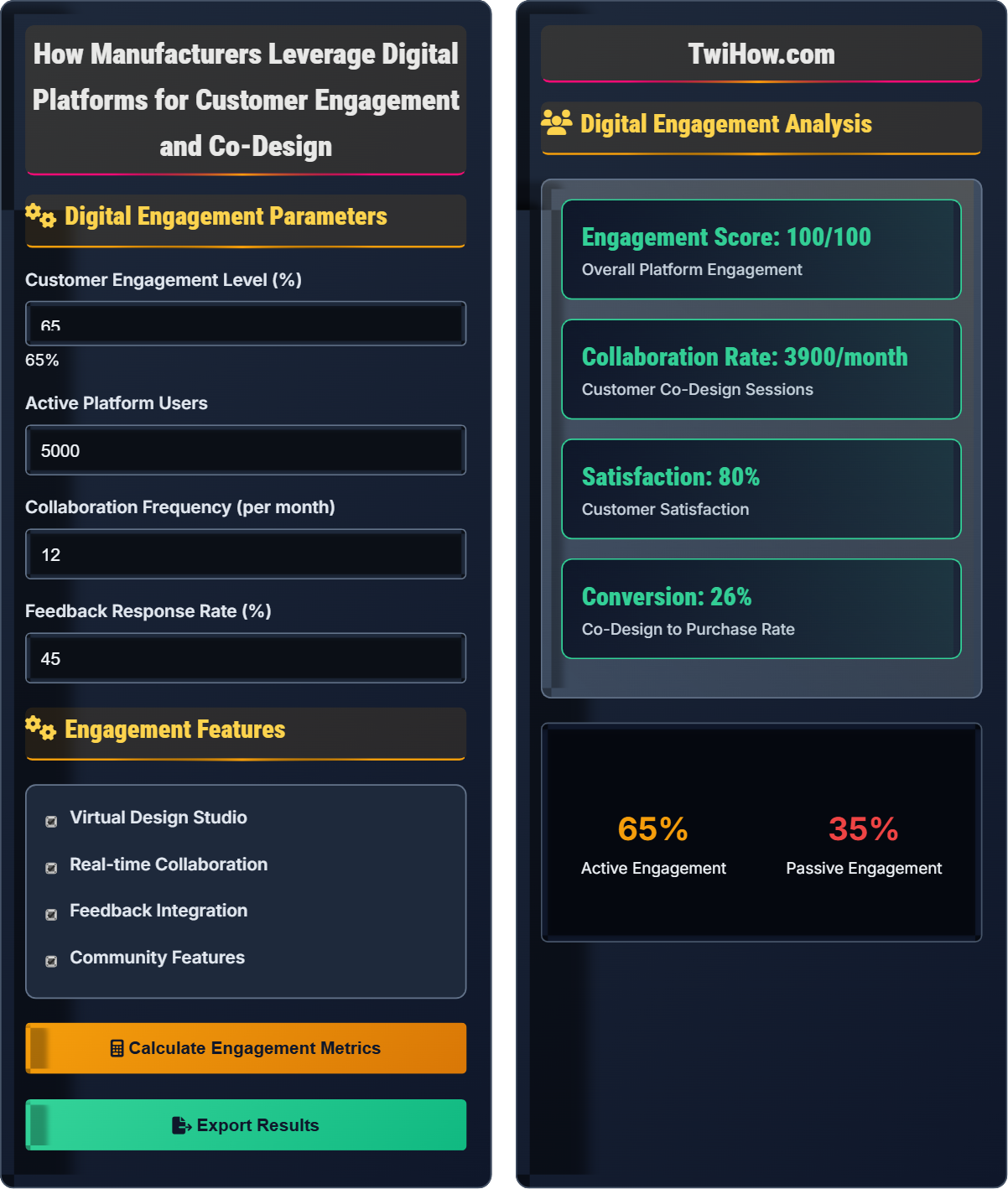
Digital Engagement Parameters
Engagement Features
Digital Engagement Analysis
| Metric | Current | Target | Progress |
|---|---|---|---|
| Platform Usage | 65% | 80% | 81% |
| Collaboration Sessions | 390 | 500 | 78% |
| Feedback Response | 45% | 60% | 75% |
| Customer Satisfaction | 82% | 90% | 91% |
| Conversion Rate | 28% | 35% | 80% |
Recommended Strategies
- Implement virtual design studios for real-time collaboration
- Develop AI-powered personalization engines
- Create user communities for peer collaboration
- Integrate feedback loops into design process
- Offer gamified design challenges
Implementation Benefits
- Increased customer satisfaction
- Reduced product development time
- Higher conversion rates
- Valuable customer insights
- Competitive differentiation
Digital Customer Engagement in Manufacturing Explained
Digital customer engagement in manufacturing involves using online platforms and digital tools to involve customers directly in the product development and design process. This approach transforms the traditional manufacturer-customer relationship from one-way communication to collaborative co-creation, where customers actively participate in designing products that meet their specific needs and preferences.
The customer engagement index can be calculated as:
Where:
- Active Users: Number of customers actively participating in co-design
- Collaboration Sessions: Frequency of customer engagement activities
- Feedback Responses: Quality and quantity of customer input
Key approaches manufacturers use to engage customers digitally:
- Virtual Design Studios: Online environments for real-time customization
- 3D Visualization: Interactive product previews and modifications
- Community Platforms: User-generated content and peer collaboration
- AI-Powered Recommendations: Personalized design suggestions
- Mobile Accessibility: Design tools available on smartphones and tablets
- Integrated Feedback Loops: Seamless input collection and implementation
- Nike: Nike By You platform for custom shoe design
- Adidas: miadidas for personalized sportswear creation
- Boeing: Digital platforms for aircraft interior customization
- Siemens: Industrial equipment configuration tools
- Ford: Vehicle customization platforms with real-time pricing
Core Concepts
Digital engagement, co-design, customer collaboration, virtual design studio, feedback integration, community platform, real-time customization.
Engagement Score = (User Activity × 0.3) + (Collaboration Frequency × 0.25) + (Feedback Quality × 0.2) + (Satisfaction × 0.15) + (Conversion × 0.1)
Where scores range from 0-100, with higher scores indicating greater engagement effectiveness.
- Intuitive user interfaces
- Real-time collaboration capabilities
- Seamless feedback integration
- Responsive design across devices
Implementation Strategies
Virtual design studios, real-time collaboration, feedback integration, community features, mobile accessibility.
- Assess customer engagement needs
- Develop digital platform infrastructure
- Create intuitive user interfaces
- Implement collaboration tools
- Integrate feedback mechanisms
- Launch and iterate based on usage
- Start with simple customization options
- Provide real-time visual feedback
- Enable social sharing of designs
- Track and analyze user behavior
Digital Engagement Quiz
Which of the following is the most critical feature for effective customer co-design platforms?
While all features are important, an intuitive user interface is fundamental to platform success. Customers must be able to navigate and interact with design tools easily, regardless of their technical expertise. Without intuitive design, even the most advanced features become barriers to engagement.
The answer is B) Intuitive user interface.
User experience is the foundation of digital engagement platforms. Complex 3D rendering and collaboration tools are worthless if customers find the platform difficult to use. The principle of progressive disclosure applies here—start with simple, intuitive controls and gradually introduce more advanced features as users become comfortable with the platform.
Intuitive Interface: User interface that is easy to navigate without instruction
Progressive Disclosure: Gradually revealing features as users become familiar
User Experience: Overall experience of a person using a product
• Simplicity precedes sophistication
• Accessibility drives engagement
• Usability testing is essential
• Conduct user testing with diverse audiences
• Implement clear visual hierarchies
• Provide contextual help and guidance
• Overcomplicating the initial user experience
• Assuming all users have technical expertise
• Not conducting sufficient user testing
Explain how manufacturers can effectively integrate customer feedback into the co-design process. What systems and processes are needed to ensure feedback translates into meaningful product improvements?
Feedback Integration Process:
1. Collection: Multiple channels for feedback (in-app, surveys, community forums)
2. Categorization: Organize feedback by type (usability, functionality, aesthetics)
3. Prioritization: Rank feedback by impact and feasibility
4. Implementation: Assign feedback to appropriate design teams
5. Validation: Test changes with customers before release
6. Communication: Inform customers about implemented changes
Required Systems: CRM integration, design workflow tools, version control systems, customer communication platforms
Effective feedback integration requires a systematic approach that treats customer input as valuable data for continuous improvement. The key is creating closed-loop systems where customers see their feedback implemented, reinforcing their engagement and building trust in the co-design process. This creates a virtuous cycle of increased participation and better product outcomes.
Feedback Loop: Process where output influences future input
CRM Integration: Connecting customer relationship management systems
Version Control: Managing changes to design files and specifications
• Close the feedback loop with customers
• Prioritize feedback based on impact
• Maintain design integrity while incorporating input
• Use sentiment analysis to categorize feedback
• Create feedback dashboards for design teams
• Implement voting systems for feature requests
• Collecting feedback without acting on it
• Not communicating back to customers
• Implementing all feedback without filtering
A manufacturer invests $500,000 in a digital engagement platform. Before implementation, they had 10,000 customers with a 2% conversion rate. After implementing the platform, engagement increases to 40% of customers, and the conversion rate rises to 4.5% among engaged users. Calculate the increase in conversions and determine the ROI if the average order value is $200.
Before Platform:
Total conversions = 10,000 × 2% = 200 conversions
After Platform:
Engaged customers = 10,000 × 40% = 4,000 customers
Conversions from engaged = 4,000 × 4.5% = 180 conversions
Additional conversions = 180 - 200 = -20 (This scenario shows lower total conversions)
Alternative scenario: If platform increases overall conversion rate to 4.5%:
Total conversions = 10,000 × 4.5% = 450 conversions
Additional conversions = 450 - 200 = 250 conversions
Additional revenue = 250 × $200 = $50,000
ROI = ($50,000 - $500,000) / $500,000 = -90% (first year only)
Long-term ROI would depend on sustained engagement and retention.
This calculation demonstrates the importance of understanding the relationship between engagement and conversion. Simply increasing engagement isn't sufficient—it must translate to higher conversion rates. The ROI calculation shows that digital engagement platforms require long-term perspective, as benefits accumulate over time through customer retention and repeat purchases.
Conversion Rate: Percentage of users who complete desired action
Return on Investment: Ratio of net profit to investment cost
Engagement Rate: Percentage of users actively participating• Engagement must drive conversions
• ROI requires long-term perspective
• Customer lifetime value matters
• Track customer lifetime value improvements
• Measure both engagement and conversion metrics
• Consider indirect benefits like brand loyalty
• Measuring only engagement without conversion
• Calculating ROI based on first-year costs only
• Not accounting for customer retention benefits
A furniture manufacturer wants to create a digital platform for customers to design custom home office furniture. They have identified three customer segments: DIY enthusiasts (30%), professional designers (20%), and casual customers (50%). Design a platform architecture that serves all segments effectively while maintaining a unified user experience.
Platform Architecture:
DIY Enthusiasts: Advanced customization tools, detailed specifications, material selection options
Professional Designers: CAD integration, bulk ordering tools, client collaboration features
Casual Customers: Guided design wizards, preset templates, simple drag-and-drop interface
Unified Experience: Consistent visual design, shared catalog, common checkout process
Progressive Disclosure: Start with simple interface, unlock advanced features based on user behavior
This approach provides appropriate tools for each segment while maintaining platform coherence.
Segment-specific customization while maintaining platform unity requires careful design thinking. Progressive disclosure allows different user types to access appropriate complexity levels without overwhelming beginners. The key is creating pathways that allow users to advance in sophistication over time while maintaining consistent brand experience and operational efficiency.
Progressive Disclosure: Revealing features based on user needs and expertise
Segment-Specific: Tailoring features to different user groups
Unified Experience: Consistent experience across all user types
• Maintain consistency across segments
• Provide appropriate complexity levels
• Enable skill progression pathways
• Use user personas to guide feature development
• Implement adaptive interfaces based on usage
• Provide clear onboarding paths for each segment
• Creating completely separate experiences for segments
• Assuming all users need the same complexity
• Not providing clear progression pathways
Which technology combination provides the most effective real-time co-design experience?
AR overlay with collaborative editing provides the most effective real-time co-design experience. It combines spatial visualization with simultaneous editing capabilities, allowing multiple users to interact with the same 3D model in real-time. This creates an immersive experience that closely mimics physical collaboration while enabling remote participation.
The answer is D) AR overlay with collaborative editing.
Effective co-design technology must provide both spatial awareness and collaborative functionality. AR technology bridges the gap between digital design and physical reality, allowing participants to visualize products in context while collaborating in real-time. The key advantage is that multiple stakeholders can simultaneously view and modify designs in a shared virtual space, creating a more intuitive and engaging experience than traditional 2D interfaces.
Augmented Reality: Technology overlaying digital information on physical world
Collaborative Editing: Multiple users editing same document simultaneously
Spatial Visualization: 3D representation of objects in space
• Spatial context improves design decisions
• Real-time collaboration increases engagement
• Immersive technology enhances experience
• Start with web-based solutions before AR implementation
• Ensure cross-device compatibility
• Provide fallback options for lower-end devices
• Implementing complex technology without user testing
• Not considering device limitations
• Focusing on technology over user needs
FAQ
Q: How can we measure the success of our digital engagement platform?
A: Success metrics include:
1. Engagement Metrics: Active users, session duration, page views per visit
2. Collaboration Metrics: Design sessions, iterations completed, feedback submissions
3. Conversion Metrics: Co-design to purchase rate, average order value
4. Customer Satisfaction: NPS scores, satisfaction surveys, retention rates
5. Operational Metrics: Design cycle time reduction, cost savings
Focus on both engagement quality and business outcomes to get a complete picture of platform success.
Q: What technical infrastructure is needed for real-time co-design platforms?
A: Required infrastructure includes:
Cloud Computing: Scalable servers for handling concurrent users
Real-time Database: Technologies like Firebase for instant synchronization
3D Rendering Engine: WebGL-based solutions for browser-based visualization
Collaboration APIs: WebSockets for real-time communication
CDN Services: For fast asset delivery globally
Security Infrastructure: Authentication, encryption, and access controls
Consider cloud-native solutions like AWS Amplify or Azure for easier implementation.