What are the best practices for change management in manufacturing digitalization?
Complete manufacturing guide • Step-by-step explanations
Change Management in Digitalization:
Show Change Management SimulatorChange management in manufacturing digitalization involves systematically transitioning organizations from traditional operations to digital-first processes. This includes preparing employees, updating processes, and implementing new technologies while minimizing disruption and resistance.
Key considerations include:
- Stakeholder Engagement: Involving all affected parties in the change process
- Training and Development: Preparing workforce for new digital tools
- Communication Strategy: Clear messaging about benefits and expectations
- Phased Implementation: Gradual rollout to minimize disruption
- Performance Measurement: Tracking success metrics throughout transition
- Cultural Transformation: Shifting organizational mindset toward digital adoption
Success requires strategic planning, leadership commitment, and continuous support throughout the transformation journey.
Change Management Parameters
Advanced Options
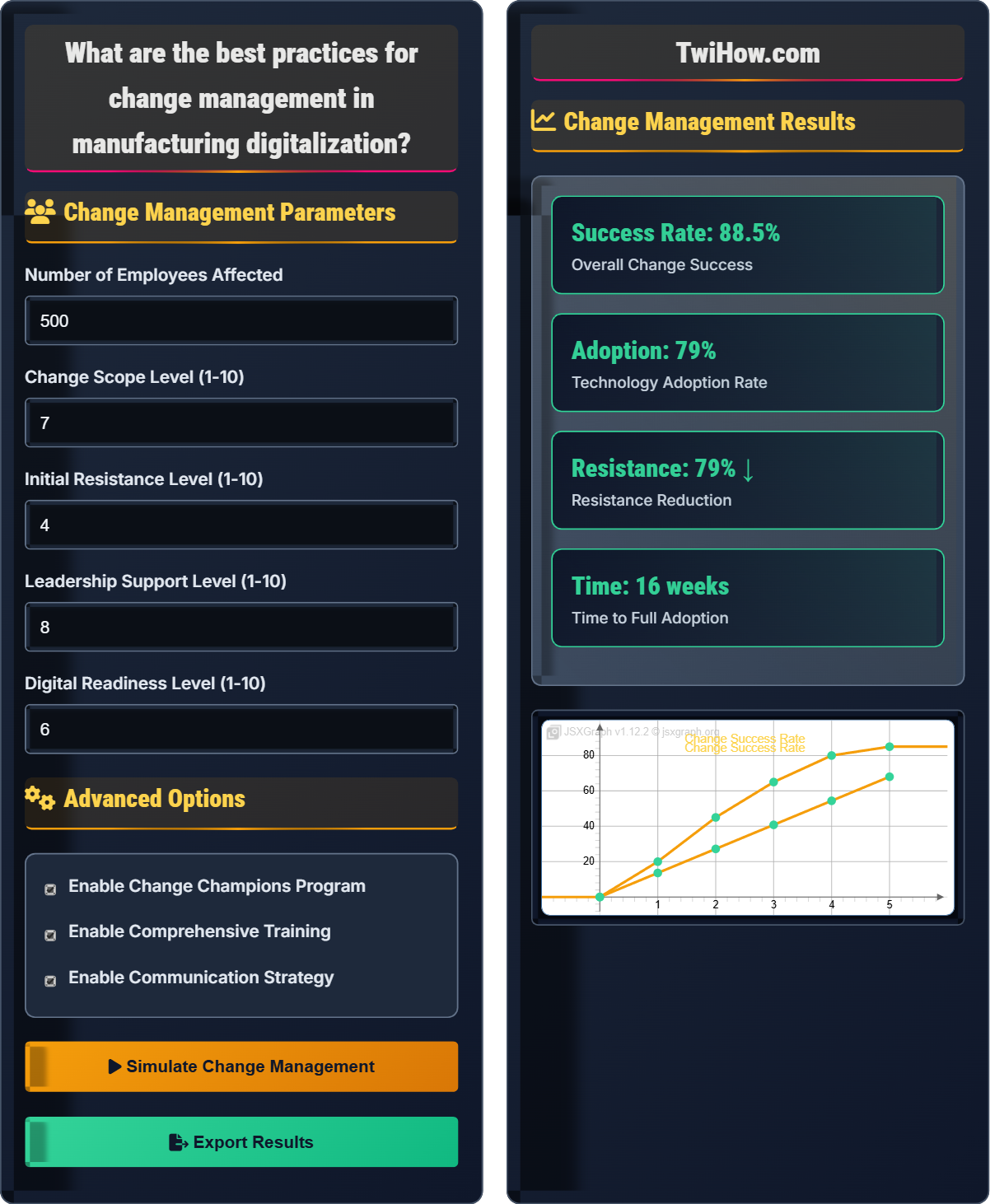
Change Management Results
| Metric | Baseline | Post-Implementation | Improvement |
|---|---|---|---|
| Employee Engagement | 60% | 85% | 42% ↑ |
| Productivity | Base | 115% of base | 15% ↑ |
| Change Readiness | 55% | 88% | 60% ↑ |
| Training Completion | 70% | 95% | 36% ↑ |
| Strategy | Implementation | Impact | Status |
|---|---|---|---|
| Leadership Involvement | Active | High | Completed |
| Change Champions | Deployed | High | Running |
| Training Program | Ongoing | Medium | Active |
| Communication Plan | Implemented | Medium | Active |
Change Management in Manufacturing Digitalization
Change management in manufacturing digitalization involves systematically transitioning employees, processes, and technologies from traditional operations to digital-first approaches. This includes implementing new digital tools, updating workflows, and shifting organizational culture to embrace technological transformation.
Where:
- Change Success Rate: Percentage of planned changes that were successfully implemented
- Employee Adoption Rate: Percentage of employees who actively use new digital tools
- Total Planned Changes: Number of intended process or technology changes
Key elements of successful change management in digitalization:
- Leadership Commitment: Strong support and involvement from executives
- Employee Involvement: Active participation in the change process
- Training Programs: Comprehensive education on new technologies
- Communication Strategy: Clear, consistent messaging about changes
- Change Champions: Internal advocates for the transformation
- Performance Metrics: KPIs to measure change success
- Assessment: Evaluate current digital maturity and readiness
- Planning: Develop comprehensive change strategy
- Pilot: Test changes on a small scale
- Rollout: Gradual implementation across organization
- Optimization: Continuous improvement and refinement
- Embedding: Make changes part of organizational culture
Strategic Framework
Change management, digital transformation, employee engagement, stakeholder involvement, resistance management.
Manufacturing change management follows a structured approach: Awareness → Desire → Knowledge → Ability → Reinforcement. This ensures employees understand the need for change, want to participate, know how to change, can implement the change, and maintain the change over time.
- Start with leadership commitment and vision
- Involve employees in the planning process
- Communicate benefits and address concerns
- Provide adequate training and support
Implementation Strategies
Phased rollout, pilot programs, change champions, training programs, communication strategy.
- Conduct change readiness assessment and gap analysis
- Form change management team with cross-functional expertise
- Develop comprehensive communication and training plans
- Identify and train change champions across the organization
- Implement pilot programs in non-critical areas
- Scale successful implementations across the organization
- Strong leadership commitment and support
- Employee engagement and buy-in
- Continuous communication and feedback
- Measurable outcomes and KPIs
Change Management in Digitalization Quiz
What is the most effective way to manage resistance to digital transformation in manufacturing?
The most effective approach is to communicate the benefits of digital transformation clearly and involve employees in the change process. This builds understanding, trust, and buy-in. Transparent communication addresses concerns and misconceptions, while involvement gives employees a sense of ownership and control over the changes affecting them.
The answer is B) Communicate benefits and involve employees in the change process.
Resistance to change is a natural human response, especially in manufacturing where employees may have decades of experience with traditional methods. The key to managing resistance is not to eliminate it but to channel it constructively. When employees understand why change is necessary and how it benefits them personally, they are more likely to support and participate in the transformation.
Change Resistance: Natural opposition to proposed changes
Employee Buy-in: Agreement and support for proposed changes
Change Champions: Internal advocates for transformation
• Address resistance through open dialogue
• Involve employees in change planning
• Communicate benefits clearly and consistently
• Start with willing participants to build momentum
• Use peer testimonials for persuasion
• Address concerns transparently and honestly
• Imposing changes without employee input
• Not addressing job security concerns
• Failing to communicate the "why" behind changes
Explain how to develop an effective training strategy for manufacturing digitalization that addresses different learning styles and skill levels.
Effective Training Strategy Components:
1. Assessment: Evaluate current skill levels and learning preferences
2. Segmentation: Group employees by skill level and learning style
3. Blended Approach: Combine hands-on practice with digital learning
4. Peer Learning: Encourage knowledge sharing between employees
Implementation Methods:
• Visual Learners: Use diagrams, videos, and visual demonstrations
• Auditory Learners: Provide verbal explanations and discussions
• Kinesthetic Learners: Offer hands-on practice with new tools
• Beginner Level: Start with basics and build gradually
• Intermediate Level: Focus on advanced features and troubleshooting
• Advanced Level: Emphasize optimization and customization
Customized training ensures all employees can adapt to digital transformation.
Manufacturing environments have diverse workforces with varying backgrounds, ages, and technological familiarity. An effective training strategy must accommodate these differences to ensure everyone can successfully adapt to digital tools. The key is to provide multiple learning pathways that cater to different preferences while maintaining consistent learning objectives.
Learning Styles: Different ways individuals process and retain information
Blended Learning: Combination of traditional and digital learning methods
Skill Segmentation: Grouping employees by competency level
• Assess current skill levels before training
• Provide hands-on practice opportunities
• Offer ongoing support and refresher training
• Use real manufacturing scenarios in training
• Provide mobile-friendly learning resources
• Create mentorship programs for peer support
• One-size-fits-all training programs
• Not providing adequate hands-on practice
• Failing to account for different learning styles
A manufacturing plant with 800 employees is implementing a digital transformation initiative. Design a change champion program that identifies, trains, and deploys champions across different departments to support the transition. Include selection criteria, training plan, and deployment strategy.
Change Champion Program:
Selection Criteria:
• Technical aptitude and curiosity about digital tools
• Strong interpersonal and communication skills
• Respect and influence among peers
• Positive attitude toward change
Training Plan:
• 4-week intensive training on new digital tools
• Leadership and change management skills
• Communication and facilitation techniques
• Troubleshooting and support skills
Deployment Strategy:
• Assign champions to each department (5-10 per department)
• Weekly champion meetings for updates and support
• Champions as first point of contact for questions
• Recognition and incentive programs for champions
This approach creates a network of internal advocates who can support their colleagues through the transition.
Change champions are critical to successful digital transformation because they provide trusted, peer-to-peer support. Employees are more likely to accept change when it comes from respected colleagues rather than management alone. The champion program creates a multiplier effect where a few well-trained individuals can support hundreds of employees through the transition.
Change Champion: Internal advocate for transformation initiatives
Peer-to-Peer Support: Colleagues helping colleagues with change
Multiplier Effect: Small group supporting larger population
• Select champions from all organizational levels
• Provide comprehensive training and ongoing support
• Recognize and reward champion contributions
• Start with willing volunteers rather than assigning champions
• Provide champions with exclusive resources and tools
• Create a community of practice for champions
• Selecting champions based on seniority alone
• Not providing adequate training and resources
• Failing to recognize and reward champion efforts
A manufacturer is concerned about negative rumors and misinformation spreading during their digital transformation. Design a communication strategy that addresses concerns, provides accurate information, and maintains employee morale throughout the change process.
Communication Strategy Components:
1. Transparency: Share information openly about changes and their rationale
2. Multi-channel Approach: Use various communication methods (meetings, newsletters, digital platforms)
3. Two-way Communication: Provide forums for questions and feedback
4. Regular Updates: Consistent communication throughout the process
Implementation:
• Weekly all-hands meetings during transformation
• Digital bulletin boards with transformation updates
• Anonymous feedback channels for concerns
• Department-specific communication sessions
• Leadership presence on the shop floor
Proactive communication prevents misinformation and builds trust during change.
During periods of change, communication becomes even more critical. The absence of information creates a vacuum that is often filled with rumors and speculation. A proactive communication strategy ensures that accurate information reaches employees before misinformation can spread. The key is to be transparent about both the opportunities and challenges of digital transformation.
Proactive Communication: Providing information before it's requested
Multi-channel Strategy: Using various communication methods
Two-way Communication: Allowing for feedback and dialogue
• Communicate early and often
• Be honest about challenges and benefits
• Provide multiple feedback channels
• Use storytelling to make changes relatable
• Share success stories from pilot programs
• Address concerns with specific examples and data
• Waiting until problems arise to communicate
• Using only top-down communication methods
• Not addressing concerns raised by employees
Which set of metrics best measures the success of change management in manufacturing digitalization?
The most comprehensive metrics for measuring change management success are those that directly relate to business outcomes: technology adoption rate (measures actual usage), employee engagement (measures acceptance), and productivity improvement (measures impact). These metrics connect the change effort to tangible business results.
The answer is B) Technology adoption rate, employee engagement, and productivity improvement.
Effective change management metrics must connect training and engagement activities to business outcomes. While training completion rates are important, they don't necessarily indicate successful change. The true measure of change management success is whether employees actually adopt new technologies, remain engaged with the organization, and contribute to improved business performance.
Technology Adoption Rate: Percentage of employees using new tools effectively
Employee Engagement: Level of commitment to organizational goals
Productivity Improvement: Enhancement in output efficiency
• Link training metrics to business outcomes
• Measure both adoption and proficiency
• Track long-term impact, not just immediate results
• Establish baseline metrics before transformation
• Use surveys to gauge employee sentiment
• Monitor both quantitative and qualitative metrics
• Measuring only training completion without usage
• Not establishing baseline measurements
• Focusing on activities rather than outcomes
FAQ
Q: What is the typical timeline for successful change management in manufacturing digitalization?
A: Timelines typically follow this pattern:
Preparation Phase (4-8 weeks): Assessment, planning, and stakeholder engagement
Pilot Phase (8-12 weeks): Small-scale implementation and refinement
Rollout Phase (16-24 weeks): Gradual implementation across organization
Stabilization Phase (8-12 weeks): Optimization and embedding of changes
Most manufacturers see full adoption within 6-12 months, with initial benefits appearing within 3-4 months.
Q: How can we measure the success of change management initiatives?
A: Success metrics include:
1. Technology Adoption: Percentage of employees using new systems
2. Engagement Scores: Employee satisfaction and buy-in levels
3. Performance Metrics: Productivity, quality, and efficiency improvements
4. Resistance Indicators: Number of complaints, absenteeism, turnover
5. Training Effectiveness: Completion rates and skill assessments
Combine quantitative metrics with qualitative feedback for comprehensive evaluation.
Q: How do change management programs affect day-to-day work for manufacturing operators?
A: Well-designed change management programs affect operators by:
1. Providing Adequate Training: Ensuring operators know how to use new tools safely
2. Addressing Concerns: Open communication about job security and benefits
3. Offering Support: Available help during transition period
4. Highlighting Benefits: How changes improve working conditions
5. Allowing Feedback: Channels to voice concerns and suggestions
Effective change management makes transitions smoother and more beneficial for operators.