What are the best practices for data integration and interoperability in smart factories?
Complete manufacturing guide • Step-by-step explanations
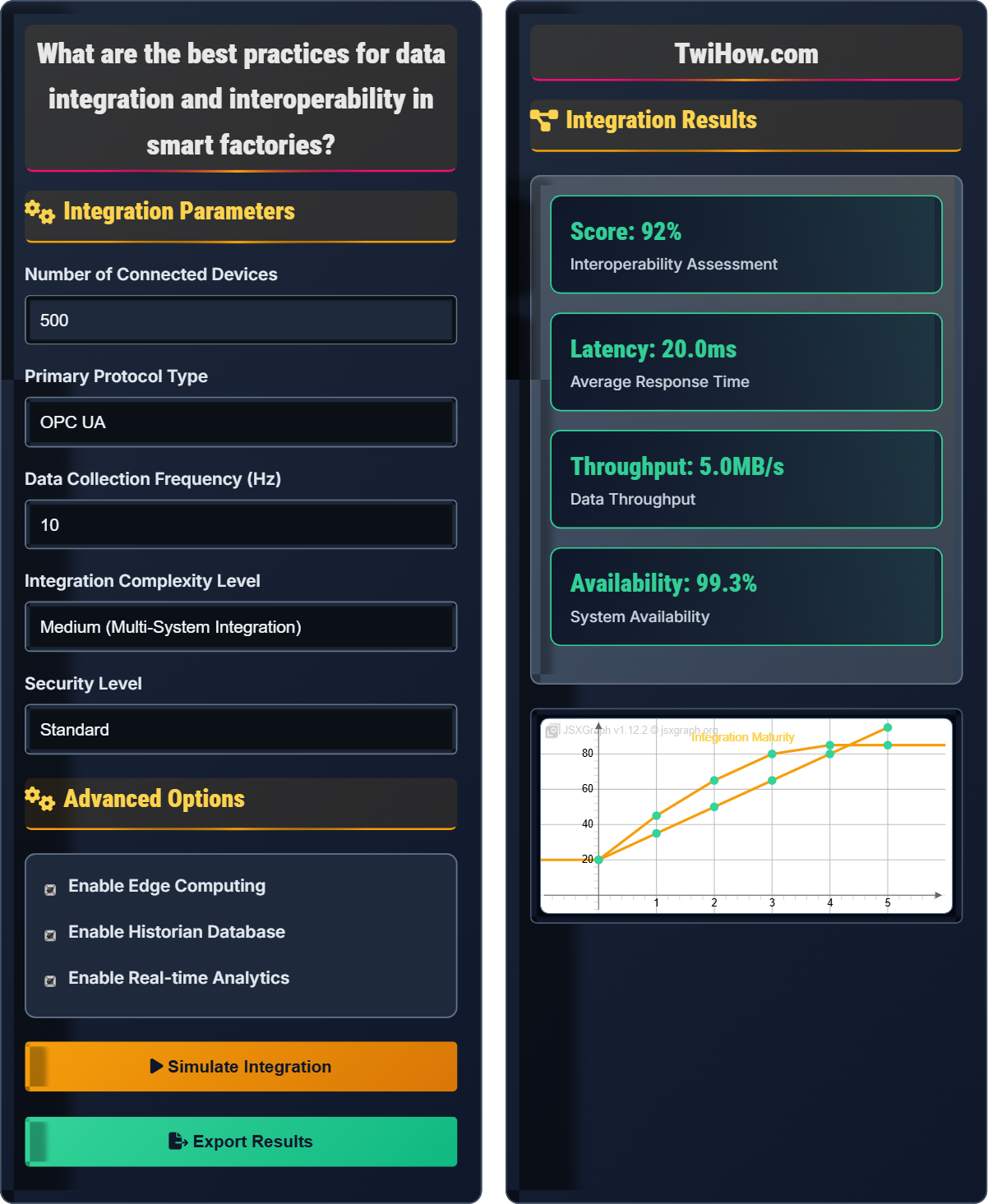
Smart Factory Data Integration:
Show Integration SimulatorData integration and interoperability in smart factories involve connecting diverse systems, devices, and platforms to enable seamless data flow. This enables real-time visibility, analytics, and control across the manufacturing ecosystem.
Key components include:
- Communication Protocols: OPC UA, MQTT, Ethernet/IP for device connectivity
- Data Standards: Standardized formats ensuring consistent interpretation
- Integration Platforms: Middleware solutions bridging different systems
- Security Frameworks: Protecting data integrity and access
Best practices ensure reliable, scalable, and secure data exchange across the factory floor.
Integration Parameters
Advanced Options
Integration Results
| Layer | Component | Status | Performance |
|---|---|---|---|
| Field | PLC/SCADA | Connected | Excellent |
| Control | Edge Gateway | Active | Good |
| Operation | MES | Integrated | Excellent |
| Enterprise | ERP | Synchronized | Good |
| Protocol | Usage | Compatibility | Security |
|---|---|---|---|
| OPC UA | 80% | High | Advanced |
| MQTT | 15% | Medium | Standard |
| Ethernet/IP | 5% | High | Basic |
Data Integration and Interoperability in Smart Factories
Data integration in smart factories involves connecting different systems, devices, and software platforms to enable seamless data flow. Interoperability ensures that diverse systems can communicate and work together effectively, regardless of vendor or technology differences.
Where:
- Compatible Connections: Successfully integrated system pairs
- Total Possible Connections: All possible system integrations
- Data Throughput: Volume of data processed per unit time
Key communication protocols in smart factories:
- OPC UA: Platform-independent standard for industrial automation
- MQTT: Lightweight protocol ideal for IoT devices
- Profinet: Industrial Ethernet standard for automation
- Ethernet/IP: Industrial protocol using standard Ethernet
- Modbus: Serial communication protocol widely used in industry
- REST APIs: Web-based interfaces for system integration
- Hub-and-Spoke: Central integration point connecting all systems
- Mesh Network: Direct connections between systems
- Event-Driven: Asynchronous communication based on events
- API-First: Standardized interfaces for all communications
- Microservices: Decoupled services with independent scaling
Best Practices Framework
Interoperability, data integration, communication protocols, edge computing, API management, security frameworks.
Smart factory integration follows the 4-tier architecture: Field (sensors/actuators), Control (PLCs/DCS), Operation (MES), Enterprise (ERP).
Each tier communicates using standardized protocols ensuring seamless data flow.
- Standardize protocols across the enterprise
- Implement security at every integration point
- Design for scalability and future needs
- Ensure real-time data synchronization
Implementation Strategies
Phased rollouts, pilot programs, vendor partnerships, and change management.
- Assess current infrastructure and legacy systems
- Define integration requirements and objectives
- Select appropriate protocols and technologies
- Develop integration architecture and security framework
- Execute phased deployment starting with pilot areas
- Monitor, optimize, and scale successful implementations
- Executive support and cross-functional collaboration
- Skilled workforce and training programs
- Visionary planning and technology roadmaps
- Continuous monitoring and optimization
Data Integration and Interoperability Quiz
Which communication protocol is most appropriate for integrating diverse industrial systems while maintaining platform independence?
OPC UA (Open Platform Communications Unified Architecture) is specifically designed for industrial automation with platform independence as a core feature. It provides a unified framework for data exchange across different vendors, operating systems, and programming languages, making it ideal for heterogeneous smart factory environments.
The answer is B) OPC UA.
OPC UA addresses interoperability challenges by providing a standardized, secure, and reliable communication framework. Unlike proprietary protocols, OPC UA ensures that systems from different manufacturers can communicate seamlessly. Its information modeling capability allows complex data structures to be exchanged consistently across platforms.
OPC UA: Open Platform Communications Unified Architecture - platform-independent industrial communication standard
Platform Independence: Ability to operate across different hardware and software environments
Information Modeling: Structured representation of data and relationships in OPC UA
• Choose protocols based on interoperability requirements
• Consider security features in protocol selection
• Evaluate vendor support and standardization
• Assess existing infrastructure compatibility
• Consider future scalability needs
• Evaluate protocol maturity and community support
• Selecting proprietary protocols limiting vendor choice
• Ignoring security requirements in protocol selection
• Not considering bandwidth and latency requirements
Explain the role of edge computing in smart factory data integration and interoperability. What are the key benefits compared to centralized data processing?
Edge Computing Role:
Edge computing processes data near its source rather than sending it to a central server. In smart factories, edge devices handle real-time processing, filtering, and analysis before transmitting relevant data to central systems.
Key Benefits:
1. Reduced Latency: Critical for real-time control and safety systems
2. Better Bandwidth Management: Filters unnecessary data, reducing network load
3. Enhanced Reliability: Local processing continues during network outages
4. Improved Security: Sensitive data processed locally, reducing exposure
5. Scalability: Distributed processing handles growing data volumes
Compared to centralized processing, edge computing enables faster response times, reduces network congestion, and provides greater resilience in industrial environments.
Edge computing transforms smart factory architecture by distributing intelligence across the network. Instead of sending raw sensor data to the cloud, edge devices analyze and interpret data locally, transmitting only meaningful insights. This approach optimizes network resources while enabling real-time decision-making critical for manufacturing operations.
Edge Computing: Processing data near its source rather than in a central location
Latency: Time delay between data generation and processing
Bandwidth: Maximum data transmission capacity of a network
• Deploy edge computing for time-sensitive applications
• Balance local and central processing needs
• Ensure edge devices have adequate computational power
• Use edge computing for predictive maintenance analytics
• Implement edge-to-cloud data pipelines
• Consider edge device security and management
• Deploying edge computing without clear use cases
• Underestimating edge device management complexity
• Not considering data consistency across edge and cloud
A smart factory operates with 500+ devices from 8 different vendors using 5 different communication protocols. The plant manager wants to implement real-time analytics and predictive maintenance. Design an integration architecture that addresses interoperability challenges while maintaining security and performance requirements.
Recommended Architecture:
1. Edge Gateway Layer: Deploy protocol converters and edge gateways to standardize communications to OPC UA or MQTT
2. Integration Bus: Implement an Enterprise Service Bus (ESB) or API gateway for message routing and transformation
3. Data Lake: Central repository for structured and unstructured data with real-time ingestion capabilities
4. Analytics Engine: Real-time analytics platform for predictive maintenance algorithms
5. Security Layer: Zero-trust architecture with authentication, encryption, and access controls
Implementation Steps:
• Start with pilot area to validate architecture
• Gradually expand to other production lines
• Implement comprehensive monitoring and logging
This architecture provides vendor neutrality, scalable performance, and robust security while enabling real-time analytics.
This solution demonstrates the importance of abstraction layers in managing complexity. The edge gateways act as translators, converting diverse protocols to standardized formats. The integration bus provides a centralized point for data routing and transformation, while the data lake enables flexible analytics. This layered approach separates concerns and allows each layer to evolve independently.
ESB: Enterprise Service Bus - middleware for integrating applications
Protocol Converter: Device translating between different communication protocols
Data Lake: Repository for storing structured and unstructured data
• Abstract protocol differences at the edge layer
• Implement centralized monitoring and management
• Design for incremental deployment and testing
• Use containerization for edge gateway deployments
• Implement data lineage tracking for quality assurance
• Design failover mechanisms for critical systems
• Attempting direct integration without abstraction layers
• Not planning for security across all integration points
• Overlooking data quality and validation requirements
A manufacturer is integrating IoT sensors with their ERP system through cloud services. Identify potential security vulnerabilities and propose a defense-in-depth strategy for protecting data integration pathways.
Potential Vulnerabilities:
1. Device Authentication: Unauthorized devices accessing the network
2. Data Transmission: Interception of sensitive data in transit
3. Cloud Interfaces: API vulnerabilities and misconfigurations
4. Legacy System Integration: Older systems lacking modern security
5. Access Control: Unauthorized access to integrated systems
Defense-in-Depth Strategy:
1. Physical Layer: Secure device placement and tamper detection
2. Network Layer: VPNs, firewalls, and network segmentation
3. Transport Layer: TLS encryption for all communications
4. Application Layer: API keys, OAuth, and input validation
5. Data Layer: Encryption at rest and access logging
This multi-layered approach ensures security at every integration point while maintaining operational efficiency.
Security in integrated systems requires a holistic approach addressing all potential attack vectors. The defense-in-depth strategy recognizes that no single security measure is foolproof. By implementing multiple layers of protection, the system maintains security even if one layer is compromised. This is particularly important in industrial environments where security breaches can have physical consequences.
Defense-in-Depth: Multi-layered security approach with overlapping protections
TLS: Transport Layer Security - encryption protocol for data in transit
Zero Trust: Security model requiring verification of all connections
• Encrypt data both in transit and at rest
• Implement least-privilege access controls
• Regular security assessments and updates
• Use certificate-based authentication for devices
• Implement network micro-segmentation
• Conduct regular penetration testing
• Relying solely on perimeter security
• Not updating security patches regularly
• Inadequate monitoring of integration points
What is the most critical factor to consider when designing a scalable data integration architecture for a smart factory?
Future data volume and device growth is the most critical factor for scalable integration architecture. Without planning for growth, the system will quickly become overwhelmed, leading to performance degradation, data loss, and integration failures. Scalability planning must account for exponential increases in connected devices and data streams typical in Industry 4.0 environments.
The answer is C) Future data volume and device growth.
Scalability in smart factories is driven by the Internet of Things explosion, where device counts grow exponentially. A well-designed architecture anticipates this growth through distributed processing, elastic cloud resources, and flexible data models. The architecture should support horizontal scaling (adding more nodes) and vertical scaling (increasing capacity of existing nodes) to handle increasing demands.
Horizontal Scaling: Adding more nodes to distribute workload
Vertical Scaling: Increasing capacity of existing nodes
Elastic Resources: Cloud resources that adapt to demand
• Design for 3-5x current capacity
• Use cloud-native, containerized solutions
• Implement automated scaling policies
• Use microservices architecture for flexibility
• Implement data partitioning strategies
• Plan for peak usage scenarios
• Underestimating growth rates in IoT deployments
• Not planning for data retention and archival
• Choosing monolithic architectures for distributed systems
FAQ
Q: How do we ensure data quality when integrating systems from multiple vendors?
A: Data quality in multi-vendor environments requires comprehensive governance:
1. Data Validation: Implement schema validation at integration points
2. Consistency Checks: Cross-reference data from different sources
3. Normalization: Standardize units, formats, and naming conventions
4. Data Lineage: Track origin and transformations of data
5. Monitoring: Real-time quality metrics and alerts
Establish data quality gates at each integration layer and implement automated cleansing routines for common issues.
Q: What is the typical ROI timeline for smart factory data integration projects?
A: ROI timelines for data integration projects typically follow this pattern:
Quick Wins (3-6 months): Energy optimization, basic analytics, inventory management
Medium-term Benefits (6-18 months): Predictive maintenance, quality improvements, efficiency gains
Full Realization (18-36 months): Advanced analytics, optimization, innovation
Most manufacturers see 15-25% productivity improvements within the first year, with total ROI of 100-300% over 3-5 years depending on implementation scope and effectiveness.
Q: How do we handle legacy systems that don't support modern protocols?
A: Legacy system integration strategies include:
1. Protocol Converters: Gateways translating legacy protocols to modern ones
2. Middleware Adapters: Software bridges connecting old and new systems
3. Data Wrappers: APIs wrapping legacy data access methods
4. Virtualization: Running legacy systems in virtual environments
5. Gradual Replacement: Phased migration to modern alternatives
Focus on preserving functionality while enabling data exchange. Prioritize critical systems and plan for eventual modernization.