What are the best practices for implementing predictive maintenance?
Complete maintenance guide • Best practices & implementation
Predictive Maintenance Best Practices:
Show Maintenance SimulatorPredictive maintenance is a proactive approach that uses data analytics, sensors, and monitoring technologies to predict equipment failures before they occur. Best practices include strategic planning, proper technology selection, and systematic implementation to maximize reliability and minimize costs.
Key components include condition monitoring, data collection, analysis, and predictive modeling. Successful implementation requires careful planning, appropriate technology selection, and organizational commitment to data-driven decision making.
Best practice pillars:
- Equipment Criticality: Focus on high-impact equipment first
- Technology Selection: Choose appropriate monitoring methods
- Data Management: Implement robust data collection and storage
- Analysis Capabilities: Develop predictive modeling expertise
Effective predictive maintenance programs can reduce maintenance costs by 20-30% and increase equipment availability by 10-20%.
Implementation Parameters
Technology Options
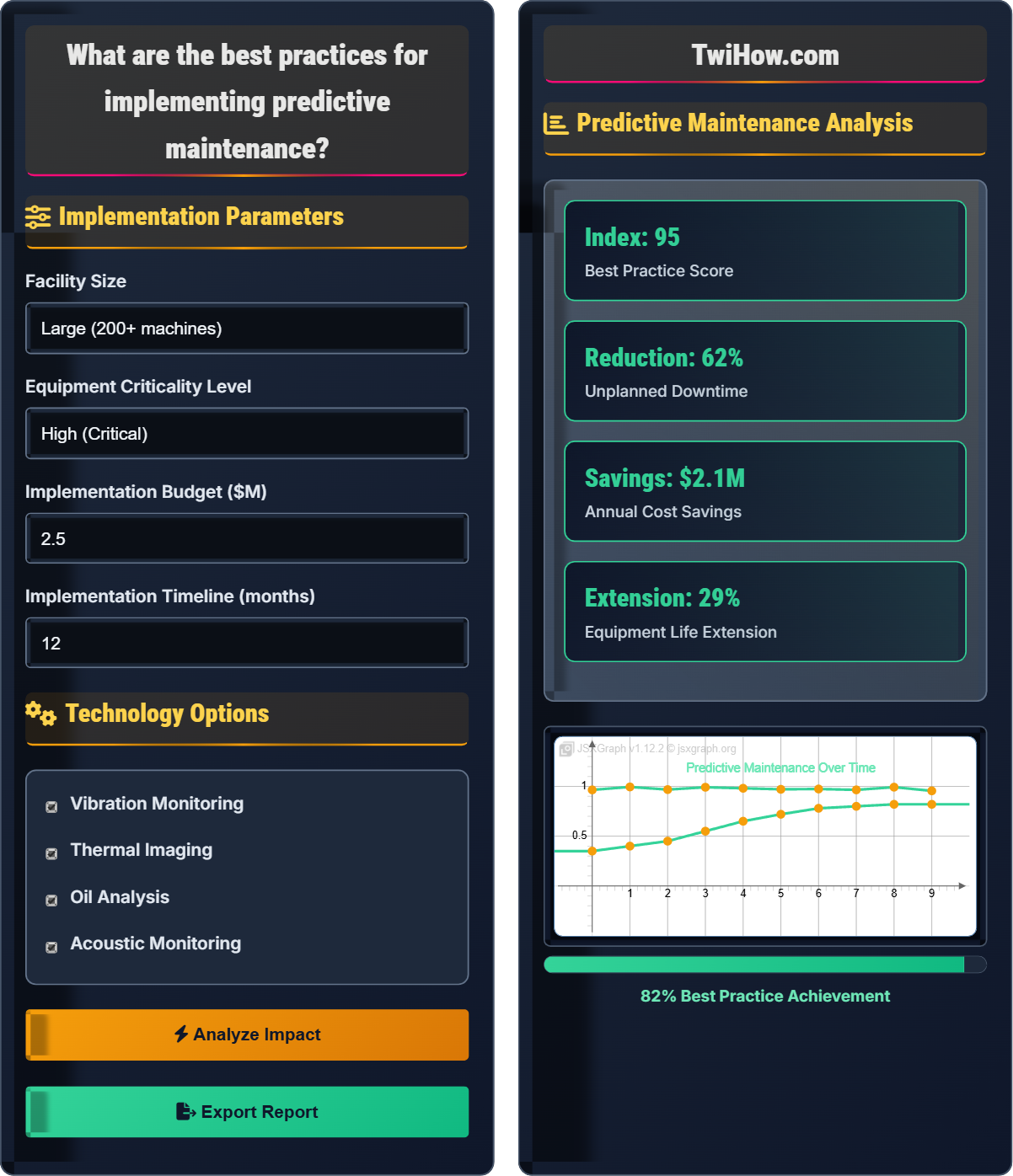
Predictive Maintenance Analysis
| Practice | Priority | Impact | ROI |
|---|---|---|---|
| Equipment Criticality | High | 90% | 45% |
| Technology Selection | High | 85% | 40% |
| Data Management | High | 80% | 35% |
| Team Training | Medium | 75% | 30% |
| Change Management | Medium | 70% | 25% |
Failure Prediction Visualization
Maintenance Flow
Predictive Maintenance Best Practices Explained
Predictive maintenance is a proactive maintenance strategy that uses data collection, condition monitoring, and predictive analytics to anticipate equipment failures before they occur. It optimizes maintenance schedules based on actual equipment condition rather than predetermined time intervals.
Effective predictive maintenance follows a systematic framework:
Framework components include:
- Equipment Criticality Assessment: Prioritizing equipment based on impact
- Technology Selection: Choosing appropriate monitoring methods
- Data Collection: Gathering relevant condition data
- Analysis & Modeling: Developing predictive algorithms
- Decision Making: Translating insights into actions
- Continuous Improvement: Refining processes over time
Common predictive maintenance technologies:
- Vibration Analysis: Detecting mechanical issues and wear patterns
- Thermal Imaging: Identifying overheating and electrical issues
- Oil Analysis: Monitoring lubricant condition and contamination
- Acoustic Monitoring: Detecting bearing and gear issues
- Motor Current Analysis: Monitoring electrical motor health
- Ultrasonic Testing: Detecting early-stage problems
- Reduced Downtime: Preventing unexpected equipment failures
- Cost Savings: Reducing maintenance and replacement costs
- Extended Equipment Life: Optimizing maintenance timing
- Improved Safety: Preventing dangerous equipment failures
- Better Planning: Scheduling maintenance during planned downtime
- Enhanced Reliability: Consistent equipment performance
Best Practice Metrics & Assessment
- Start with the most critical equipment first
- Invest in proper training and skill development
- Ensure data quality and reliability
- Integrate with existing maintenance systems
Technology-Specific Best Practice Profiles
Predictive Maintenance Quiz
Which equipment should be prioritized for predictive maintenance implementation?
Equipment with high failure impact and probability should be prioritized. This approach maximizes the return on investment by focusing resources on equipment that would cause the most significant problems if it failed unexpectedly.
The answer is C) Equipment with high failure impact and probability.
Equipment criticality assessment is a fundamental best practice that ensures optimal resource allocation. The assessment considers both the likelihood of failure and the consequences of that failure, allowing organizations to focus their predictive maintenance efforts where they will have the greatest impact.
Equipment Criticality: Assessment of failure impact and probability
Failure Impact: Consequences of equipment failure
Failure Probability: Likelihood of equipment failure
• Prioritize high-impact equipment
• Consider both probability and consequence
• Reassess criticality periodically
• Use failure mode analysis
• Consider safety and environmental impacts
• Include production and financial impacts
• Focusing only on high-value equipment
• Not considering cascading effects
• Static criticality assessment
Explain how to select the appropriate predictive maintenance technology for different types of equipment and applications.
Technology Selection Process:
• Equipment Type: Match technology to equipment characteristics
• Failure Modes: Select technology that detects likely failure modes
• Environment: Consider operating conditions and accessibility
• Cost-Benefit: Evaluate implementation and maintenance costs
Technology-Specific Applications:
• Vibration Analysis: Rotating equipment with mechanical issues
• Thermal Imaging: Electrical connections and overheating
• Oil Analysis: Lubricated systems and contamination
• Acoustic Monitoring: Early-stage bearing and gear problems
Technology selection is critical for predictive maintenance success. Different technologies are suited to different failure modes and equipment types. The selection process should consider the specific failure mechanisms that are likely to occur in each piece of equipment.
Failure Mode: Specific way equipment can fail
Technology Suitability: Appropriateness of technology for application
Cost-Benefit Analysis: Evaluation of investment returns
• Match technology to failure modes
• Consider environmental constraints
• Evaluate total cost of ownership
• Use multiple technologies for critical equipment
• Consider vendor support and training
• Plan for technology integration
• Using inappropriate technology for application
• Not considering environmental factors
• Failing to plan for data integration
A manufacturing facility implements predictive maintenance on 50 critical machines at a total cost of $1.5M. The system reduces unplanned downtime by 60%, and the facility previously experienced $2.5M in annual downtime costs. It also reduces maintenance costs by 25% from a previous $800K annual maintenance budget. Calculate the first-year ROI and payback period.
Downtime Cost Savings:
$2.5M × 60% = $1.5M annually
Maintenance Cost Savings:
$800K × 25% = $200K annually
Total Annual Benefits:
$1.5M + $200K = $1.7M annually
First-Year ROI:
($1.7M ÷ $1.5M) × 100 = 113% ROI
Payback Period:
$1.5M ÷ $1.7M = 0.88 years (approximately 10.6 months)
The predictive maintenance investment achieves a 113% ROI in the first year with a payback period of 10.6 months.
This calculation demonstrates the significant financial benefits of predictive maintenance. The combination of reduced downtime costs and lower maintenance expenses creates substantial returns that often justify the initial investment within the first year of operation.
ROI: Return on Investment (gain divided by cost)
Payback Period: Time to recover initial investment
Unplanned Downtime: Unexpected equipment failures
• Multiple benefit streams contribute to ROI
• Downtime costs often dominate savings
• Benefits compound over time
• Calculate all potential benefit streams
• Consider indirect benefits like quality improvements
• Account for reduced spare parts inventory
• Only counting direct cost savings
• Not including maintenance cost reductions
• Underestimating downtime cost impact
You're tasked with implementing predictive maintenance in a facility with 200 machines. Design a phased implementation strategy that ensures success while managing costs and risks.
Phase 1 (Months 1-3): Critical equipment assessment and pilot program
• Identify top 20 most critical machines
• Implement on 5 machines as pilot
• Develop processes and train team
Phase 2 (Months 4-8): Expand to high-criticality equipment
• Implement on remaining 15 critical machines
• Refine processes based on pilot lessons
• Expand team and vendor support
Phase 3 (Months 9-15): Moderate-criticality equipment
• Implement on 50 moderate-criticality machines
• Optimize data collection and analysis
• Integrate with maintenance management system
Phase 4 (Months 16-24): Remaining equipment
• Implement on remaining 130 machines
• Full system optimization and continuous improvement
Phased implementation allows for learning and refinement while managing risks. Starting with critical equipment ensures maximum early impact while providing experience for broader deployment. Each phase builds on lessons learned from previous phases.
Phased Implementation: Gradual rollout in stages
Critical Equipment: High-impact machines requiring priority
Pilot Program: Small-scale initial implementation
• Start with critical equipment
• Learn from pilot programs
• Scale gradually to manage complexity
• Document lessons learned from each phase
• Maintain momentum during expansion
• Ensure adequate support during growth
• Attempting enterprise-wide implementation immediately
• Not learning from pilot programs
• Scaling too quickly without adequate support
What is the most critical aspect of data management in predictive maintenance?
Data quality and reliability are the most critical aspects. Predictive models are only as good as the data they use. Poor quality data leads to inaccurate predictions and unreliable maintenance decisions, potentially causing more harm than traditional maintenance approaches.
The answer is B) Data quality and reliability.
Garbage in, garbage out is a fundamental principle in predictive maintenance. High-quality, reliable data is essential for accurate predictive models. Without quality data, even the most sophisticated analytics tools will produce unreliable results.
Data Quality: Accuracy, completeness, and consistency of data
Data Reliability: Consistency and trustworthiness of data
Predictive Models: Algorithms that predict equipment failures
• Data quality affects prediction accuracy
• Reliable data is essential for trust
• Poor data quality negates benefits
• Implement data validation checks
• Monitor sensor accuracy regularly
• Establish data quality metrics
• Not validating data quality
• Using inconsistent data sources
• Ignoring sensor calibration
FAQ
Q: How long does it typically take to see results from a predictive maintenance program?
A: Results typically appear in phases:
Early Wins (3-6 months): Initial equipment issues detected and resolved
Significant Impact (6-12 months): Measurable reduction in unplanned downtime
Full Benefits (12-24 months): Optimized maintenance schedules and predictive capabilities
Maturation (2+ years): Continuous improvement and expanded program benefits
Most organizations see initial benefits within 3-6 months, with full ROI typically achieved within 12-18 months.
Q: How does predictive maintenance affect the role of maintenance technicians?
A: Predictive maintenance transforms technician roles:
Enhanced Skills: Technicians develop data analysis and diagnostic capabilities
Proactive Focus: Shift from reactive repairs to preventive maintenance
Specialized Knowledge: Expertise in monitoring technologies and predictive tools
Planning: More involvement in maintenance planning and scheduling
Continuous Learning: Ongoing training in new technologies and techniques
Technicians become more valuable as predictive maintenance experts rather than just repair specialists.