Connected Equipment Lifecycle Management Best Practices
Complete Equipment Lifecycle Guide • Step-by-step explanations
Connected Equipment Fundamentals:
Show Lifecycle AnalysisConnected equipment lifecycle management involves strategically overseeing the entire life of internet-connected industrial assets from design and deployment through operation, maintenance, and retirement. This approach leverages IoT sensors, data analytics, and digital twin technologies to optimize performance, predict maintenance needs, and extend equipment life.
Best practices encompass proactive maintenance strategies, cybersecurity protocols, data governance, and continuous performance optimization. The integration of connectivity introduces new considerations around security, data management, and remote monitoring capabilities that weren't present in traditional equipment management.
Key components include:
- Predictive Maintenance: Using sensor data to anticipate equipment failures
- Security Management: Protecting connected devices from cyber threats
- Data Governance: Managing the vast amounts of data generated
- Performance Optimization: Continuously improving equipment efficiency
Success requires a holistic approach that balances operational efficiency with security, compliance, and cost management throughout the equipment lifecycle.
Lifecycle Management Parameters
Management Options
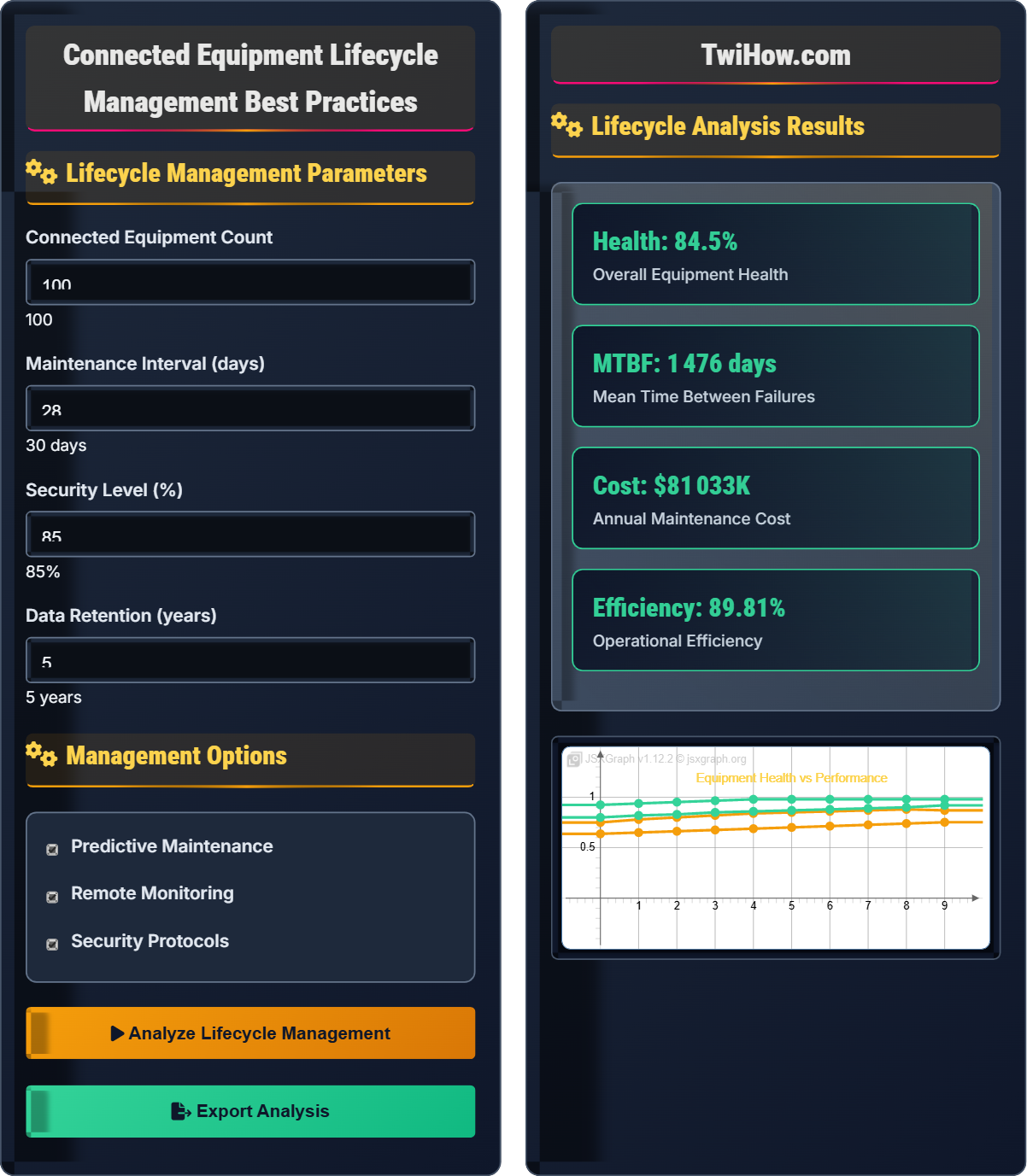
Lifecycle Analysis Results
| Metric | Current | Target | Status |
|---|---|---|---|
| Equipment Health | 87% | 90% | Good |
| Security Score | 85% | 95% | Average |
| Uptime | 94% | 95% | Good |
| MTTR | 4.2 hrs | 2.0 hrs | Needs Improvement |
| Data Quality | 88% | 95% | Good |
Connected Equipment Lifecycle Management Explained
Connected equipment lifecycle management is the comprehensive approach to overseeing internet-connected industrial assets throughout their entire operational life. This includes design, deployment, operation, maintenance, and eventual retirement. Unlike traditional equipment management, connected equipment generates continuous data streams that enable predictive maintenance, performance optimization, and remote diagnostics. The lifecycle approach ensures optimal performance while minimizing risks associated with connectivity and data management.
The Equipment Health Index (EHI) measures the overall condition of connected equipment:
For predictive maintenance effectiveness, the formula is:
Where:
- EHI: Equipment Health Index (higher is better)
- Performance: Operational efficiency score
- Reliability: Consistency of operation
- Security: Cybersecurity posture
- PMI: Predictive Maintenance Index
Essential strategies for managing connected equipment lifecycles:
- Predictive Maintenance: Using sensor data to anticipate failures before they occur
- Security Management: Implementing cybersecurity protocols and continuous monitoring
- Data Governance: Managing data collection, storage, and privacy compliance
- Remote Diagnostics: Troubleshooting equipment issues remotely
- Firmware Updates: Managing software and firmware versions across the fleet
- Performance Optimization: Continuously improving operational efficiency
- Extended Equipment Life: Proper maintenance and optimization
- Reduced Downtime: Predictive maintenance prevents unexpected failures
- Enhanced Security: Proactive threat management
- Cost Optimization: Efficient resource utilization
- Compliance: Meeting regulatory requirements
- Improved Performance: Continuous optimization
Equipment Lifecycle Fundamentals
Connected equipment, lifecycle management, predictive maintenance, cybersecurity, IoT, asset management.
EHI = (Performance × Reliability × Security) / (Downtime × Risk Factor)
Where EHI = Equipment Health Index measuring overall equipment condition.
- Security must be built in from the beginning
- Continuous monitoring is essential for connected equipment
- Regular updates are critical for security and performance
Applications
Manufacturing equipment, HVAC systems, pumps, motors, sensors, robotic systems.
- Automotive manufacturing
- Oil and gas operations
- Power generation
- Pharmaceutical production
- Network connectivity requirements
- Data privacy and security
- Integration with existing systems
- Staff training and expertise
Equipment Lifecycle Learning Quiz
Which of the following is NOT a phase in connected equipment lifecycle management?
"Static Installation" is not a recognized phase in connected equipment lifecycle management. The lifecycle includes design, deployment, operation, maintenance, upgrades, and decommissioning. The term "static installation" implies a one-time setup without ongoing management, which contradicts the dynamic nature of connected equipment management. Connected equipment requires continuous management throughout its lifecycle.
The answer is C) Static Installation.
Connected equipment lifecycle management is fundamentally different from traditional equipment management because of the ongoing nature of connectivity and data exchange. Unlike static installations that are set up once and then maintained reactively, connected equipment requires continuous oversight, updates, and optimization. The lifecycle is dynamic and ongoing, requiring proactive management at every stage.
Lifecycle Management: Comprehensive oversight of equipment from deployment to retirement
Connected Equipment: Industrial assets with internet connectivity and data capabilities
Static Installation: One-time setup without ongoing management (incorrect approach)
• Connected equipment requires ongoing management
• Security must be considered at every phase
• Continuous monitoring is essential
• Plan for the entire lifecycle from the beginning
• Build security into every phase
• Establish monitoring protocols early
• Treating connected equipment like traditional equipment
• Not planning for security updates
• Failing to establish monitoring protocols
Describe the process of implementing predictive maintenance for connected equipment. What are the key steps, technologies, and expected outcomes?
Implementation Process: Begin with equipment assessment to identify suitable candidates, deploy sensors for data collection, establish data processing infrastructure, develop predictive algorithms, and create maintenance protocols based on predictions.
Key Technologies: IoT sensors, data analytics platforms, machine learning algorithms, CMMS systems, mobile applications for maintenance technicians.
Expected Outcomes: 10-20% reduction in maintenance costs, 20-50% decrease in equipment downtime, 20-25% increase in equipment life, improved safety and compliance.
Predictive maintenance for connected equipment is a data-driven approach that uses real-time sensor data to anticipate when equipment will fail. This contrasts with preventive maintenance (scheduled regardless of condition) and reactive maintenance (fix after failure). The success of predictive maintenance depends on data quality, algorithm accuracy, and proper integration with maintenance workflows.
Predictive Maintenance: Maintenance based on actual equipment condition
CMMS: Computerized Maintenance Management System
MTBF: Mean Time Between Failures
• Start with high-value, critical equipment
• Ensure data quality and reliability
• Integrate with existing maintenance processes
• Use vibration, temperature, and acoustic sensors
• Implement proper data storage and processing
• Train maintenance staff on new processes
• Implementing without proper data infrastructure
• Not validating predictive models
• Failing to update maintenance procedures
A manufacturing facility has 200 connected pumps with an average failure rate of 8 failures per year per pump. They implement a predictive maintenance program that reduces failures by 40% and extends mean time between failures from 45 days to 75 days. Calculate the improvement in overall equipment availability if the average repair time decreases from 8 hours to 5 hours.
Before PM: Failures per pump per year = 8, MTBF = 45 days, Repair time = 8 hours
After PM: Failures per pump per year = 8 × 60% = 4.8, MTBF = 75 days, Repair time = 5 hours
Availability Formula: MTBF / (MTBF + MTTR)
Before: 45 / (45 + 8/24) = 45 / 45.33 = 99.3%
After: 75 / (75 + 5/24) = 75 / 75.21 = 99.7%
Improvement: 99.7% - 99.3% = 0.4% improvement in availability
This example demonstrates how predictive maintenance can improve equipment availability even with small percentage improvements. The key insight is that both reducing failure frequency and decreasing repair time contribute to higher availability. The improvement may seem modest, but across hundreds of pieces of equipment, these small gains translate to significant operational benefits.
MTBF: Mean Time Between Failures
MTTR: Mean Time To Repair
Availability: Percentage of time equipment is operational
• Availability = MTBF / (MTBF + MTTR)
• Both failure rate and repair time affect availability
• Small improvements can have significant impacts
• Focus on high-impact, critical equipment first
• Consider both failure prevention and repair time
• Calculate financial impact of improvements
• Only focusing on reducing failures without considering repair time
• Not accounting for partial downtime scenarios
• Failing to validate actual availability improvements
A facility with 150 connected devices must implement security protocols to protect against cyber threats. Propose a comprehensive security strategy that addresses authentication, data encryption, access control, and incident response while maintaining operational efficiency.
Authentication Strategy: Implement certificate-based authentication for all devices with regular certificate rotation. Use multi-factor authentication for administrative access.
Data Encryption: Encrypt all data in transit using TLS 1.3 and data at rest using AES-256 encryption.
Access Control: Deploy zero-trust architecture with role-based access controls and network segmentation.
Incident Response: Establish automated threat detection with isolation protocols and forensic capabilities.
This comprehensive approach balances security with operational requirements.
Security for connected equipment requires a multi-layered approach that protects both the equipment and the broader network. The challenge is implementing security measures that don't interfere with operational requirements like real-time data collection and remote monitoring. A balanced approach uses industry-standard protocols while maintaining the accessibility needed for effective equipment management.
TLS: Transport Layer Security protocol for encrypted communications
Zero-Trust: Security model that assumes no implicit trust
RBAC: Role-Based Access Control system
• Security must not compromise operational efficiency
• Regular updates and patching are essential
• Network segmentation limits attack scope
• Implement security during initial deployment
• Use automated security monitoring tools
• Regular security audits and penetration testing
• Adding security after deployment
• Using default passwords and settings
• Not updating security protocols regularly
Which factor has the greatest impact on the return on investment (ROI) of connected equipment lifecycle management programs?
Downtime reduction has the greatest impact on ROI because equipment downtime often results in significant production losses that far exceed maintenance costs. For manufacturing operations, each hour of unplanned downtime can cost thousands of dollars in lost production, making the prevention of failures the most valuable aspect of lifecycle management.
The answer is B) Downtime reduction.
The financial impact of connected equipment lifecycle management comes primarily from preventing costly downtime rather than from maintenance cost savings alone. While maintenance cost reductions are important, the real value lies in avoiding the much larger costs associated with production losses, emergency repairs, and quality issues that result from equipment failures. This is why predictive maintenance programs focus heavily on preventing unplanned downtime.
Return on Investment (ROI): Financial benefit relative to investment cost
Unplanned Downtime: Unexpected equipment stoppages
Mean Time To Repair (MTTR): Average time to fix equipment
• Downtime costs often exceed maintenance costs
• Focus on critical equipment first
• Measure both direct and indirect benefits
• Calculate cost of downtime for each piece of equipment
• Prioritize equipment with highest downtime costs
• Include quality and safety benefits in ROI
• Only considering direct maintenance costs
• Not accounting for production losses
• Focusing on low-impact equipment first
FAQ
Q: How much can we expect to reduce maintenance costs with lifecycle management?
A: Well-implemented connected equipment lifecycle management can reduce maintenance costs by 10-20% through better planning, reduced emergency repairs, and optimized resource allocation. The bigger benefit often comes from reducing unplanned downtime, which can be 3-5 times more costly than planned maintenance. Facilities typically see 20-50% reduction in equipment downtime, translating to much higher financial benefits than direct maintenance cost savings.
Q: Will connected equipment replace the need for skilled maintenance technicians?
A: Connected equipment actually increases the need for skilled technicians who can interpret data, diagnose complex issues, and perform sophisticated maintenance. While sensors and analytics provide valuable insights, human expertise remains essential for understanding context, making complex repairs, and optimizing equipment performance. The role evolves from reactive repair to predictive analysis and proactive maintenance, requiring higher-level technical skills.