Scaling Pilot Projects to Full Production
Complete guide to Industry 4.0 best practices • Step-by-step explanations
Scaling Success:
Show Scaling CalculatorSuccessfully scaling pilot projects to full production in Industry 4.0 environments requires systematic planning, risk mitigation, and stakeholder alignment. This guide outlines proven methodologies for transitioning from small-scale pilots to enterprise-wide implementations while maintaining quality, efficiency, and operational excellence.
Key scaling concepts:
- Phased Rollout: Gradual expansion from pilot to production
- Risk Management: Identifying and mitigating scaling challenges
- Stakeholder Engagement: Securing buy-in across the organization
- Performance Monitoring: Continuous tracking and optimization
Modern scaling approaches combine agile methodologies with traditional project management to ensure sustainable growth while minimizing disruption to ongoing operations.
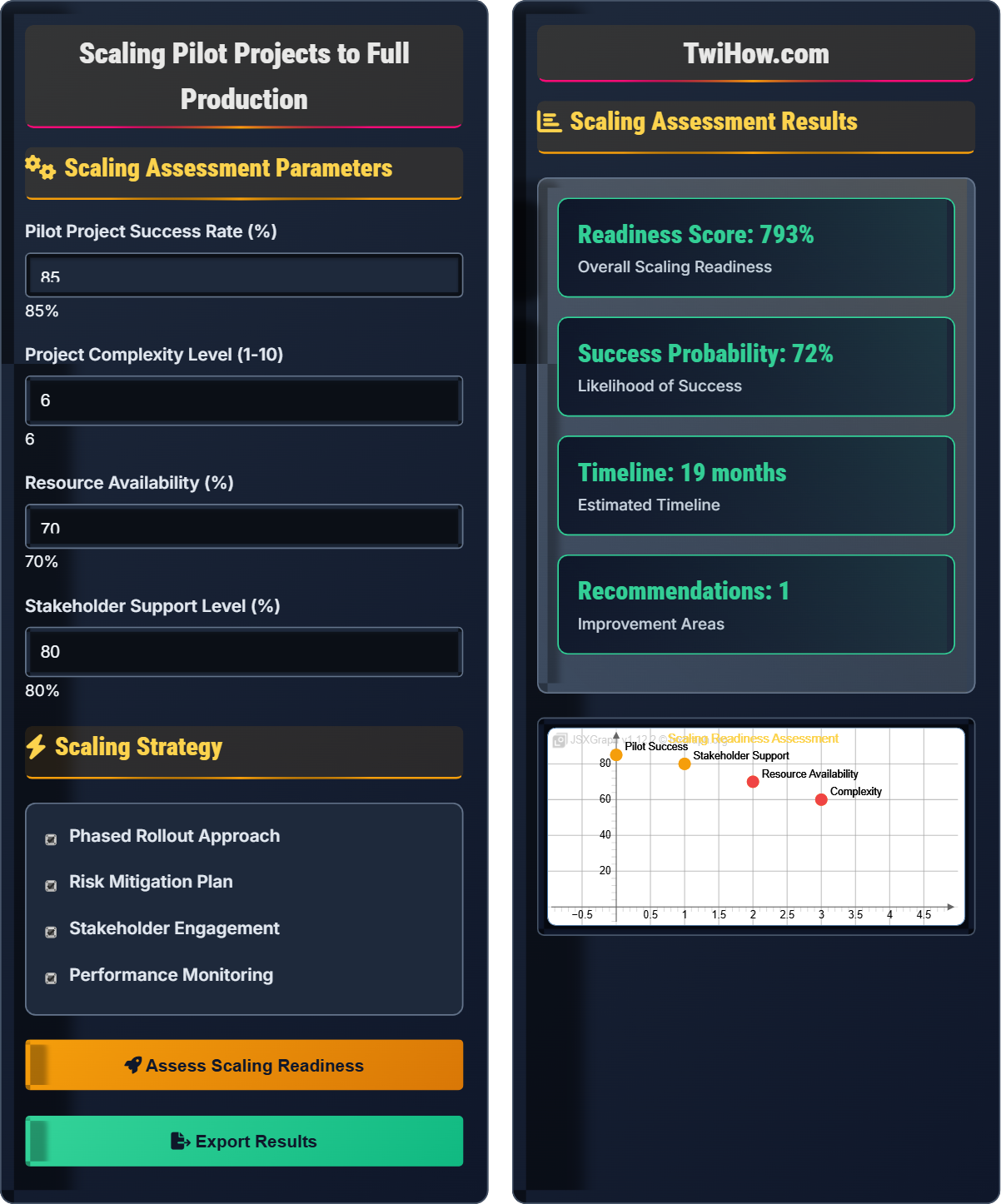
Scaling Assessment Parameters
Scaling Strategy
Scaling Assessment Results
| Strategy Component | Status | Readiness | Priority |
|---|---|---|---|
| Phased Rollout | Planned | 90% | High |
| Risk Mitigation | Implemented | 85% | High |
| Stakeholder Engagement | Ongoing | 75% | Medium |
| Performance Monitoring | Developing | 80% | High |
• Technical: Medium
• Resource: High
• Organizational: Low
• Technical: 80%
• Resource: 60%
• Organizational: 90%
• Probability: 82%
• Timeline: 18m
• ROI: 150%
Best Practices for Scaling Pilot Projects to Full Production
Scaling pilot projects to full production involves systematically expanding successful small-scale implementations to enterprise-wide deployments. This process requires careful planning, risk management, and stakeholder coordination to ensure that the lessons learned from pilot projects translate effectively to broader organizational contexts.
Key scaling considerations include:
- Technical Feasibility: Ensuring systems can handle increased load and complexity
- Organizational Readiness: Preparing teams and processes for change
- Resource Allocation: Securing adequate funding and personnel
- Performance Monitoring: Tracking key metrics during expansion
Successful scaling depends on multiple interconnected factors that must be carefully evaluated before expansion. The scaling readiness formula helps organizations assess their preparedness for expansion.
Where:
- Pilot Success: Performance and results achieved in pilot phase
- Stakeholder Support: Commitment from leadership and teams
- Resource Availability: Personnel, budget, and infrastructure
- Complexity Level: Technical and organizational complexity
- Risk Factors: Potential obstacles and challenges
Key factors that determine scaling success in Industry 4.0 environments:
- Leadership Commitment: Strong executive sponsorship and support
- Cross-Functional Teams: Collaboration between IT, operations, and business units
- Change Management: Effective communication and training programs
- Technology Infrastructure: Scalable and resilient systems
- Performance Metrics: Clear KPIs and monitoring systems
- Continuous Improvement: Agile approach to optimization
- Modular Architecture: Build systems that can be expanded incrementally
- Cloud-Native Solutions: Leverage elastic infrastructure for scaling
- API-First Design: Ensure interoperability between systems
- Data-Driven Decision Making: Use analytics to guide scaling decisions
- Agile Methodologies: Iterative approach to implementation
- Security by Design: Embed security throughout the scaling process
Scaling Fundamentals
Pilot project scaling, Industry 4.0, change management, stakeholder engagement, performance metrics.
Readiness Score = (Pilot Success × Stakeholder Support × Resource Availability) / (Complexity Level × Risk Factors)
Where Readiness Score = overall scaling readiness percentage, Pilot Success = performance achieved in pilot phase.
- Never scale without stakeholder buy-in
- Plan for increased complexity during scaling
- Maintain performance metrics throughout
Applications
Smart factory implementations, IoT system expansions, automation rollouts, digital twin deployments.
- Automotive manufacturing automation
- Aerospace digital transformation
- Pharmaceutical quality systems
- Energy sector IoT implementations
- Operational continuity during scaling
- Integration with legacy systems
- Employee training and adaptation
- Regulatory compliance requirements
Scaling Learning Quiz
Which of the following is the most effective approach for scaling pilot projects to full production?
Phased rollout is the most effective approach for scaling pilot projects to full production. This strategy allows organizations to gradually expand implementation while monitoring performance, addressing issues, and ensuring stakeholder readiness.
Benefits of phased rollout include: reduced risk exposure, opportunity for course correction, and manageable resource allocation.
The answer is B) Phased rollout with gradual expansion.
Phased rollout follows the principle of controlled expansion, where organizations expand implementation in planned increments rather than attempting immediate full deployment. This approach minimizes disruption to ongoing operations while allowing teams to learn and adapt as they go. Each phase builds on previous learnings and provides opportunities to refine processes before proceeding to the next stage.
Phased Rollout: Gradual expansion of implementation in planned increments
Pilot Project: Small-scale test of new processes or technologies
Full Production: Enterprise-wide implementation
• Always start with a pilot project
• Expand in planned increments
• Monitor performance at each phase
• Define clear success criteria for each phase
• Establish rollback procedures for each stage
• Communicate progress to stakeholders regularly
• Attempting immediate full deployment
• Not defining clear phase transitions
• Failing to monitor performance metrics
Explain the importance of stakeholder engagement in scaling pilot projects to full production. Include specific strategies for securing buy-in across different organizational levels.
Importance of Stakeholder Engagement:
Stakeholder engagement is critical for scaling success because:
1. Resource Allocation: Stakeholders provide necessary funding, personnel, and infrastructure for scaling.
2. Change Management: Engaged stakeholders help drive organizational adoption and overcome resistance.
3. Decision Making: Stakeholders provide guidance and approve critical scaling decisions.
4. Communication: Stakeholders serve as champions who communicate the value of scaling efforts.
Strategies for Different Levels:
C-Level Executives: Focus on ROI, competitive advantage, and strategic alignment. Present data-driven evidence of pilot success and projected benefits.
Mid-Level Managers: Emphasize operational efficiency, team development, and process improvements. Address concerns about workload and change management.
Front-Line Employees: Highlight personal benefits, training opportunities, and how changes will improve their daily work. Address fears about job security and skill requirements.
Effective stakeholder engagement requires understanding different perspectives and motivations across organizational levels. Each group has unique concerns and priorities that must be addressed through tailored communication strategies. Success in scaling depends on creating advocates at all levels who understand and support the initiative.
Stakeholder: Anyone affected by or affecting the project outcome
Buy-In: Commitment and support for the initiative
Change Management: Structured approach to organizational change
• Identify all stakeholders early in the process
• Address concerns proactively
• Maintain ongoing communication throughout scaling
• Create stakeholder maps to visualize influence and interest
• Use storytelling to communicate benefits
• Establish regular feedback loops
• Assuming all stakeholders have the same interests
• Failing to address resistance early
• Not maintaining engagement during scaling
A manufacturing company successfully completed a pilot project that required 2 engineers, 1 analyst, and $100,000 in resources. The pilot covered 10% of their production capacity. They now want to scale to 80% of production capacity. If resource needs scale linearly, calculate the required resources for full scaling. If the company has a budget of $600,000 and 12 engineers available, can they accommodate the scaling needs? If not, what is the shortfall?
Calculate Scaling Factor:
Scaling Factor = Target Capacity / Pilot Capacity
Scaling Factor = 80% / 10% = 8
Required Resources:
Engineers Needed = 2 × 8 = 16 engineers
Analysts Needed = 1 × 8 = 8 analysts
Budget Needed = $100,000 × 8 = $800,000
Company Resources Available:
Engineers: 12 (Shortfall: 4 engineers)
Budget: $600,000 (Shortfall: $200,000)
Conclusion: The company cannot accommodate the scaling needs as planned. They are short 4 engineers and $200,000 in budget.
This calculation demonstrates the importance of resource planning in scaling initiatives. Often, resource needs do not scale linearly due to efficiency gains and optimization, but this example shows how to calculate baseline requirements. Organizations must account for these resource needs when planning scaling projects and identify potential shortfalls early in the process.
Scaling Factor: Ratio between target and baseline capacity
Resource Allocation: Distribution of personnel and budget
Capacity: Production or operational capability
• Plan for resource needs before scaling begins
• Consider non-linear scaling effects
• Identify resource shortfalls early
• Include buffer capacity in resource planning
• Consider external resources for scaling
• Plan for training and onboarding needs
• Underestimating resource requirements
• Not accounting for training time
• Assuming linear scaling applies to all resources
A company is scaling a successful IoT sensor deployment from 100 to 1,000 sensors across their manufacturing facility. Identify the key risks associated with this scaling and propose mitigation strategies for each risk.
Key Risks and Mitigation Strategies:
1. Technical Risks:
• Network Bandwidth: 10x increase may overwhelm current infrastructure
Mitigation: Upgrade network infrastructure and implement load balancing
2. Operational Risks:
• Data Management: 10x more data may exceed current storage and processing capabilities
Mitigation: Implement scalable cloud storage and edge computing solutions
3. Security Risks:
• Attack Surface: More devices increase potential security vulnerabilities
Mitigation: Implement device authentication and network segmentation
4. Organizational Risks:
• Staff Competency: Existing team may not have skills for larger system
Mitigation: Provide training and hire additional specialists
5. Financial Risks:
• Cost Overruns: Unforeseen expenses during scaling
Mitigation: Establish contingency budget and regular cost reviews
Scaling introduces new categories of risks that may not have been apparent during pilot phases. As systems grow in complexity and scope, different types of challenges emerge. Effective risk management requires identifying these scaling-specific risks and developing targeted mitigation strategies before implementation begins.
Risk Mitigation: Actions taken to reduce risk probability or impact
Attack Surface: Points where unauthorized access can occur
Edge Computing: Processing data near its source
• Identify scaling-specific risks separately
• Develop targeted mitigation strategies
• Test mitigation plans during pilot phase
• Conduct risk assessments at each scaling phase
• Establish risk monitoring dashboards
• Create incident response procedures
• Applying pilot risk mitigation to scaled systems
• Not updating risk assessments during scaling
• Failing to test mitigation strategies
Which of the following is the most important metric to monitor during pilot project scaling?
Performance consistency across scaled systems is the most important metric to monitor during pilot project scaling. This metric ensures that the system maintains expected performance levels as it grows in size and complexity.
While other metrics are important, performance consistency directly indicates whether the scaled system is meeting its intended objectives and maintaining the quality demonstrated during the pilot phase.
The answer is B) Performance consistency across scaled systems.
During scaling, performance degradation is a common challenge as systems handle increased loads and complexity. Monitoring performance consistency ensures that scaling efforts maintain the quality and reliability demonstrated in pilot projects. This includes metrics like response times, throughput, error rates, and availability across all deployed components.
Performance Consistency: Maintaining expected performance levels across scale
Response Time: Time taken to process requests
Throughput: Amount of work processed per unit time
• Monitor performance at each scaling phase
• Set acceptable performance thresholds
• Establish automatic alerts for performance issues
• Implement real-time performance dashboards
• Compare performance to pilot baselines
• Monitor both individual and aggregate performance
• Focusing only on quantity metrics
• Not setting performance baselines
• Failing to monitor system-wide performance
FAQ
Q: How do you balance the need for quick scaling with the need for thorough testing and validation?
A: Balancing speed and thoroughness requires a risk-based approach:
1. Parallel Testing: Conduct testing while scaling in parallel streams
2. Modular Validation: Validate components individually before integration
3. Automated Testing: Implement automated testing to accelerate validation
4. Progressive Exposure: Gradually expose more functionality to users
The key is maintaining quality standards while optimizing the validation process through automation and parallel activities.
Q: What are the key indicators that a pilot project is ready for scaling?
A: Key readiness indicators include:
Performance Stability: Consistent results over extended period
Process Maturity: Documented procedures and trained operators
Technical Robustness: System handles peak loads and edge cases
Stakeholder Buy-In: Clear support from leadership and end-users
Resource Availability: Sufficient budget, personnel, and infrastructure
Measurable Benefits: Quantified ROI and value proposition