Circular Economy in Manufacturing
Sustainable manufacturing guide • Step-by-step explanations
Circular Manufacturing:
Show Circular Manufacturing CalculatorCircular economy principles in manufacturing represent a fundamental shift from the traditional linear "take-make-dispose" model to a regenerative system that keeps materials and products in use for as long as possible. This approach emphasizes designing for durability, repairability, and recyclability, while minimizing waste and environmental impact throughout the product lifecycle.
Key considerations include:
- Design for Disassembly: Creating products that can be easily taken apart for recycling
- Material Recovery: Efficiently recovering valuable materials from end-of-life products
- Waste Reduction: Minimizing waste generation during production
- Energy Efficiency: Optimizing energy consumption in manufacturing processes
- Supply Chain Integration: Coordinating with suppliers for circular inputs
Implementing circular economy principles in manufacturing requires strategic planning, technological innovation, and collaboration across the entire value chain to create closed-loop systems that maximize resource utilization while minimizing environmental impact.
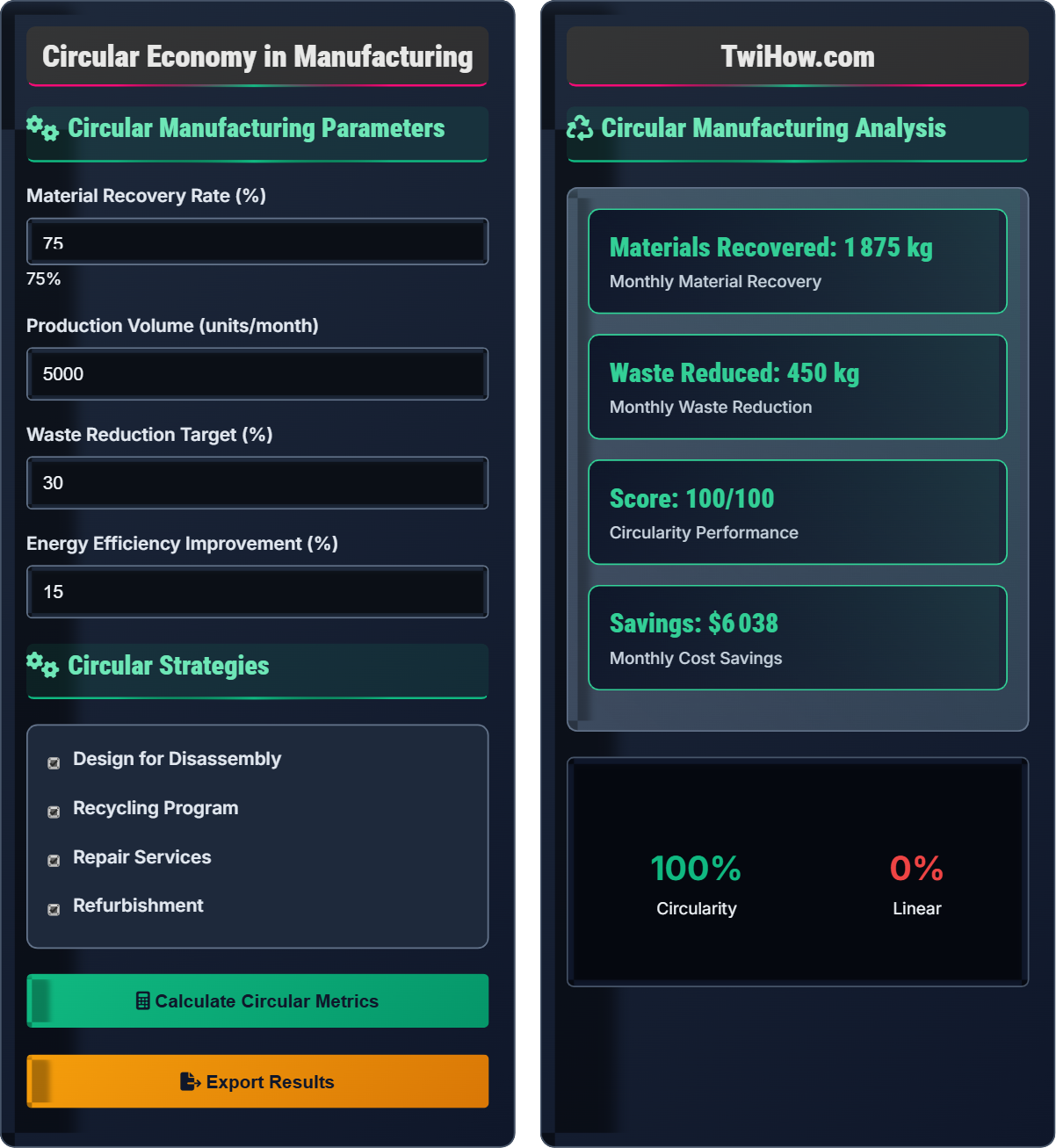
Circular Manufacturing Parameters
Circular Strategies
Circular Manufacturing Analysis
| Metric | Current | Target | Progress |
|---|---|---|---|
| Material Recovery Rate | 75% | 85% | 88% |
| Waste Reduction | 30% | 40% | 75% |
| Energy Efficiency | 15% | 25% | 60% |
| Product Lifespan Extension | 20% | 35% | 57% |
| Recycled Content | 40% | 60% | 67% |
Recommended Strategies
- Implement design for disassembly principles
- Establish take-back programs for end-of-life products
- Integrate recycled materials into production
- Develop repair and refurbishment services
- Optimize manufacturing processes for minimal waste
Implementation Benefits
- Reduced raw material costs
- Lower waste disposal expenses
- Enhanced brand reputation
- Compliance with regulations
- Improved customer loyalty
Circular Economy in Manufacturing Explained
Circular manufacturing is an approach that eliminates waste and promotes the continual use of resources. It involves designing products and processes to minimize waste, extend product lifecycles, and recover valuable materials at the end of a product's life. Unlike the traditional linear model (make, use, dispose), circular manufacturing creates closed-loop systems where materials and products remain in productive use for as long as possible.
The circularity index can be calculated as:
Where:
- Material Recovery Rate: Percentage of materials recovered from end-of-life products
- Waste Reduction: Percentage decrease in waste generation
- Resource Efficiency: Improvement in resource utilization
Key approaches manufacturers use to implement circular economy principles:
- Design for Disassembly: Creating products that can be easily taken apart
- Material Recovery: Efficiently recovering valuable materials from waste
- Product Life Extension: Repair, refurbishment, and remanufacturing
- Waste-to-Resource: Converting waste streams into valuable inputs
- Sharing Economy: Product-as-a-service models
- Industrial Symbiosis: Sharing resources between industries
- Patagonia: Worn Wear program for repairing and reselling used clothing
- Interface: Mission Zero initiative to eliminate environmental footprint
- Philips: Lighting-as-a-service model instead of selling light bulbs
- Unilever: Sustainable living plan with circular packaging
- BMW: Closed-loop aluminum recycling in car production
Core Concepts
Circular economy, design for disassembly, material recovery, waste reduction, resource efficiency, product lifecycle extension.
Circularity Score = (Material Recovery × 0.3) + (Waste Reduction × 0.25) + (Energy Efficiency × 0.2) + (Product Lifespan × 0.15) + (Recycled Content × 0.1)
Where scores range from 0-100, with higher scores indicating greater circularity.
- Design out waste and pollution
- Keep products and materials in use
- Regenerate natural systems
- Optimize resource efficiency
Implementation Strategies
Design for disassembly, material recovery, waste reduction, energy efficiency, product lifecycle extension.
- Conduct circularity assessment
- Identify material recovery opportunities
- Design for circularity
- Implement waste reduction measures
- Establish take-back programs
- Monitor and optimize
- Integrate circular design early
- Collaborate with suppliers
- Engage customers in take-back
- Measure circularity metrics
Circular Manufacturing Quiz
Which of the following is NOT a principle of circular design in manufacturing?
Planned obsolescence is the opposite of circular design principles. It involves deliberately designing products with limited lifespans to encourage replacement purchases. Circular design principles focus on extending product lifecycles, not shortening them. The other options all support circularity by enabling reuse, repair, and recycling.
The answer is B) Planned obsolescence.
Circular design fundamentally opposes the traditional linear model of planned obsolescence. Instead of encouraging frequent replacement, circular design aims to maximize product utility over extended periods. This includes designing products that can be easily repaired, upgraded, or disassembled for material recovery. The contrast between these approaches highlights the paradigm shift required for circular manufacturing.
Planned Obsolescence: Deliberately designing products to fail or become outdated
Design for Disassembly: Creating products that can be easily taken apart
Modularity: Designing products with interchangeable components
• Circular design extends product lifecycles
• Avoid designs that promote waste
• Enable material recovery at end-of-life
• Use standardized fasteners for easy disassembly
• Select materials that can be separated efficiently
• Design for upgradeability rather than replacement
• Using mixed materials that are difficult to separate
• Employing adhesives instead of mechanical fasteners
• Ignoring end-of-life recovery in design phase
Explain the steps involved in material recovery from end-of-life products in a circular manufacturing system. What are the challenges and how can they be addressed?
Material Recovery Steps:
1. Collection: Gathering end-of-life products from consumers
2. Sorting: Separating products by type and material composition
3. Disassembly: Taking products apart into components
4. Processing: Breaking down components into raw materials
5. Purification: Cleaning and refining recovered materials
6. Quality Control: Testing material properties for reuse
Challenges: Mixed materials, contamination, complex assemblies, economic viability
Solutions: Standardized design, improved sorting technology, economic incentives, policy support
Material recovery is a complex process that requires coordination across multiple stages. The efficiency of recovery depends largely on the design phase—products designed for easy disassembly and material separation significantly reduce recovery costs and improve material quality. This illustrates the importance of considering end-of-life scenarios during the initial design process.
End-of-Life Products: Items that have reached end of useful life
Material Recovery: Process of extracting valuable materials from waste
Contamination: Presence of impurities in recovered materials
• Design for disassembly is crucial
• Quality control ensures material value
• Economic viability drives adoption
• Use homogeneous materials where possible
• Implement reverse logistics systems
• Partner with specialized recovery companies
• Neglecting recovery design in product development
• Underestimating collection and sorting costs
• Failing to ensure recovered material quality
A manufacturing company produces 10,000 units per month. Their current material input is 500 kg per unit, with 10% waste. They plan to implement circular manufacturing practices that will reduce waste to 3% and increase material recovery to 70%. Calculate the monthly material savings and the amount of material that will be recovered for reuse.
Current State:
Total material input = 10,000 units × 500 kg/unit = 5,000,000 kg
Current waste = 5,000,000 kg × 10% = 500,000 kg
After Circular Implementation:
New waste = 5,000,000 kg × 3% = 150,000 kg
Waste reduction = 500,000 kg - 150,000 kg = 350,000 kg
Material recovered = 150,000 kg × 70% = 105,000 kg
Monthly material savings: 350,000 kg (waste reduction) + 105,000 kg (recovered material) = 455,000 kg
This calculation demonstrates the dual benefit of circular manufacturing: reducing waste generation while recovering valuable materials. The total benefit includes both the direct reduction in waste (350,000 kg) and the material that becomes available for reuse (105,000 kg). This approach creates economic value from what was previously considered waste, illustrating the economic incentive for circular practices.
Material Recovery: Extracting usable materials from waste streams
Waste Reduction: Decreasing the amount of waste generated
Resource Efficiency: Optimizing resource use per unit of output
• Measure both waste reduction and recovery
• Consider economic value of recovered materials
• Track material flow throughout system
• Calculate material flow rates systematically
• Consider quality degradation of recycled materials
• Account for processing costs in calculations
• Only calculating waste reduction, ignoring recovery
• Not accounting for material quality in recovery
• Failing to consider processing costs
A company currently sells washing machines with a 5-year lifespan. They want to transition to a circular business model by offering washing machine rentals with full maintenance and eventual refurbishment. The current purchase price is $600 per unit, with a 5-year replacement cycle. The rental model charges $30/month for 5 years. Calculate the revenue implications and discuss the circular benefits.
Revenue Comparison:
Traditional model: $600 per unit every 5 years
Rental model: $30/month × 12 months × 5 years = $1,800 per unit over 5 years
Revenue increase: $1,800 - $600 = $1,200 per unit over 5 years
Circular Benefits:
1. Extended product lifecycle through maintenance
2. Full material recovery through refurbishment
3. Customer retention through ongoing service
4. Reduced environmental impact per use
5. Steady revenue stream for company
This model creates economic and environmental value while maintaining customer satisfaction.
This example demonstrates how circular business models can create win-win scenarios for companies and the environment. The rental model provides higher revenue for the company while extending product lifecycles and ensuring proper end-of-life handling. This approach aligns economic incentives with environmental goals, making circular practices more viable in the marketplace.
Product-as-a-Service: Business model where customers pay for access rather than ownership
Extended Lifecycle: Increasing product utility over time
Revenue Stream: Ongoing income from recurring payments
• Align economic and environmental incentives
• Maintain customer value proposition
• Plan for end-of-life recovery
• Develop maintenance and refurbishment capabilities
• Build customer trust in service model
• Plan for material recovery logistics
• Underestimating service delivery complexity
• Failing to plan for material recovery logistics
• Not considering customer acceptance
Which of the following is the most critical factor for successful circular supply chain integration?
While all factors are important, a shared sustainability vision among supply chain partners is fundamental to circular integration success. Without alignment on sustainability goals and circular principles, other technical and logistical factors cannot overcome philosophical disagreements about resource management and environmental responsibility.
The answer is C) Shared sustainability vision.
Circular supply chains require unprecedented collaboration and shared responsibility for environmental outcomes. This goes beyond traditional supplier relationships focused solely on cost and quality. Partners must share a commitment to circular principles, including material recovery, waste reduction, and resource optimization. Technical compatibility and quality standards are important, but they cannot be effectively implemented without the foundational alignment on sustainability goals.
Supply Chain Integration: Coordinated activities across supply chain partners
Sustainability Vision: Shared commitment to environmental goals
Circular Principles: Design, recovery, and reuse guidelines
• Alignment on sustainability goals is essential
• Collaboration requires shared values
• Technical factors support foundational alignment
• Assess supplier sustainability commitment early
• Develop joint sustainability agreements
• Share circular performance metrics
• Focusing only on technical compatibility
• Assuming sustainability alignment exists
• Not measuring circular performance jointly
FAQ
Q: How can we implement circular manufacturing without disrupting our current production processes?
A: Start with pilot programs in non-critical product lines:
1. Gradual Integration: Begin with design improvements for new products
2. Waste Stream Analysis: Identify high-volume waste streams for recovery
3. Supplier Collaboration: Work with suppliers to source recycled materials
4. Process Optimization: Implement lean principles to reduce waste
5. Employee Training: Build internal capability for circular practices
Focus on quick wins like waste reduction and material recovery before major design changes. This approach allows you to build experience and demonstrate ROI before expanding to more complex circular initiatives.
Q: What design principles should we follow to make products more circular?
A: Follow these key design principles:
Design for Disassembly: Use standard fasteners, avoid adhesives, create clear separation lines between materials
Material Selection: Choose mono-materials or easily separable material combinations
Modularity: Design replaceable components to extend overall product life
Durability: Focus on quality construction to minimize premature failure
Repairability: Make parts accessible and provide spare part documentation
Upgradeability: Allow for component upgrades rather than whole product replacement
These principles ensure products can be maintained, repaired, and eventually disassembled for material recovery.