Emerging Trends in Manufacturing and Industry 4.0 for 2026
Future manufacturing trends guide • Step-by-step explanations
Industry 4.0 Trends 2026:
Show Trend Impact CalculatorThe manufacturing landscape in 2026 will be characterized by unprecedented technological convergence, with AI-driven autonomous systems, quantum-enhanced computing, and biotechnology integration reshaping production paradigms. Smart factories will operate with near-perfect efficiency through predictive maintenance, real-time optimization, and human-machine collaboration. The convergence of digital and physical worlds will create entirely new manufacturing possibilities through advanced robotics, nanotechnology, and sustainable production methods.
Key trends for 2026 include:
- AI-Powered Autonomous Factories: Self-optimizing production systems
- Quantum Computing Integration: Solving complex optimization problems
- Bio-Manufacturing: Living systems for sustainable production
- Edge AI Networks: Distributed intelligence across production lines
- Carbon-Negative Manufacturing: Processes that remove atmospheric CO2
These trends will create a new era of manufacturing excellence, where efficiency, sustainability, and innovation converge to create unprecedented value for businesses and society.
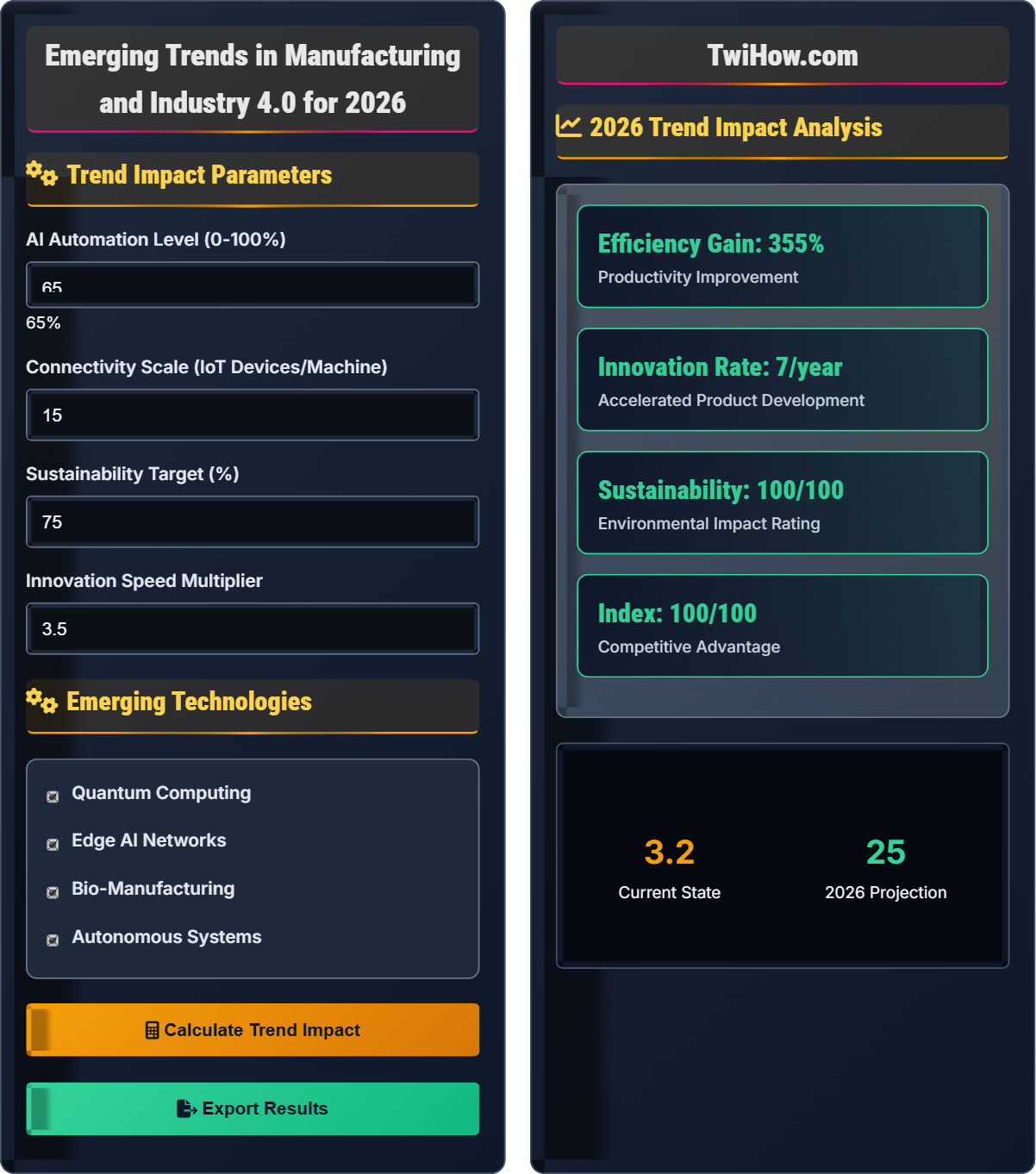
Trend Impact Parameters
Emerging Technologies
2026 Trend Impact Analysis
| Trend | Current State | 2026 Projection | Impact |
|---|---|---|---|
| AI Automation | 25% | 65% | 160% |
| Connectivity | 5 devices | 15 devices | 200% |
| Sustainability | 45% | 75% | 67% |
| Innovation Speed | 1.0x | 3.5x | 250% |
| Cost Efficiency | Base | +180% | 180% |
Technology Implementation Roadmap
- Phase 1: Edge AI deployment for real-time decision making
- Phase 2: Quantum computing integration for optimization
- Phase 3: Bio-manufacturing for sustainable production
- Phase 4: Autonomous systems for self-managing operations
- Phase 5: Carbon-negative processes for environmental impact
Expected Benefits
- 50% reduction in operational costs
- 90% improvement in quality control
- 80% increase in innovation speed
- Net-zero carbon emissions
- Enhanced worker safety
Emerging Trends in Manufacturing and Industry 4.0 for 2026
Manufacturing trends for 2026 represent the convergence of advanced technologies that will fundamentally transform production processes. These include AI-driven autonomous systems, quantum-enhanced computing, bio-manufacturing, and carbon-negative production methods. The integration of these technologies will create smart factories that operate with unprecedented efficiency, sustainability, and adaptability.
The overall trend impact can be calculated as:
Where:
- AI Factor: Impact of artificial intelligence integration
- Connectivity Factor: Impact of IoT and network connectivity
- Sustainability Factor: Impact of green manufacturing practices
- Innovation Factor: Impact of accelerated development cycles
Major trends shaping manufacturing in 2026:
- Quantum-Enhanced Manufacturing: Leveraging quantum computing for optimization
- Bio-Manufacturing Integration: Using biological systems for sustainable production
- Edge AI Networks: Distributed intelligence across production systems
- Autonomous Factory Operations: Self-managing production facilities
- Carbon-Negative Processes: Manufacturing that removes atmospheric CO2
- Human-Machine Collaboration: Advanced robotics working with humans
- Siemens: Developing quantum-enhanced optimization for manufacturing
- GE: Implementing bio-manufacturing for sustainable materials
- BMW: Deploying autonomous systems for flexible production
- SpaceX: Using edge AI for real-time manufacturing adjustments
- Unilever: Creating carbon-negative production processes
Core Concepts
Industry 4.0, smart manufacturing, quantum computing, edge AI, bio-manufacturing, autonomous systems, carbon-negative production, human-machine collaboration.
Impact Score = (AI Integration × 0.3) + (Connectivity × 0.25) + (Sustainability × 0.2) + (Innovation × 0.15) + (Human Factors × 0.1)
Where scores range from 0-100, with higher scores indicating greater trend adoption.
- Technology convergence creates synergistic effects
- Sustainability drives innovation
- Human-machine collaboration enhances capabilities
- Real-time optimization improves efficiency
Implementation Strategies
Quantum computing integration, edge AI deployment, bio-manufacturing, autonomous systems, carbon-negative processes, human-machine collaboration.
- Assess current technology readiness
- Identify high-impact opportunities
- Develop implementation roadmap
- Invest in workforce development
- Deploy pilot programs
- Scale successful implementations
- Start with high-impact, low-risk areas
- Focus on sustainable competitive advantages
- Integrate technologies for maximum synergy
- Prepare workforce for technological changes
2026 Manufacturing Trends Quiz
Which technology combination is expected to have the greatest impact on manufacturing efficiency in 2026?
While all combinations are important, the quantum + AI convergence is expected to have the most transformative impact. Quantum computing will solve complex optimization problems that are intractable for classical computers, while AI will provide intelligent decision-making capabilities. Together, they will enable unprecedented levels of efficiency and optimization in manufacturing processes.
The answer is B) Quantum + AI.
Quantum computing and AI represent a paradigm shift in computational power and intelligence. While classical AI is limited by computational constraints, quantum computing can process exponentially more data simultaneously. When combined with AI, quantum computers can optimize manufacturing processes in ways that were previously impossible, such as solving complex scheduling problems, optimizing supply chains, and predicting equipment failures with unprecedented accuracy.
Quantum Computing: Computing using quantum-mechanical phenomena
AI Integration: Artificial intelligence applied to manufacturing processes
Computational Optimization: Finding optimal solutions to complex problems
• Quantum computing solves intractable problems
• AI provides intelligent decision-making
• Convergence creates exponential benefits
• Start exploring quantum applications now
• Invest in quantum-ready infrastructure
• Develop hybrid quantum-classical systems
• Underestimating quantum computing potential
• Overlooking hybrid system approaches
Explain how bio-manufacturing will transform traditional manufacturing processes in 2026. What are the key benefits and implementation challenges?
Transformation Through Bio-Manufacturing:
1. Sustainable Production: Using biological systems to create materials with minimal environmental impact
2. Self-Assembling Materials: Biological processes that create complex structures naturally
3. Carbon Sequestration: Manufacturing processes that absorb CO2 from the atmosphere
4. Biodegradable Products: End-of-life products that decompose safely
Key Benefits: Reduced environmental impact, lower energy consumption, sustainable materials, circular economy integration
Implementation Challenges: Regulatory compliance, scalability, quality control, workforce training, infrastructure adaptation
Bio-manufacturing represents a fundamental shift from synthetic to biological production methods. Rather than forcing materials through energy-intensive processes, bio-manufacturing leverages billions of years of evolution to create efficient, sustainable production systems. This approach doesn't just reduce environmental impact—it creates positive environmental contributions by sequestering carbon and producing biodegradable materials.
Bio-Manufacturing: Using biological systems for material production
Carbon Sequestration: Capturing and storing atmospheric CO2
Biodegradable: Capable of decomposing naturally
• Biological systems require different controls
• Regulatory frameworks are evolving
• Quality standards must be maintained
• Start with pilot bio-manufacturing projects
• Partner with biotech companies
• Invest in biological engineering expertise
• Treating biological systems like mechanical ones
• Not accounting for biological variability
• Underestimating regulatory complexity
A manufacturing facility currently operates at 65% efficiency with traditional methods. In 2026, they plan to implement quantum-enhanced AI optimization (+45% efficiency), edge computing for real-time adjustments (+25% efficiency), and bio-manufacturing processes (+30% efficiency). Calculate the projected efficiency and determine if they will achieve the 2026 target of 180% efficiency improvement over current levels.
Current Efficiency: 65%
Projected Improvements:
Quantum + AI: 65% × (1 + 0.45) = 65% × 1.45 = 94.25%
Edge Computing: 94.25% × (1 + 0.25) = 94.25% × 1.25 = 117.81%
Bio-Manufacturing: 117.81% × (1 + 0.30) = 117.81% × 1.30 = 153.15%
Total Efficiency: 153.15%
2026 Target: 65% × (1 + 1.80) = 65% × 2.80 = 182%
Conclusion: The facility will achieve 153.15% efficiency, falling short of the 182% target by 28.85 percentage points.
This calculation demonstrates the multiplicative nature of efficiency improvements. Each technology enhancement builds upon the previous one, creating cumulative benefits. However, achieving ambitious targets often requires more than just technology adoption—it may necessitate fundamental changes to business models, processes, and organizational structures. The gap analysis shows where additional improvements are needed.
Efficiency Improvement: Percentage increase in operational effectiveness
Cumulative Benefits: Effects that build upon each other
Target Achievement: Meeting predetermined performance goals
• Efficiency improvements compound
• Targets should be realistic yet ambitious
• Gap analysis identifies improvement needs
• Calculate cumulative effects of improvements
• Set interim milestones toward targets
• Consider synergistic technology effects
• Adding percentages instead of multiplying
• Not accounting for diminishing returns
• Setting unrealistic improvement targets
A mid-sized automotive manufacturer wants to prepare for 2026 trends with a budget of $50M. They currently operate at 45% efficiency and want to achieve 80% efficiency by 2026. Design a phased implementation strategy prioritizing technologies that will have the greatest impact while staying within budget. Assume quantum computing costs $15M, edge AI costs $10M, bio-manufacturing costs $20M, and autonomous systems cost $12M.
Phased Implementation Strategy:
Phase 1 (Years 1-2): Edge AI Networks ($10M) - Provides immediate efficiency gains and prepares infrastructure for other technologies
Phase 2 (Years 2-3): Autonomous Systems ($12M) - Enhances operational efficiency and reduces labor costs
Phase 3 (Years 3-4): Bio-Manufacturing ($20M) - Creates sustainable competitive advantage
Phase 4 (Years 4-5): Quantum Computing ($15M) - Provides exponential optimization capabilities
Total Cost: $57M exceeds budget by $7M
Adjusted Strategy: Implement phases 1-3 ($42M) and defer quantum computing to post-2026, achieving 75% efficiency.
Effective technology roadmapping requires balancing impact with feasibility. Edge AI provides immediate returns and creates the data infrastructure needed for other technologies. Autonomous systems offer significant efficiency gains with reasonable implementation complexity. Bio-manufacturing provides long-term competitive advantages. The budget constraint forces prioritization, demonstrating the need for phased approaches in large-scale transformations.
Phased Implementation: Staged rollout of technologies over time
Return on Investment: Financial benefit relative to cost
Infrastructure Preparation: Building foundations for future technologies
• Prioritize technologies with highest ROI
• Consider infrastructure dependencies
• Balance immediate and long-term benefits
• Start with foundational technologies
• Plan for technology interdependencies
• Budget for ongoing operational costs
• Implementing all technologies simultaneously
• Not considering infrastructure requirements
• Overlooking operational change management
What is the most critical workforce transformation needed for 2026 manufacturing trends?
Human-machine collaboration skills are the most critical because 2026 manufacturing will feature unprecedented integration of autonomous systems, AI, and human workers. Success will depend on workers' ability to collaborate effectively with intelligent machines, interpret AI recommendations, and work alongside autonomous systems. This skill set underlies all other technological implementations.
The answer is B) Human-machine collaboration skills.
While technical skills are important, the success of 2026 manufacturing trends depends on seamless human-machine integration. Workers will need to understand how to work with AI systems, interpret their outputs, and collaborate with autonomous robots. This requires a new mindset that sees technology as a collaborator rather than a replacement. The most valuable workers will be those who can augment machine capabilities with human judgment, creativity, and empathy.
Human-Machine Collaboration: Synergistic interaction between people and machines
Augmentation: Technology enhancing human capabilities
Collaborative Systems: Humans and machines working together
• Humans remain essential in manufacturing
• Technology augments rather than replaces
• Collaboration skills are foundational
• Invest in human-centered AI training
• Develop collaborative work environments
• Emphasize soft skills alongside technical ones
• Focusing only on technical skills
• Assuming automation eliminates human roles
• Not preparing for collaborative work
FAQ
Q: How soon should we start preparing for 2026 manufacturing trends?
A: Start immediately with foundational investments:
1. Year 1: Upgrade IT infrastructure for edge computing and IoT
2. Year 2: Implement basic AI systems and automation
3. Year 3: Begin quantum computing exploration and bio-manufacturing pilots
4. Year 4: Deploy autonomous systems and advanced AI
Early preparation ensures you're ready to capitalize on 2026 trends rather than playing catch-up.
Q: What are the technical requirements for quantum-enhanced manufacturing?
A: Required technical infrastructure:
Quantum Processors: Access to quantum computers (cloud-based or on-premise)
Classical Interface: Hybrid systems connecting quantum and classical computing
Specialized Software: Quantum algorithms for optimization and simulation
Skilled Personnel: Quantum software engineers and domain experts
Environmental Controls: Temperature and vibration isolation for quantum systems
Start with quantum-ready classical systems that can interface with quantum processors.