What is Industry 4.0 and how does it transform manufacturing?
Complete Industry 4.0 guide • Smart manufacturing transformation
Industry 4.0 & Smart Manufacturing:
Show Transformation SimulatorIndustry 4.0 represents the fourth industrial revolution, characterized by the integration of digital technologies, IoT, artificial intelligence, and cyber-physical systems into manufacturing processes. This transformation creates smart factories with unprecedented connectivity, automation, and data-driven decision making.
Key technologies include Internet of Things (IoT), artificial intelligence, robotics, big data analytics, and cloud computing. These technologies work together to create highly efficient, flexible, and responsive manufacturing systems.
Core components of Industry 4.0:
- Interconnectivity: Seamless communication between devices and systems
- Information Transparency: Real-time visibility into all processes
- Technical Assistance: Human-machine collaboration
- Decentralized Decisions: Autonomous decision-making systems
Industry 4.0 transforms manufacturing by increasing efficiency, reducing costs, and enabling mass customization while improving quality and sustainability.
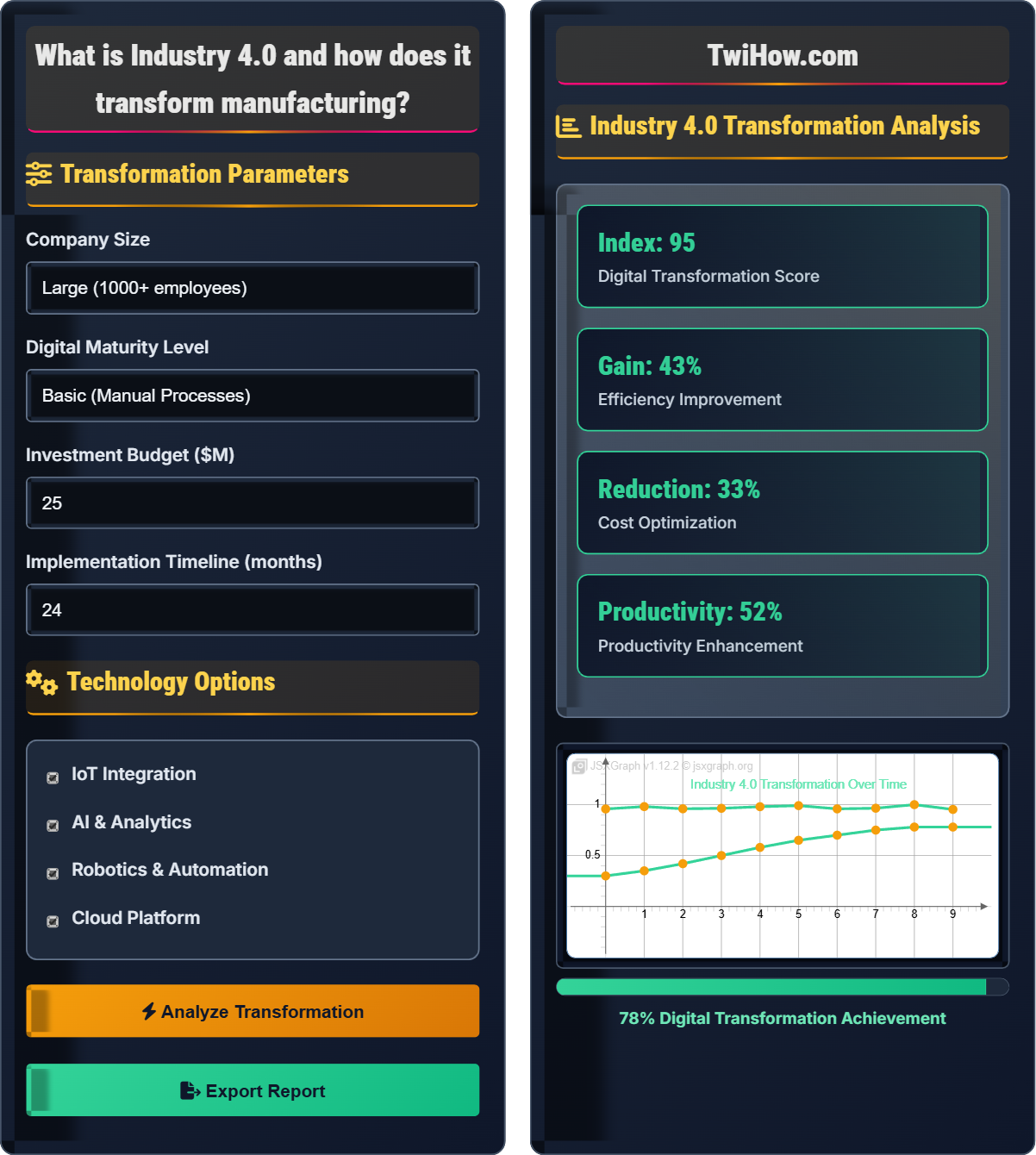
Transformation Parameters
Technology Options
Industry 4.0 Transformation Analysis
| Technology | Readiness | Impact | ROI |
|---|---|---|---|
| IoT Sensors | High | 90% | 25% |
| AI Analytics | High | 85% | 30% |
| Robotics | Medium | 75% | 20% |
| Cloud Platform | High | 80% | 22% |
| Digital Twin | Medium | 70% | 18% |
Cyber-Physical System Visualization
Smart Factory Flow
Industry 4.0 & Smart Manufacturing Explained
Industry 4.0 is the fourth industrial revolution characterized by the integration of cyber-physical systems, the Internet of Things (IoT), cloud computing, and cognitive computing in manufacturing. It represents a fundamental shift from traditional manufacturing to smart, connected, and data-driven production systems.
Industry 4.0 follows a structured approach:
Framework components include:
- Interconnectivity: Seamless communication between all systems
- Information Transparency: Real-time visibility into processes
- Technical Assistance: Human-machine collaboration
- Decentralized Decisions: Autonomous system responses
- Data-Driven Insights: Analytics for optimization
Key Industry 4.0 technologies:
- Internet of Things (IoT): Connected devices and sensors
- Artificial Intelligence: Machine learning and cognitive computing
- Robotics: Automated systems and cobots
- Cloud Computing: Scalable data storage and processing
- Digital Twins: Virtual replicas of physical assets
- Big Data Analytics: Advanced data processing and insights
- Increased Efficiency: Optimized production processes and reduced waste
- Enhanced Quality: Real-time monitoring and quality control
- Greater Flexibility: Rapid response to market changes
- Cost Reduction: Lower operational and maintenance costs
- Predictive Maintenance: Reduced downtime and equipment failures
- Mass Customization: Personalized products at scale
Transformation Metrics & Industry Assessment
- Start with a clear digital strategy aligned with business goals
- Invest in employee training and change management
- Build robust cybersecurity infrastructure
- Ensure data quality and governance
Technology-Specific Transformation Profiles
Industry 4.0 Quiz
Which of the following is NOT a core component of Industry 4.0?
Manual assembly lines are characteristic of traditional manufacturing, not Industry 4.0. Industry 4.0 emphasizes automation, connectivity, and digitalization. The core components include IoT, AI, robotics, and cyber-physical systems that create smart, connected manufacturing environments.
The answer is C) Manual Assembly Lines.
Industry 4.0 represents a fundamental shift from manual and semi-automated processes to highly connected, intelligent systems. The key is understanding that Industry 4.0 is characterized by digital transformation, automation, and data-driven decision making rather than traditional manufacturing methods.
Industry 4.0: Fourth industrial revolution with digital integration
Cyber-Physical Systems: Integration of computation and physical processes
IoT: Internet of Things connecting devices and systems
• Industry 4.0 emphasizes automation over manual processes
• Connectivity is a fundamental requirement
• Data-driven decisions are central to Industry 4.0
• Look for digital and automated solutions
• Consider connectivity and data flow
• Focus on intelligent systems
• Confusing Industry 4.0 with traditional automation
• Not recognizing the importance of connectivity
• Overlooking the data aspect of Industry 4.0
Explain what a digital twin is in Industry 4.0 and describe its applications in manufacturing.
Digital Twin Definition: A digital twin is a virtual replica of a physical asset, process, or system that enables real-time monitoring, analysis, and optimization. It uses real-time data to mirror the state of its physical counterpart.
Manufacturing Applications:
• Predictive Maintenance: Monitor equipment health and predict failures
• Process Optimization: Simulate and optimize production processes
• Design Validation: Test products and processes virtually before implementation
• Quality Control: Monitor and improve product quality
• Supply Chain: Model and optimize supply chain operations
• Training: Provide virtual environments for operator training
A digital twin creates a bridge between physical and digital worlds, allowing manufacturers to experiment, optimize, and predict outcomes without affecting actual production. It's like having a "parallel universe" version of your manufacturing system that responds in real-time to changes in the physical system.
Digital Twin: Virtual replica of physical asset or system
Real-time Mirror: Digital representation updated in real-time
Simulation: Virtual testing and optimization environment
• Digital twins require real-time data feeds
• They enable virtual experimentation
• They bridge physical and digital worlds
• Start with critical assets for maximum impact
• Ensure data quality and connectivity
• Use for predictive rather than just descriptive analytics
• Creating static rather than dynamic twins
• Not integrating real-time data streams
• Using for reporting rather than optimization
A manufacturing company invests $10M in Industry 4.0 technologies. The implementation results in 25% reduction in production costs, 30% increase in productivity, and 20% reduction in maintenance costs. If the company's original annual production cost was $50M, calculate the annual savings and ROI for the first year.
Production Cost Savings:
$50M × 25% = $12.5M annually
Productivity Gain Value:
30% increase in productivity on $50M base = $15M additional value
Maintenance Cost Savings:
Assuming maintenance was 10% of production cost: $5M × 20% = $1M annually
Total Annual Savings:
$12.5M + $15M + $1M = $28.5M
ROI Calculation:
($28.5M ÷ $10M) × 100 = 285% ROI in first year
The Industry 4.0 investment generates 285% ROI in the first year.
This calculation demonstrates the significant financial benefits of Industry 4.0 implementations. The combination of cost reductions, productivity gains, and operational improvements can create substantial returns on investment, often paying for themselves in short timeframes.
ROI: Return on Investment (gain divided by cost)
Productivity Gain: Increased output per unit of input
Operational Efficiency: Improved resource utilization
• Industry 4.0 investments often have high ROI
• Benefits compound over time
• Multiple benefit streams contribute to ROI
• Consider multiple benefit streams
• Account for indirect benefits
• Calculate payback periods
• Only counting direct cost savings
• Not accounting for productivity gains
• Ignoring long-term benefits
You're designing a smart factory for Industry 4.0. Identify the key systems to implement and explain how they would work together to create a connected manufacturing environment.
Key Systems to Implement:
• IoT Sensor Network: Deploy sensors throughout the factory floor to monitor equipment, environmental conditions, and product quality
• Edge Computing: Install edge devices for real-time data processing and decision making
• Cloud Platform: Centralized system for data storage, analytics, and machine learning
• AI/ML Systems: Predictive maintenance, quality control, and process optimization algorithms
• Robotic Systems: Automated assembly, inspection, and material handling
Integration Approach: All systems connect through a unified digital thread, sharing real-time data and enabling coordinated responses to changing conditions.
A smart factory requires seamless integration of multiple technologies working in harmony. The key is creating a unified digital infrastructure where data flows freely between systems, enabling intelligent, coordinated responses to real-time conditions and market demands.
Digital Thread: Continuous flow of data across systems
Edge Computing: Processing data closer to sourceUnified Infrastructure: Integrated technology stack
• Systems must communicate seamlessly
• Data standardization is essential
• Security must be built in from start
• Start with foundational infrastructure
• Plan for scalability from the beginning
• Focus on data quality and governance
• Implementing technologies in isolation
• Not considering cybersecurity early
• Failing to standardize data formats
What is the primary benefit of predictive maintenance in Industry 4.0 compared to traditional maintenance approaches?
The primary benefit of predictive maintenance is reduced unplanned downtime. By monitoring equipment conditions in real-time and predicting failures before they occur, manufacturers can schedule maintenance during planned downtime, preventing costly production interruptions.
The answer is B) Reduced unplanned downtime.
Predictive maintenance transforms maintenance from reactive (fix after failure) or preventive (scheduled regardless of condition) to predictive (maintenance based on actual equipment condition). This approach maximizes equipment availability while minimizing maintenance costs.
Predictive Maintenance: Maintenance based on equipment condition
Unplanned Downtime: Unexpected equipment failures
Condition Monitoring: Real-time equipment health tracking
• Predictive maintenance reduces unexpected failures
• Condition-based scheduling is more efficient
• Real-time monitoring enables proactive maintenance
• Start with critical equipment
• Use multiple sensor types for accuracy
• Combine with AI for better predictions
• Confusing predictive with preventive maintenance
• Not investing in proper sensors
• Ignoring data quality for predictions
FAQ
Q: How long does it typically take to implement Industry 4.0 technologies in a manufacturing facility?
A: Implementation timelines vary by scope and complexity:
Phased Approach: 2-5 years for comprehensive transformation
Pilot Projects: 6-18 months for specific applications
Full Rollout: 3-7 years for enterprise-wide deployment
Key Factors: Company size, current technology maturity, budget, and change management effectiveness.
Most successful implementations follow a phased approach starting with pilot projects and scaling based on results.
Q: Will Industry 4.0 technologies replace human workers in manufacturing?
A: Industry 4.0 changes job roles rather than eliminating them:
Job Evolution: Workers transition to higher-skilled positions
Collaborative Robots: Humans work alongside automated systems
New Opportunities: Data analysis, system monitoring, programming
Human Skills: Creativity, problem-solving, and complex decision-making remain essential
Successful Industry 4.0 implementations emphasize human-machine collaboration rather than replacement.