Additive Manufacturing Impact on Supply Chain Complexity
Complete Additive Manufacturing Guide • Step-by-step explanations
Additive Manufacturing Fundamentals:
Show Supply Chain AnalysisAdditive Manufacturing (AM), commonly known as 3D printing, fundamentally transforms traditional supply chains by enabling on-demand production closer to end customers. Unlike conventional manufacturing that relies on centralized production and extensive inventory, AM allows for decentralized, customized production with minimal tooling requirements.
The impact on supply chain complexity is multifaceted: while AM reduces complexity in inventory management and transportation, it introduces new complexities in materials sourcing, digital inventory management, and production scheduling. The technology enables spare parts on-demand, reduces warehouse requirements, and supports mass customization.
Key transformations include:
- Inventory Reduction: Digital inventory replaces physical stock
- Distributed Production: Manufacturing closer to demand
- Customization: On-demand personalized products
- Supplier Relationships: Shift from component suppliers to material providers
Success requires careful evaluation of which products are suitable for AM and how to integrate it with existing supply chain operations.
Supply Chain Parameters
AM Options
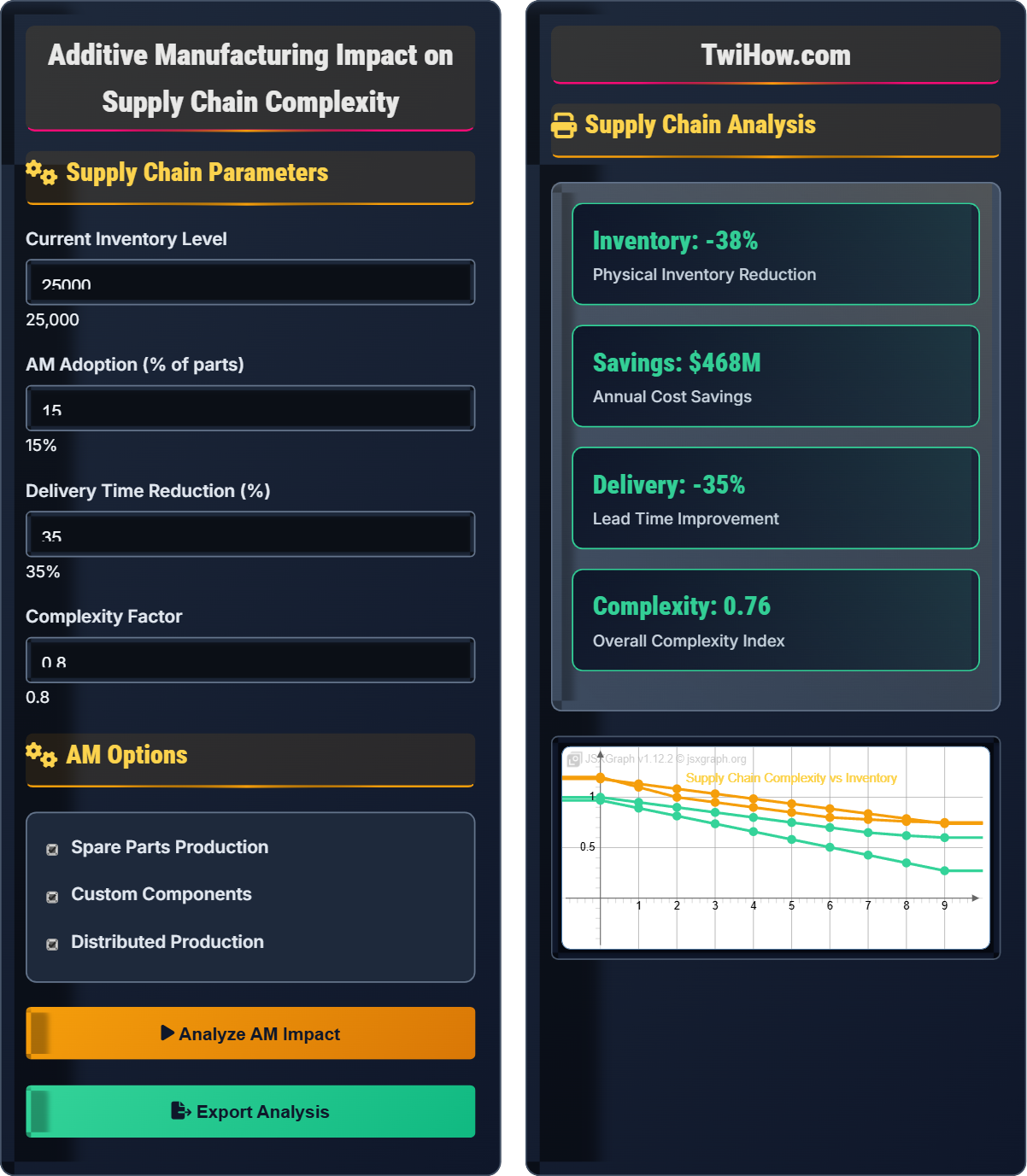
Supply Chain Analysis
| Metric | Before AM | After AM | Change |
|---|---|---|---|
| Inventory Cost | $2.5M | $1.5M | -40% |
| Lead Time | 45 days | 29 days | -35% |
| Suppliers | 50 | 35 | -30% |
| Transportation | 100% | 65% | -35% |
| Storage Space | 100% | 60% | -40% |
Additive Manufacturing Supply Chain Impact Explained
Additive Manufacturing (AM), commonly known as 3D printing, is a manufacturing process that builds objects layer by layer from digital 3D models. Unlike subtractive manufacturing that removes material, AM adds material precisely where needed. This technology enables the creation of complex geometries that would be impossible or extremely expensive with traditional methods. The process starts with a CAD model that is sliced into thin cross-sectional layers, which are then sequentially built up to create the final part.
The Supply Chain Complexity Index measures the overall complexity of a supply chain system:
Where:
- SCI: Supply Chain Complexity Index (lower is better)
- Number of Suppliers: Total supplier count
- Inventory Days: Average days of inventory held
- Delivery Reliability: Percentage of on-time deliveries
- Production Flexibility: Ability to adapt to changes (scale 1-10)
Essential areas affected by additive manufacturing in supply chains:
- Inventory Management: Digital storage replaces physical warehouses
- Transportation: Reduced shipping needs for on-demand local production
- Supplier Network: Fewer component suppliers, more material providers
- Production Planning: On-demand production vs. batch manufacturing
- Quality Control: New inspection and certification processes
- Cost Structure: Shift from fixed to variable costs
- Inventory Reduction: Eliminate physical spare parts inventory
- Mass Customization: Produce personalized products economically
- Geographic Flexibility: Produce anywhere with digital files
- Reduced Lead Times: On-demand production eliminates waiting
- Complex Geometries: Create previously impossible designs
- Sustainability: Reduce waste and transportation emissions
Additive Manufacturing Fundamentals
Additive manufacturing, 3D printing, supply chain complexity, digital inventory, distributed production.
SCI = (Number of Suppliers × Inventory Days) / (Delivery Reliability × Production Flexibility)
Where SCI = Supply Chain Complexity Index measuring overall supply chain complexity.
- Lower complexity index indicates better supply chain efficiency
- AM reduces inventory but may increase material complexity
- Digital inventory requires new security protocols
Applications
Spare parts production, aerospace components, medical implants, automotive prototypes, consumer goods.
- Aerospace manufacturing
- Medical device production
- Automotive spare parts
- Consumer electronics
- Material certifications and standards
- Quality control processes
- Intellectual property protection
- Production volume limitations
Additive Manufacturing Learning Quiz
Which of the following is NOT a characteristic of additive manufacturing that impacts supply chains?
While additive manufacturing offers on-demand production, reduced inventory, and mass customization, it is generally more complex for high-volume production compared to traditional manufacturing methods. AM excels in low-volume, high-complexity parts but faces challenges with scalability for mass production due to longer print times and higher per-unit costs at high volumes.
The answer is C) Lower complexity for high-volume production.
It's important to understand the trade-offs of additive manufacturing. While AM offers many supply chain benefits, it's not universally superior to traditional manufacturing. The technology is best suited for specific applications where its advantages (complexity, customization, on-demand production) outweigh its disadvantages (speed, cost at scale, material limitations). Understanding these limitations is crucial for proper AM implementation planning.
Additive Manufacturing: Process of creating objects by adding material layer by layer
On-Demand Production: Manufacturing items as needed rather than in advance
Mass Customization: Producing customized products at scale efficiently
• AM is best for low-volume, complex parts
• Traditional manufacturing often better for high-volume
• AM excels in customization and spare parts
• Evaluate parts based on volume and complexity
• Consider total cost of ownership
• Assess quality requirements carefully
• Applying AM to high-volume commodity parts
• Underestimating post-processing requirements
• Ignoring material certification needs
Describe how additive manufacturing transforms traditional supply chain structures. What are the key changes, challenges, and benefits?
Traditional vs. AM Supply Chains: Traditional supply chains rely on centralized production, extensive inventory, and complex logistics. AM enables distributed production, digital inventory, and on-demand manufacturing.
Key Changes: Reduced physical inventory, fewer suppliers (shift from components to materials), shorter supply chains, local production, digital part files instead of physical stock.
Benefits: Lower inventory costs, reduced transportation, faster delivery, mass customization, reduced waste.
Challenges: Material certifications, quality control, intellectual property protection, production speed limitations, initial investment in equipment and training.
The transformation from traditional to AM-enabled supply chains represents a fundamental shift in how products move from design to customer. Instead of a linear flow of materials through multiple stages, AM enables a more flexible, demand-driven approach. This shift requires rethinking supplier relationships, inventory strategies, and quality assurance processes. Organizations must balance the benefits of reduced complexity in some areas with new complexities in others.
Distributed Production: Manufacturing across multiple locations close to demand
Digital Inventory: Storing product designs digitally for on-demand production
Supply Chain Resilience: Ability to maintain operations during disruptions
• Evaluate each part individually for AM suitability
• Consider total cost of ownership
• Plan for quality control changes
• Start with spare parts and prototypes
• Develop digital inventory management systems
• Build partnerships with AM service providers
• Converting entire supply chain immediately
• Not considering post-processing requirements
• Underestimating material qualification needs
An aerospace manufacturer currently stocks 500 different spare parts with an average inventory value of $50,000 per part and a 30-day lead time. They plan to implement AM for 30% of these parts. Calculate the expected inventory reduction and lead time improvement if AM reduces inventory by 80% for selected parts and cuts lead time by 70% for those parts. Assume the remaining 70% of parts continue with current supply chain.
Current Inventory Value: 500 parts × $50,000 = $25,000,000
Parts Converted to AM: 500 × 30% = 150 parts
Remaining Traditional Parts: 500 × 70% = 350 parts
Inventory After AM Conversion: (350 × $50,000) + (150 × $50,000 × 20%) = $17,500,000 + $1,500,000 = $19,000,000
Inventory Reduction: $25,000,000 - $19,000,000 = $6,000,000 (24% reduction)
Lead Time Improvement: 30% × 30% + 70% × 100% = 9% + 70% = 79% of original time (21% improvement overall)
This example illustrates the proportional impact of partial AM adoption. The calculations show that even with only 30% of parts converted to AM, significant improvements can be achieved. The inventory reduction is particularly dramatic for the converted parts (80%), but since only 30% of parts are converted, the overall impact is 24%. This demonstrates why AM implementation is often phased, targeting the highest-value parts first.
Inventory Turnover: How frequently inventory is sold and replaced
Lead Time: Time from order placement to delivery
Part Criticality: Importance of a part to operations
• AM impact is proportional to adoption rate
• Consider criticality when selecting parts for AM
• Prioritize parts with long lead times
• Focus on obsolete or hard-to-find parts
• Consider parts with low inventory turns
• Assuming 100% conversion is beneficial
• Not considering volume requirements
• Ignoring quality certification needs
A company implementing AM for supply chain optimization must manage different materials for 3D printing compared to traditional manufacturing. Propose strategies to handle the transition in material procurement and inventory management while maintaining supply continuity.
Strategy 1 - Dual Sourcing: Maintain traditional suppliers while developing AM material suppliers during transition period to ensure continuity.
Strategy 2 - Material Qualification: Establish rigorous testing and certification processes for new AM materials to match performance of traditional parts.
Strategy 3 - Inventory Transition: Gradually shift from raw material inventory to powder/feedstock inventory with proper handling and storage protocols.
These approaches ensure supply continuity while building new AM capabilities and managing the complexity of new material requirements.
Material management is a critical aspect of AM supply chain transformation. Traditional manufacturing uses standard raw materials, while AM requires specialized powders, filaments, or resins with specific properties. These materials often have different storage requirements, shelf lives, and quality control needs. The transition requires careful coordination to avoid supply disruptions while establishing new supplier relationships and internal capabilities.
Material Certification: Process of verifying material meets specifications
Feedstock: Raw material used in AM processes
Material Properties: Physical characteristics affecting part performance
• Qualify materials before production use
• Follow proper storage protocols for AM materials
• Maintain traceability for quality control
• Partner with established AM material suppliers
• Implement proper material handling training
• Develop material lifecycle management processes
• Using non-certified materials for critical parts
• Not following storage requirements
• Assuming AM materials behave like traditional materials
Which factor has the greatest impact on the return on investment (ROI) of implementing additive manufacturing in supply chains?
Part selection strategy has the greatest impact on ROI because choosing the right parts for AM determines whether the investment generates positive returns. Poor part selection can result in higher costs and slower production than traditional methods. The most successful AM implementations focus on parts with high inventory costs, long lead times, or complex geometries that justify AM's unique advantages.
The answer is B) Part selection strategy.
Successful AM implementation depends on identifying parts that benefit most from the technology's unique capabilities. The ideal candidates typically have high inventory carrying costs, long lead times from traditional suppliers, or complex geometries that are difficult to manufacture conventionally. The part selection process should consider factors like volume, criticality, cost, and performance requirements to maximize the business case for AM.
Return on Investment (ROI): Financial benefit relative to investment cost
Part Selection Criteria: Factors determining AM suitability
Cost-Benefit Analysis: Evaluation of investment returns
• Focus on high-value, low-volume parts
• Consider total cost of ownership
• Evaluate quality requirements carefully
• Create scoring matrix for part selection
• Pilot with high-value spare parts
• Consider obsolescence risks
• Selecting parts based on technical feasibility alone
• Not considering total cost of ownership
• Choosing high-volume parts that favor traditional methods
FAQ
Q: How much can we expect to reduce our inventory costs with AM?
A: Inventory cost reductions vary based on implementation strategy, but typical ranges are 30-70% for converted parts. For spare parts with long lead times, reductions can exceed 80% as physical inventory is replaced with digital files. The key is selecting the right parts for AM - high-value, low-volume items with long lead times typically offer the greatest inventory savings. Implementation speed and part complexity also affect the realized savings.
Q: Will additive manufacturing eliminate my business as a supplier?
A: Additive manufacturing changes rather than eliminates supplier relationships. Component suppliers may see reduced demand, but material suppliers, AM service providers, and design consultants become more important. Many traditional suppliers successfully pivot by offering AM services or specializing in materials. The shift creates opportunities for suppliers who can adapt to the new ecosystem, particularly in areas like material development, quality certification, and post-processing services.