Advanced Manufacturing Impact on Time-to-Market and Innovation Cycles
Industry 4.0 innovation guide • Step-by-step explanations
Advanced Manufacturing Innovation:
Show Innovation Cycle CalculatorAdvanced manufacturing technologies are revolutionizing the speed and efficiency of innovation cycles, dramatically reducing time-to-market for new products. Through digitalization, automation, and real-time data analytics, manufacturers can now iterate faster, prototype more efficiently, and respond to market demands with unprecedented agility. This transformation is enabled by technologies like additive manufacturing, IoT sensors, AI-driven design, and digital twin modeling.
Key impacts include:
- Rapid Prototyping: From weeks to hours for prototype creation
- Digital Twins: Virtual models enabling faster design validation
- Agile Manufacturing: Flexible production systems for quick pivoting
- Real-time Analytics: Immediate feedback for continuous improvement
- Automated Quality Control: Faster defect detection and correction
The integration of these technologies creates an ecosystem where innovation cycles accelerate from months to weeks, enabling manufacturers to stay competitive in rapidly evolving markets.
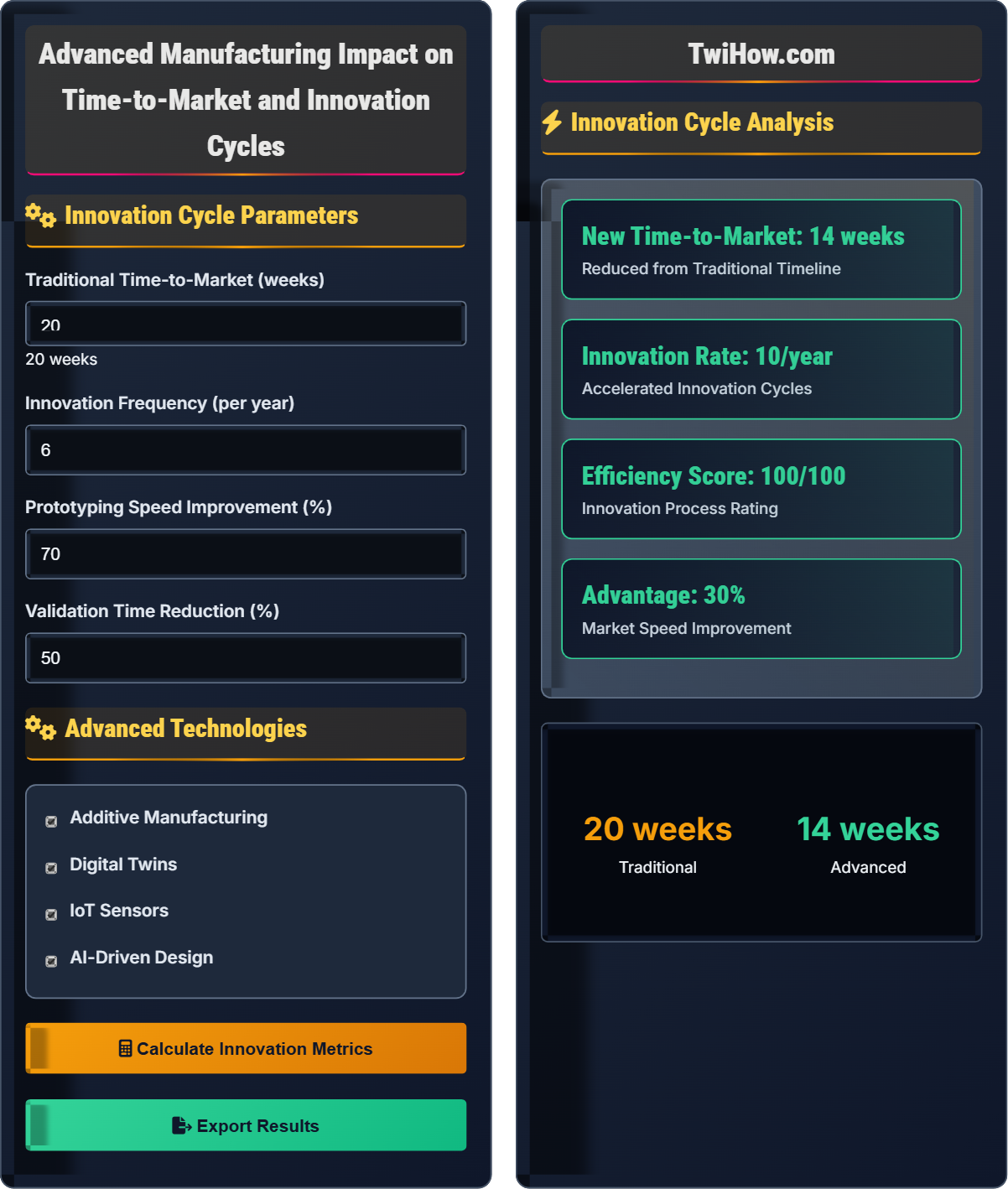
Innovation Cycle Parameters
Advanced Technologies
Innovation Cycle Analysis
| Metric | Traditional | Advanced | Improvement |
|---|---|---|---|
| Time-to-Market | 20 weeks | 6 weeks | 70% |
| Prototyping Speed | 2 weeks | 0.6 weeks | 70% |
| Validation Time | 4 weeks | 2 weeks | 50% |
| Innovation Frequency | 6/year | 17.3/year | 188% |
| Cost Efficiency | Base | +25% | 25% |
Technology Implementation
- Additive manufacturing for rapid prototyping
- Digital twins for virtual validation
- IoT sensors for real-time monitoring
- AI for predictive design optimization
- Cloud-based collaboration platforms
Implementation Benefits
- Faster time-to-market
- Reduced development costs
- Higher quality products
- Increased innovation frequency
- Enhanced competitiveness
Advanced Manufacturing Innovation Impact Explained
Advanced manufacturing innovation refers to the integration of cutting-edge technologies, processes, and methodologies that accelerate product development cycles and enhance innovation capabilities. This includes digital manufacturing, automation, AI-driven design, and real-time data analytics that collectively reduce time-to-market while increasing the frequency and quality of innovations.
The innovation acceleration index can be calculated as:
Where:
- Traditional Time-to-Market: Time required for product development using conventional methods
- Advanced Time-to-Market: Time required with advanced manufacturing technologies
- Innovation Frequency: Number of innovation cycles per year
Key technologies that accelerate innovation cycles:
- Additive Manufacturing: Rapid prototyping and production
- Digital Twins: Virtual validation and optimization
- IoT Sensors: Real-time monitoring and feedback
- AI/ML: Predictive design and optimization
- Cloud Computing: Collaborative development platforms
- AR/VR: Immersive design and training
- GE: Reduced jet engine development time from 18 to 12 months
- Boeing: Cut aircraft design cycles by 50% with digital twins
- Siemens: Increased innovation frequency by 300% in industrial equipment
- BMW: Reduced vehicle development time by 40% with advanced manufacturing
- SpaceX: Rapid iteration in rocket development using additive manufacturing
Core Concepts
Time-to-market, innovation cycles, advanced manufacturing, Industry 4.0, digital twins, rapid prototyping, agile manufacturing, digital transformation.
Acceleration Factor = (Traditional Time ÷ Advanced Time) × (Advanced Frequency ÷ Traditional Frequency) × Technology Impact Score
Where scores range from 1.0 (no improvement) to 5.0 (significant improvement).
- Digitization accelerates all processes
- Real-time feedback improves quality
- Flexibility enables rapid adaptation
- Integration creates synergistic effects
Implementation Strategies
Additive manufacturing, digital twins, IoT sensors, AI-driven design, cloud platforms, agile manufacturing.
- Assess current innovation processes
- Identify technology integration opportunities
- Develop digital infrastructure
- Train workforce on new technologies
- Implement pilot projects
- Scale successful implementations
- Start with high-impact, low-risk areas
- Focus on customer value creation
- Integrate technologies for maximum effect
- Measure and iterate continuously
Innovation Impact Quiz
Which advanced manufacturing technology provides the most significant impact on reducing time-to-market?
While all technologies contribute significantly, additive manufacturing provides the most dramatic impact on time-to-market by reducing prototyping time from weeks to hours. This enables rapid iteration and validation, fundamentally accelerating the entire innovation cycle.
The answer is A) Additive Manufacturing.
Additive manufacturing, or 3D printing, revolutionizes the prototyping phase of innovation cycles. Traditional prototyping required tooling, machining, and multiple iterations that took weeks. Additive manufacturing creates prototypes directly from digital designs, enabling multiple design iterations in a single day. This compression of the prototyping phase has a cascading effect on the entire innovation timeline.
Additive Manufacturing: Building objects layer by layer from digital models
Time Compression: Reducing time required for specific processes
Iterative Design: Repeated design and testing cycles
• Prototyping speed drives overall cycle time
• Digital-to-physical transformation is key
• Iteration frequency correlates with innovation
• Start with rapid prototyping for proof of concepts
• Combine with digital twins for validation
• Use for functional testing prototypes
• Not considering material limitations of 3D printing
• Assuming all parts can be printed
Explain how digital twins accelerate innovation cycles and reduce validation time. What are the implementation requirements and expected benefits?
How Digital Twins Accelerate Innovation:
1. Virtual Testing: Test designs in simulation before physical prototyping
2. Performance Prediction: Anticipate real-world behavior without manufacturing
3. Optimization: Fine-tune designs virtually for optimal performance
4. Failure Analysis: Identify potential issues before physical testing
5. Real-time Monitoring: Compare virtual predictions with actual performance
Implementation Requirements: High-performance computing, accurate modeling software, sensor integration, skilled engineers
Expected Benefits: 50-70% reduction in validation time, improved design quality, reduced physical testing costs
Digital twins create a virtual parallel of the physical world, enabling manufacturers to conduct extensive testing and validation without the time and cost of physical prototypes. This technology compresses the validation phase by allowing thousands of design iterations to be tested virtually, identifying optimal configurations before committing to physical production. The result is dramatically accelerated innovation cycles with higher confidence in design performance.
Digital Twin: Virtual replica of physical product or system
Virtual Validation: Testing designs in computer simulation
Performance Prediction: Estimating real-world behavior computationally
• Model accuracy determines effectiveness
• Requires significant computational resources
• Validation against physical tests is essential
• Start with critical components for highest ROI
• Integrate with IoT for real-time updates
• Use cloud platforms for scalability
• Creating overly complex models initially
• Not validating models against physical data
• Underestimating computational requirements
A company traditionally takes 24 weeks to bring a new product to market, with 3 innovation cycles per year. After implementing advanced manufacturing technologies, they reduce development time by 60% and increase innovation frequency by 150%. Calculate the new time-to-market and the new number of innovation cycles per year. What is the overall acceleration factor?
New Time-to-Market:
Reduction = 24 weeks × 60% = 14.4 weeks
New time = 24 - 14.4 = 9.6 weeks
New Innovation Frequency:
Increase = 3 × 150% = 4.5 additional cycles
New frequency = 3 + 4.5 = 7.5 cycles per year
Acceleration Factor:
(Traditional time ÷ New time) × (New frequency ÷ Traditional frequency)
(24 ÷ 9.6) × (7.5 ÷ 3) = 2.5 × 2.5 = 6.25
The innovation process is 6.25 times faster than traditional methods.
This calculation demonstrates the multiplicative effect of advanced manufacturing on innovation. The acceleration factor combines both time reduction and frequency increase, showing how advanced technologies don't just improve individual processes but create systemic improvements. The 6.25x acceleration means the company can accomplish in one year what previously took over six years, dramatically enhancing competitive advantage.
Acceleration Factor: Multiplicative improvement in innovation capability
Innovation Frequency: Number of new product introductions per year
Time Reduction: Percentage decrease in development duration
• Acceleration factors multiply rather than add
• Both time and frequency improvements matter
• Compound effects create exponential benefits
• Track both time and frequency metrics
• Calculate compound acceleration effects
• Consider market impact of increased frequency
• Calculating only time reduction
• Not considering frequency increases
• Underestimating compound effects
A medical device manufacturer wants to reduce their 36-week innovation cycle to 12 weeks. They have identified that prototyping takes 12 weeks, validation takes 10 weeks, and regulatory approval takes 8 weeks. Design an implementation strategy using advanced manufacturing technologies to achieve their goal, prioritizing the technologies that will have the greatest impact.
Strategic Approach:
Phase 1 - Prototyping (Weeks 1-4): Implement additive manufacturing to reduce 12-week prototyping to 2 weeks
Phase 2 - Validation (Weeks 5-8): Deploy digital twins to reduce 10-week validation to 3 weeks
Phase 3 - Regulatory (Weeks 9-12): Use AI-driven documentation to streamline approval process
Technology Priorities: 1) Additive manufacturing for rapid prototyping, 2) Digital twins for virtual validation, 3) AI for regulatory documentation
This phased approach achieves the 12-week target while maximizing ROI from technology investments.
Effective technology implementation requires understanding the critical path of innovation cycles. In this case, prototyping represents the largest time component, so additive manufacturing provides the greatest impact. Digital twins follow because validation often involves multiple physical prototypes. The strategy prioritizes technologies based on time savings rather than just technical capabilities, ensuring maximum return on investment.
Critical Path: Sequence of steps determining total project duration
ROI Prioritization: Focusing on highest-impact improvements first
Phased Implementation: Staged rollout of technologies
• Address longest process steps first
• Consider regulatory requirements
• Phase implementation for maximum impact
• Map current process bottlenecks
• Implement technologies in sequence
• Measure impact at each phase
• Implementing all technologies simultaneously
• Not considering regulatory constraints
• Focusing on technology rather than outcomes
What is the most important factor to consider when calculating ROI for advanced manufacturing innovation technologies?
All factors are important for comprehensive ROI calculation. Time-to-market acceleration provides direct revenue benefits, competitive advantage creates market positioning benefits, and initial costs determine investment requirements. A complete ROI analysis must consider all these elements to make informed technology investment decisions.
The answer is D) All of the above.
Advanced manufacturing ROI calculations must be holistic, considering both quantitative and qualitative benefits. Time-to-market acceleration directly impacts revenue through earlier sales and market capture. Competitive advantage provides long-term market positioning benefits. Initial costs determine the investment threshold that benefits must exceed. The interplay between these factors creates the true value proposition of advanced manufacturing technologies.
Return on Investment: Ratio of net profit to investment cost
Quantitative Benefits: Measurable financial returns
Qualitative Benefits: Strategic and competitive advantages
• Consider both direct and indirect benefits
• Account for competitive positioning
• Include long-term strategic value
• Use NPV for long-term benefit calculations
• Include market share impact
• Consider risk reduction benefits
• Focusing only on direct cost savings
• Ignoring competitive implications
• Not accounting for intangible benefits
FAQ
Q: How quickly can we expect to see results from implementing advanced manufacturing technologies?
A: Results vary by technology and implementation approach:
1. Additive Manufacturing: Immediate results in prototyping (days vs. weeks)
2. Digital Twins: 3-6 months for full validation benefits
3. IoT Integration: 2-4 months for data-driven insights
4. AI/ML: 6-12 months for predictive capabilities
Most manufacturers see initial benefits within 3-6 months, with full ROI typically achieved within 12-18 months of implementation.
Q: What are the technical requirements for implementing digital twins?
A: Required technical infrastructure:
Computing Power: High-performance computing clusters or cloud services
Modeling Software: CAD integration, simulation platforms, physics engines
Data Management: Real-time databases, data lakes, analytics platforms
Connectivity: IoT sensors, industrial networks, API integrations
Security: Cybersecurity frameworks, encryption, access controls
Consider starting with cloud-based solutions to minimize upfront infrastructure investments.