Impact of On-Demand and Distributed Manufacturing on Business Models
Complete manufacturing guide • Step-by-step explanations
Manufacturing Revolution:
Show Manufacturing SimulatorOn-demand and distributed manufacturing are transforming traditional business models by enabling flexible, localized production closer to customers. These approaches shift manufacturing from centralized, mass-production facilities to decentralized networks of smaller, specialized facilities that can respond quickly to market demands.
Key manufacturing concepts:
- On-Demand Manufacturing: Production triggered by customer orders
- Distributed Manufacturing: Production spread across multiple locations
- Supply Chain Optimization: Reduced inventory and logistics costs
- Agile Operations: Rapid response to market changes
Modern manufacturing systems leverage digital technologies, IoT sensors, and cloud platforms to coordinate distributed production networks, enabling manufacturers to scale operations dynamically while reducing capital investments in fixed infrastructure.
Manufacturing Parameters
Distribution Options
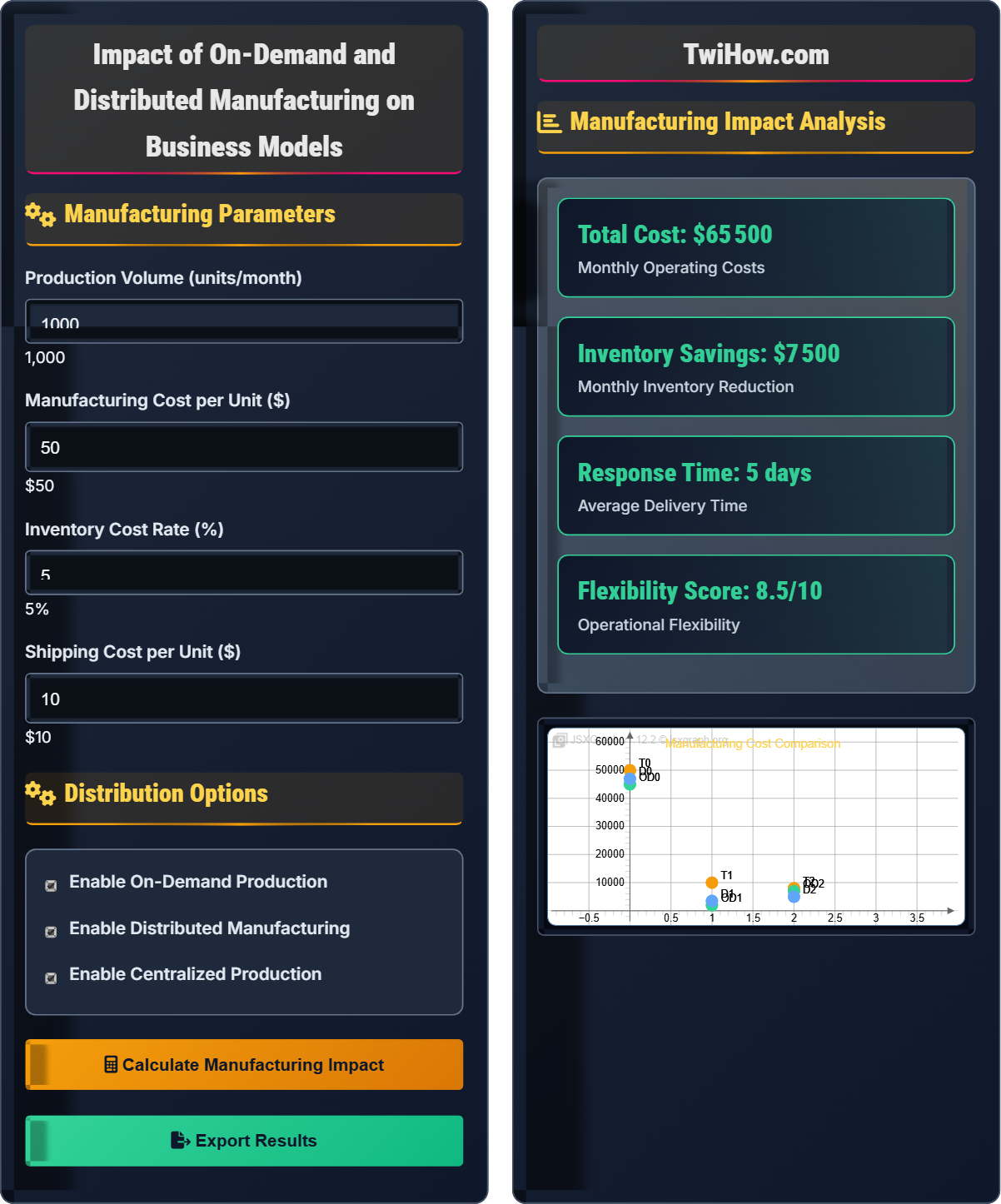
Manufacturing Impact Analysis
| Cost Type | Traditional | On-Demand | Distributed |
|---|---|---|---|
| Manufacturing | $50,000 | $45,000 | $47,000 |
| Inventory | $10,000 | $2,000 | $3,500 |
| Shipping | $8,000 | $7,000 | $5,000 |
| Management | $3,000 | $2,500 | $2,000 |
• No inventory waste
• Lower storage costs
• Reduced obsolescence
• Local production
• Faster delivery
• Reduced shipping
• Agile operations
• Market adaptability
• Risk mitigation
On-Demand and Distributed Manufacturing Explained
On-demand manufacturing is a production strategy where products are manufactured only when customer orders are received, eliminating the need for large inventories. This approach leverages digital manufacturing platforms, 3D printing, CNC machining, and other flexible production technologies to create products on a just-in-time basis.
Key characteristics include:
- Zero Inventory: Products made only when ordered
- Customization: Flexible to customer specifications
- Technology Driven: Digital workflows and automation
- Reduced Waste: No obsolete inventory
Distributed manufacturing involves spreading production across multiple geographically dispersed facilities rather than concentrating production in a single location. This model uses a network of smaller, specialized manufacturing centers that can serve local markets more efficiently.
Where:
- Manufacturing Cost: Direct production expenses
- Inventory Cost: Storage and holding expenses
- Distribution Cost: Shipping and logistics
- Management Cost: Coordination and oversight
Key areas where on-demand and distributed manufacturing transform business models:
- Capital Expenditure: Reduced need for large manufacturing facilities
- Cash Flow: Improved working capital through reduced inventory
- Market Reach: Global access through local production networks
- Product Development: Faster iteration and customization
- Supply Chain: Resilience through distributed risk
- Customer Experience: Faster delivery and personalization
- Cloud Platforms: Coordinate distributed production networks
- IoT Sensors: Monitor equipment and track production
- AI/ML: Predict demand and optimize scheduling
- 3D Printing: Enable local, customized production
- Blockchain: Secure supply chain transactions
Manufacturing Fundamentals
On-demand manufacturing, distributed manufacturing, digital fabrication, supply chain optimization.
Total Cost = Manufacturing Cost + Inventory Cost + Distribution Cost + Management Cost
Where Total Cost = total monthly operating expenses, Manufacturing Cost = direct production costs.
- Lower inventory reduces carrying costs
- Distributed production reduces shipping distances
- On-demand eliminates obsolete stock
Applications
3D printing, custom parts manufacturing, spare parts production, prototyping, small batch production.
- Automotive spare parts
- Aerospace components
- Medical device manufacturing
- Consumer product customization
- Quality control across network
- Intellectual property protection
- Regulatory compliance
- Supplier relationship management
Manufacturing Learning Quiz
Which of the following is NOT a characteristic of on-demand manufacturing?
On-demand manufacturing is characterized by producing items only when orders are received, which eliminates the need for large inventory buffers. Instead of maintaining stock, manufacturers respond directly to customer demand, reducing carrying costs and obsolescence risks.
The answer is B) Large inventory buffers to ensure availability.
On-demand manufacturing fundamentally shifts from the traditional push model (produce based on forecasts) to a pull model (produce based on actual demand). This eliminates the need for large safety stocks and buffer inventory, which were traditionally maintained to handle demand variability and supply uncertainties. The model relies on responsive production capabilities rather than inventory buffers.
On-Demand Manufacturing: Production initiated by actual customer orders
Inventory Buffer: Excess stock maintained to handle demand fluctuations
Push Model: Production based on forecasts rather than actual demand
• On-demand eliminates safety stock requirements
• Production is driven by actual orders
• Requires flexible manufacturing capabilities
• Focus on production flexibility over inventory
• Invest in responsive manufacturing technologies
• Develop strong supplier networks for agility
• Confusing on-demand with traditional inventory management
• Maintaining excess inventory in on-demand models
• Underestimating the need for production flexibility
Explain the advantages and challenges of implementing a distributed manufacturing model compared to centralized manufacturing. Include specific examples of cost savings and operational improvements.
Advantages of Distributed Manufacturing:
1. Reduced Shipping Costs: Local production centers serve regional markets, reducing transportation distances and costs. For example, a manufacturer serving Europe and Asia can establish facilities in both regions rather than shipping globally.
2. Faster Response Times: Proximity to customers enables quicker delivery and better responsiveness to market changes. A distributed network can achieve 2-3 day delivery versus 10-14 days for centralized production.
3. Risk Mitigation: Production is not dependent on a single facility, reducing impact of disruptions. If one facility faces issues, others can compensate.
4. Lower Capital Investment: Smaller facilities require less upfront investment than massive centralized plants.
Challenges of Distributed Manufacturing:
1. Quality Control Complexity: Maintaining consistent quality across multiple facilities requires standardized processes and oversight.
2. Coordination Overhead: Managing multiple facilities increases administrative complexity.
3. Economies of Scale: May not achieve the same cost efficiencies as large-scale centralized production for high-volume items.
Distributed manufacturing represents a strategic trade-off between operational efficiency and resilience. While centralized manufacturing achieves economies of scale, distributed models offer geographic arbitrage and risk diversification. The choice depends on factors like product type, market distribution, volume requirements, and supply chain complexity.
Distributed Manufacturing: Production spread across multiple geographically dispersed facilities
Centralized Manufacturing: Production concentrated in a single or few large facilities
Economies of Scale: Cost advantages from large-scale production
• Distributed models work best for customized products
• Quality standards must be uniform across all sites
• Technology platforms enable coordination
• Standardize processes across all locations
• Use cloud platforms for real-time coordination
• Focus on products with regional demand variations
• Inconsistent quality standards across facilities
• Insufficient technology integration
• Poor supplier relationship management
A company currently operates a centralized manufacturing facility with monthly costs of $200,000 (manufacturing: $150,000, inventory: $30,000, shipping: $20,000). They are considering switching to a distributed model with 4 regional facilities. Each facility has monthly costs of $40,000 (manufacturing: $35,000, inventory: $2,000, shipping: $3,000). Calculate the total monthly cost difference and identify the main financial benefits of the distributed model.
Current Centralized Model:
Total Monthly Cost = $150,000 + $30,000 + $20,000 = $200,000
Distributed Model (4 facilities):
Per Facility Cost = $35,000 + $2,000 + $3,000 = $40,000
Total Monthly Cost = 4 × $40,000 = $160,000
Cost Difference: $200,000 - $160,000 = $40,000 monthly savings
Main Financial Benefits:
1. Inventory Reduction: From $30,000 to $8,000 (savings of $22,000)
2. Shipping Efficiency: Local distribution reduces shipping costs
3. Overall Cost Savings: $40,000 per month
This calculation demonstrates the financial impact of distributed manufacturing through inventory optimization. By spreading production closer to customers, companies can significantly reduce both inventory carrying costs and shipping expenses. The key insight is that inventory costs often represent a substantial portion of total operating costs in centralized models.
Inventory Carrying Cost: Expenses associated with storing and managing inventory
Geographic Arbitrage: Cost advantages from producing in different locationsTotal Cost of Ownership: Comprehensive view of all manufacturing-related expenses
• Inventory costs compound over time
• Shipping costs decrease with proximity
• Fixed costs may increase with distribution
• Calculate total cost of ownership, not just production costs
• Factor in inventory reduction benefits
• Consider scalability when designing network
• Focusing only on manufacturing costs
• Ignoring inventory carrying costs
• Underestimating coordination overhead
A manufacturing company wants to transition to on-demand and distributed production. Identify the key technologies they need to implement and explain how these technologies support the new business model. Discuss potential challenges and solutions.
Key Technologies Required:
1. Cloud-Based Manufacturing Platform: Centralized system to manage orders, inventory, and production schedules across distributed facilities
2. IoT Sensors and Equipment Monitoring: Real-time tracking of production status, equipment health, and quality metrics
3. 3D Printing and Flexible Manufacturing: Enable on-demand production and customization capabilities
4. AI-Powered Demand Forecasting: Predict customer demand and optimize production planning
5. Blockchain for Supply Chain: Ensure transparency and traceability across distributed network
Challenges and Solutions:
Challenge: Quality control across distributed facilities → Solution: Standardized processes and real-time monitoring
Challenge: Technology integration complexity → Solution: Phased implementation and staff training
Challenge: Initial investment costs → Solution: ROI-focused pilot programs
Technology integration is crucial for successful implementation of on-demand and distributed manufacturing. The key is creating a connected ecosystem where all facilities can communicate, share resources, and coordinate activities seamlessly. Digital platforms serve as the backbone of this distributed model, enabling visibility and control across the entire network.
Industrial IoT: Internet-connected devices in manufacturing environments
Smart Manufacturing: Integration of digital technologies in production processes
End-to-End Visibility: Complete transparency across the manufacturing network
• Technology must enable real-time coordination
• Standardization is critical for success
• Security considerations are paramount
• Start with pilot programs to validate technology
• Invest in staff training for new systems
• Plan for cybersecurity in distributed networks
• Underestimating technology integration complexity
• Neglecting cybersecurity in distributed systems
• Failing to standardize processes across facilities
Which of the following represents the most significant impact of on-demand and distributed manufacturing on traditional business models?
On-demand and distributed manufacturing fundamentally shift the business model from asset-heavy (large factories and inventory) to capability-heavy (flexible production networks and responsive systems). Companies invest in digital platforms, supplier relationships, and production flexibility rather than physical inventory and centralized facilities.
The answer is B) Shift from inventory-based to capability-based assets.
This represents a fundamental paradigm shift in how companies think about their assets and competitive advantages. Traditional manufacturing relied heavily on physical assets (factories, equipment, inventory) as sources of competitive advantage. Modern models rely more on intangible assets like technology platforms, supplier networks, and operational capabilities that can be scaled and adapted more easily.
Asset-Heavy Model: Business model relying on physical capital investments
Capability-Based Assets: Intangible resources like technology and relationships
Operational Agility: Ability to adapt operations quickly to market changes
• Modern models prioritize flexibility over scale
• Technology platforms enable distributed control
• Relationships become strategic assets
• Focus on building scalable capabilities
• Invest in technology platforms early
• Cultivate strong supplier partnerships
• Treating distributed manufacturing as just relocation
• Underinvesting in technology infrastructure
• Neglecting relationship management
FAQ
Q: How do on-demand and distributed manufacturing models affect quality control?
A: Quality control becomes more complex in distributed models but also more sophisticated:
1. Standardization: Processes must be standardized across all facilities to ensure consistent quality
2. Real-Time Monitoring: IoT sensors and digital platforms enable continuous quality tracking
3. Centralized Oversight: Cloud-based systems allow central quality teams to monitor distributed operations
4. Proactive Management: Predictive analytics can identify quality issues before they become problems
The key is shifting from periodic inspections to continuous monitoring and standardization across the network.
Q: What are the financial implications of transitioning to distributed manufacturing?
A: The financial implications of distributed manufacturing include:
Positive Impacts:
• Reduced inventory carrying costs (can save 20-30% of working capital)
• Lower shipping costs due to geographic proximity to customers
• Reduced obsolescence risk
• Improved cash flow from reduced inventory investment
Investment Requirements:
• Technology platform development/integration
• Supplier qualification and relationship management
• Potential increase in fixed costs from multiple facilities
ROI Timeline: Typically 12-24 months for companies with appropriate product portfolios and market distribution.