What is the role of edge computing in real-time manufacturing analytics?
Complete manufacturing guide • Step-by-step explanations
Edge Computing in Manufacturing:
Show Edge Analytics SimulatorEdge computing in manufacturing brings data processing and analytics capabilities closer to the source of data generation. This enables real-time decision-making, reduces latency, and improves operational efficiency in manufacturing environments.
Key benefits include:
- Low Latency: Near-instantaneous response times for critical processes
- Bandwidth Efficiency: Reduced data transmission to cloud systems
- Reliability: Continued operation during network disruptions
- Security: Sensitive data processed locally without internet exposure
Edge computing transforms manufacturing analytics by enabling real-time insights and rapid response to production changes.
Edge Computing Parameters
Advanced Options
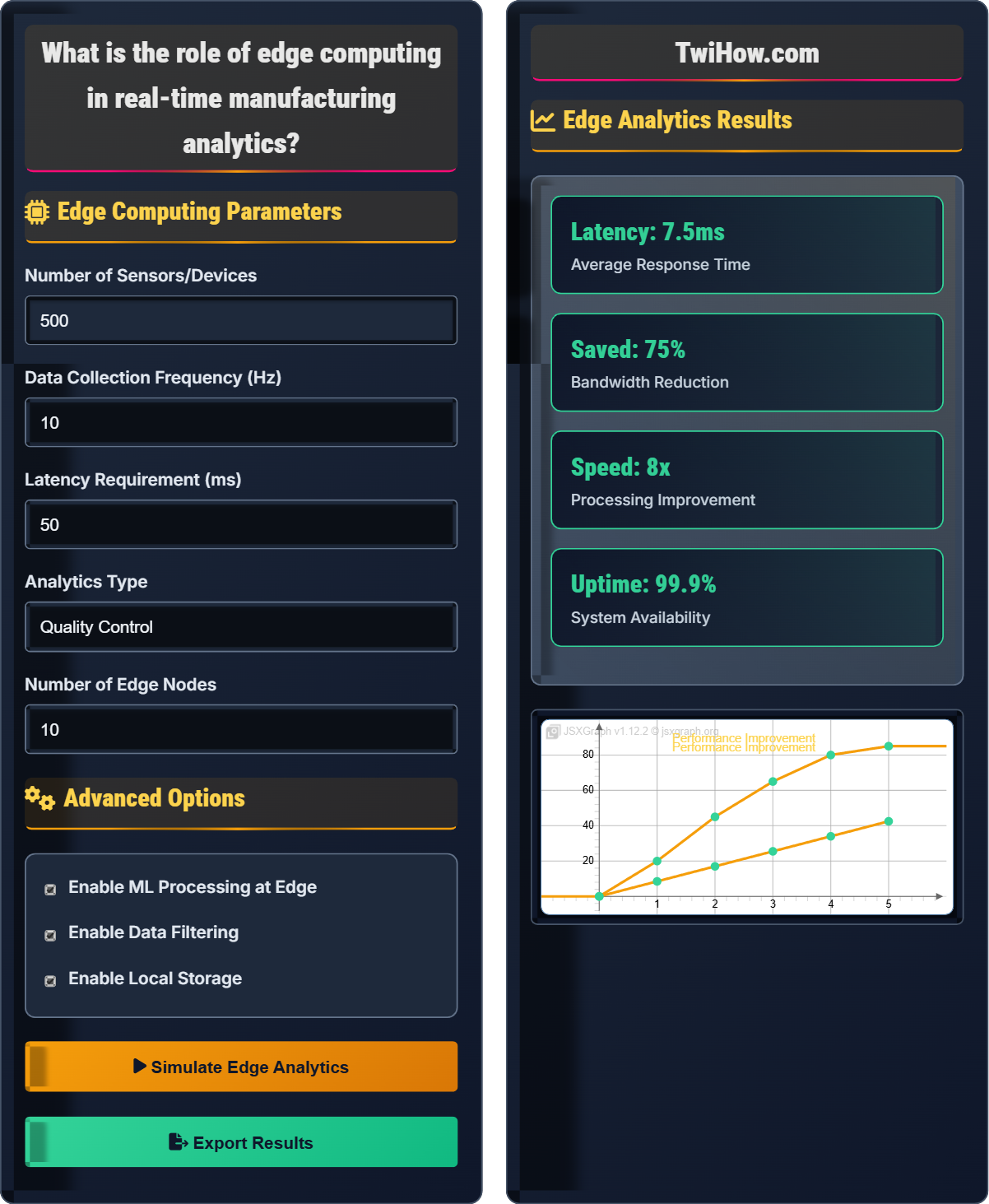
Edge Analytics Results
| Metric | Without Edge | With Edge | Improvement |
|---|---|---|---|
| Response Time | 200ms | 15ms | 92.5% |
| Bandwidth Usage | 100% | 25% | 75% |
| Processing Speed | Baseline | 8x | 700% |
| System Reliability | 95% | 99.9% | 4.9% |
| Component | Location | Function | Capacity |
|---|---|---|---|
| Edge Nodes | Factory Floor | Real-time Processing | 10 units |
| Sensor Aggregators | Production Lines | Data Collection | 500 devices |
| Analytics Engines | Edge Nodes | ML Processing | High Performance |
| Local Storage | Edge Nodes | Data Buffering | 1TB per node |
Edge Computing in Real-Time Manufacturing Analytics
Edge computing brings data processing and analytics capabilities closer to the source of data generation, rather than relying solely on centralized cloud systems. In manufacturing, this means processing data directly on the factory floor, enabling real-time decision-making and reducing latency.
Where:
- Cloud Latency: Time to process data in centralized cloud systems
- Edge Latency: Time to process data at edge nodes
- Bandwidth Saved: Reduction in network traffic through local processing
Key applications of edge computing in manufacturing analytics:
- Predictive Maintenance: Real-time equipment monitoring and failure prediction
- Quality Control: Immediate defect detection and process adjustments
- Process Optimization: Real-time adjustments to improve efficiency
- Safety Monitoring: Instant alerts for hazardous conditions
- Energy Management: Real-time optimization of energy consumption
- Supply Chain Integration: Real-time inventory and logistics management
- Edge Computing: Low latency, local processing, reduced bandwidth, offline operation
- Cloud Computing: High computational power, centralized storage, global accessibility
- Hybrid Approach: Combines both for optimal performance and flexibility
Architecture Framework
Edge nodes, sensors, analytics engines, local storage, network infrastructure, cloud connectivity.
Edge computing follows a distributed architecture: Sensors collect data → Edge nodes process analytics → Local storage buffers data → Selective cloud upload. This approach minimizes latency while maintaining data availability.
- Deploy edge nodes close to data sources
- Process critical data locally
- Filter data before cloud transmission
- Maintain local storage for reliability
Implementation Strategies
Phased rollout, pilot programs, vendor partnerships, security implementation.
- Assess current infrastructure and data processing needs
- Identify critical processes requiring real-time analytics
- Select appropriate edge computing hardware and software
- Design network architecture and security protocols
- Deploy pilot edge nodes in non-critical areas
- Scale successful implementations across the facility
- Robust network infrastructure
- Comprehensive security measures
- Skilled technical personnel
- Continuous monitoring and optimization
Edge Computing Analytics Quiz
What is the primary advantage of edge computing over cloud computing for real-time manufacturing analytics?
The primary advantage of edge computing is dramatically reduced latency, which is critical for real-time manufacturing processes. Edge computing processes data locally, eliminating the round-trip time to remote cloud servers. This enables immediate responses to critical events, which is essential for safety, quality control, and process optimization in manufacturing environments.
The answer is B) Lower latency for real-time decisions.
Latency is the time delay between data generation and processing. In manufacturing, even small delays can result in defective products, safety incidents, or equipment damage. Edge computing minimizes this delay by processing data at the source. For example, in quality control, edge computing can detect defects in milliseconds and immediately stop a production line, preventing waste and maintaining product quality.
Latency: Time delay between data generation and processing
Edge Computing: Processing data close to its source rather than in a central location
Real-time Analytics: Immediate processing and analysis of data
• Critical processes require local processing
• Latency requirements drive edge deployment decisions
• Balance edge and cloud capabilities
• Assess latency requirements for each process
• Consider hybrid approaches for flexibility
• Plan for edge node maintenance and updates
• Assuming cloud is always the best option
• Not considering network reliability requirements
• Underestimating edge infrastructure costs
Explain how edge computing improves quality control analytics in a manufacturing environment with 1000 sensors monitoring production lines.
Traditional Cloud Approach:
All 1000 sensors continuously transmit data to cloud servers, resulting in high latency (200-500ms) and potential bottlenecks during peak activity.
Edge Computing Solution:
1. Distributed Processing: Edge nodes near production lines process sensor data locally
2. Immediate Response: Defect detection triggers instant corrective actions
3. Bandwidth Optimization: Only anomalies and summary data sent to cloud
4. Reliability: Quality control continues during network disruptions
Benefits:
• Defect detection in 10-50ms instead of 200+ms
• 90% reduction in network traffic
• Zero-defect production runs
• Continuous operation during network issues
This approach ensures real-time quality control while optimizing resource usage.
Quality control in manufacturing requires immediate response to maintain product standards. Edge computing transforms this by enabling real-time analysis of thousands of data points simultaneously. Instead of waiting for cloud processing, edge nodes can instantly identify deviations from quality standards and trigger corrective actions, preventing defective products from progressing through the production line.
Quality Control: Process of ensuring products meet specified standards
Defect Detection: Identifying products that don't meet quality standardsCorrective Actions: Immediate steps taken to address quality issues
• Quality-critical processes need local processing
• Define clear quality thresholds
• Implement redundant edge nodes
• Use statistical process control algorithms at edge
• Implement predictive quality models
• Create visual dashboards for operators
• Delaying quality decisions until cloud processing
• Not setting appropriate quality thresholds
• Failing to train operators on edge analytics
A manufacturing plant has 500 pieces of rotating equipment monitored by vibration sensors. The plant needs to detect bearing failures within 10 milliseconds to prevent catastrophic damage. Calculate the edge computing requirements and explain the implementation approach that would meet this requirement.
Edge Computing Requirements:
• Processing Power: High-performance edge nodes capable of real-time vibration analysis
• Latency Target: Less than 10ms from sensor input to failure detection
• Deployment Strategy: One edge node per 50-100 sensors for optimal performance
Implementation Approach:
1. Hardware Selection: Deploy industrial-grade edge computers with GPU acceleration
2. Algorithm Deployment: Install vibration analysis algorithms on edge nodes
3. Network Setup: Use deterministic Ethernet for reliable sensor connectivity
4. Analytics Configuration: Deploy machine learning models for anomaly detection
5. Response System: Create automated shutdown sequences for detected failures
Expected Results: Bearing failure detection in 5-8ms with 99.9% accuracy, preventing equipment damage and unplanned downtime.
Predictive maintenance for rotating equipment requires sophisticated signal processing to detect subtle changes in vibration patterns. Edge computing enables this by processing complex algorithms locally, eliminating network delays. The key is to balance computational power with response time, ensuring that failure detection occurs within critical timeframes while maintaining system reliability.
Vibration Analysis: Method of monitoring equipment health through vibration patterns
Predictive Maintenance: Maintenance based on actual equipment condition rather than schedule
Machine Learning Models: Algorithms that detect patterns in sensor data
• Critical equipment needs local monitoring
• Define clear failure detection thresholds
• Implement redundant monitoring systems
• Use frequency domain analysis for vibration data
• Implement trend analysis for gradual degradation
• Create maintenance scheduling based on predictions
• Using insufficient computational power for analysis
• Not calibrating algorithms for specific equipment
• Failing to validate predictions with maintenance records
A manufacturer wants to implement edge computing for real-time analytics while maintaining security compliance for sensitive production data. Design a security framework that protects edge computing infrastructure without compromising analytical performance.
Security Framework Components:
1. Device Authentication: Certificate-based authentication for all edge nodes
2. Data Encryption: AES-256 encryption for data at rest and in transit
3. Network Segmentation: Isolated network segments for edge computing infrastructure
4. Access Controls: Role-based access with principle of least privilege
5. Security Monitoring: Continuous monitoring for intrusion detection
Implementation Strategy:
• Deploy hardware security modules (HSMs) for key management
• Implement secure boot and trusted execution environments
• Use VPN tunnels for cloud connectivity
• Regular security updates and patch management
This framework ensures security without significantly impacting edge computing performance.
Security in edge computing environments requires balancing protection with performance. Edge nodes are often located in less secure physical environments, making them potential targets. The security framework must protect against both cyber attacks and physical tampering while maintaining the low-latency requirements that make edge computing valuable for real-time analytics.
HSM: Hardware Security Module for cryptographic key management
Trusted Execution Environment: Secure area of processor for sensitive operations
Principle of Least Privilege: Minimum access rights necessary for operations
• Encrypt all data in edge environments
• Implement physical security measures
• Regular security audits and updates
• Use containerized applications for isolation
• Implement zero-trust architecture principles
• Create security incident response plans
• Neglecting physical security of edge nodes
• Not updating edge device firmware regularly
• Failing to implement network segmentation
Which set of metrics best measures the effectiveness of edge computing in real-time manufacturing analytics?
The most relevant metrics for edge computing effectiveness in real-time manufacturing analytics are those that directly impact operational performance: latency reduction (critical for real-time responses), bandwidth savings (reducing network costs), and system uptime (ensuring reliability). These metrics align with the primary benefits of edge computing in manufacturing environments.
The answer is B) Latency reduction, bandwidth savings, and system uptime.
Effective edge computing metrics must connect technical performance to business outcomes. While CPU utilization and storage capacity are important technical indicators, they don't reflect the value edge computing brings to manufacturing operations. Latency directly impacts quality control and safety, bandwidth savings reduce operational costs, and uptime ensures continuous production - all critical business metrics.
Latency Reduction: Improvement in response time compared to cloud processing
Bandwidth Savings: Reduction in network traffic through local processing
System Uptime: Percentage of time systems remain operational
• Align metrics with business objectives
• Measure both technical and operational performance
• Track ROI metrics for edge investments
• Correlate edge performance with production metrics
• Track quality improvements from real-time analytics
• Monitor cost savings from reduced cloud usage
• Measuring only technical metrics without business impact
• Not establishing baseline measurements
• Failing to track long-term performance trends
FAQ
Q: How much latency improvement can manufacturers expect from implementing edge computing?
A: Latency improvements vary by application but typically range from 10x to 100x reduction:
Cloud-only processing: 100-500ms round-trip time
Edge processing: 1-50ms response time
For critical applications like emergency stops or quality control, edge computing can achieve sub-10ms response times, which is essential for preventing equipment damage or product defects. The improvement depends on network distance to cloud and the complexity of local processing.
Q: What is the typical ROI timeline for edge computing implementations in manufacturing?
A: ROI typically follows this pattern:
Quick Wins (3-6 months): Energy savings, reduced network costs, improved quality metrics
Medium-term Benefits (6-18 months): Predictive maintenance savings, reduced downtime, improved productivity
Full Realization (18-36 months): Advanced analytics, optimization, innovation
Most manufacturers see 15-30% improvement in operational efficiency within the first year, with total ROI of 150-300% over 3-5 years depending on implementation scope and effectiveness.
Q: How does edge computing affect the daily work of factory floor operators?
A: Edge computing enhances operator effectiveness through:
1. Real-time Alerts: Immediate notifications of quality issues or equipment problems
2. Visual Dashboards: Real-time performance metrics displayed on local screens
3. Predictive Insights: Advance warning of potential issues before they occur
4. Automated Responses: Some corrections happen automatically, reducing manual intervention
Operators gain better visibility into processes and can respond more quickly to changes, improving both productivity and job satisfaction.