Standards and Frameworks in Manufacturing Digitalization
Complete Standards Guide • Step-by-step explanations
Manufacturing Digitalization Standards:
Show Standards AnalysisStandards and frameworks in manufacturing digitalization provide the essential foundation for interoperability, security, and seamless integration of Industry 4.0 technologies. These guidelines ensure that different systems, devices, and software can communicate effectively, share data, and work together harmoniously.
Standards cover everything from communication protocols and data formats to security requirements and quality management. Frameworks provide structured approaches for implementing digitalization initiatives while ensuring compliance with industry best practices and regulatory requirements.
Key areas include:
- Interoperability: Ensuring different systems can communicate and work together
- Security: Protecting digital manufacturing systems from cyber threats
- Data Exchange: Standardized formats for information sharing
- Quality Management: Maintaining standards throughout digital transformation
Success requires understanding which standards apply to specific use cases and implementing them systematically to achieve maximum interoperability and efficiency.
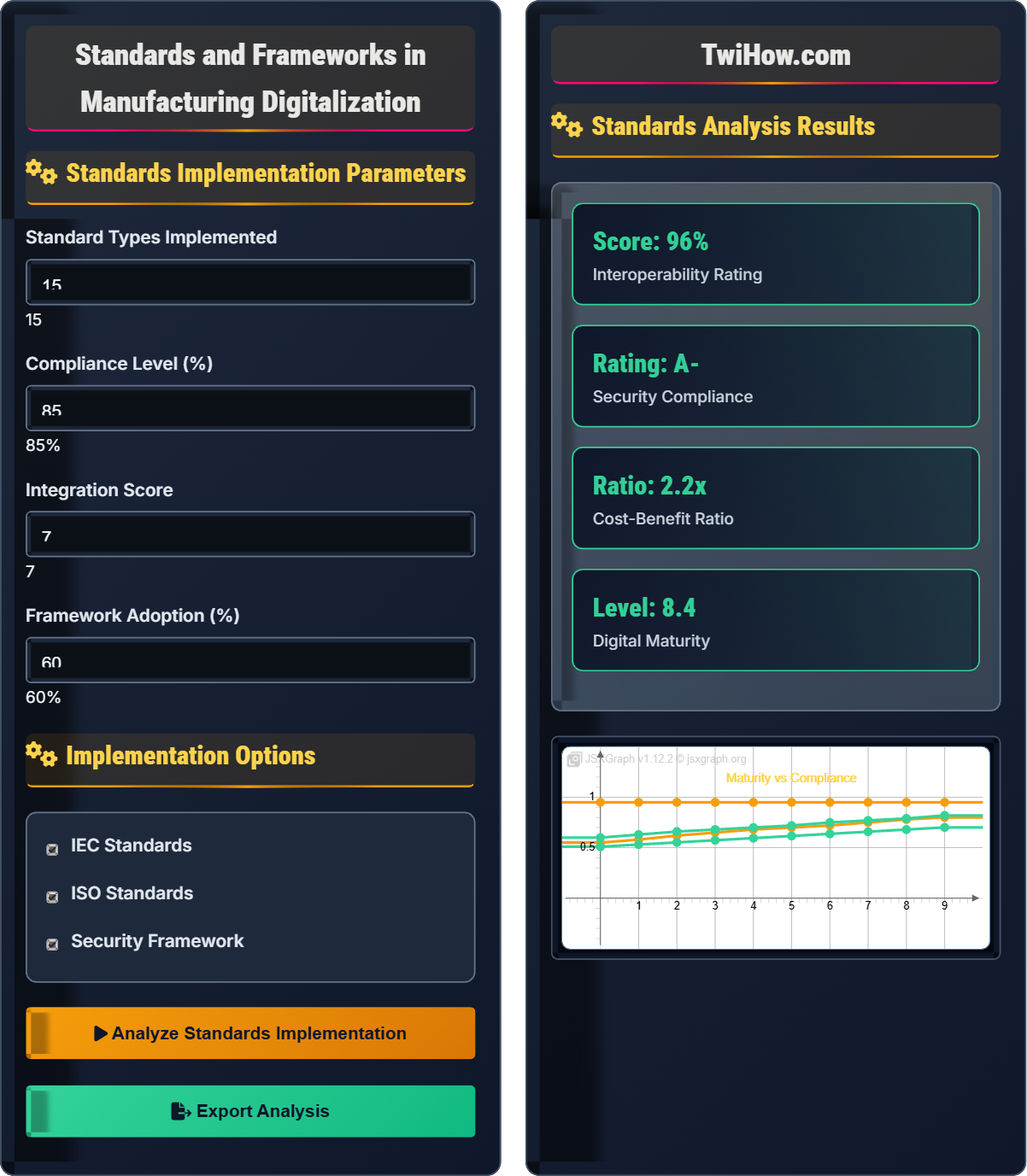
Standards Implementation Parameters
Implementation Options
Standards Analysis Results
| Category | Implemented | Target | Status |
|---|---|---|---|
| Communication | 12 | 15 | 80% |
| Security | 8 | 10 | 80% |
| Data Exchange | 6 | 8 | 75% |
| Quality | 5 | 6 | 83% |
| Interoperability | 9 | 12 | 75% |
Standards and Frameworks in Manufacturing Digitalization Explained
Standards and frameworks in manufacturing digitalization provide the essential guidelines, protocols, and best practices that enable successful implementation of Industry 4.0 technologies. Standards are formalized specifications that ensure consistency, interoperability, and quality across systems and processes. Frameworks are structured approaches that guide organizations through the digital transformation journey, providing roadmaps, methodologies, and governance structures.
For measuring interoperability effectiveness:
Where:
- DMI: Digitalization Maturity Index (higher is better)
- IEI: Interoperability Effectiveness Index
- Standards Implemented: Number of standards adopted
- Compliance Level: Percentage of adherence to standards
- Complexity Factor: Difficulty of implementation environment
Essential standards categories for manufacturing digitalization:
- Communication Standards: IEC 61158, IEC 61784, IEEE 802.11 for network protocols
- Security Standards: IEC 62443, ISO 27001 for cybersecurity frameworks
- Data Exchange: OPC UA, MQTT, AMQP for standardized communication
- Quality Management: ISO 9001, Six Sigma for quality standards
- Interoperability: IEC 62264, ISA-95 for enterprise-system integration
- Asset Management: ISO 55000, PAS 55 for asset lifecycle management
- Interoperability: Seamless communication between different systems
- Reduced Costs: Lower integration and maintenance expenses
- Enhanced Security: Consistent protection across all systems
- Scalability: Easier expansion and system upgrades
- Compliance: Meeting regulatory and industry requirements
- Competitive Advantage: Faster innovation and market responsiveness
Standards and Frameworks Fundamentals
Standards, frameworks, interoperability, Industry 4.0, digital transformation, compliance, security.
DMI = (Standards Implemented × Compliance Level) / (Complexity Factor × Time Factor)
Where DMI = Digitalization Maturity Index measuring implementation effectiveness.
- Standards must be implemented consistently across the organization
- Interoperability is the primary benefit of standards adoption
- Security standards must be integrated from the beginning
Applications
Smart factories, IoT networks, supply chain integration, quality management, cybersecurity.
- Automotive manufacturing
- Electronics production
- Pharmaceutical manufacturing
- Food and beverage processing
- Implementation complexity and costs
- Staff training and expertise requirements
- Technology compatibility issues
- Regulatory compliance requirements
Standards and Frameworks Learning Quiz
Which of the following is NOT a primary category of standards for manufacturing digitalization?
"Fashion Standards" is not a relevant category for manufacturing digitalization. The primary categories include communication standards (like IEC 61158), security standards (like IEC 62443), and data exchange standards (like OPC UA). Fashion standards would apply to the textile and apparel industry, not to manufacturing digitalization standards.
The answer is C) Fashion Standards.
Manufacturing digitalization standards are categorized based on their functional purpose in the digital transformation process. Communication standards ensure systems can talk to each other, security standards protect digital assets, and data exchange standards ensure consistent information flow. Understanding these categories helps organizations prioritize their standards adoption efforts based on their specific digitalization needs.
Standards: Formalized specifications ensuring consistency and interoperability
Interoperability: Ability of different systems to work together
OPC UA: Open Platform Communications Unified Architecture
• Standards must be industry-relevant
• Implementation requires systematic approach
• Interoperability is the primary goal
• Start with communication and security standards
• Focus on widely adopted industry standards
• Plan for future standard evolution
• Adopting non-industry-specific standards
• Not considering interoperability requirements
• Failing to plan for standard updates
Describe the process of implementing manufacturing digitalization standards. What are the key steps, challenges, and expected outcomes?
Implementation Process: Begin with standards assessment to identify applicable requirements, select relevant standards based on business needs, develop implementation roadmap, execute adoption across systems, validate compliance through testing, and establish continuous improvement processes.
Key Challenges: Legacy system compatibility, staff training requirements, implementation costs, organizational resistance, and technology integration complexity.
Expected Outcomes: 20-40% improvement in system integration efficiency, enhanced cybersecurity posture, reduced maintenance costs, and improved regulatory compliance.
Implementing manufacturing digitalization standards is a complex, multi-phase process that requires careful planning and execution. The success of standards implementation depends on understanding both the technical requirements and the organizational changes needed. The process should be approached systematically, with clear milestones and success metrics to ensure progress and value realization.
Implementation Roadmap: Detailed plan for standards adoption
Compliance Validation: Process of verifying standard adherenceLegacy Systems: Existing technology infrastructure
• Assess current state before implementation
• Develop clear implementation timeline
• Plan for staff training and change management
• Start with pilot implementations
• Focus on high-impact, low-complexity standards first
• Establish governance structure early
• Attempting enterprise-wide implementation immediately
• Not considering legacy system integration
• Failing to plan for ongoing maintenance
A manufacturing company currently has 5 different communication protocols across their factory floor, resulting in integration challenges and high maintenance costs. They implement IEC 61158 communication standards, consolidating to 2 protocols. Calculate the improvement in system interoperability and estimated cost savings if the previous integration complexity cost $500K annually and maintenance was $300K, with new standards reducing these by 40% and 30% respectively.
Before Standards: 5 protocols, High complexity, $500K integration + $300K maintenance = $800K total
After Standards: 2 protocols, Lower complexity, $500K × 60% + $300K × 70% = $300K + $210K = $510K total
Cost Savings: $800K - $510K = $290K annually (36% reduction)
Interoperability Improvement: From 5 protocols to 2 protocols = 60% reduction in complexity, leading to 40% improvement in system integration efficiency
This example demonstrates the tangible benefits of implementing communication standards. Reducing the number of protocols simplifies system integration, reduces maintenance complexity, and creates significant cost savings. The reduction from 5 to 2 protocols represents a 60% reduction in complexity, which translates directly into operational efficiency improvements and cost reductions.
IEC 61158: International standard for fieldbus communication
Protocol: Set of rules governing data communication
Interoperability: Ability of systems to work together seamlessly
• Fewer protocols improve system efficiency
• Standards reduce integration complexity
• Cost savings compound over time
• Consolidate protocols during technology refresh cycles
• Plan for future scalability needs
• Consider total cost of ownership
• Maintaining too many different protocols
• Not planning for standard evolution
• Failing to consider integration costs
A company implementing manufacturing digitalization must select appropriate security frameworks. Propose a comprehensive security strategy that addresses IEC 62443 standards, risk assessment, and continuous monitoring while ensuring operational continuity.
Framework Selection: Implement IEC 62443 industrial cybersecurity standards as the foundation, complemented by NIST Cybersecurity Framework for comprehensive coverage.
Risk Assessment: Conduct regular vulnerability assessments and penetration testing using standardized methodologies.
Monitoring: Deploy SIEM systems with industrial-specific monitoring capabilities and incident response protocols.
Operational Continuity: Implement security measures that don't compromise production efficiency.
This approach ensures comprehensive security while maintaining operational requirements.
Security in manufacturing digitalization requires a balanced approach that protects systems without hindering operational efficiency. IEC 62443 provides specific guidance for industrial environments, while complementary frameworks fill gaps in areas like risk management and incident response. The implementation must consider the unique requirements of manufacturing operations, including safety systems and production continuity.
IEC 62443: Series of standards for industrial communication network security
SIEM: Security Information and Event Management system
Vulnerability Assessment: Systematic evaluation of security weaknesses
• Security must not compromise operational efficiency
• Regular assessments are essential
• Industry-specific standards are critical
• Implement security during initial digitalization
• Use industrial-specific security solutions
• Regular security training for staff
• Applying IT security to OT systems without modification
• Not considering operational technology requirements
• Failing to update security measures regularly
Which factor has the greatest impact on the return on investment (ROI) of manufacturing digitalization standards implementation?
Interoperability improvement has the greatest impact on ROI because it enables seamless system communication, reduces integration costs, and unlocks the full value of digitalization investments. When systems can communicate effectively, the benefits compound across the entire digital ecosystem. While implementation costs and vendor support matter, the fundamental value of standards comes from enabling systems to work together effectively.
The answer is B) Interoperability improvement.
The primary value of manufacturing digitalization standards comes from enabling systems to work together seamlessly. When different technologies can communicate and share data effectively, the combined value exceeds the sum of individual system values. This network effect creates exponential benefits that justify the investment in standards implementation. The improved interoperability leads to reduced maintenance costs, faster problem resolution, and more efficient operations.
Return on Investment (ROI): Financial benefit relative to investment cost
Interoperability: Ability of different systems to work together
Network Effect: Value increases with number of connected systems
• Interoperability creates exponential value
• Standards enable system integration
• Network effects compound over time
• Focus on standards that enable system communication
• Measure interoperability improvements
• Consider long-term integration benefits
• Focusing only on individual system improvements
• Not measuring interoperability benefits
• Ignoring network effects of standards
FAQ
Q: How much can we expect to save by implementing manufacturing standards?
A: Well-implemented manufacturing standards typically deliver 20-40% reduction in system integration costs, 15-30% decrease in maintenance expenses, and 25-50% improvement in system interoperability. The exact savings depend on current system complexity, the number of standards implemented, and how well they're executed. Companies often see $2-5 in benefits for every $1 invested in standards implementation, with the biggest savings coming from reduced integration complexity and improved system reliability.
Q: Do manufacturing standards limit our flexibility to adopt new technologies?
A: Actually, manufacturing standards enhance rather than limit flexibility by providing a framework for integrating new technologies. Standards create plug-and-play capabilities that make it easier to add new systems, swap vendors, or upgrade components. Rather than constraining choices, they provide a common language that enables seamless technology adoption. The key is selecting standards that are widely adopted and regularly updated to accommodate new technologies.