How to Address Cybersecurity Risks in Connected Supply Chain Systems
Complete guide • Step-by-step explanations
Cybersecurity Fundamentals:
Show Cybersecurity Risk AnalyzerAddressing cybersecurity risks in connected supply chain systems requires a comprehensive approach that encompasses threat identification, vulnerability assessment, risk mitigation, and continuous monitoring. As supply chains become increasingly digitized with IoT devices, cloud platforms, and interconnected systems, the attack surface expands significantly.
Key challenges include managing third-party vendors, securing communication protocols, protecting sensitive data, and ensuring system integrity across multiple tiers of suppliers. Effective cybersecurity in supply chains requires collaboration between all stakeholders and implementation of industry-standard security frameworks.
Core principles:
- Defense in Depth: Multi-layered security controls
- Zero Trust: Verify every connection and transaction
- Continuous Monitoring: Real-time threat detection
- Incident Response: Rapid containment and recovery
Successful implementation requires executive commitment, employee training, regular assessments, and adaptation to evolving threats. The goal is to maintain operational continuity while protecting critical assets and sensitive information throughout the supply chain ecosystem.
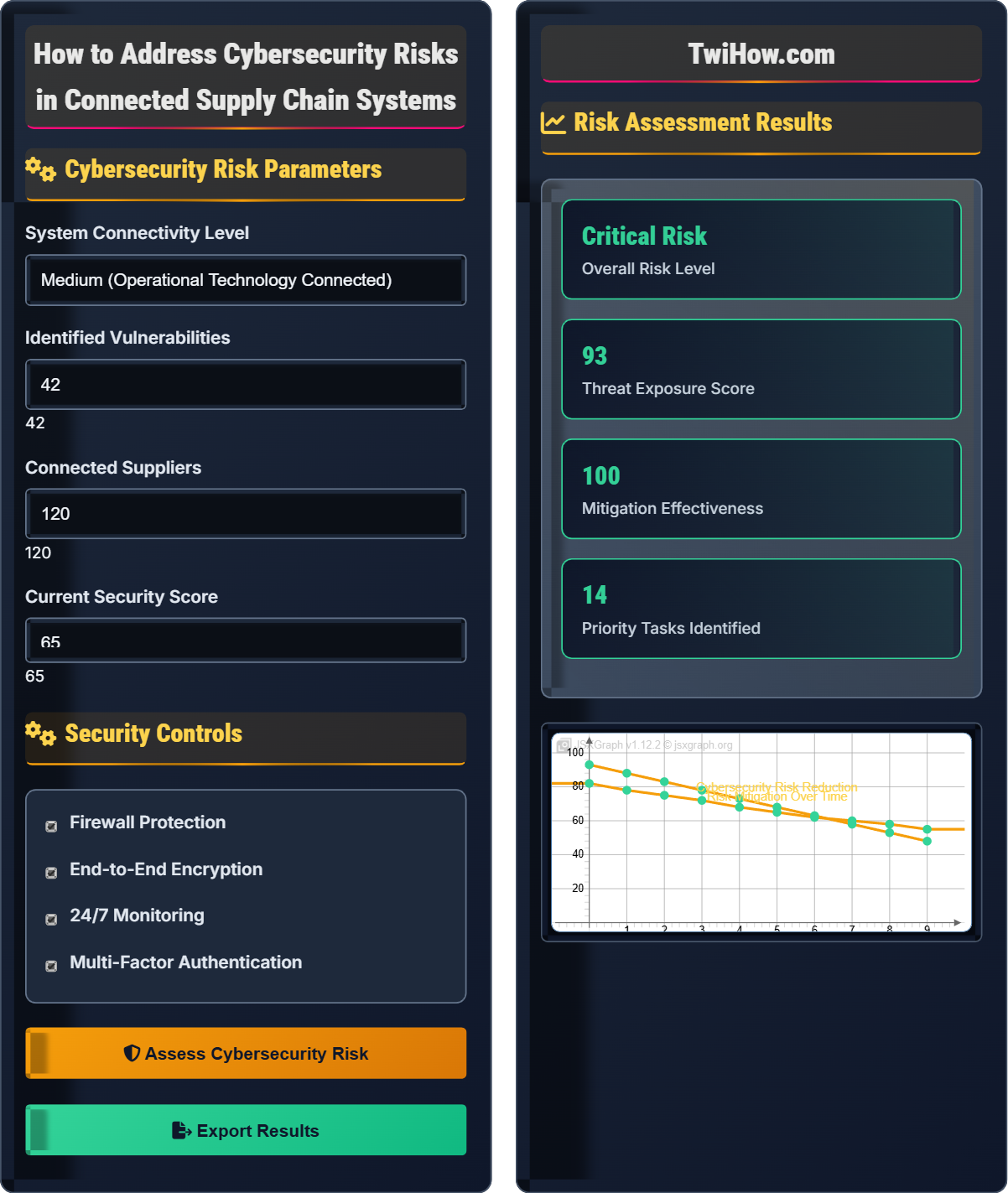
Cybersecurity Risk Parameters
Security Controls
Risk Assessment Results
| Risk Factor | Score | Status | Impact |
|---|---|---|---|
| Network Security | 78 | Medium | High |
| Access Control | 85 | Good | Medium |
| Data Protection | 65 | Medium | High |
| Vendor Management | 45 | Weak | Critical |
Immediate Actions Required
- Implement zero-trust network architecture
- Enhance vendor security assessments
- Deploy advanced threat detection
- Strengthen encryption protocols
Cybersecurity in Connected Supply Chains Explained
Supply chain cybersecurity refers to the protection of digital systems, networks, and data that connect various entities within a supply chain ecosystem. This includes manufacturers, suppliers, distributors, logistics providers, and customers who share information through interconnected platforms and devices. The complexity arises from multiple entry points, diverse technologies, and varying security standards across different organizations.
A comprehensive cybersecurity risk assessment follows this framework:
Where:
- Threat: Potential adverse events or actors targeting the system
- Vulnerability: Weaknesses that can be exploited by threats
- Impact: Consequences of successful exploitation
Primary cybersecurity threats in connected supply chains:
- Third-Party Vendor Breaches: Compromise through less secure suppliers
- IoT Device Vulnerabilities: Unsecured sensors and connected equipment
- Man-in-the-Middle Attacks: Interception of communications
- Ransomware: Malware that encrypts critical systems
- Data Exfiltration: Unauthorized data extraction
- Supply Chain Poisoning: Compromised hardware or software
- Zero Trust Architecture: Never assume trust, always verify
- Segmentation: Isolate critical systems from general networks
- Encryption: Protect data in transit and at rest
- Regular Audits: Continuous security assessments
- Incident Response: Prepared response plans
- Employee Training: Human firewall development
Risk Assessment
Cybersecurity, supply chain risks, threat modeling, vulnerability assessment, zero trust, defense in depth.
Risk Score = (Threat Level × Vulnerability × Asset Value) / Mitigation Factor
Where higher scores indicate greater risk requiring immediate attention.
- Assess third-party vendors thoroughly
- Implement defense in depth
- Maintain incident response plans
Implementation
Executive support, cross-functional collaboration, vendor management, continuous monitoring, employee training.
- Assessment and planning
- Infrastructure hardening
- Policy implementation
- Monitoring and maintenance
- Balance security with operational efficiency
- Consider cost implications
- Plan for scalability
- Ensure compliance requirements
Cybersecurity Learning Quiz
Which principle is fundamental to zero trust security in supply chain systems?
Zero trust architecture is built on the principle of "never trust, always verify." This means that no entity, whether inside or outside the network perimeter, is automatically trusted. Every access request must be authenticated, authorized, and continuously validated. This is particularly important in supply chain systems where multiple vendors and partners connect to shared systems.
The answer is C) Never trust, always verify.
Traditional network security operated on the "castle and moat" model where internal systems were trusted by default. Zero trust completely颠覆s this approach by treating every connection as potentially hostile. In supply chain contexts, this is crucial because suppliers, contractors, and partners may have varying security standards, creating potential entry points for attackers.
Zero Trust: Security model that assumes breach and verifies every transaction
Authentication: Verifying identity of users/devices
Authorization: Determining what resources can be accessed
• Verify identity before granting access
• Assume every connection could be compromised
• Implement least privilege access
• Implement multi-factor authentication
• Use micro-segmentation
• Monitor all network traffic
• Treating internal systems as trusted
• Overlooking third-party access
Explain the concept of third-party vendor risk in connected supply chains and describe three specific security measures that should be implemented when integrating new suppliers into the network.
Third-Party Vendor Risk: This refers to cybersecurity threats that originate from external suppliers, partners, or service providers who have access to your supply chain systems. Since these entities often have different security postures, they can serve as entry points for attackers to reach your critical systems.
Three Specific Security Measures:
1. Security Assessment: Require vendors to undergo comprehensive security audits and provide evidence of security certifications (ISO 27001, SOC 2, etc.).
2. Network Segmentation: Implement isolated network segments for vendor access with strict controls on lateral movement.
3. Continuous Monitoring: Deploy systems to monitor vendor activities and detect anomalous behavior in real-time.
These measures ensure that vendor integration doesn't compromise overall supply chain security.
Third-party risk is often the weakest link in supply chain security. Attackers frequently target smaller suppliers with weaker security controls to gain access to larger, more valuable targets. Understanding and managing this risk requires a proactive approach that treats vendor integration as a security event, not just a business process.
Third-Party Risk: Security vulnerabilities introduced by external entities
Network Segmentation: Dividing network into isolated sections
Continuous Monitoring: Ongoing surveillance of system activities
• Assess vendor security before integration
• Implement access controls and monitoring
• Review vendor security regularly
• Use security questionnaires
• Implement vendor risk scoring
• Establish security SLAs
• Not verifying vendor security
• Giving excessive access privileges
• Not monitoring vendor activities
A manufacturing company discovers that malware has been detected in their supply chain management system. The malware appears to have originated from a third-party logistics provider. Describe the immediate actions the company should take and explain how they can prevent similar incidents in the future, considering the interconnected nature of their supply chain systems.
Immediate Actions:
1. Containment: Isolate affected systems immediately to prevent lateral spread
2. Communication: Notify the third-party logistics provider and relevant stakeholders
3. Investigation: Determine scope of compromise and data accessed
4. Remediation: Remove malware and restore systems from clean backups
5. Verification: Confirm systems are clean before reconnecting
Future Prevention:
• Implement network segmentation for third-party access
• Deploy endpoint detection and response (EDR) solutions
• Establish security requirements for all suppliers
• Conduct regular security assessments of connected vendors
• Develop comprehensive incident response playbooks
Incident response in connected supply chains is more complex than in isolated systems because compromise can spread rapidly across interconnected networks. The response must consider not only the immediate threat but also the potential impact on partners and customers. Coordination with third parties is essential since they may be both sources of threats and victims of the same attack.
Incident Response: Coordinated approach to handling security breaches
Containment: Preventing spread of malicious activity
EDR: Endpoint Detection and Response security solution
• Respond quickly to contain damage
• Coordinate with affected parties
• Document all actions taken
• Have incident response plans ready
• Practice response procedures
• Maintain contact lists for vendors
• Delaying containment efforts
• Not notifying affected parties
• Reconnecting systems too quickly
A logistics company has deployed hundreds of IoT sensors throughout their warehouse and transportation fleet to optimize supply chain operations. Identify the main cybersecurity risks associated with these IoT devices and recommend specific security controls that should be implemented to protect against these threats.
Main IoT Security Risks:
1. Default Credentials: Many IoT devices ship with unchanged default passwords
2. Unpatched Firmware: Difficulty updating firmware across many distributed devices
3. Weak Encryption: Some devices use inadequate encryption or transmit data in plain text
4. Network Access: IoT devices may provide unauthorized network access if compromised
Recommended Security Controls:
1. Device Management: Enforce unique, strong passwords and regular credential rotation
2. Network Segmentation: Place IoT devices on isolated network segments
3. Secure Communication: Require encrypted communication with TLS/SSL
4. Firmware Management: Establish processes for timely security updates
5. Monitoring: Implement anomaly detection for unusual device behavior
IoT devices in supply chains create significant security challenges because they're often deployed in large numbers, located in remote locations, and may not receive regular maintenance. Their interconnected nature means that a compromise of one device can lead to broader network infiltration. Security must be considered from the procurement stage through the entire lifecycle of these devices.
IoT: Internet of Things - network-connected physical devices
Firmware: Software embedded in hardware devices
Network Segmentation: Isolating network parts for security
• Never use default device credentials
• Segment IoT devices from critical systems
• Encrypt all device communications
• Create IoT device inventory
• Implement device authentication
• Plan for secure firmware updates
• Not changing default passwords
• Connecting IoT devices to main network
• Ignoring firmware updates
Which cybersecurity framework is most appropriate for manufacturing companies seeking to secure their connected supply chain systems?
The NIST Cybersecurity Framework is the most appropriate for manufacturing companies securing connected supply chain systems. It provides a flexible, risk-based approach that covers five core functions: Identify, Protect, Detect, Respond, and Recover. This framework is specifically designed to help organizations manage and reduce cybersecurity risks across all sectors, including manufacturing and supply chain environments.
While other frameworks have specific applications (PCI DSS for payment data, HIPAA for health data, SOX for financial reporting), NIST offers comprehensive guidance for general cybersecurity management.
The answer is B) NIST Cybersecurity Framework.
Choosing the right cybersecurity framework is crucial for establishing effective security programs. The NIST framework is particularly valuable for manufacturing companies because it's technology-neutral, risk-based, and adaptable to various organizational structures. It emphasizes continuous improvement and considers the entire cybersecurity lifecycle, which is essential for complex supply chain environments.
NIST: National Institute of Standards and Technology
Framework: Structured approach to cybersecurity management
Supply Chain Security: Protection of interconnected systems
• Select framework appropriate for industry
• Customize framework to organizational needs
• Implement framework consistently
• Map framework to business processes
• Establish governance structure
• Regular framework assessments
• Using inappropriate framework
• Not customizing framework
• Inconsistent implementation
FAQ
Q: How do we balance cybersecurity with operational efficiency in our supply chain?
A: Balancing security and efficiency requires thoughtful implementation of security controls:
1. Automated Security: Implement security measures that don't require manual intervention
2. Zero Touch Security: Use solutions that provide protection without disrupting workflows
3. Risk-Based Approach: Focus security efforts on highest-risk areas
4. User Experience: Choose security solutions that are easy to use
5. Performance Monitoring: Continuously measure both security and efficiency metrics
The key is implementing security as an enabler rather than a barrier to efficient operations.
Q: What's the typical ROI for supply chain cybersecurity investments?
A: ROI for supply chain cybersecurity investments can be challenging to quantify directly, but studies suggest:
Cost Avoidance: Organizations report avoiding costs equivalent to 10-30 times their cybersecurity investment by preventing breaches.
Operational Benefits: Improved visibility, better vendor management, and streamlined processes can provide 5-15% efficiency gains.
Compliance Savings: Avoiding regulatory fines and maintaining certifications can save millions in potential penalties.
Reputation Protection: The cost of a supply chain breach can exceed $4 million on average, making prevention investments highly valuable.
While ROI varies by industry and implementation, most organizations see positive returns within 12-24 months.