How do I address the challenges of supply chain digitalization for small businesses?
Complete small business digitalization guide • Step-by-step explanations
Supply Chain Digitalization Fundamentals:
Show Digitalization SimulatorSupply chain digitalization for small businesses involves implementing technology solutions to streamline operations, improve visibility, and enhance efficiency. This includes adopting digital tools for inventory management, supplier communication, order processing, and data analytics to compete effectively in the modern marketplace.
At their core, digitalization solutions help small businesses overcome resource constraints by automating processes, reducing manual errors, and providing real-time insights into supply chain operations. These technologies enable smaller companies to achieve efficiencies traditionally available only to larger enterprises.
Key digitalization concepts:
- Cloud-Based Solutions: Affordable, scalable technology platforms
- Integration: Connecting different business systems
- Automation: Reducing manual processes
- Analytics: Data-driven decision making
Modern digitalization solutions use cloud platforms, mobile technologies, and AI to provide cost-effective and accessible tools for small businesses. This enables them to improve operations, reduce costs, and enhance customer service while maintaining competitive pricing.
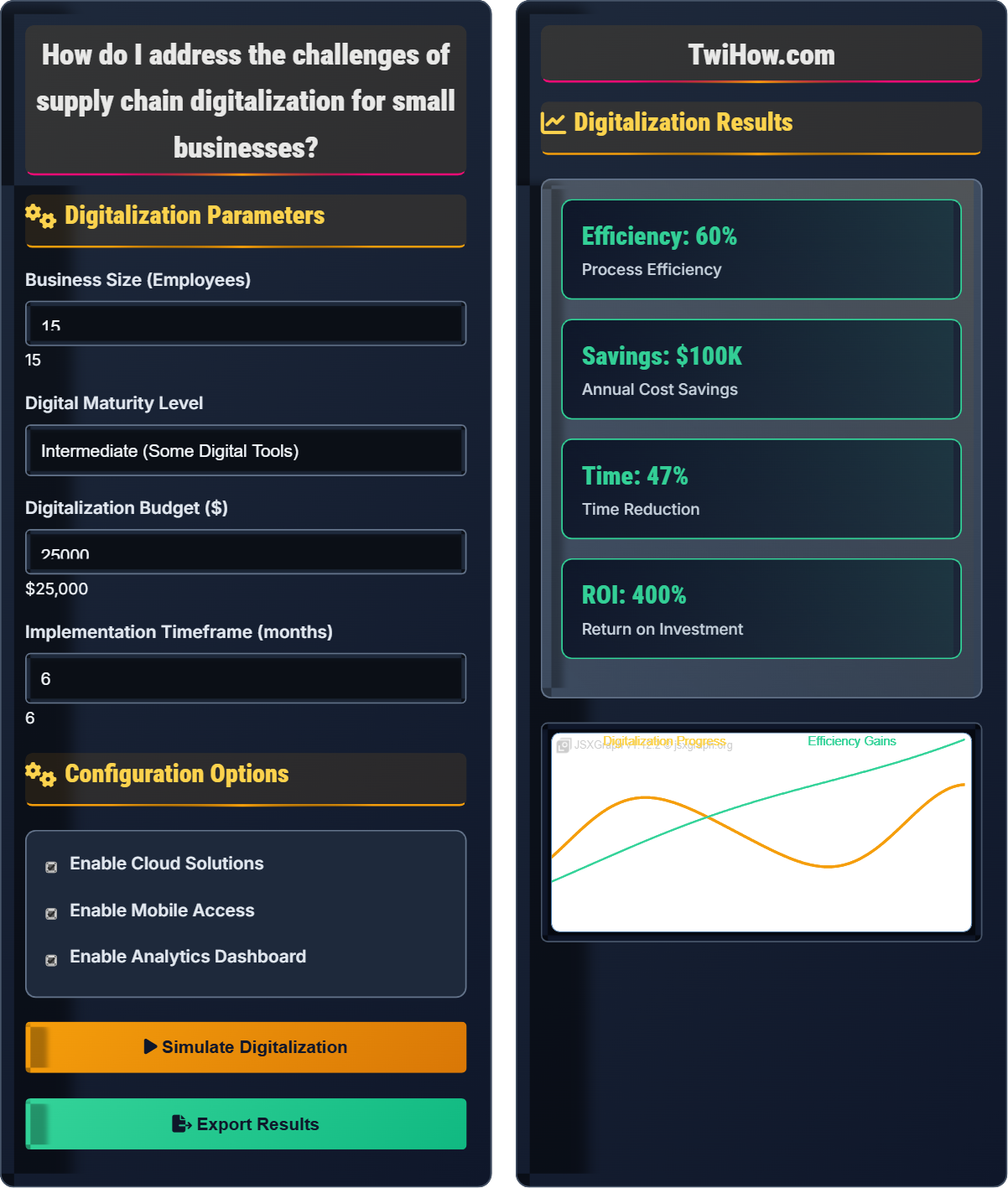
Digitalization Parameters
Configuration Options
Digitalization Results
| Area | Before | After | Improvement |
|---|---|---|---|
| Inventory | 65% | 88% | +23% |
| Orders | 55% | 92% | +37% |
| Communication | 45% | 85% | +40% |
| Tracking | 30% | 90% | +60% |
Supply Chain Digitalization for Small Businesses
Supply chain digitalization involves implementing technology solutions to automate, integrate, and optimize supply chain processes. For small businesses, this means using affordable, cloud-based tools to connect suppliers, manage inventory, process orders, and gain real-time visibility into operations. It transforms manual, paper-based processes into automated, data-driven systems.
Key components of small business digitalization:
Where:
- Investment: Financial resources allocated to digitalization
- Adoption Rate: Speed of technology acceptance
- Training Effectiveness: Employee skill development
- Implementation Time: Duration of deployment
Key advantages of implementing supply chain digitalization:
- Cost Reduction: Lower operational and administrative costs
- Improved Visibility: Real-time tracking and monitoring
- Enhanced Efficiency: Automated processes and reduced errors
- Better Decision Making: Data-driven insights and analytics
- Competitive Advantage: Ability to compete with larger enterprises
- Scalability: Systems that grow with the business
- Cloud Platforms: Affordable, scalable hosting solutions
- Mobile Apps: On-the-go access and management
- APIs: Integration between different systems
- Analytics Tools: Performance monitoring and insights
- IoT Sensors: Real-time monitoring capabilities
Digitalization Fundamentals
Supply chain digitalization, cloud computing, automation, integration, small business technology.
ROI = (Annual Savings - Annual Costs) / Total Investment × 100%
Where ROI = return on investment, Savings = cost reductions from digitalization.
- Start with high-impact areas
- Choose scalable solutions
- Invest in training
Applications
Retail, manufacturing, food service, construction, healthcare, professional services.
- Inventory management
- Order processing
- Supplier communication
- Customer tracking
- Budget constraints
- Staff training needs
- Integration complexity
- Security requirements
Digitalization Learning Quiz
Which of the following is NOT a core component of supply chain digitalization for small businesses?
Supply chain digitalization involves replacing paper-based processes with digital alternatives. Paper-based processes are the opposite of digitalization, which seeks to eliminate manual, paper-driven systems in favor of automated, electronic solutions.
The answer is C) Paper-Based Processes.
Digitalization is fundamentally about replacing manual, paper-based processes with automated, digital systems. While small businesses may initially rely on paper processes, the goal of digitalization is to move away from these inefficient methods toward technology-enabled solutions that provide better visibility, accuracy, and efficiency.
Cloud-Based Solutions: Online software platforms
Mobile Accessibility: Smartphone/tablet access to systems
Real-Time Analytics: Instant data insights and reporting
• Digitalization eliminates manual processes
• Technology enables scalability
• Start with cloud solutions
• Focus on mobile accessibility
• Implement gradually
• Keeping paper backups indefinitely
• Not training staff adequately
• Choosing overly complex solutions
Explain the main benefits of implementing supply chain digitalization for small businesses, and how these benefits translate into measurable improvements in business performance.
Main Benefits: Digitalization provides cost reduction through automation, improved visibility into operations, enhanced customer service, better decision-making through data insights, competitive advantage through technology adoption, and scalability for business growth.
Measurable Improvements: Operational costs can decrease by 20-40%. Processing time can reduce by 30-60%. Error rates can decrease by 50-80%. Customer satisfaction can improve by 15-35%. Inventory accuracy can increase by 25-50%. Order fulfillment speed can improve by 40-70%.
Supply chain digitalization creates a multiplier effect where improvements in one area lead to benefits in others. For example, better inventory visibility reduces stockouts, which improves customer satisfaction, which leads to repeat business. The measurable improvements demonstrate the tangible value of digitalization investments for small businesses.
Operational Costs: Expenses for running business processes
Customer Satisfaction: Customer experience and loyalty
Inventory Accuracy: Correctness of stock tracking
• Focus on high-impact areas first
• Measure improvements consistently
• Plan for scalability
• Start with inventory management
• Choose user-friendly solutions
• Track key metrics
• Not measuring baseline performance
• Choosing overly complex systems
• Inadequate staff training
A small manufacturing business with 20 employees currently spends 40 hours per week on manual inventory tracking and order processing. The owner estimates that digitalization could reduce this time by 70%. If employees earn $25/hour and the digitalization investment costs $15,000, calculate the annual savings and estimate the payback period.
Current Weekly Hours: 40 hours
Hours Saved: 40 × 70% = 28 hours per week
Weekly Savings: 28 hours × $25 = $700
Annual Savings: $700 × 52 weeks = $36,400
Payback Period: $15,000 ÷ $36,400 = 0.41 years (about 5 months)
Additional Benefits: Improved accuracy, better customer service, reduced errors, and enhanced visibility into operations.
This example demonstrates the significant financial impact of digitalization for small businesses. The calculation shows that even with modest investment, the time savings from automation can result in substantial cost savings. The short payback period illustrates how digitalization can quickly become profitable for small businesses.
Payback Period: Time to recover investment costs
Time Savings: Reduced manual effort from automation
Cost-Benefit Analysis: Financial impact assessment
• Calculate time savings accurately
• Plan for ongoing costs
• Quantify manual process time
• Include employee productivity gains
• Plan for implementation timeline
• Underestimating time savings
• Not including training costs
• Ignoring ongoing maintenance
A small retail business with 10 employees wants to digitize their supply chain but faces limited budget, staff with basic computer skills, and concerns about data security. Identify three major challenges they might face and propose solutions for each challenge.
Challenge 1: Budget Constraints: Limited funds for technology investment. Solution: Choose affordable cloud-based solutions with monthly subscriptions instead of large upfront costs.
Challenge 2: Skill Gaps: Staff unfamiliar with technology. Solution: Select user-friendly solutions with good support and provide hands-on training.
Challenge 3: Security Concerns: Worries about data protection. Solution: Choose reputable providers with strong security certifications and implement proper access controls.
Success requires careful planning and gradual implementation.
Small businesses face unique challenges in digitalization due to resource constraints. The key is finding solutions that balance affordability with effectiveness while considering the specific constraints of small business operations. Gradual implementation helps manage both financial and learning curves.
Budget Constraints: Limited financial resources
Skill Gaps: Insufficient technical capabilities
Data Security: Protection of sensitive information
• Start with affordable solutions
• Invest in staff training
• Prioritize security
• Look for SMB-focused solutions
• Start with one area
• Choose intuitive systems
• Overestimating budget needs
• Not training staff properly
• Ignoring security requirements
Which technology combination best supports effective supply chain digitalization for small businesses?
Effective small business digitalization requires cloud platforms for affordability, mobile apps for accessibility, and analytics tools for insights. This combination provides the scalability, accessibility, and intelligence needed to compete effectively while maintaining cost-effectiveness.
The answer is A) Cloud platforms, mobile apps, analytics tools.
Small businesses need technology solutions that are affordable, accessible, and easy to use. Cloud platforms eliminate the need for expensive hardware, mobile apps provide accessibility for field workers, and analytics tools provide the insights needed to make data-driven decisions.
Cloud Platforms: Online software and storage solutions
Mobile Apps: Smartphone and tablet applications
Analytics Tools: Data analysis and reporting systems
• Affordability is crucial
• User-friendly design matters
• Integration enables efficiency
• Choose SaaS solutions
• Look for mobile-first platforms
• Consider integration capabilities
• Choosing enterprise solutions
• Not considering mobile access
• Ignoring integration needs
FAQ
Q: What's the difference between cloud-based and on-premise digitalization solutions?
A: The key differences are:
Cloud-Based: Hosted online, subscription-based, automatic updates, accessible anywhere, lower upfront costs, scalable.
On-Premise: Installed locally, purchased licenses, manual updates, location-restricted, higher upfront costs, fixed capacity.
For small businesses, cloud solutions are typically more cost-effective and easier to implement, while on-premise solutions offer more control but require greater technical expertise and investment.
Q: What are the main challenges in implementing supply chain digitalization for small businesses?
A: The main challenges in small business digitalization include:
1. Budget Constraints: Limited funds for technology investment.
2. Technical Expertise: Lack of IT staff and knowledge.
3. Staff Resistance: Reluctance to change familiar processes.
4. Integration Complexity: Connecting different systems and data sources.
5. Security Concerns: Protecting sensitive business data.
Success requires addressing these challenges systematically with appropriate solutions.