How do I address the environmental and social governance (ESG) expectations of stakeholders?
Complete ESG guide • Step-by-step explanations
ESG Fundamentals:
Show ESG SimulatorAddressing ESG expectations requires a comprehensive approach that integrates environmental stewardship, social responsibility, and governance excellence throughout manufacturing and supply chain operations. This involves setting measurable targets, implementing sustainable practices, engaging stakeholders transparently, and continuously improving performance across all ESG dimensions. Modern ESG strategies encompass carbon footprint reduction, ethical labor practices, supply chain transparency, and robust governance frameworks that ensure accountability and long-term value creation.
Successful ESG implementation transforms business operations from compliance-driven to value-creating activities that benefit shareholders, employees, communities, and the environment. It requires cross-functional collaboration, stakeholder engagement, and systematic measurement of environmental, social, and governance impacts.
Core components:
- Environmental Stewardship: Carbon reduction, resource efficiency, waste management
- Social Responsibility: Labor practices, community engagement, diversity inclusion
- Corporate Governance: Transparency, ethics, accountability, risk management
- Stakeholder Engagement: Communication, feedback, collaboration
Success depends on strategic alignment between ESG objectives and business operations, creating sustainable competitive advantages while meeting stakeholder expectations.
ESG Parameters
ESG Options
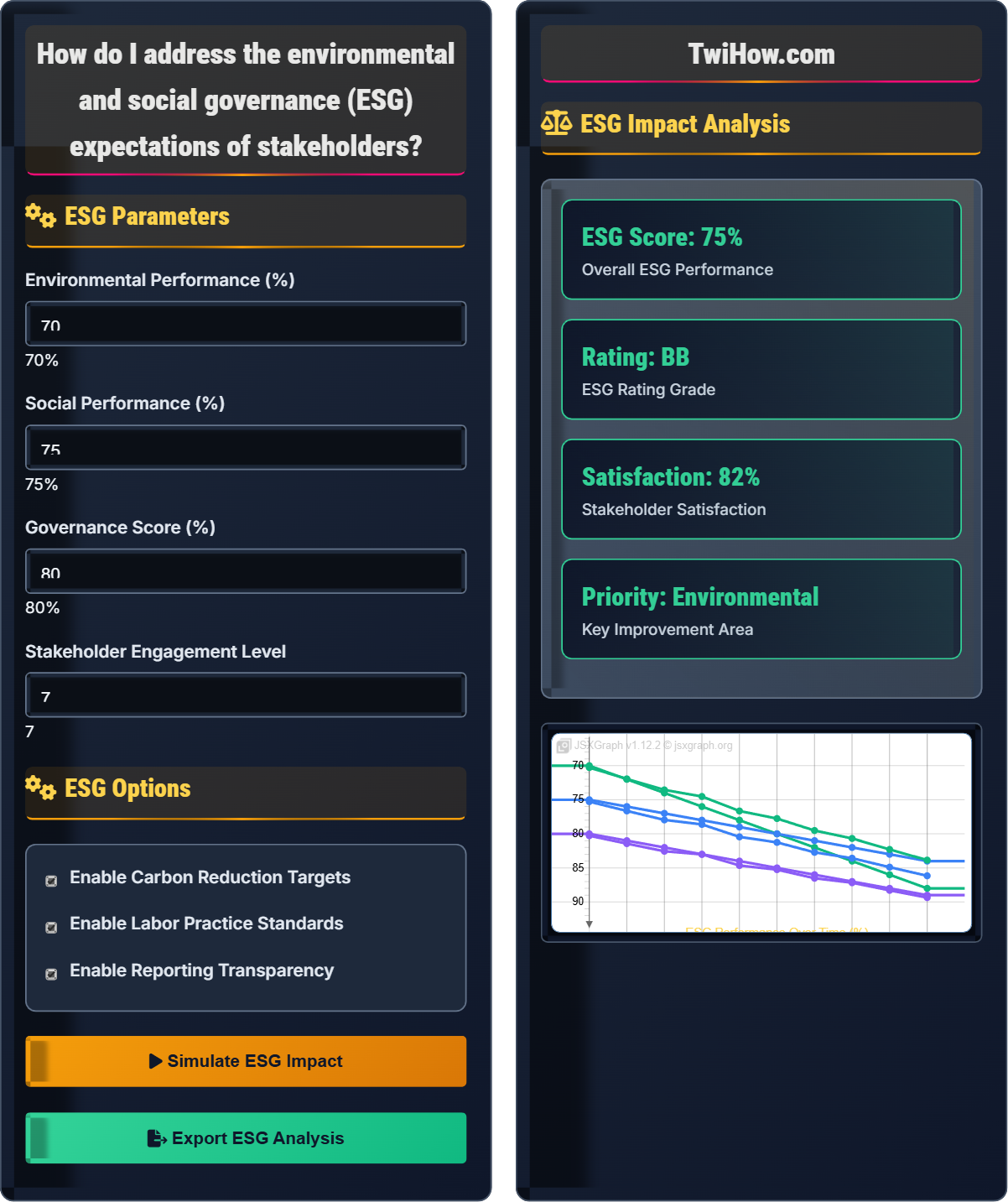
ESG Impact Analysis
| Dimension | Score | Target | Status |
|---|---|---|---|
| Environmental | 70% | 85% | Improving |
| Social | 75% | 80% | On Track |
| Governance | 80% | 85% | On Track |
How ESG Expectations Work in Manufacturing & Supply Chain
Environmental, Social, and Governance (ESG) in manufacturing and supply chain encompasses the systematic approach to managing environmental impacts, social responsibilities, and governance practices throughout the value chain. This framework evaluates how companies address climate change, labor practices, supply chain ethics, transparency, and accountability to stakeholders.
Effective ESG implementation integrates multiple interconnected elements:
Where:
- Environmental Impact: Carbon emissions, resource usage, waste management
- Social Responsibility: Labor practices, community engagement, diversity
- Governance Quality: Transparency, ethics, accountability, compliance
- Stakeholder Expectations: Investor, customer, regulatory, and community demands
Critical ESG focus areas for supply chain operations include:
- Environmental: Carbon footprint, resource efficiency, circular economy practices
- Social: Labor standards, human rights, community impact, supplier diversity
- Governance: Ethics, compliance, transparency, risk management
- Supply Chain: Due diligence, supplier engagement, audit programs
- Reporting: ESG metrics, sustainability reporting, third-party verification
- Stakeholder: Investor relations, customer expectations, regulatory compliance
- Integrated Approach: Embed ESG into business strategy and operations
- Stakeholder Engagement: Regular communication and feedback mechanisms
- Measurement & Reporting: Consistent metrics and transparent disclosure
- Continuous Improvement: Regular assessment and enhancement of practices
- Supply Chain Collaboration: Partner with suppliers on ESG initiatives
- Technology Integration: Use data analytics for ESG monitoring
ESG Fundamentals
ESG, environmental governance, social responsibility, corporate governance, sustainability, stakeholder engagement, ESG reporting, supply chain ethics.
ESG Score = (Environmental + Social + Governance) / Stakeholder Expectations
Where Environmental = carbon reduction, Social = labor practices, Governance = transparency.
- ESG is integral to business strategy
- Stakeholder expectations continue to evolve
- Measurement and transparency are essential
Applications
Manufacturing sustainability, supply chain ethics, corporate reporting, investor relations, regulatory compliance, customer satisfaction.
- Carbon footprint reduction programs
- Supply chain labor standards
- ESG reporting frameworks
- Stakeholder engagement programs
- Regulatory compliance requirements
- Investor and customer expectations
- Industry benchmark comparisons
- Global standard alignment
ESG Stakeholder Engagement Learning Quiz
Which ESG dimension typically has the most immediate impact on stakeholder perceptions in manufacturing?
Environmental ESG typically has the most immediate impact on stakeholder perceptions in manufacturing because environmental impacts are tangible and visible. Issues like pollution, carbon emissions, and resource consumption directly affect communities and customers, making them highly salient to stakeholders.
The answer is C) Environmental.
While all ESG dimensions are important, environmental impacts in manufacturing are often the most immediately visible to stakeholders. Environmental incidents can quickly damage reputations and relationships, making environmental performance a critical starting point for ESG programs. However, all dimensions are interconnected and require attention.
ESG Dimensions: Environmental, Social, and Governance factors
Stakeholder Perceptions: How stakeholders view company performance
Manufacturing Impact: Effects of production activities on stakeholders
• Environmental impacts are often most visible
• All ESG dimensions are interconnected
• Stakeholder priorities vary by context
• Start with most visible impacts
• Address all dimensions systematically
• Engage stakeholders on priorities
• Focusing on only one dimension
• Not measuring stakeholder priorities
• Inconsistent messaging across dimensions
Explain how to develop an effective stakeholder engagement strategy for ESG initiatives in manufacturing and supply chains.
Stakeholder Engagement Strategy:
1. Identification: Map all stakeholders including investors, customers, employees, communities, regulators, suppliers
2. Analysis: Assess stakeholder influence, interest, and ESG priorities
3. Segmentation: Group stakeholders by common interests and concerns
4. Communication: Develop tailored messages for each stakeholder group
5. Feedback: Establish mechanisms for ongoing input and dialogue
6. Integration: Incorporate stakeholder feedback into ESG strategy
Specific Approaches:
• Investor relations: Quarterly ESG reporting and calls
• Customers: Sustainability certifications and transparency
• Communities: Regular meetings and impact reports
• Employees: Training and engagement surveys
• Suppliers: ESG requirements and collaboration
Effective stakeholder engagement requires systematic identification of all parties affected by or interested in ESG performance. Different stakeholders have varying levels of influence and interest, requiring tailored engagement approaches. The goal is to build trust, gather input, and demonstrate responsiveness to stakeholder concerns.
Stakeholder Mapping: Identifying and analyzing stakeholder interests
Engagement Strategy: Planned approach to stakeholder communication
ESG Priorities: Specific ESG concerns of stakeholders
• Engage early and regularly
• Be transparent and honest
• Act on feedback received
• Use multiple communication channels
• Document all interactions
• Measure engagement effectiveness
• Not identifying all stakeholders
• Inconsistent messaging
• Not following up on commitments
A manufacturing company currently emits 100,000 tons of CO2 annually and faces stakeholder pressure to reduce emissions by 50% within 5 years. Calculate the annual reduction target and propose a strategy that addresses stakeholder expectations while maintaining operational efficiency. If they can reduce emissions by 12% annually, what will be their cumulative reduction after 5 years?
Calculations:
Target reduction: 100,000 × 50% = 50,000 tons
Annual reduction target: 50,000 ÷ 5 = 10,000 tons per year
With 12% annual reduction:
Year 1: 100,000 × 0.12 = 12,000 tons reduction
Year 2: 88,000 × 0.12 = 10,560 tons reduction
Year 3: 77,440 × 0.12 = 9,293 tons reduction
Year 4: 68,147 × 0.12 = 8,178 tons reduction
Year 5: 59,969 × 0.12 = 7,196 tons reduction
Total reduction: 47,227 tons (47.2% reduction)
Strategy: Energy efficiency, renewable energy, process optimization, supply chain collaboration.
This example demonstrates the importance of setting realistic yet ambitious ESG targets that meet stakeholder expectations while remaining achievable. The compounding effect of percentage reductions means that actual tonnage reductions decrease over time, requiring careful planning to meet cumulative targets.
Carbon Emissions: Greenhouse gases released from operations
Reduction Targets: Measurable ESG objectivesStakeholder Pressure: External expectations for performance
• Set science-based targets
• Consider operational constraints
• Plan for compounding effects
• Use baseline year for consistency
• Plan interim milestones
• Consider technology roadmaps
• Setting unrealistic targets
• Not considering operational impacts
• Inadequate monitoring systems
A company with 500 suppliers faces increasing ESG scrutiny from investors and customers. Develop a supplier ESG program that addresses stakeholder expectations while maintaining supply chain performance. Include assessment criteria, monitoring mechanisms, and improvement strategies.
Supplier ESG Program:
1. Assessment Criteria: Environmental impact, labor practices, governance standards, risk ratings
2. Segmentation: Categorize suppliers by risk level and impact significance
3. Monitoring: Self-assessments, third-party audits, continuous monitoring tools
4. Support: Training, resources, and collaborative improvement programs
5. Accountability: ESG clauses in contracts, performance reviews, incentive structures
6. Transparency: Reporting on supplier ESG performance and progress
Implementation Strategy: Start with high-risk suppliers, expand systematically, measure impact.
Supplier ESG programs require balancing stakeholder expectations with practical implementation. The key is starting with high-impact suppliers and using a risk-based approach to prioritize efforts. Success depends on collaboration rather than just enforcement, helping suppliers improve rather than simply demanding compliance.
Supplier ESG Assessment: Evaluating supplier ESG performance
Third-Party Audits: Independent verification of ESG practices
Continuous Monitoring: Ongoing ESG performance tracking
• Risk-based approach to prioritization
• Support rather than just enforce
• Measure and report progress
• Use technology for monitoring
• Start with willing suppliers
• Share best practices
• Trying to address all suppliers at once
• Not providing adequate support
• Lacking consistent standards
Which ESG reporting framework provides the most comprehensive guidance for manufacturing companies?
All major ESG reporting frameworks provide valuable guidance for manufacturing companies. GRI covers comprehensive sustainability topics, SASB focuses on industry-specific material issues, and TCFD addresses climate-related financial disclosures. The most comprehensive approach uses multiple frameworks to address different stakeholder needs.
The answer is D) All of the above.
Different ESG reporting frameworks serve different purposes and stakeholder groups. GRI provides comprehensive sustainability reporting, SASB focuses on financially material ESG issues, and TCFD addresses climate risks. Manufacturing companies benefit from using multiple frameworks to meet diverse stakeholder expectations.
GRI Standards: Global Reporting Initiative sustainability framework
SASB Standards: Sustainability Accounting Standards Board
TCFD: Task Force on Climate-related Financial Disclosures
• Use appropriate frameworks for audience
• Maintain consistency across reports
• Align with stakeholder expectations
• Understand stakeholder preferences
• Benchmark against peers
• Integrate reporting systems
• Using only one framework
• Not aligning with stakeholder needs
• Inconsistent reporting approaches
FAQ
Q: How do we balance ESG initiatives with operational efficiency and profitability?
A: Balancing ESG with operations requires strategic integration:
1. Value Creation: Focus on ESG initiatives that also improve efficiency
2. Cost-Benefit Analysis: Quantify both ESG and financial benefits
3. Phased Implementation: Start with high-impact, low-cost initiatives
4. Stakeholder Alignment: Ensure ESG supports business objectives
5. Long-term Perspective: Consider ESG as strategic investment
6. Performance Metrics: Track both ESG and operational KPIs
Many ESG initiatives, like energy efficiency, improve both sustainability and profitability.
Q: What's the difference between ESG compliance and ESG leadership in supply chains?
A: These represent different approaches to ESG management:
ESG Compliance: Meeting minimum regulatory requirements and industry standards. Focus is on avoiding penalties and meeting basic expectations.
ESG Leadership: Exceeding standards and driving innovation in sustainable practices. Focus is on creating competitive advantage and stakeholder value.
Leadership involves proactive initiatives, stakeholder engagement, and continuous improvement beyond compliance requirements.