How do I address the ethical considerations of labor practices in global supply chains?
Complete supply chain ethics guide • Step-by-step explanations
Supply Chain Ethics Fundamentals:
Show Ethics SimulatorAddressing ethical considerations in global supply chains involves implementing comprehensive strategies to ensure fair labor practices, eliminate human trafficking, prevent child labor, and maintain safe working conditions across all tiers of suppliers. This requires establishing clear standards, conducting regular audits, building supplier relationships, and maintaining transparency throughout the entire supply network.
Key ethical labor practices include ensuring living wages, safe working conditions, freedom of association, and non-discrimination policies. Modern approaches combine compliance monitoring with capacity building and collaborative partnerships to create sustainable improvements.
Core components:
- Compliance Standards: Codes of conduct, certifications, and audit protocols
- Risk Assessment: Country risk mapping, supplier evaluation, and vulnerability analysis
- Supplier Management: Onboarding, training, and ongoing relationship management
- Transparency: Reporting, traceability systems, and stakeholder communication
Successful implementation requires commitment from leadership, adequate resources, and continuous improvement processes to adapt to evolving challenges and regulations.
Supply Chain Ethics Parameters
Ethics Options
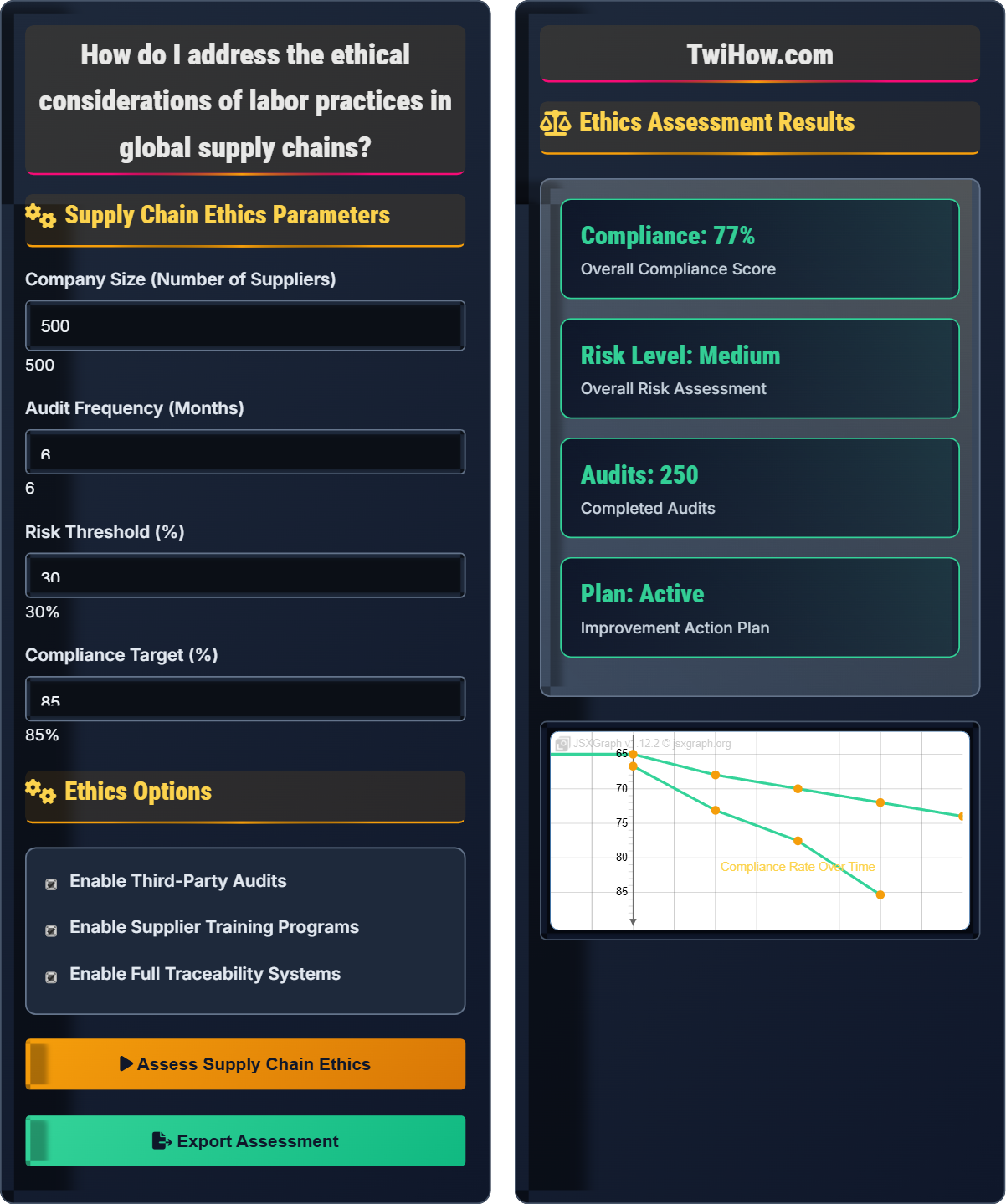
Ethics Assessment Results
| Quarter | Compliance | Risk Level | Audits |
|---|---|---|---|
| Q1 | 65% | Medium | 30 |
| Q2 | 72% | Medium | 52 |
| Q3 | 78% | Low | 80 |
| Q4 | 82% | Low | 124 |
How Supply Chain Ethics Work Explained
Supply chain ethics refers to the moral principles and standards that govern business practices throughout the entire supply network, from raw material sourcing to final product delivery. It encompasses ensuring fair labor practices, environmental sustainability, anti-corruption measures, and respect for human rights across all tiers of suppliers and partners.
Effective supply chain ethics programs include multiple interconnected elements:
Where:
- Compliance Rate: Percentage of suppliers meeting ethical standards
- Audit Coverage: Proportion of suppliers regularly audited
- Training Effectiveness: Improvement in supplier practices
- Risk Factors: Geographical, operational, and financial risks
Critical ethical considerations in global supply chains:
- Labor Rights: Fair wages, safe working conditions, freedom of association
- Child Labor: Prevention and remediation programs
- Forced Labor: Human trafficking prevention and victim support
- Environmental Impact: Sustainable practices and resource management
- Anti-Corruption: Transparency and ethical business practices
- Diversity & Inclusion: Fair treatment and equal opportunities
- Multi-Tier Visibility: Map and monitor suppliers beyond Tier 1
- Collaborative Approach: Work with suppliers to drive improvements
- Technology Integration: Use digital tools for real-time monitoring
- Stakeholder Engagement: Involve workers, communities, and NGOs
- Regular Updates: Adapt policies to changing regulations and expectations
- Transparency: Public reporting and third-party verification
Ethics Fundamentals
Codes of conduct, audit protocols, risk assessment, supplier engagement, compliance monitoring, transparency.
Compliance Score = (Passed Audits / Total Audits) × 100%
Where Passed Audits = Suppliers meeting all ethical requirements, Total Audits = All assessments conducted.
- Due diligence extends to all supply chain tiers
- Regular audits are essential for compliance
- Corrective action plans must be implemented
Applications
Manufacturing compliance, textile industry monitoring, electronics sourcing, food safety, pharmaceutical supply chains.
- Apparel and textiles compliance
- Electronics component sourcing
- Food and agriculture monitoring
- Automotive parts verification
- Regulatory compliance requirements
- Consumer expectations and brand reputation
- Investor pressure for ESG reporting
- Legal liability and risk management
Supply Chain Ethics Learning Quiz
Which of the following is NOT typically included in a supplier code of conduct?
Supplier codes of conduct typically focus on ethical practices including labor rights, environmental protection, and anti-corruption measures. Product pricing guidelines are business terms that belong in commercial agreements rather than ethical standards.
The answer is C) Product pricing guidelines.
Understanding the distinction between ethical requirements and business terms is crucial for effective supply chain management. Ethical standards address human rights, environmental protection, and integrity, while commercial terms cover pricing, delivery, and quality specifications. Separating these helps ensure that ethical obligations remain paramount regardless of commercial pressures.
Code of Conduct: Document outlining ethical standards suppliers must follow
Child Labor: Employment of children below minimum age for work
Anti-Corruption: Policies preventing bribery and unethical practices
• Ethical standards are non-negotiable
• Commercial terms are separate from ethics
• Regular updates ensure relevance
• Clearly define ethical vs. commercial terms
• Use international standards as baseline
• Regular training ensures understanding
• Confusing ethics with commercial terms
• Not adapting to local regulations
• Failing to communicate standards clearly
Explain the key steps in conducting an ethical audit of a supplier facility and describe how to handle findings of non-compliance.
Audit Steps:
1. Preparation: Review documentation, plan visit, assemble team
2. On-site Assessment: Interview workers, inspect facilities, review records
3. Evidence Collection: Document findings with photos and records
4. Analysis: Compare findings to standards and regulations
5. Reporting: Issue detailed report with findings and recommendations
Non-Compliance Response:
• Immediate actions for serious violations (forced labor, child labor)
• Collaborative corrective action plans for minor issues
• Timeline with milestones for improvement
• Follow-up audits to verify corrections
• Termination for persistent non-compliance
Effective auditing requires systematic approach and clear procedures. The audit process must balance verification with relationship building, as most issues can be resolved through collaboration. However, serious violations require immediate action to protect workers and maintain ethical standards. The goal is continuous improvement while ensuring worker protection.
Corrective Action Plan: Documented steps to address audit findings
Immediate Action: Urgent response to serious violations
Follow-up Audit: Verification of corrective measures
• Serious violations require immediate action
• Worker interviews are essential
• Documentation must be thorough
• Include worker interviews in every audit
• Provide support for improvement
• Maintain consistent standards
• Not interviewing workers privately
• Accepting inadequate corrective plans
• Failing to verify improvements
A global electronics manufacturer sources components from 500 Tier 1 suppliers, each of whom has an average of 10 Tier 2 suppliers. The company discovers that 20% of Tier 2 suppliers have labor violations. Calculate the total number of suppliers affected and propose a strategy to address this issue while maintaining supply continuity.
Calculation:
Total Tier 2 suppliers = 500 Tier 1 suppliers × 10 Tier 2 suppliers = 5,000 Tier 2 suppliers
Suppliers with violations = 20% of 5,000 = 1,000 suppliers
Strategy:
1. Immediate Assessment: Prioritize high-risk violations (child labor, forced labor)
2. Corrective Action: Develop improvement plans with timelines
3. Capacity Building: Provide training and resources
4. Monitoring: Increased audit frequency for violators
5. Contingency Planning: Identify alternative suppliers
6. Transparency: Report progress publicly
This scenario illustrates the complexity of multi-tier supply chains, where companies may have limited visibility beyond their direct suppliers. The exponential growth of suppliers at each tier creates significant monitoring challenges. Effective strategies must balance ethical imperatives with business continuity, often requiring collaborative improvement efforts rather than immediate termination.
Tier 1 Suppliers: Direct suppliers to the company
Tier 2 Suppliers: Suppliers to Tier 1 suppliers
Multi-Tier Visibility: Understanding suppliers beyond direct relationships
• Due diligence extends beyond Tier 1
• Business continuity requires planning
• Collaboration often yields better results
• Map multi-tier supply chains systematically
• Focus on high-risk areas first
• Build supplier capacity proactively
• Limited visibility beyond Tier 1
• Reactive rather than proactive approach
• Not balancing ethics with business needs
A fashion retailer operates in 15 countries with varying risk levels for labor violations. Country A has a 5% risk rate with 50 suppliers, Country B has 25% risk with 30 suppliers, and Country C has 40% risk with 20 suppliers. Calculate the weighted risk score and recommend allocation of audit resources based on this assessment.
Calculations:
Country A: 5% × 50 = 2.5 expected violations
Country B: 25% × 30 = 7.5 expected violations
Country C: 40% × 20 = 8 expected violations
Total expected violations = 2.5 + 7.5 + 8 = 18
Resource Allocation:
• Country C: 44% of audits (8/18) - highest priority
• Country B: 42% of audits (7.5/18) - high priority
• Country A: 14% of audits (2.5/18) - routine monitoring
This approach maximizes impact by focusing resources where risks are greatest.
Risk-based auditing allocates resources proportionally to potential impact, maximizing effectiveness with limited budgets. The weighted approach considers both the probability of violations (risk rate) and the potential scale (number of suppliers). This method ensures that high-risk areas receive appropriate attention while maintaining coverage of lower-risk operations.
Risk-Based Auditing: Allocating audit resources based on risk levels
Weighted Risk Score: Combining probability and scale of risks
Resource Optimization: Maximizing impact with available resources
• Risk assessment must be data-driven
• Resource allocation follows risk priorities
• Continuous monitoring refines assessments
• Use historical data for risk assessment
• Adjust allocations based on results
• Consider emerging risks regularly
• Equal distribution regardless of risk
• Outdated risk assessments
• Not tracking audit effectiveness
Which technology solution is most effective for achieving real-time visibility into multi-tier supply chains?
Blockchain-based tracking systems offer distributed, immutable records that can provide real-time visibility across complex multi-tier supply chains. Unlike traditional methods, blockchain enables transparent, tamper-proof tracking of products and materials from origin to destination, facilitating rapid identification of issues and ensuring accountability.
The answer is B) Blockchain-based tracking systems.
Traditional supply chain management relies on periodic audits and manual reporting, which creates blind spots and delays in identifying issues. Modern technologies like blockchain, IoT sensors, and AI-powered analytics enable real-time monitoring and predictive capabilities. These solutions enhance transparency, accelerate response times, and improve overall supply chain resilience.
Real-Time Visibility: Immediate access to supply chain status
Blockchain Tracking: Distributed ledger for transparent record-keeping
Multi-Tier Mapping: Understanding all supply chain levels
• Technology must scale with supply chain
• Integration with existing systems is key
• Data security and privacy are critical
• Start with pilot programs
• Focus on high-risk areas first
• Ensure supplier adoption
• Overlooking supplier technology readiness
• Not considering integration costs
• Underestimating change management
FAQ
Q: How do we balance cost pressures with ethical supply chain requirements?
A: Balancing cost and ethics requires strategic thinking and long-term perspective:
1. Shared Value Creation: Invest in supplier development to improve efficiency and compliance simultaneously
2. Consolidated Sourcing: Work with fewer suppliers who meet ethical standards
3. Long-term Contracts: Provide stability in exchange for ethical commitments
4. Brand Protection: Recognize that ethical breaches cost more than compliance
5. Stakeholder Alignment: Communicate ethical investments to investors and customers
Ultimately, ethical supply chains often become more efficient and resilient over time.
Q: What's the difference between compliance auditing and capacity building in supply chain ethics?
A: These represent different approaches to supply chain ethics:
Compliance Auditing: Focuses on verifying adherence to standards through inspections and assessments. It's reactive, identifying problems after they occur. Audits typically result in pass/fail determinations and corrective action plans.
Capacity Building: Proactive approach that develops supplier capabilities through training, resources, and collaborative improvement. It addresses root causes rather than symptoms, creating sustainable change.
Best practice combines both approaches: auditing identifies issues while capacity building prevents them. This dual strategy creates more resilient and ethical supply chains.