How to Build Resilience Into Your Supply Chain Against Disruptions
Supply chain resilience guide • Step-by-step explanations
Supply Chain Resilience:
Show Resilience CalculatorBuilding resilience into your supply chain is crucial for navigating today's volatile business environment. Supply chain resilience refers to the ability to anticipate, prepare for, respond to, and adapt to disruptions while maintaining operational continuity. This involves creating redundancy, diversifying suppliers, investing in visibility technologies, and establishing robust contingency plans to ensure business continuity during unexpected events.
Key resilience strategies include:
- Supplier Diversification: Multiple suppliers across different geographic regions
- Demand Forecasting: Advanced analytics for better demand prediction
- Inventory Buffering: Strategic stockpiling of critical components
- Technology Integration: Real-time visibility and predictive analytics
- Flexible Operations: Agile processes that can quickly adapt to changes
Resilient supply chains not only survive disruptions but emerge stronger, with enhanced capabilities to handle future challenges and competitive advantages.
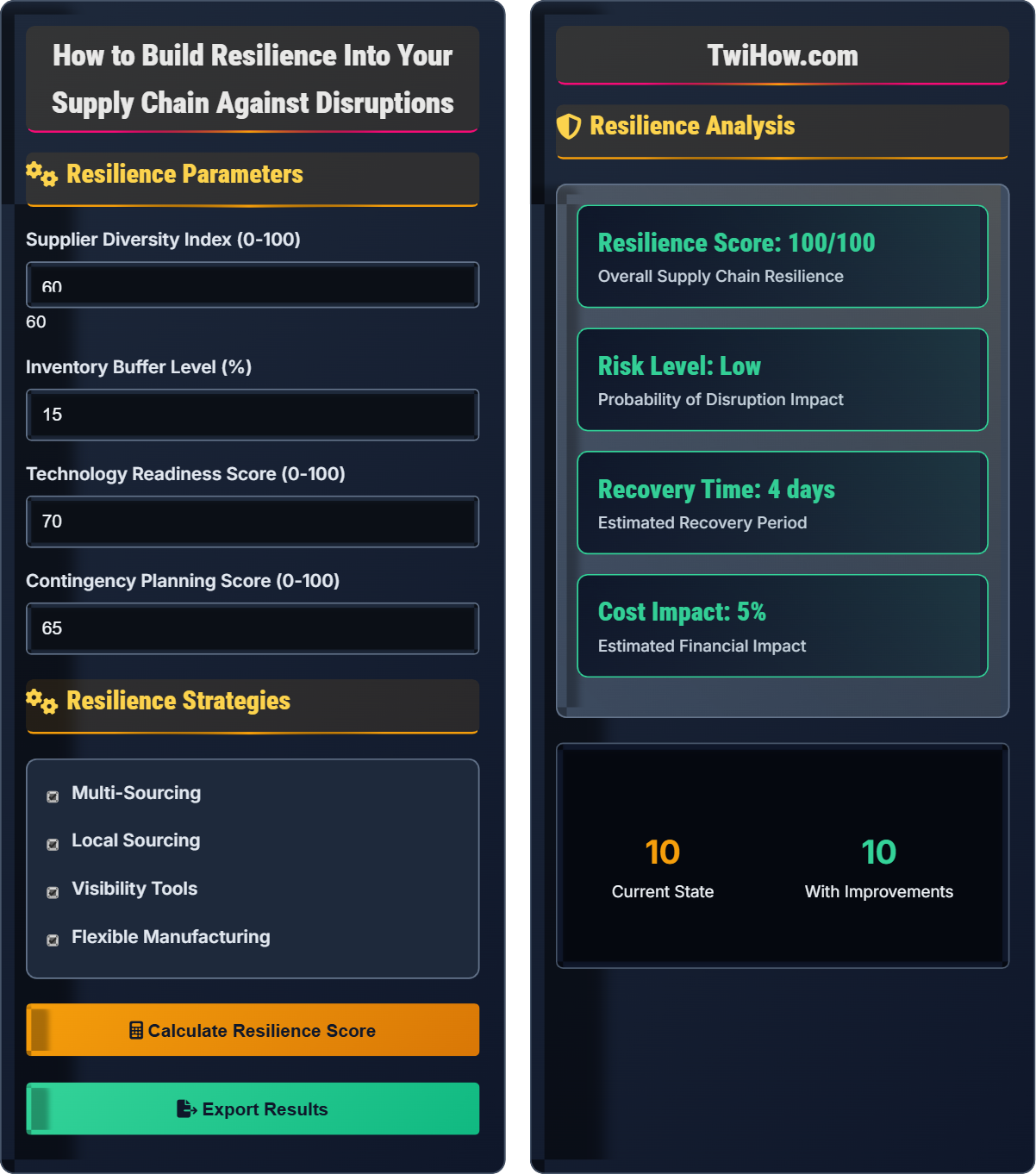
Resilience Parameters
Resilience Strategies
Resilience Analysis
| Component | Score | Target | Status |
|---|---|---|---|
| Supplier Diversity | 60 | 80 | Needs Improvement |
| Inventory Buffer | 15% | 25% | Needs Improvement |
| Technology Readiness | 70 | 85 | Good |
| Contingency Planning | 65 | 80 | Needs Improvement |
| Risk Management | 68 | 85 | Good |
Recommended Actions
- Expand supplier base to reduce dependency on single sources
- Increase inventory buffers for critical components
- Implement real-time supply chain visibility tools
- Develop alternative transportation routes
- Strengthen supplier relationships and communication
Implementation Benefits
- Reduced disruption impact
- Shorter recovery times
- Lower financial losses
- Enhanced customer satisfaction
- Competitive advantage
Building Resilient Supply Chains Against Disruptions
Supply chain resilience is the ability of a supply network to anticipate, prepare for, respond to, and adapt to disruptions while maintaining operational continuity. It encompasses the capacity to absorb shocks, recover quickly from setbacks, and emerge stronger from challenges. Resilient supply chains incorporate redundancy, flexibility, and visibility to withstand various types of disruptions while continuing to deliver value to customers.
The supply chain resilience index can be calculated as:
Where:
- Diversity Score: Supplier diversification and geographic spread
- Flexibility Score: Ability to adapt operations quickly
- Visibility Score: Real-time tracking and monitoring capabilities
- Recovery Score: Speed and effectiveness of recovery plans
Key strategies for building supply chain resilience:
- Supplier Diversification: Multiple suppliers across different regions
- Inventory Buffering: Strategic stockpiling of critical items
- Technology Integration: Real-time visibility and predictive analytics
- Flexible Operations: Agile processes that can adapt quickly
- Strong Partnerships: Collaborative relationships with suppliers
- Scenario Planning: Preparing for various disruption scenarios
- Apple: Diversified supplier base across multiple countries
- Toyota: Just-in-time with backup suppliers and inventory buffers
- Unilever: Regional sourcing strategies for local resilience
- Procter & Gamble: Integrated supply chain visibility systems
- McDonald's: Flexible menu and ingredient substitution strategies
Core Concepts
Supply chain resilience, risk management, supplier diversification, inventory buffering, demand forecasting, contingency planning, business continuity.
Resilience Score = (Supplier Diversity × 0.25) + (Inventory Buffer × 0.2) + (Technology Readiness × 0.25) + (Contingency Planning × 0.2) + (Flexibility × 0.1)
Where scores range from 0-100, with higher scores indicating greater resilience.
- Anticipate and prepare for disruptions
- Build redundancy and flexibility
- Invest in visibility and technology
- Maintain strong supplier relationships
Implementation Strategies
Multi-sourcing, local sourcing, visibility tools, flexible manufacturing, inventory optimization, contingency planning.
- Assess current supply chain vulnerabilities
- Identify critical suppliers and components
- Develop diversification strategies
- Implement visibility technologies
- Create contingency plans
- Test and refine strategies
- Start with critical components first
- Balance cost with resilience
- Regularly review and update plans
- Collaborate with suppliers on resilience
Supply Chain Resilience Quiz
What is the primary benefit of supplier diversification in building supply chain resilience?
The primary benefit of supplier diversification is reduced dependency risk. By having multiple suppliers, a company reduces its vulnerability to disruptions from any single supplier. If one supplier faces issues, alternative suppliers can maintain operations, ensuring continuity of supply and reducing the impact of disruptions.
The answer is B) Reduced dependency risk.
Supplier diversification follows the fundamental principle of risk management: don't put all your eggs in one basket. In supply chain contexts, this means spreading procurement across multiple suppliers to reduce the risk of total disruption. The strategy works because the probability of all suppliers failing simultaneously is much lower than the probability of a single supplier failing.
Supplier Diversification: Using multiple suppliers to reduce risk
Dependency Risk: Risk associated with relying on single sources
Supply Continuity: Maintaining uninterrupted supply of materials
• Diversification reduces single-point-of-failure risk
• Geographic spread adds additional protection
• Balance diversification with management complexity
• Aim for at least 3-5 suppliers for critical items
• Spread suppliers across different regions
• Maintain good relationships with all suppliers
• Over-diversifying and increasing complexity
• Not considering supplier capacity and quality
• Focusing only on cost instead of resilience
Explain the concept of inventory buffering and how it contributes to supply chain resilience. What are the trade-offs involved?
Inventory Buffering: Strategic stockpiling of critical materials to provide protection against supply disruptions. Buffers act as a cushion between supply and demand uncertainties.
Contribution to Resilience:
1. Disruption Protection: Maintains operations during supplier disruptions
2. Lead Time Variability: Absorbs variations in delivery times
3. Demand Fluctuations: Handles unexpected increases in demand
4. Price Volatility: Allows purchasing during favorable price periods
Trade-offs: Higher carrying costs, capital tie-up, obsolescence risk, storage requirements vs. improved service levels and reduced disruption risk.
Inventory buffering represents a fundamental trade-off in supply chain management between cost efficiency and resilience. While lean inventory practices reduce costs, they also increase vulnerability to disruptions. The key is finding the optimal balance where the cost of carrying additional inventory is less than the cost of potential disruptions. This requires sophisticated analysis of disruption probabilities, costs, and service level requirements.
Inventory Buffer: Extra stock held for protection against uncertainty
Carrying Costs: Costs associated with holding inventory
Service Level: Probability of meeting customer demand
• Critical items require larger buffers
• Balance cost vs. risk mitigation
• Regularly review buffer levels
• Use ABC analysis to prioritize buffering
• Consider safety stock formulas
• Review buffers based on seasonality
• Applying uniform buffers to all items
• Not adjusting for changing conditions
• Over-buffering low-value items
A company relies on a single supplier for a critical component that costs $500 per unit. The probability of supplier disruption is 15% annually, and a disruption would cause a 30-day shutdown with daily losses of $20,000. The company can diversify by adding a second supplier for $50,000 annually. Calculate whether diversification is financially beneficial, assuming it reduces disruption probability to 5%.
Current Risk Cost:
Annual disruption probability: 15%
Cost per disruption: 30 days × $20,000/day = $600,000
Expected annual cost: 15% × $600,000 = $90,000
With Diversification:
Annual disruption probability: 5%
Cost per disruption: $600,000
Expected annual cost: 5% × $600,000 = $30,000
Additional diversification cost: $50,000
Total cost with diversification: $30,000 + $50,000 = $80,000
Conclusion: Diversification saves $10,000 annually ($90,000 - $80,000), making it financially beneficial.
This calculation demonstrates how to make data-driven decisions about resilience investments. The key is comparing the cost of protective measures against the expected cost of disruptions they prevent. In this case, the diversification cost is justified by the risk reduction it provides. This approach can be applied to various resilience strategies to determine their economic viability.
Expected Value: Probability-weighted average outcome
Risk Mitigation: Actions that reduce potential losses
Cost-Benefit Analysis: Comparing costs vs. benefits of actions• Calculate expected costs of disruptions
• Compare mitigation costs to risk reduction
• Consider both tangible and intangible benefits
• Include intangible costs in calculations
• Consider compounding effects of disruptions
• Account for inflation and changing probabilities
• Not considering probability changes with diversification
• Ignoring intangible costs and benefits
• Failing to update calculations regularly
A food manufacturer supplies a major retailer with 10,000 units weekly. Their primary plant can produce 8,000 units/week, with a backup plant that can produce 5,000 units/week. Transportation takes 2 days, and they maintain 1 week of inventory. A disruption at the primary plant occurred for 2 weeks. Calculate the supply shortfall and suggest contingency improvements.
Weekly Demand: 10,000 units
Current Capacity: Primary (8,000) + Backup (5,000) = 13,000 units/week
Available Inventory: 10,000 units (1 week supply)
During 2-week disruption:
Week 1: Supply 5,000 (backup) + 10,000 (inventory) = 15,000 units
Week 2: Supply 5,000 (backup only) = 5,000 units
Shortfall: Week 2: 10,000 - 5,000 = 5,000 units
Contingency Improvements: Increase backup capacity, boost inventory, identify additional suppliers, negotiate flexible contracts.
This problem demonstrates the importance of capacity planning in contingency strategies. The company has sufficient total capacity but inadequate backup capacity to handle primary plant disruptions. The solution shows how to calculate shortfall and identify improvement opportunities. This type of analysis helps companies prepare for specific disruption scenarios.
Capacity Planning: Determining production capabilities
Backup Capacity: Alternative production capabilities
Supply Shortfall: Gap between demand and available supply
• Backup capacity should cover critical demand
• Inventory levels should reflect disruption duration
• Plans must be executable in real scenarios
• Model various disruption scenarios
• Test plans through simulations
• Maintain flexibility in contracts
• Underestimating disruption duration
• Not accounting for transportation delays
• Failing to update plans regularly
Which technology has the greatest impact on supply chain resilience visibility?
While all technologies contribute to visibility, IoT sensors provide the most direct impact on real-time visibility. IoT sensors enable continuous monitoring of goods, locations, conditions, and movements throughout the supply chain. They provide granular, real-time data that allows immediate response to disruptions and better anticipation of potential issues.
The answer is B) IoT Sensors.
IoT sensors transform supply chain visibility by providing real-time, granular data about shipments, inventory levels, storage conditions, and transportation status. This level of detail enables proactive management and rapid response to disruptions. While ERP systems and blockchain provide important foundational capabilities, IoT sensors deliver the real-time visibility that directly supports resilience by enabling immediate awareness of disruptions.
IoT Sensors: Internet-connected devices that collect data
Real-Time Visibility: Immediate awareness of supply chain status
Proactive Management: Taking action before problems occur
• Visibility enables rapid response
• Real-time data is critical for resilience
• Technology must be integrated across supply chain
• Start with critical items for tracking
• Ensure data quality and reliability
• Integrate with decision-making systems
• Implementing technology without strategy
• Not ensuring data accuracy
• Failing to integrate with existing systems
FAQ
Q: How can small suppliers build resilience in their own operations to better serve their customers?
A: Small suppliers can build resilience through:
1. Relationship Building: Develop strong partnerships with customers and other suppliers
2. Flexible Capacity: Maintain some excess capacity for emergency orders
3. Quality Focus: Reduce defects and rework that can cause delays
4. Simple Technology: Use basic tracking and communication tools
5. Financial Stability: Maintain cash reserves for disruptions
6. Alternative Resources: Identify backup suppliers for raw materials
Focus on what you can control and communicate proactively with customers.
Q: How do I balance cost reduction with supply chain resilience?
A: Balance cost and resilience through:
Strategic Sourcing: Diversify critical items while consolidating non-critical items
Smart Inventory: Focus buffers on high-risk, high-impact items
Collaborative Relationships: Work with suppliers to reduce costs while improving reliability
Technology Investment: Use data analytics to optimize both cost and resilience
Scenario Planning: Quantify the cost of disruptions to justify resilience investments
The goal is to achieve optimal resilience, not maximum resilience.