How to Evaluate and Select Suppliers for Quality, Cost, and Sustainability
Supply chain management guide • Step-by-step explanations
Supplier Evaluation:
Show Supplier Evaluation CalculatorEffective supplier evaluation and selection is crucial for maintaining competitive advantage in today's global marketplace. Modern procurement strategies must balance three critical dimensions: quality standards, cost efficiency, and sustainability practices. This comprehensive approach ensures long-term value creation while managing risks and meeting stakeholder expectations.
Key evaluation criteria include:
- Quality Standards: Certifications, defect rates, process controls
- Cost Competitiveness: Total cost of ownership, pricing strategies
- Sustainability Practices: Environmental impact, social responsibility
- Reliability: Delivery performance, capacity, financial stability
- Innovation Capability: Technology adoption, R&D investment
Successful supplier selection requires a systematic approach that weighs these factors appropriately based on your organization's priorities and strategic objectives.
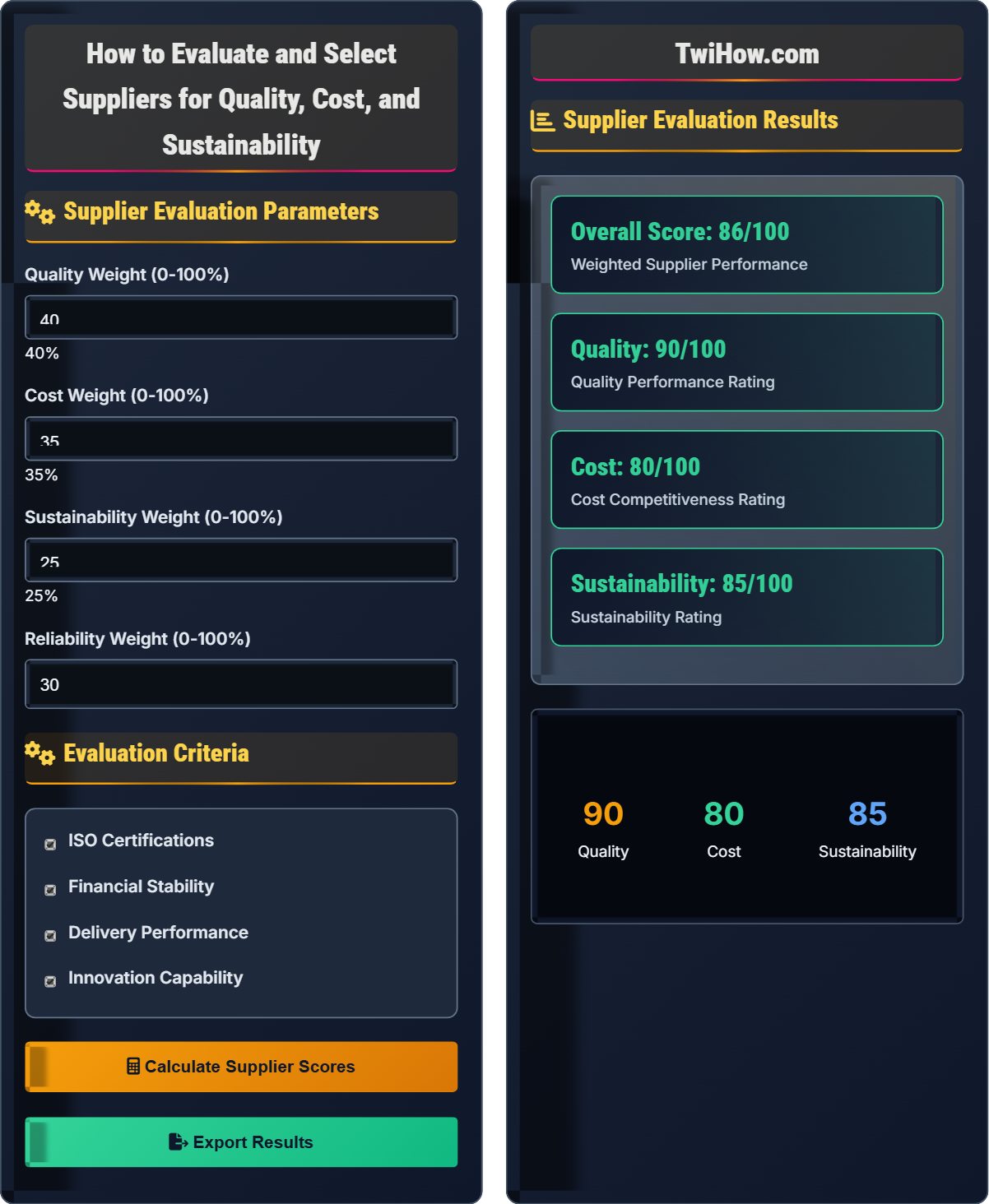
Supplier Evaluation Parameters
Evaluation Criteria
Supplier Evaluation Results
| Criterion | Weight | Score | Contribution |
|---|---|---|---|
| Quality | 40% | 90 | 36.0 |
| Cost | 35% | 80 | 28.0 |
| Sustainability | 25% | 85 | 21.25 |
| Reliability | 30% | 88 | 26.4 |
| Overall | 100% | 85 | 100.0 |
Recommendations
- Supplier meets quality standards with excellent certification
- Cost competitive but room for negotiation
- Strong sustainability practices aligned with corporate goals
- Reliable delivery performance with financial stability
- Recommended for long-term partnership
Areas for Improvement
- Negotiate better pricing terms
- Request sustainability reporting metrics
- Establish penalty clauses for late deliveries
- Plan for capacity expansion discussions
Supplier Evaluation and Selection Best Practices
Supplier evaluation is a systematic process of assessing potential and existing suppliers based on multiple criteria including quality, cost, delivery, service, and sustainability. This process helps organizations make informed decisions about which suppliers to work with, ensuring they meet business requirements while minimizing risks and optimizing value.
The weighted supplier score can be calculated as:
Where:
- Criterion Score: Performance rating for each criterion (0-100)
- Weight: Importance factor for each criterion (0-1)
- Sum: All weights should equal 100%
Key criteria for supplier evaluation:
- Quality: Product specifications, defect rates, certifications
- Cost: Pricing, payment terms, total cost of ownership
- Sustainability: Environmental impact, social responsibility
- Reliability: Delivery performance, capacity, financial stability
- Service: Responsiveness, support, communication
- Innovation: R&D capabilities, technology adoption
- Apple: Strict quality and sustainability standards for component suppliers
- Walmart: Sustainability scorecards for all major suppliers
- Toyota: Long-term partnerships based on quality and continuous improvement
- Unilever: Sustainable sourcing requirements for all ingredients
- Google: Vendor sustainability assessments and reporting
Core Concepts
Supplier evaluation, TCO, quality management, sustainability assessment, vendor selection, procurement, supplier audit, risk management, vendor relationship management.
Composite Score = (Quality × Weight₁) + (Cost × Weight₂) + (Sustainability × Weight₃) + (Reliability × Weight₄) + (Innovation × Weight₅)
Where all weights sum to 100% and each criterion is scored 0-100.
- Balance multiple criteria
- Assign appropriate weights
- Verify supplier claims
- Regular performance review
Implementation Strategies
ISO certifications, financial stability assessment, delivery performance tracking, innovation capability evaluation, sustainability metrics, supplier audits.
- Define evaluation criteria and weights
- Develop assessment tools and processes
- Collect supplier information
- Conduct supplier audits
- Calculate composite scores
- Make selection decisions
- Use multiple evaluation methods
- Validate supplier information
- Consider long-term partnership
- Regular supplier reviews
Supplier Evaluation Quiz
Which factor should typically receive the highest weight in supplier evaluation?
The appropriate weights for supplier evaluation criteria depend on the specific business requirements, industry, and strategic objectives. A luxury goods manufacturer may prioritize quality over cost, while a discount retailer may emphasize cost competitiveness. The key is aligning weights with business priorities.
The answer is C) Depends on business requirements.
Supplier evaluation weights should reflect the organization's strategic priorities. There is no universal weighting scheme that works for all companies. The weights assigned to quality, cost, and sustainability should be determined based on factors such as product type, market positioning, customer requirements, and regulatory environment. This ensures that the evaluation process aligns with business objectives.
Weight Assignment: Importance factors for evaluation criteria
Strategic Priorities: Company's key business objectives
Business Requirements: Specific needs and constraints
• Weights should reflect business priorities
• Consider total cost of ownership
• Balance multiple criteria
• Involve stakeholders in weight determination
• Review weights periodically
• Consider supplier impact on business
• Using standard weights for all suppliers
• Not considering business context
• Focusing only on price
Explain how to assess supplier quality and what metrics are most important. How does this relate to supplier selection?
Quality Assessment Methods:
1. Certifications: ISO 9001, Six Sigma, industry-specific standards
2. Defect Rates: Defective units per million, return rates
3. Process Controls: Statistical process control, quality management systems
4. Audits: On-site inspections, quality system reviews
5. Performance History: Past performance data, customer complaints
Key Metrics: Defect rate, on-time delivery, quality certifications, corrective action response time
Quality assessment directly impacts supplier selection as poor quality can lead to customer dissatisfaction, recalls, and increased costs. High-quality suppliers are essential for maintaining product standards and brand reputation.
Quality assessment in supplier evaluation involves both objective metrics and subjective evaluations. The most effective approach combines quantitative measurements (defect rates, performance data) with qualitative assessments (certifications, audit findings). Quality is often the most critical factor in supplier selection because poor quality can have cascading effects throughout the supply chain, affecting customer satisfaction and company reputation.
Defect Rate: Percentage of defective products
ISO 9001: International quality management standard
Statistical Process Control: Method for monitoring quality
• Quality should never be compromised
• Verify quality claims independently
• Consider long-term quality performance
• Request quality reports regularly
• Conduct surprise audits
• Benchmark against industry standards
• Relying only on supplier claims
• Not verifying quality certifications
• Focusing only on current performance
A company is evaluating two suppliers for a component. Supplier A offers $10 per unit with 99% quality rate and on-time delivery. Supplier B offers $9 per unit but has 97% quality rate and 95% on-time delivery. If the company orders 10,000 units annually, calculate the total cost of ownership including quality and delivery penalties (assume $5 penalty per defective unit and $10 penalty per late delivery).
Supplier A:
Unit cost: $10 × 10,000 = $100,000
Defects: (1 - 0.99) × 10,000 = 100 units
Quality penalty: 100 × $5 = $500
Delays: (1 - 1.00) × 10,000 = 0 units
Delivery penalty: 0 × $10 = $0
Total Cost A: $100,000 + $500 + $0 = $100,500
Supplier B:
Unit cost: $9 × 10,000 = $90,000
Defects: (1 - 0.97) × 10,000 = 300 units
Quality penalty: 300 × $5 = $1,500
Delays: (1 - 0.95) × 10,000 = 500 units
Delivery penalty: 500 × $10 = $5,000
Total Cost B: $90,000 + $1,500 + $5,000 = $96,500
Supplier B has lower TCO despite higher defect and delay rates.
This calculation demonstrates the importance of considering total cost of ownership rather than just unit price. While Supplier A has superior quality and delivery, Supplier B's lower unit cost compensates for the penalties. However, this analysis should also consider intangible costs like customer satisfaction, brand damage, and potential recall costs that may not be captured in direct penalties.
TCO: Total Cost of Ownership - all costs over product lifecycle
Penalty Costs: Additional costs for poor performance
Quality Rate: Percentage of defect-free products
• Consider all costs in TCO
• Include quality and delivery penalties
• Account for intangible costs
• Calculate TCO for different scenarios
• Include hidden costs in analysis
• Consider long-term cost implications
• Focusing only on unit price
• Not including penalty costs
• Ignoring intangible costs
A company wants to evaluate suppliers based on sustainability criteria. Define a scoring system for sustainability assessment that includes environmental impact, social responsibility, and governance. How would you weight these factors and what metrics would you use?
Sustainability Scoring System:
Environmental Impact (40%):
- Carbon footprint (0-25 points)
- Waste reduction programs (0-15 points)
- Energy efficiency initiatives (0-15 points)
Social Responsibility (35%):
- Labor practices compliance (0-20 points)
- Community involvement (0-10 points)
- Health and safety records (0-15 points)
Governance (25%):
- Transparency in reporting (0-10 points)
- Ethical business practices (0-10 points)
- Compliance certifications (0-10 points)
Metrics: Carbon emissions per unit, waste reduction percentage, safety incident rates, ethical compliance scores.
Sustainability assessment requires a balanced approach that considers environmental, social, and governance factors (ESG). The weights can be adjusted based on industry and stakeholder priorities. Environmental impact often receives the highest weight due to growing climate concerns. The scoring system should use measurable metrics that can be verified and tracked over time.
ESG: Environmental, Social, and Governance criteria
Carbon Footprint: Total greenhouse gas emissions
Sustainability Score: Composite rating for ESG factors
• Use measurable and verifiable metrics
• Balance all ESG factors
• Regular assessment and updates
• Require third-party sustainability certifications
• Track metrics over time
• Benchmark against industry standards
• Using subjective sustainability measures
• Not verifying sustainability claims
• Focusing only on environmental factors
Which supplier characteristic poses the highest risk to the supply chain?
All of these characteristics pose significant risks to the supply chain. Financial instability can lead to supplier bankruptcy, inconsistent quality affects product integrity, and delivery delays disrupt production schedules. The relative importance depends on the business context, but all represent critical supply chain risks that must be managed.
The answer is D) All of the above.
Supply chain risk management requires consideration of multiple risk factors. Financial risk, quality risk, and delivery risk all have the potential to severely disrupt operations. The most effective approach is to develop a comprehensive risk assessment that considers all these factors and implements mitigation strategies for each. Risk assessment should be ongoing and dynamic.
Supply Chain Risk: Potential for disruption to supply
Financial Stability: Supplier's ability to remain operational
Risk Mitigation: Strategies to reduce potential impacts
• Assess multiple risk factors
• Implement risk mitigation strategies
• Monitor risks continuously
• Diversify supplier base to reduce risk
• Monitor supplier financial health
• Establish backup suppliers
• Focusing on single risk factor
• Not having contingency plans
• Ignoring financial indicators
FAQ
Q: How often should we re-evaluate our suppliers?
A: Supplier evaluation frequency depends on risk and criticality:
1. Critical suppliers: Quarterly reviews with monthly KPI monitoring
2. Strategic suppliers: Semi-annual comprehensive reviews
3. Transactional suppliers: Annual reviews or as needed
Additionally, conduct immediate reviews when:
• Quality issues arise
• Financial stability concerns emerge
• Major operational changes occur
• Contract renewals are approaching
The key is balancing thorough evaluation with administrative efficiency.
Q: What documentation should suppliers prepare for evaluation?
A: Suppliers should prepare:
Quality Documentation:
• Quality certifications (ISO 9001, etc.)
• Quality management system documentation
• Test certificates and inspection reports
• Corrective action reports
Financial Documentation:
• Audited financial statements
• Credit reports
• Insurance certificates
Sustainability Documentation:
• Environmental certifications
• Social responsibility reports
• Safety records
Operational Documentation:
• Capacity and capability statements
• Delivery performance history
• References from other clients
Preparation should be comprehensive and organized for efficient evaluation.