How do I evaluate the impact of climate change on supply chain vulnerability?
Complete climate risk assessment guide • Step-by-step explanations
Climate Risk Fundamentals:
Show Climate Risk SimulatorClimate change poses significant risks to supply chains through extreme weather events, changing precipitation patterns, rising sea levels, and temperature variations. These environmental changes can disrupt transportation, damage facilities, affect agricultural production, and compromise supplier operations, creating cascading effects throughout the supply network.
At its core, climate risk assessment involves identifying vulnerable locations and processes, analyzing potential impacts, and developing mitigation strategies. This includes mapping supply chain geographies against climate projections, evaluating supplier resilience, and implementing adaptive measures to maintain continuity.
Key climate risk concepts:
- Physical Risks: Direct impacts from weather events and environmental changes
- Transition Risks: Changes due to policy and market shifts
- Supply Disruption: Interruption of materials and services
- Geographic Vulnerability: Location-based exposure to hazards
Modern climate risk management uses predictive analytics, satellite data, and climate modeling to assess and mitigate potential impacts. This enables companies to proactively address vulnerabilities and build resilient supply chains.
Climate Risk Parameters
Configuration Options
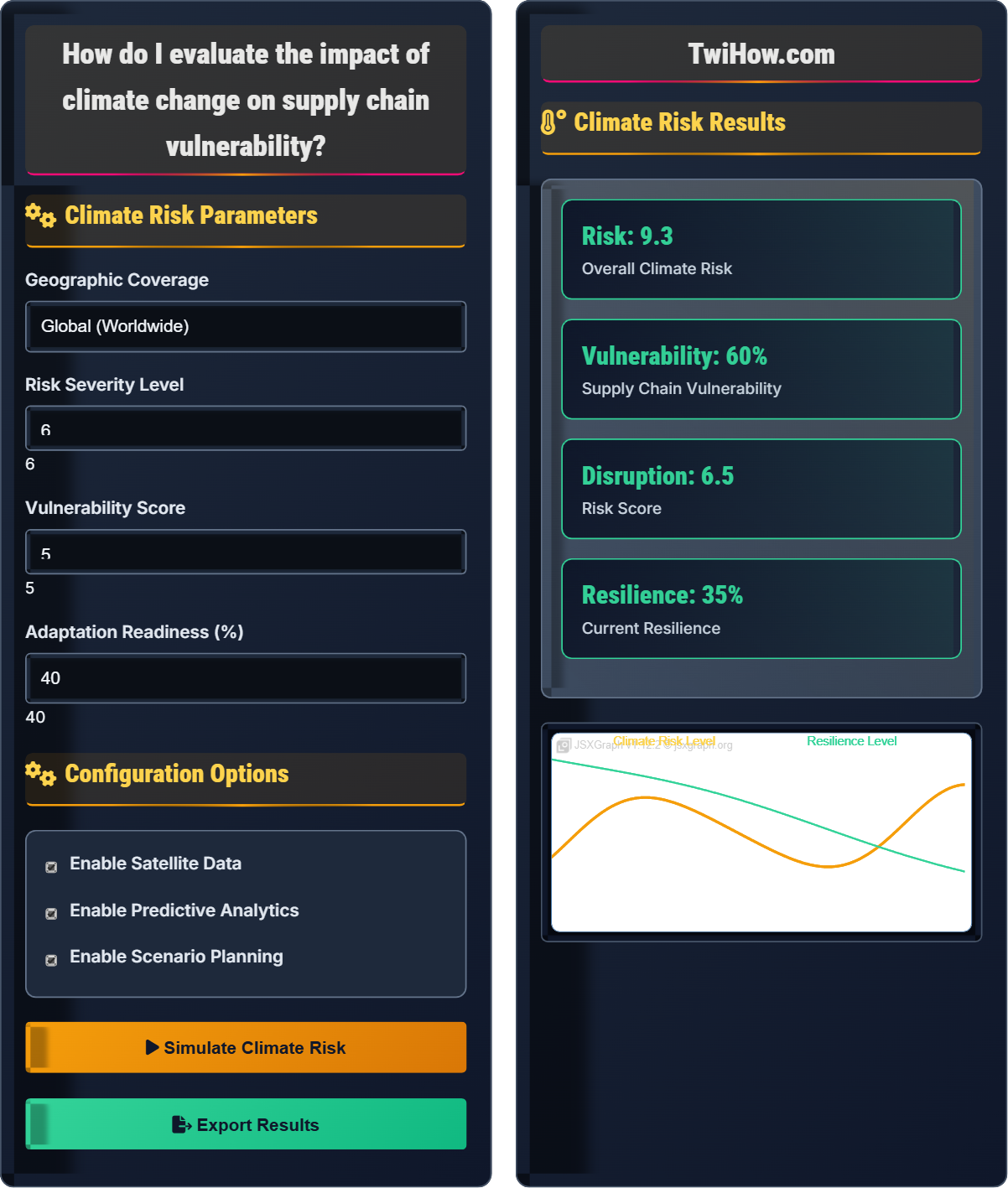
Climate Risk Results
| Risk Type | Severity | Probability | Impact |
|---|---|---|---|
| Floods | High | 35% | Severe |
| Hurricanes | Medium | 25% | High |
| Drought | Medium | 30% | High |
| Heat Waves | Low | 20% | Medium |
Evaluating Climate Change Impact on Supply Chain Vulnerability
Climate risk assessment involves evaluating how environmental changes and extreme weather events could affect supply chain operations. This includes identifying vulnerable locations, processes, and suppliers, analyzing potential impacts, and developing strategies to mitigate risks and maintain business continuity.
Key components of climate risk evaluation:
Where:
- Vulnerability: Susceptibility to climate impacts
- Exposure: Degree of contact with hazards
- Likelihood: Probability of occurrence
- Resilience: Ability to adapt and recover
Key advantages of implementing climate risk assessment:
- Proactive Planning: Prepare for potential disruptions
- Cost Reduction: Minimize losses from climate events
- Business Continuity: Maintain operations during disruptions
- Compliance: Meet regulatory requirements
- Competitive Advantage: Demonstrate resilience
- Stakeholder Confidence: Build trust with investors
- Satellite Data: Real-time environmental monitoring
- Climate Modeling: Long-term projections
- GIS Mapping: Geographic information systems
- AI/ML: Predictive analytics
- IoT Sensors: Local condition monitoring
Climate Risk Fundamentals
Climate risk, supply chain vulnerability, physical risks, transition risks, resilience planning.
Risk = Probability × Impact × (1 - Mitigation Effectiveness)
Where Risk = potential exposure, Probability = likelihood of occurrence, Impact = severity of consequences.
- Location matters significantly
- Multiple hazards compound risks
- Adaptation reduces vulnerability
Applications
Agriculture, manufacturing, retail, energy, transportation, pharmaceuticals.
- Supplier risk evaluation
- Facility location planning
- Transportation route optimization
- Inventory management
- Long-term climate projections
- Regulatory compliance
- Cost of mitigation measures
- Stakeholder engagement
Climate Risk Learning Quiz
Which of the following is NOT a primary component of climate risk assessment?
Climate risk assessment primarily focuses on vulnerability, exposure, and likelihood of future events. While historical weather patterns provide context, they are not a core component of risk assessment, which emphasizes future projections and potential impacts.
The answer is C) Historical Weather Patterns.
Climate risk assessment is forward-looking, focusing on future risks rather than past events. While historical data provides baseline information, the assessment process emphasizes predicting future vulnerabilities and potential impacts based on climate projections and supply chain characteristics.
Vulnerability Analysis: Identifying weak points in supply chains
Exposure Assessment: Measuring contact with hazards
Likelihood Estimation: Predicting probability of events
• Focus on future risks
• Evaluate supply chain dependencies
• Use geographic mapping
• Consider cascading effects
• Plan for multiple scenarios
• Relying only on historical data
• Not considering supply chain dependencies
• Ignoring multiple hazard interactions
Explain the main benefits of implementing climate risk assessment in supply chains, and how these benefits translate into measurable improvements in business performance.
Main Benefits: Climate risk assessment provides proactive disruption planning, cost reduction through prevention, business continuity during extreme events, regulatory compliance, competitive advantage through resilience demonstration, and stakeholder confidence.
Measurable Improvements: Risk exposure can be reduced by 20-50%. Business continuity can be maintained at 85-95% during disruptions. Cost savings from prevented disruptions can reach $5-50 million annually. Insurance premiums can decrease by 10-30%. Stakeholder confidence scores can improve by 15-25%.
Climate risk assessment creates a proactive approach to supply chain management. By identifying vulnerabilities in advance, companies can implement preventive measures that are typically much more cost-effective than reactive responses. The measurable improvements demonstrate the value of investing in climate resilience.
Proactive Planning: Preparing for potential disruptions
Business Continuity: Maintaining operations during disruptions
Stakeholder Confidence: Trust from investors and partners
• Prevention is better than reaction
• Early investment pays dividends
• Climate risks are increasing
• Start with critical locations
• Use multiple data sources
• Regular assessment updates
• Not updating assessments regularly
• Underestimating compound risks
• Ignoring supplier dependencies
A global electronics manufacturer has $2 billion in annual revenue and operates facilities in flood-prone areas. Historical data shows a 15% chance of major flooding annually with an estimated $100 million impact. The company plans to invest $50 million in climate risk assessment and mitigation to reduce this risk by 70%. Calculate the expected annual savings from reduced risk exposure and estimate the payback period for the investment.
Current Expected Loss: 15% × $100M = $15M per year
Reduced Expected Loss: $15M × (1 - 70%) = $4.5M per year
Annual Savings: $15M - $4.5M = $10.5M per year
Payback Period: $50M ÷ $10.5M = 4.76 years
Additional Benefits: Improved reputation, regulatory compliance, and stakeholder confidence.
This example demonstrates the financial justification for climate risk investments. The company can expect significant annual savings from reduced risk exposure. The payback calculation helps determine the economic viability of risk mitigation investments, showing that climate resilience can be financially beneficial.
Expected Loss: Probability × Impact
Payback Period: Time to recover investment costs
Risk Reduction: Percentage decrease in risk exposure
• Expected value calculations guide investment
• Risk reduction creates measurable savings
• Payback periods should be reasonable
• Calculate expected values for decision-making
• Consider intangible benefits
• Plan for multiple risk scenarios
• Not quantifying risk exposure
• Ignoring intangible benefits
• Underestimating disruption costs
A multinational corporation with suppliers across 20 countries wants to implement climate risk assessment for their supply chain. Identify three major challenges they might face and propose solutions for each challenge.
Challenge 1: Data Availability: Accessing reliable climate data for all regions. Solution: Partner with global climate data providers and local meteorological services.
Challenge 2: Cultural Differences: Varying approaches to risk management. Solution: Develop culturally-sensitive risk assessment frameworks.
Challenge 3: Coordination: Managing risk assessment across multiple time zones and languages. Solution: Implement centralized digital platforms with local coordinators.
Success requires global coordination and local adaptation.
Global climate risk assessments face unique challenges due to geographic dispersion, cultural differences, and regulatory variations. Success requires balancing global consistency with local adaptation. The key is developing capabilities that work across different contexts while maintaining assessment quality.
Data Availability: Access to reliable climate information
Cultural Differences: Varying risk management approaches
Global Coordination: Managing across multiple locations
• Global consistency with local adaptation
• Cultural sensitivity matters
• Reliable data is essential
• Build local partnerships
• Invest in cultural training
• Establish regional expertise
• Assuming one-size-fits-all approach
• Not considering local regulations
• Ignoring cultural differences
Which technology combination best supports effective climate risk assessment?
Effective climate risk assessment requires satellite data for real-time monitoring, GIS mapping for geographic analysis, and predictive analytics for future projections. These technologies work together to provide comprehensive climate risk insights across supply chain networks.
The answer is A) Satellite data, GIS mapping, predictive analytics.
Traditional tools like spreadsheets, manual assessments, and historical records are insufficient for climate risk assessment. Modern climate risk management requires sophisticated technology platforms that can process large volumes of environmental data, provide geographic analysis, and generate predictive insights.
Satellite Data: Remote sensing environmental information
GIS Mapping: Geographic Information Systems
Predictive Analytics: Future trend analysis
• Technology enables scale and accuracy
• Integration is critical
• Real-time data is essential
• Choose integrated solutions
• Plan for scalability
• Consider cloud options
• Using inadequate technology tools
• Not planning for data growth
• Ignoring integration requirements
FAQ
Q: What's the difference between physical and transition climate risks?
A: The key differences are:
Physical Risks: Direct impacts from climate events like floods, hurricanes, droughts, and temperature changes that affect operations, facilities, and transportation.
Transition Risks: Indirect impacts from the shift to a low-carbon economy, including policy changes, market shifts, and technology transitions.
Physical risks affect immediate operations, while transition risks impact long-term business models and market positions. Both require different mitigation strategies.
Q: What are the main challenges in implementing climate risk assessment?
A: The main challenges in climate risk assessment include:
1. Data Quality: Accessing reliable and granular climate data.
2. Complexity: Managing the complexity of global supply chains with multiple variables.
3. Uncertainty: Dealing with long-term climate projections and uncertainties.
4. Coordination: Aligning across departments and external partners.
5. Cost: Balancing investment with expected returns.
Success requires addressing both technical and organizational challenges systematically.