How to Evaluate Sustainability Credentials of Logistics Partners
Complete guide • Step-by-step explanations
Sustainability Evaluation:
Show Sustainability EvaluatorEvaluating the sustainability credentials of logistics partners is a critical process that involves assessing their environmental, social, and governance (ESG) practices. This comprehensive evaluation helps organizations select partners who align with their sustainability goals and contribute to reducing the overall environmental impact of the supply chain.
The evaluation process encompasses multiple dimensions including carbon emissions management, energy efficiency, waste reduction, social responsibility, and governance practices. It requires a systematic approach that combines self-assessment questionnaires, third-party certifications, site visits, and ongoing monitoring.
Core principles:
- Environmental Impact: Carbon footprint, energy use, emissions
- Social Responsibility: Labor practices, community engagement
- Governance: Transparency, ethics, compliance
- Continuous Improvement: Ongoing sustainability initiatives
Successful evaluation requires clear criteria, standardized metrics, and regular reassessment to ensure partners maintain their sustainability commitments over time. This process helps build resilient, responsible supply chains that meet stakeholder expectations.
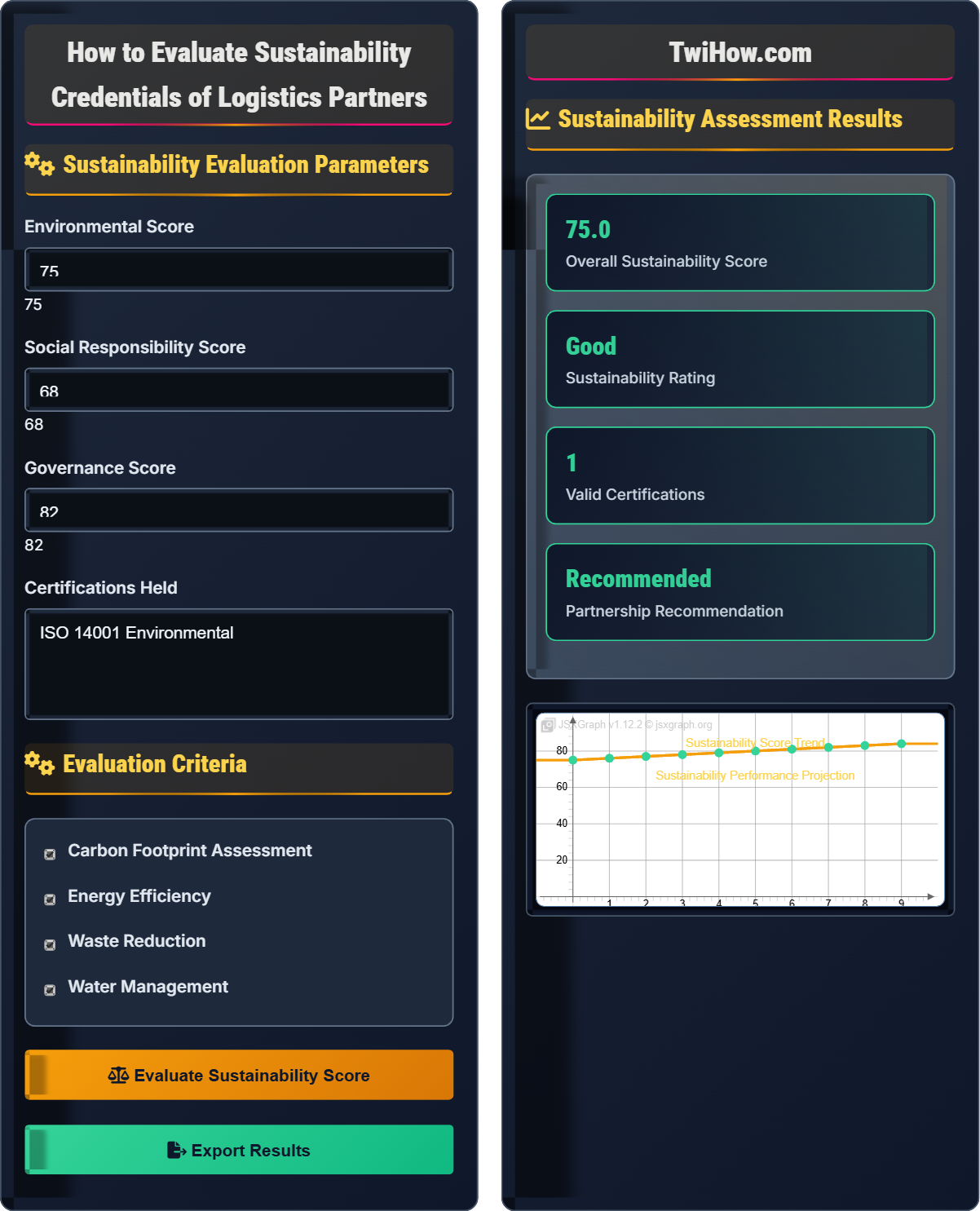
Sustainability Evaluation Parameters
Evaluation Criteria
Sustainability Assessment Results
| Category | Score | Weight | Contribution |
|---|---|---|---|
| Environmental | 75 | 40% | 30.0 |
| Social | 68 | 30% | 20.4 |
| Governance | 82 | 30% | 24.6 |
| Total | 75.0 | 100% | 75.0 |
Recommendations
- Improve energy efficiency initiatives
- Enhance social responsibility programs
- Expand carbon reduction efforts
- Consider additional certifications
Sustainability Evaluation in Logistics Partners Explained
Sustainability evaluation of logistics partners involves systematically assessing their environmental, social, and governance (ESG) practices to determine their alignment with your organization's sustainability goals. This process helps identify partners who contribute positively to your supply chain's environmental impact while maintaining operational excellence.
The sustainability evaluation follows this framework:
Where:
- Environmental (E): Carbon emissions, energy use, waste management
- Social (S): Labor practices, community impact, diversity
- Governance (G): Ethics, transparency, compliance
- Weights (W): Relative importance of each dimension
Critical areas for sustainability assessment:
- Carbon Footprint: Emissions from transportation, warehousing, operations
- Energy Efficiency: Use of renewable energy, fuel-efficient vehicles
- Waste Management: Recycling, packaging reduction, circular economy
- Social Impact: Fair labor practices, community engagement, diversity
- Compliance: Adherence to environmental regulations and standards
- Transparency: Reporting, disclosure, and accountability measures
- Standardized Metrics: Use consistent measurement approaches
- Third-Party Verification: Validate claims with independent assessors
- Continuous Monitoring: Regular reassessment of sustainability practices
- Collaborative Improvement: Partner with suppliers to enhance sustainability
- Stakeholder Engagement: Involve all relevant parties in evaluation
- Technology Integration: Leverage tools for data collection and analysis
Evaluation Framework
Sustainability evaluation, ESG criteria, carbon footprint, environmental standards, logistics certification, supply chain sustainability.
Sustainability Score = Σ(Category Score × Weight)
Where each category is weighted based on organizational priorities.
- Use standardized assessment criteria
- Verify claims with evidence
- Monitor performance continuously
Implementation
Clear criteria definition, stakeholder buy-in, technology support, regular monitoring, continuous improvement.
- Criteria development
- Partner assessment
- Scoring and ranking
- Ongoing monitoring
- Balance sustainability with operational needs
- Consider regional differences
- Plan for scalability
- Ensure data quality
Sustainability Evaluation Learning Quiz
Which of the following is NOT a component of the ESG (Environmental, Social, Governance) framework for sustainability evaluation?
The ESG framework consists of three core components: Environmental (E), Social (S), and Governance (G). Economic profitability is not part of the ESG framework, although it may be considered separately in business evaluations. The ESG components specifically address sustainability-related factors that impact long-term value creation.
The answer is C) Economic Profitability.
ESG evaluation provides a standardized framework for assessing sustainability credentials. Understanding the distinct components helps evaluators focus on the right aspects when assessing logistics partners. Environmental factors relate to ecological impact, social factors to stakeholder relationships, and governance to ethical practices and transparency.
ESG: Environmental, Social, and Governance factors
Environmental: Ecological impact and resource management
Social: Stakeholder relationships and community impact
• Focus on sustainability factors
• Consider all three ESG components
• Balance competing priorities
• Use standardized assessment tools
• Verify claims with evidence
• Consider long-term impact
• Confusing ESG with financial metrics
• Neglecting any ESG component
• Not validating claims
Explain the key components of carbon footprint assessment in logistics operations and describe how organizations can verify the accuracy of reported emissions from their logistics partners.
Key Components of Carbon Footprint Assessment:
1. Scope 1 Emissions: Direct emissions from owned or controlled sources (company vehicles, facilities)
2. Scope 2 Emissions: Indirect emissions from purchased electricity, steam, heating
3. Scope 3 Emissions: All other indirect emissions in the value chain (transportation, waste disposal)
Verification Methods:
• Third-Party Audits: Independent verification by certified auditors
• Documentation Review: Examination of fuel records, utility bills, transportation logs
• Site Visits: Physical inspection of facilities and operations
• Data Analytics: Cross-referencing reported data with operational metrics
• Certification Programs: Verification through recognized standards (GHG Protocol, ISO 14064)
Accurate carbon footprint assessment is essential for sustainable logistics partnerships.
Carbon footprint assessment in logistics is complex due to the multiple emission sources and transportation modes involved. Scope 3 emissions often represent the largest portion of a logistics company's carbon footprint, making them critical to assess accurately. Verification ensures that reported sustainability achievements are genuine and measurable.
Carbon Footprint: Total greenhouse gas emissions caused directly or indirectly
Scope 1: Direct emissions from company operations
Scope 3: Indirect emissions across the value chain
• Assess all three scopes of emissions
• Verify reported data independently
• Use standardized methodologies
• Use GHG Protocol guidelines
• Request detailed documentation
• Conduct periodic audits
• Only assessing direct emissions
• Not verifying reported data
• Using inconsistent methodologies
A manufacturing company needs to evaluate three logistics partners for a sustainability initiative. Partner A has excellent environmental practices (score: 90) but average social responsibility (score: 65). Partner B has moderate environmental practices (score: 70) but strong social responsibility (score: 85). Partner C has balanced scores (environmental: 75, social: 75). If environmental factors are weighted at 60% and social factors at 40%, calculate the composite scores and recommend the best partner.
Calculations:
Partner A: (90 × 0.6) + (65 × 0.4) = 54 + 26 = 80
Partner B: (70 × 0.6) + (85 × 0.4) = 42 + 34 = 76
Partner C: (75 × 0.6) + (75 × 0.4) = 45 + 30 = 75
Recommendation: Partner A with a composite score of 80 is the best choice based on the given weightings. Despite having lower social responsibility, Partner A's superior environmental practices result in the highest overall score.
This example demonstrates how weightings influence sustainability evaluation outcomes and the importance of clearly defining organizational priorities before conducting assessments.
This problem illustrates the impact of weightings in sustainability evaluations. Organizations must carefully consider their sustainability priorities when assigning weights to different criteria. In this case, the heavy weighting toward environmental factors favored Partner A despite their average social responsibility score. The evaluation process should align with the organization's specific sustainability goals and stakeholder expectations.
Composite Score: Weighted sum of individual criterion scores
Weighting: Relative importance assigned to evaluation criteria
Sustainability Priorities: Organizational focus areas
• Define weightings before evaluation
• Use consistent scoring methods
• Align with organizational priorities
• Engage stakeholders in weighting
• Consider trade-offs explicitly
• Document decision rationale
• Changing weightings mid-evaluation
• Not considering trade-offs
• Using inconsistent scoring
A logistics partner claims to have ISO 14001 Environmental Management certification and carbon neutrality status. Describe the verification process you would follow to validate these claims and explain what specific documentation and evidence you would request.
Verification Process:
1. Document Review: Request official certificates and audit reports
2. Registrar Verification: Contact certifying body to confirm authenticity
3. On-Site Audit: Verify implemented practices match certified systems
4. Recertification Status: Confirm certificate is current and valid
Requested Documentation:
• Original ISO 14001 certificate with valid dates
• Latest third-party audit reports
• Environmental management system documentation
• Carbon neutrality verification certificate
• Emission inventory and offset documentation
• Annual compliance statements
Verification Steps: Cross-reference certificate numbers with registrar databases, confirm scope of certification matches claimed activities, validate recertification dates, and ensure no suspended or withdrawn status.
Certification verification is crucial for credibility in sustainability evaluations. Many organizations falsely claim certifications, so thorough verification protects against greenwashing. The process involves both documentary evidence and database confirmation with certifying bodies. This ensures that claimed credentials are legitimate and applicable to the scope of work being evaluated.
ISO 14001: International standard for environmental management systems
Greenwashing: Misleading claims about environmental benefits
Registrar: Organization that issues certifications
• Verify all certifications independently
• Confirm scope matches claimed activities
• Check certificate validity dates
• Use official verification portals
• Request detailed audit reports
• Conduct surprise site visits
• Accepting certificates at face value
• Not verifying scope of certification
• Not checking expiration dates
Which of the following is the most appropriate KPI for measuring the sustainability performance of a logistics partner?
CO2 emissions per ton-kilometer is the most appropriate sustainability KPI for logistics partners. This metric directly measures the environmental efficiency of transportation operations, which is a critical aspect of logistics sustainability. It provides a normalized measure that accounts for both distance traveled and cargo weight, allowing for meaningful comparisons between different operations and time periods.
The other options (profit margins, employee count, market share) are business performance indicators rather than sustainability metrics.
The answer is B) CO2 emissions per ton-kilometer.
Effective sustainability KPIs must be specific, measurable, and relevant to the logistics operations being evaluated. CO2 emissions per ton-kilometer is widely accepted in the industry as a standard metric because it captures the environmental efficiency of transportation activities while accounting for operational scale. This allows for fair comparisons between different partners and tracks improvement over time.
KPI: Key Performance Indicator for measuring performance
Ton-kilometer: Unit of transport work (cargo weight × distance)
Normalization: Adjusting metrics for fair comparison
• Use standardized sustainability metrics
• Normalize for operational scale
• Track over time for trends
• Use industry-standard metrics
• Combine multiple indicators
• Set baseline measurements
• Using non-sustainability metrics
• Not normalizing for scale
• Not establishing baselines
FAQ
Q: How often should we re-evaluate our logistics partners' sustainability credentials?
A: Sustainability evaluations should follow this schedule:
1. Annual Comprehensive Assessment: Full evaluation of all sustainability criteria
2. Quarterly Scorecard Reviews: Key metrics and performance tracking
3. Monthly KPI Monitoring: Operational sustainability metrics
4. Event-Driven Reviews: Triggered by major changes, incidents, or new certifications
Additionally, conduct spot audits and request updated documentation when certifications expire or when significant operational changes occur. This ensures partners maintain their sustainability commitments throughout the partnership.
Q: What's the typical cost impact of choosing more sustainable logistics partners?
A: Initial cost premiums for sustainable logistics partners typically range from 5-15%, but the total cost of ownership often shows net benefits:
Direct Costs: May be 5-10% higher due to premium services and compliance investments.
Indirect Benefits: Reduced risk, improved efficiency, better reliability, and access to green corridors.
Long-term Savings: 10-20% reduction in operational costs through efficiency gains and avoided risks.
Reputation Value: Enhanced brand value and stakeholder trust worth 15-25% of cost premium.
Most organizations see positive ROI within 12-18 months through operational efficiencies and risk mitigation.