How do I leverage 3D printing and additive manufacturing for supply chain flexibility?
Complete 3D printing supply chain guide • Step-by-step explanations
3D Printing Supply Chain Fundamentals:
Show 3D Printing Simulator3D printing and additive manufacturing can significantly enhance supply chain flexibility by enabling on-demand production, reducing inventory requirements, and allowing for distributed manufacturing. These technologies allow companies to produce parts and products as needed, closer to demand points, and with minimal tooling costs.
At their core, 3D printing technologies create objects layer by layer from digital models, eliminating the need for traditional manufacturing setup costs and long lead times. This enables companies to maintain digital inventories instead of physical stock, producing items only when needed.
Key 3D printing concepts:
- On-Demand Manufacturing: Produce items when needed, not in advance
- Distributed Production: Manufacture closer to demand locations
- Digital Inventory: Store designs instead of physical products
- Customization: Easily modify products for specific needs
Modern 3D printing implementations use advanced materials, faster production techniques, and integrated software to create cost-effective and flexible supply chain solutions. This enables companies to respond quickly to demand changes, reduce waste, and optimize their operations.
3D Printing Parameters
Configuration Options
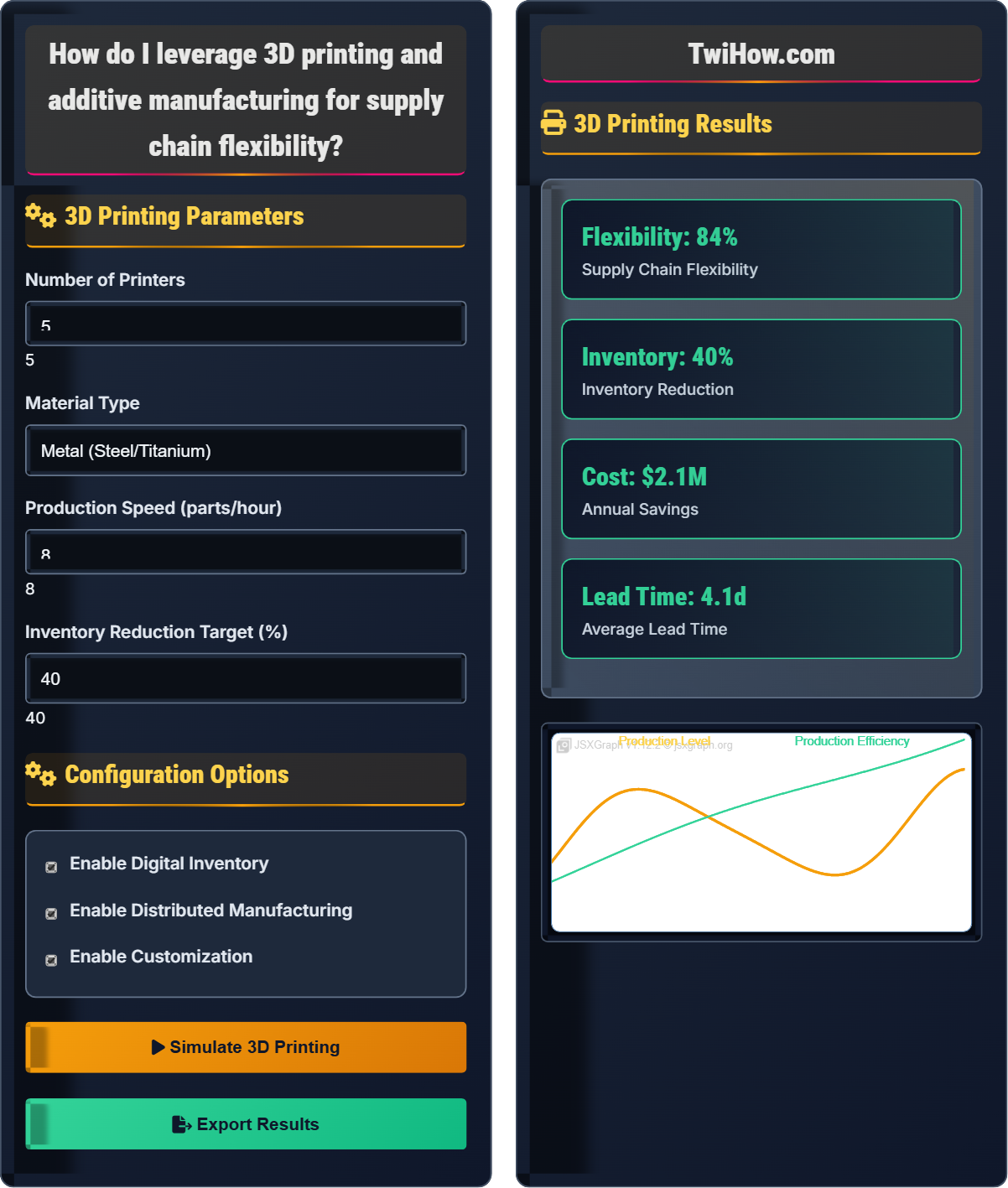
3D Printing Results
| Part Type | Volume | Reduction | Lead Time |
|---|---|---|---|
| Spares | 2,500 | 65% | 2d |
| Prototypes | 500 | 80% | 1d |
| Custom Parts | 1,200 | 70% | 3d |
| Tooling | 800 | 55% | 4d |
Leveraging 3D Printing for Supply Chain Flexibility
3D printing and additive manufacturing enable companies to create products layer by layer from digital models, fundamentally changing how supply chains operate. Instead of maintaining large inventories of physical parts, companies can store digital designs and produce items on-demand, closer to where they're needed, with minimal setup costs.
Key components of 3D printing in supply chains:
Where:
- Inventory Reduction: Decrease in physical stock requirements
- Lead Time Reduction: Shorter time from order to delivery
- Implementation Cost: Investment in 3D printing infrastructure
- Scalability Factor: Ability to expand operations
Key advantages of implementing 3D printing in supply chains:
- Inventory Reduction: Maintain digital designs instead of physical stock
- Lead Time Reduction: Produce items on-demand locally
- Cost Savings: Eliminate tooling costs and reduce shipping
- Customization: Easily modify products for specific needs
- Supply Chain Resilience: Reduce dependency on distant suppliers
- Sustainability: Reduce waste and transportation emissions
- FDM (Fused Deposition Modeling): Plastic filament extrusion
- SLA (Stereolithography): Liquid resin curing
- SLS (Selective Laser Sintering): Powder bed fusion
- SLM (Selective Laser Melting): Metal powder melting
- Software Platforms: Design, slicing, and management tools
3D Printing Fundamentals
3D printing, additive manufacturing, digital inventory, on-demand production, distributed manufacturing.
Flexibility = (Inventory Reduction + Lead Time Reduction) / Implementation Cost
Where Flexibility = supply chain adaptability score, Inventory = physical stock reduction.
- Not all parts are suitable for 3D printing
- Digital inventory requires quality assurance
- Scale considerations affect cost-effectiveness
Applications
Aerospace, automotive, healthcare, consumer goods, electronics, industrial equipment.
- Prototyping and development
- Spare parts production
- Custom tooling
- End-use parts manufacturing
- Material properties and certifications
- Production volume requirements
- Quality control processes
- Intellectual property protection
3D Printing Learning Quiz
Which of the following is NOT a core component of 3D printing in supply chains?
3D printing eliminates the need for physical tooling, which is a key advantage over traditional manufacturing methods. Instead of creating molds, dies, or fixtures, 3D printing builds objects layer by layer from digital models, reducing setup costs and time.
The answer is B) Physical Tooling.
One of the fundamental advantages of 3D printing is the elimination of tooling costs and setup time. Traditional manufacturing requires creating physical tools for each product variant, while 3D printing can produce different items from the same equipment using different digital files.
Digital Design Files: CAD models used for 3D printing
Additive Manufacturing: Building objects layer by layer
Physical Tooling: Traditional molds and fixtures
• Eliminates tooling costs
• Supports customization
• Focus on low-volume parts
• Consider material properties
• Plan for quality control
• Expecting traditional manufacturing speeds
• Not considering material limitations
• Ignoring post-processing needs
Explain the main benefits of implementing 3D printing in supply chains, and how these benefits translate into measurable improvements in business performance.
Main Benefits: 3D printing provides inventory reduction through digital storage, lead time reduction via local production, cost savings from eliminated tooling, customization capabilities, supply chain resilience through distributed manufacturing, and sustainability through reduced waste.
Measurable Improvements: Inventory can be reduced by 30-70%. Lead times can be shortened by 50-90%. Tooling costs can be eliminated entirely. Customization becomes cost-effective. Supply chain disruptions are reduced by 40-60%.
3D printing transforms supply chain economics by shifting from physical inventory to digital inventory. This eliminates carrying costs, obsolescence risks, and storage requirements. The on-demand production model also reduces transportation costs and improves responsiveness to customer needs.
Digital Inventory: Storing product designs instead of physical items
Lead Time: Time from order to delivery
Supply Chain Resilience: Ability to withstand disruptions
• Evaluate part suitability carefully
• Consider total cost of ownership
• Plan for quality assurance
• Start with spare parts
• Focus on high-value, low-volume items
• Invest in design optimization
• Expecting mass production speeds
• Not validating material properties
• Ignoring post-processing requirements
A manufacturing company currently stocks 5,000 spare parts with an average value of $200 each, costing $1 million in inventory. They plan to use 3D printing for 60% of these parts, reducing inventory by 70% for those items. If carrying costs are 20% annually, calculate the potential annual savings from reduced inventory and estimate the maximum investment they should make in 3D printing equipment if they want a 3-year payback period.
Parts to be 3D Printed: 5,000 × 60% = 3,000 parts
Inventory Reduction: 3,000 × $200 × 70% = $420,000
Annual Carrying Cost Savings: $420,000 × 20% = $84,000
Additional Benefits: Reduced obsolescence risk, faster delivery, customization capabilities
Maximum Investment for 3-Year Payback: $84,000 × 3 = $252,000
This example demonstrates the financial justification for 3D printing investments. The company can expect significant annual savings from reduced inventory carrying costs. The payback calculation helps determine how much to invest in 3D printing equipment while ensuring a reasonable return on investment.
Carrying Costs: Expenses associated with holding inventory
Payback Period: Time to recover investment costs
Obsolescence Risk: Risk of inventory becoming worthless
• Calculate carrying cost savings
• Consider obsolescence reduction
• Plan for reasonable payback periods
• Focus on high-value, slow-moving parts
• Consider total cost of ownership
• Plan for quality validation
• Not quantifying carrying costs
• Ignoring obsolescence benefits
• Overestimating production speeds
A global manufacturer wants to implement 3D printing across multiple facilities worldwide. Identify three major challenges they might face and propose solutions for each challenge.
Challenge 1: Material Certification: Ensuring printed parts meet quality standards across locations. Solution: Establish centralized quality control and certification processes.
Challenge 2: Skills Gap: Need for trained operators and designers. Solution: Invest in training programs and hire experienced personnel.
Challenge 3: Intellectual Property: Protecting design files across locations. Solution: Implement secure digital rights management and access controls.
Success requires global coordination and local implementation.
Global 3D printing implementations face unique challenges due to geographic dispersion and varying local requirements. The key is developing capabilities that work across different contexts while maintaining quality and security standards. Centralized control with decentralized execution is often the most effective approach.
Material Certification: Verifying material properties meet standards
Skills Gap: Lack of qualified personnel
Intellectual Property: Protection of design files and processes
• Maintain quality standards globally
• Invest in training and development
• Protect intellectual property
• Start with pilot programs
• Develop standard operating procedures
• Implement remote monitoring
• Assuming universal material properties
• Not investing in training
• Neglecting IP protection
Which technology combination best supports effective 3D printing for supply chain flexibility?
Effective 3D printing requires CAD software for design, 3D printers for production, and quality control systems to ensure consistent output. This combination enables digital design, on-demand manufacturing, and quality assurance for supply chain flexibility.
The answer is A) CAD software, 3D printers, quality control systems.
Traditional manufacturing methods, manual processes, and spreadsheets are insufficient for 3D printing operations. Modern 3D printing requires sophisticated technology that can handle digital design, precise manufacturing, and quality control to achieve the promised benefits of supply chain flexibility.
CAD Software: Computer-Aided Design tools
Quality Control: Systems to ensure consistent output
Digital Design: Creating products in virtual space
• Technology enables precision manufacturing
• Quality control is essential
• Integration improves efficiency
• Choose compatible systems
• Plan for scalability
• Invest in training
• Using incompatible software
• Not planning for quality control
• Ignoring operator training
FAQ
Q: What's the difference between 3D printing and traditional manufacturing in supply chains?
A: The key differences are:
3D Printing: On-demand production, no tooling costs, digital inventory, local manufacturing, high customization, slower for high volumes.
Traditional Manufacturing: Batch production, significant tooling costs, physical inventory, centralized production, low customization, faster for high volumes.
3D printing excels for low-volume, customized, or emergency parts, while traditional manufacturing is better for high-volume, standardized products.
Q: What are the main challenges in implementing 3D printing in supply chains?
A: The main challenges in implementing 3D printing in supply chains include:
1. Material Properties: Ensuring printed parts meet required specifications and certifications.
2. Production Speed: 3D printing is generally slower than traditional methods for high volumes.
3. Quality Control: Maintaining consistent quality across different machines and locations.
4. Cost Economics: Determining when 3D printing is cost-effective vs. traditional methods.
5. Skills Gap: Need for trained operators and designers.
Success requires addressing both technical and operational challenges systematically.