How do I leverage circular economy principles in supply chain design?
Complete circular economy guide • Step-by-step explanations
Circular Economy Fundamentals:
Show Circular Economy SimulatorLeveraging circular economy principles in supply chain design involves creating closed-loop systems that minimize waste, maximize resource efficiency, and extend product lifecycles. This approach transforms traditional linear "take-make-dispose" models into regenerative systems where materials are continuously reused, remanufactured, and recycled. Key principles include designing for durability, repairability, and disassembly, implementing reverse logistics, and fostering collaborative partnerships with suppliers and customers.
The circular supply chain model emphasizes waste reduction, resource conservation, and value preservation through innovative design and operational strategies. Modern implementations integrate digital technologies, sustainable materials, and collaborative platforms to create resilient and environmentally responsible supply networks.
Core components:
- Design for Circularity: Products designed for longevity, repair, and recycling
- Reverse Logistics: Systems for collecting, processing, and reintroducing materials
- Resource Efficiency: Minimizing material and energy consumption
- Collaborative Networks: Partnerships across the value chain
Success requires strategic alignment between business objectives and environmental stewardship, creating value for both shareholders and society while building long-term resilience.
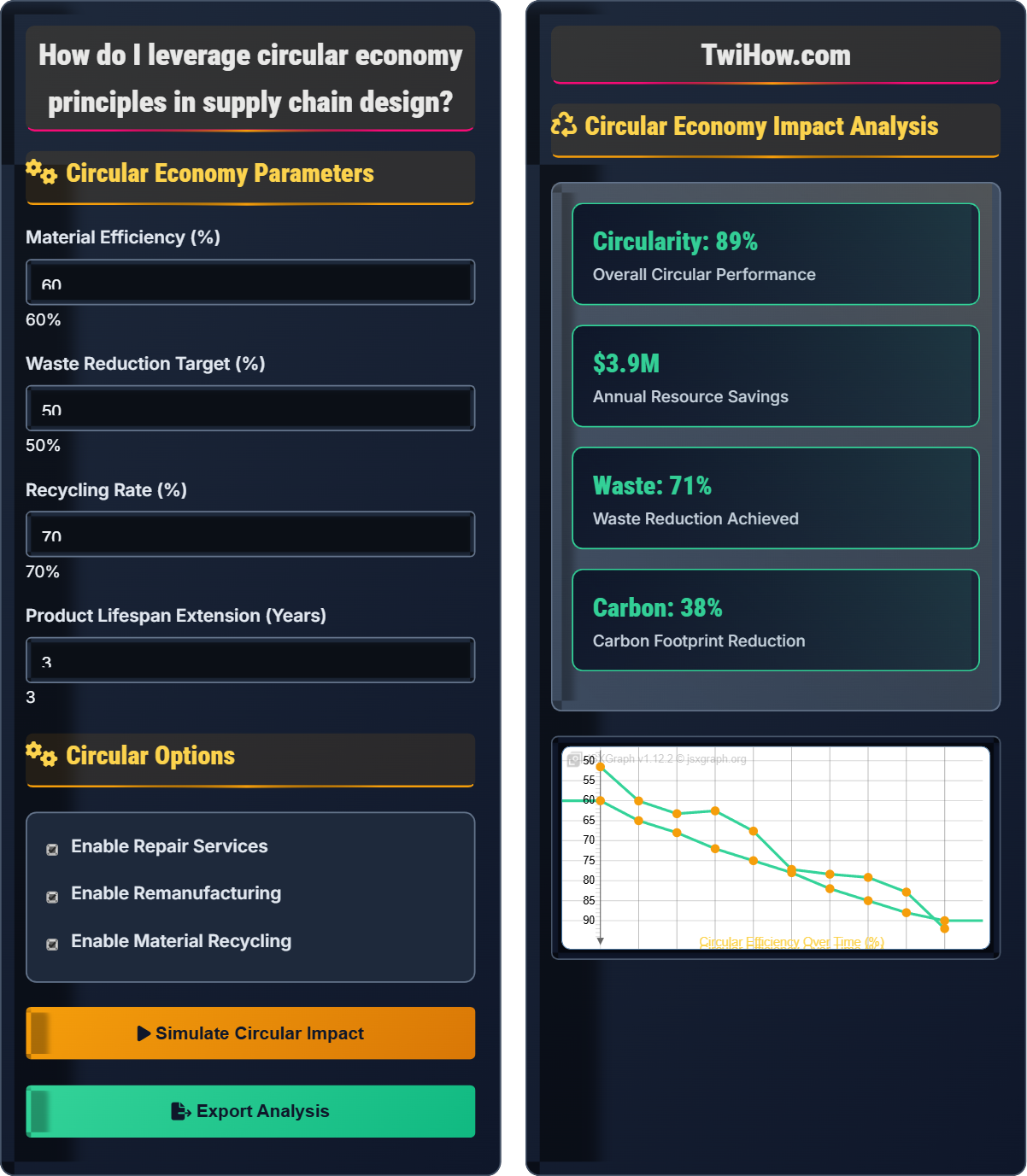
Circular Economy Parameters
Circular Options
Circular Economy Impact Analysis
| Stage | Efficiency | Impact | Opportunity |
|---|---|---|---|
| Design | 75% | High | Maximize |
| Manufacture | 65% | Medium | Improve |
| Use | 80% | High | Extend |
| End-of-Life | 55% | Medium | Optimize |
How Circular Economy Principles Work Explained
Circular economy is an economic system aimed at eliminating waste and the continual use of resources. Circular economy principles in supply chain design involve creating closed-loop systems where materials are continuously reused, remanufactured, and recycled rather than discarded after a single use. This contrasts with the traditional linear economy model of "take-make-dispose."
Effective circular supply chains incorporate multiple interconnected elements:
Where:
- Material Recovery Rate: Percentage of materials recovered for reuse
- Resource Efficiency: Optimization of material and energy use
- Lifecycle Extension: Prolonging product useful life
- Waste Generation: Amount of waste produced per unit
Primary circular economy strategies include:
- Design for Durability: Create products built to last longer
- Design for Repair: Make products easy to maintain and fix
- Design for Disassembly: Enable efficient component separation
- Remanufacturing: Restore used products to like-new condition
- Material Recovery: Extract valuable materials from end-of-life products
- Sharing Platforms: Enable collaborative use of products
- Collaborative Design: Involve suppliers and customers in design process
- Modular Architecture: Create products with replaceable components
- Service Models: Transition from ownership to usage-based models
- Digital Integration: Use IoT and data analytics for optimization
- Stakeholder Engagement: Build partnerships across the ecosystem
- Continuous Innovation: Regularly improve circular processes
Circular Economy Fundamentals
Circular economy, supply chain design, waste reduction, resource efficiency, reverse logistics, cradle-to-cradle, sustainability.
Circular Score = (Material Recovery × Resource Efficiency × Lifecycle Extension) / Waste Generation
Where Material Recovery = percentage of materials reused, Resource Efficiency = optimization ratio.
- Design for circularity from the beginning
- Minimize waste throughout the lifecycle
- Maximize resource utilization efficiency
Applications
Electronics manufacturing, automotive industry, fashion retail, packaging, construction materials, industrial equipment, consumer goods.
- Product-as-a-service models
- Industrial symbiosis networks
- Take-back programs
- Material recovery systems
- Regulatory compliance requirements
- Customer acceptance and behavior
- Technology and infrastructure needs
- Cost-benefit analysis
Circular Economy Learning Quiz
Which design principle is most important for enabling circular economy in supply chains?
Design for disassembly is crucial for circular economy as it enables efficient separation of materials and components for reuse, remanufacturing, or recycling. This design principle directly supports the circular flow of materials and is fundamental to closing the loop in supply chains.
The answer is B) Design for disassembly.
Design decisions made early in the product lifecycle have the greatest impact on circular potential. Design for disassembly ensures that products can be easily taken apart at end-of-life, allowing valuable materials and components to be recovered and reintroduced into the supply chain. This is the foundation of circular material flows.
Design for Disassembly: Creating products that can be easily taken apart
Material Recovery: Extracting valuable materials from end-of-life products
Circular Flow: Closed-loop movement of materials through supply chain
• Design impacts entire lifecycle
• Disassembly enables recovery
• Modularity supports circularity
• Use standardized fasteners
• Minimize material variety
• Plan for end-of-life from start
• Not considering disassembly early
• Using permanent adhesives
• Mixing incompatible materials
Explain the role of reverse logistics in circular economy supply chains and describe how to design effective collection and processing systems.
Role of Reverse Logistics: Reverse logistics is the backbone of circular supply chains, enabling the flow of products and materials back from end-users to manufacturers for reuse, remanufacturing, or recycling. It bridges the gap between product use and material recovery.
Designing Collection Systems:
1. Convenient Locations: Establish collection points at retail stores, service centers, or through mail-back programs
2. Customer Incentives: Offer trade-ins, discounts, or rewards for returning products
3. Streamlined Processes: Simplify return procedures and packaging requirements
4. Transportation Optimization: Route collections efficiently to minimize environmental impact
Processing Systems:
• Inspection and sorting facilities
• Component recovery operations
• Quality assessment protocols
• Integration with forward supply chain
Reverse logistics transforms the traditional one-way supply chain into a bidirectional system. The success of circular economy depends on reliable and efficient return flows, making reverse logistics design critical. The system must be convenient for customers while economically viable for the company.
Reverse Logistics: Movement of products from end-user back to manufacturer
Collection System: Network for gathering returned products
Material Recovery: Extraction of valuable components from returns
• Customer convenience drives participation
• Economic viability is essential
• Integration with forward chain is key
• Partner with retailers for collection
• Use digital tracking systems
• Optimize collection routes
• Not planning for reverse flows
• Inadequate collection infrastructure
• Poor integration with main supply chain
A manufacturing company currently uses 100 tons of raw materials to produce 80 tons of finished products, with 20 tons going to waste. If they implement circular economy principles achieving 90% material recovery and 25% efficiency improvement, calculate the new material requirements and waste generation. What is the percentage improvement in resource efficiency?
Current Situation:
Raw materials: 100 tons
Finished products: 80 tons
Waste: 20 tons
Current efficiency: 80/100 = 80%
After Circular Implementation:
Efficiency improvement: 80% × 1.25 = 100%
With 90% recovery, effective material input = 100 tons × (1 - 0.9 × 0.2) = 100 × 0.82 = 82 tons
New waste: 82 tons × (1 - 1.0) = 0 tons (theoretical perfect efficiency)
More realistically: New waste = 82 tons × 0.05 = 4.1 tons
Percentage improvement: ((80-4.1)/82 - 80/100) / (80/100) × 100% ≈ 15.6% improvement
This example demonstrates how circular economy principles multiply the benefits of individual improvements. By combining material recovery with efficiency gains, companies can achieve dramatic reductions in resource consumption and waste generation. The circular approach creates positive feedback loops that amplify individual improvements.
Resource Efficiency: Ratio of output to input materials
Material Recovery: Percentage of materials reused from waste stream
Circular Efficiency: Combined effect of reuse and efficiency gains
• Circular effects compound
• Recovery rates matter significantly
• Small improvements can be amplified
• Calculate compound effects
• Focus on high-recovery materials
• Track material flows carefully
• Not accounting for recovery rates
• Ignoring compound effects
• Miscounting material flows
A company currently sells physical products but wants to transition to a circular model. They sell high-value equipment with 5-year average lifespan. Propose a circular business model that incorporates leasing, maintenance, and end-of-life recovery while maintaining revenue and improving sustainability.
Proposed Circular Model:
1. Product-as-a-Service: Lease equipment instead of selling, charging per usage or time
2. Full-Service Maintenance: Include all maintenance, repairs, and upgrades in lease
3. Performance Guarantees: Guarantee uptime and performance metrics
4. End-of-Life Recovery: Retrieve equipment at lease end for remanufacturing
5. Upgrade Pathways: Offer technology refreshes within lease terms
6. Component Sharing: Reuse components across multiple products
Benefits: Higher customer loyalty, predictable revenue streams, controlled material recovery, reduced waste, and improved resource efficiency.
Circular business models shift from transaction-based to relationship-based value creation. By retaining ownership of products, companies maintain control over material flows while creating recurring revenue streams. This model aligns incentives for durability, maintenance, and recovery.
Product-as-a-Service: Revenue model based on usage rather than ownership
Circular Business Model: Economic model supporting circular material flows
Revenue Streams: Recurring income from ongoing services
• Retain material control
• Align incentives for durability
• Ensure economic viability
• Start with high-value products
• Pilot with willing customers
• Develop service capabilities
• Not changing revenue model
• Underestimating service requirements
• Ignoring customer preferences
Which metric provides the most comprehensive measure of circular economy success in supply chains?
The circular economy index provides the most comprehensive measure as it integrates multiple dimensions: material recovery, resource efficiency, waste reduction, and lifecycle extension. This composite metric captures the holistic nature of circular economy performance rather than focusing on a single dimension.
The answer is C) Circular economy index.
Circular economy success cannot be measured by a single metric. A comprehensive index that combines material recovery, efficiency gains, and waste reduction provides a more accurate picture of circular performance. This approach prevents optimization of one dimension at the expense of others.
Circular Economy Index: Composite measure of circular performance
Composite Metrics: Measures combining multiple dimensions
Holistic Assessment: Evaluation across all circular dimensions
• Use multiple metrics
• Balance different dimensions
• Track material flows comprehensively
• Include financial and environmental metrics
• Track material input/output ratios
• Monitor lifecycle extensions
• Focusing only on waste reduction
• Not tracking material recovery
• Ignoring economic performance
FAQ
Q: How do we transition from linear to circular supply chains without disrupting current operations?
A: Successful transition requires a phased approach:
1. Start Small: Pilot circular initiatives with select products or processes
2. Parallel Operations: Run linear and circular processes side by side initially
3. Gradual Conversion: Systematically convert processes as circular systems mature
4. Customer Communication: Prepare customers for new service models
5. Supplier Collaboration: Work with suppliers to adopt circular practices
6. Technology Integration: Implement systems to track circular flows
The key is maintaining service levels while building circular capabilities incrementally.
Q: What's the difference between sustainability and circular economy in supply chain contexts?
A: These represent different approaches to environmental responsibility:
Sustainability: Focuses on minimizing negative environmental and social impacts of current operations. It often involves reducing emissions, waste, and resource consumption within existing linear models.
Circular Economy: Seeks to redesign systems entirely by eliminating waste and keeping materials in use for as long as possible. It's a fundamental shift from linear to closed-loop models.
Circular economy is a subset of sustainability that provides specific mechanisms for achieving environmental goals through systemic redesign.