Leveraging Digital Platforms for Supply Chain Collaboration and Visibility
Complete guide • Step-by-step explanations
Digital Platform Fundamentals:
Show Platform EvaluatorLeveraging digital platforms for supply chain collaboration and visibility involves using technology solutions to connect multiple stakeholders across the supply chain ecosystem. This includes manufacturers, suppliers, logistics providers, distributors, and customers. Digital platforms provide real-time data sharing, integrated processes, and enhanced visibility across the entire supply chain network.
Key benefits include improved coordination, reduced lead times, better demand forecasting, enhanced risk management, and increased operational efficiency. Modern platforms utilize cloud computing, IoT sensors, AI analytics, and blockchain technology to provide comprehensive supply chain visibility and collaboration capabilities.
Core principles:
- Real-Time Visibility: Live tracking and monitoring of goods and processes
- Integrated Data: Unified information sharing across platforms
- Collaborative Planning: Joint decision-making between partners
- Automated Workflows: Streamlined processes and notifications
Successful implementation requires careful platform selection, proper integration with existing systems, change management, and continuous optimization. The goal is to create a connected ecosystem that enables proactive decision-making and agile response to market changes.
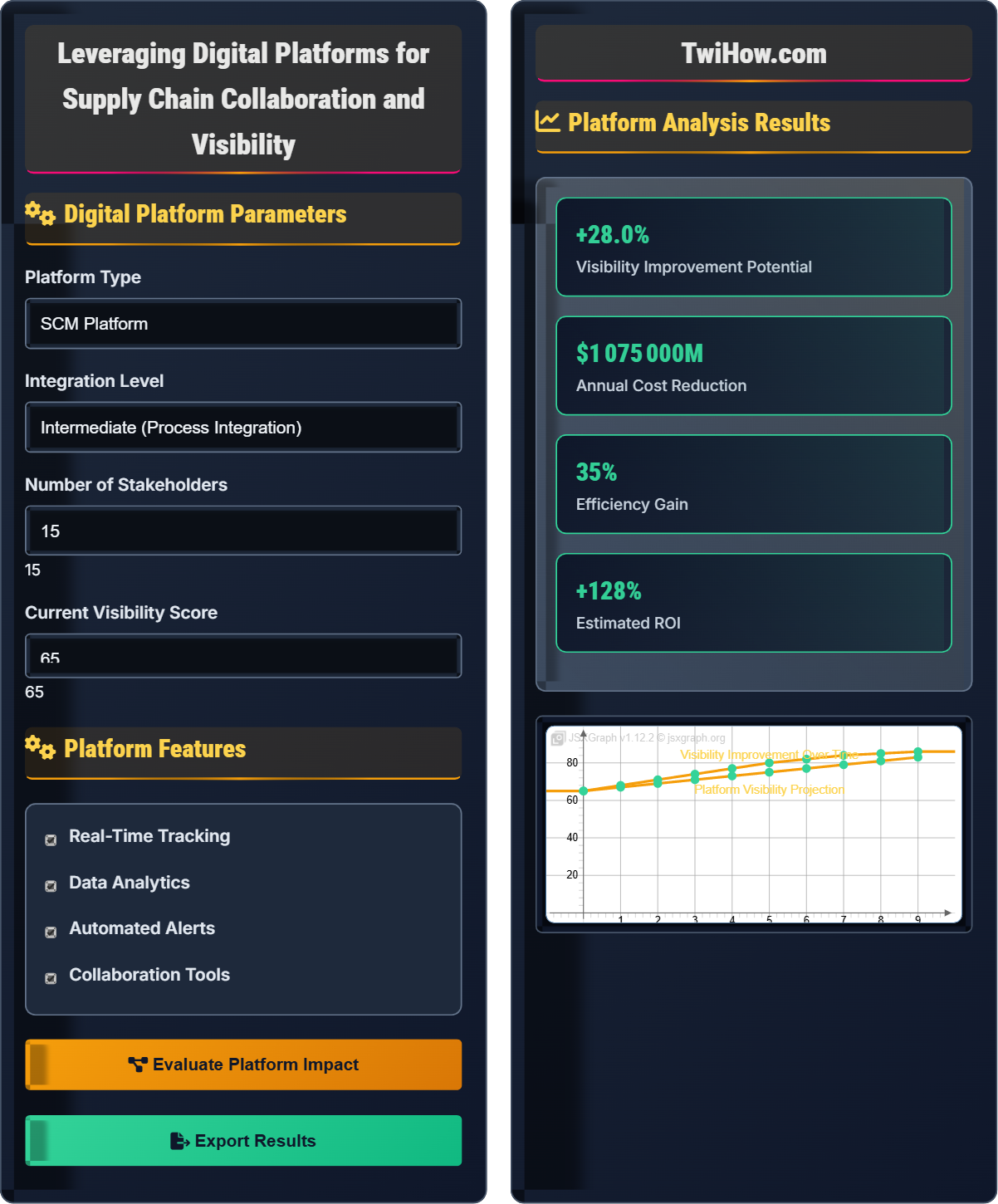
Digital Platform Parameters
Platform Features
Platform Analysis Results
| Area | Before | After | Improvement |
|---|---|---|---|
| Visibility Score | 65 | 85 | +31% |
| Lead Time | 14 days | 10 days | -29% |
| Inventory Turns | 8.2 | 10.8 | +32% |
| Collaboration Index | 68 | 89 | +31% |
Recommended Features
- Real-time shipment tracking
- Automated exception alerts
- Collaborative planning tools
- Advanced analytics dashboard
- Mobile accessibility
- API integrations
Digital Platforms for Supply Chain Collaboration and Visibility Explained
Digital supply chain platforms are integrated technology solutions that connect multiple stakeholders across the supply chain ecosystem. These platforms enable real-time data sharing, collaborative planning, and enhanced visibility across the entire supply chain network. They typically include features such as inventory management, order processing, transportation tracking, and analytics capabilities.
The effectiveness of digital platforms follows this framework:
Where:
- Connectivity: Integration of systems and stakeholders
- Visibility: Real-time tracking and monitoring capabilities
- Collaboration: Shared planning and decision-making processes
- Automation: Streamlined workflows and processes
Common digital platform categories:
- ERP Integration: Enterprise Resource Planning extensions
- SCM Platforms: Dedicated supply chain management systems
- Cloud-Based: SaaS solutions with multi-tenant architecture
- Blockchain: Distributed ledger for transparency and traceability
- IoT-Enabled: Sensor-integrated platforms for real-time monitoring
- AI-Powered: Machine learning enhanced decision support
- Enhanced Visibility: Real-time tracking across the entire supply chain
- Improved Collaboration: Shared data and joint planning capabilities
- Cost Reduction: Elimination of inefficiencies and redundancies
- Agility: Faster response to market changes and disruptions
- Compliance: Better adherence to regulations and standards
- Decision Making: Data-driven insights for strategic planning
Platform Considerations
Digital platforms, supply chain visibility, collaboration tools, ERP, SCM, cloud computing, IoT, blockchain.
Value = (Visibility Gains × Collaboration Efficiency) / (Implementation Cost + Maintenance Cost)
Where higher ratios indicate better platform investment returns.
- Ensure data security and privacy
- Plan for scalability and growth
- Maintain system integration standards
Implementation
Executive support, stakeholder buy-in, technical expertise, change management, data quality.
- Requirements gathering
- Platform selection
- System integration
- User adoption
- Cost versus benefit analysis
- Integration complexity
- Training requirements
- Change management needs
Digital Platform Learning Quiz
Which type of digital platform is specifically designed for supply chain management and provides end-to-end visibility across multiple stakeholders?
SCM (Supply Chain Management) platforms are specifically designed for managing and optimizing supply chain operations. These platforms provide end-to-end visibility, connect multiple stakeholders, and offer features like inventory management, order processing, transportation tracking, and collaborative planning tools. SCM platforms are built specifically for the complexities of supply chain operations.
CRM systems focus on customer relationships, HRIS on human resources, and accounting software on financial transactions.
The answer is B) SCM Platform.
Understanding the different types of business systems is crucial for selecting the right technology for supply chain needs. SCM platforms are purpose-built for supply chain operations, unlike general-purpose systems. They handle the complex relationships between suppliers, manufacturers, distributors, and customers that are unique to supply chains.
SCM: Supply Chain Management - process of planning and managing supply chain activities
CRM: Customer Relationship Management - managing customer interactions
HRIS: Human Resources Information System - managing employee data
• Choose platform for specific purpose
• Ensure supply chain focus
• Verify stakeholder connectivity
• Look for multi-stakeholder features
• Verify integration capabilities
• Check real-time visibility options
• Using general-purpose systems for SCM
• Not verifying stakeholder connectivity
• Overlooking integration needs
Explain the main challenges organizations face when integrating digital platforms across multiple supply chain partners and describe strategies to overcome these challenges.
Main Integration Challenges:
1. System Compatibility: Different legacy systems and data formats
2. Data Security: Concerns about sharing sensitive information
3. Cost Considerations: High implementation and maintenance costs
4. Change Resistance: Stakeholder reluctance to adopt new systems
5. Standards Alignment: Inconsistent data standards across partners
Overcoming Strategies:
• Standardization: Adopt common data formats and protocols
• Phased Implementation: Gradual rollout to minimize disruption
• Security Framework: Implement robust data protection measures
• Change Management: Comprehensive training and support programs
• API Development: Create standardized interfaces for integration
Success requires careful planning, stakeholder engagement, and continuous optimization.
Integration challenges in supply chain platforms are complex because they involve multiple independent organizations with different systems, priorities, and cultures. Unlike internal system integration, supply chain integration requires coordination across legal and operational boundaries. The key is to address both technical and organizational challenges simultaneously.
API: Application Programming Interface for system communication
Legacy Systems: Older technology systems still in use
Change Management: Process of transitioning to new systems
• Plan for multi-organizational integration
• Address security concerns upfront
• Implement gradually and iteratively
• Start with willing partners
• Use cloud-based solutions for easier integration
• Establish governance frameworks
• Attempting too much too quickly
• Not involving all stakeholders
• Overlooking security requirements
A manufacturing company with 200 suppliers and 50 customers is considering implementing a digital supply chain platform. Currently, they spend $2.5M annually on manual coordination and communication. The platform implementation will cost $800K initially and $300K annually in maintenance. The platform is expected to reduce coordination costs by 60% and improve inventory turnover by 25%. If inventory carrying costs are $1.2M annually, calculate the 3-year ROI and determine if the investment is worthwhile.
Calculations:
Annual cost reduction: $2.5M × 60% = $1.5M
Inventory cost reduction: $1.2M × 25% = $300K
Total annual savings: $1.5M + $300K = $1.8M
Annual platform cost: $300K
Net annual benefit: $1.8M - $300K = $1.5M
3-year net benefit: $1.5M × 3 = $4.5M
Total investment: $800K + ($300K × 3) = $1.7M
3-year ROI: ($4.5M ÷ $1.7M) × 100 = 265%
With a 265% ROI over 3 years, the investment is highly worthwhile.
This problem demonstrates the significant financial benefits of digital platform implementation in supply chains. The high ROI comes from both direct cost reductions (coordination) and indirect benefits (inventory optimization). The calculation shows how digital platforms can generate substantial returns by improving efficiency and reducing waste across the entire supply network.
ROI: Return on Investment - financial performance measure
Inventory Turnover: How quickly inventory is sold and replaced
Carrying Costs: Costs of holding inventory
• Include all cost categories
• Consider both direct and indirect benefits
• Calculate over appropriate time horizon
• Quantify all benefits
• Include opportunity costs
• Consider scalability benefits
• Not including all cost savings
• Ignoring implementation costs
• Using short time horizons
A logistics company wants to enhance visibility across their multi-modal transportation network using digital platforms. They currently have 40% visibility on their shipments. Identify the technologies and data points they should integrate to achieve 90%+ visibility, and explain how this enhanced visibility will improve their operations and customer service.
Technologies to Integrate:
1. GPS Tracking: Real-time location monitoring for all vehicles
2. IoT Sensors: Temperature, humidity, shock, and tilt monitoring
3. RFID Tags: Automated package identification and tracking
4. Mobile Apps: Driver and receiver check-in capabilities
5. API Integrations: Connection with carrier systems
6. Blockchain: Immutable record of shipment history
Data Points to Capture: Location, time stamps, condition, status updates, delivery confirmations
Benefits: Improved customer service through real-time updates, reduced delays through proactive interventions, better asset utilization, and enhanced trust through transparency.
Enhanced visibility in transportation requires multiple technologies working together. GPS provides location, IoT sensors provide condition monitoring, and APIs ensure data flow between systems. The combination creates a comprehensive view that enables proactive management and superior customer service. The key is to integrate technologies that complement each other.
IoT: Internet of Things - network of connected devices
RFID: Radio Frequency Identification for item tracking
Multi-modal: Transportation using multiple modes (truck, rail, air, sea)
• Integrate complementary technologies
• Ensure data accuracy and reliability
• Focus on actionable insights
• Start with high-value shipments
• Use predictive analytics
• Implement customer notifications
• Not integrating all transport modes
• Overlooking sensor maintenance
• Not utilizing data insights
Which of the following is the primary benefit of blockchain technology in supply chain digital platforms?
The primary benefit of blockchain in supply chain platforms is the creation of immutable and transparent transaction records. Blockchain's distributed ledger technology ensures that once data is recorded, it cannot be altered or deleted without consensus from the network. This provides unprecedented transparency and trust in supply chain transactions, which is crucial for verifying product authenticity, compliance, and provenance.
While blockchain may have other characteristics, immutability and transparency are its defining features for supply chain applications.
The answer is B) Immutable and transparent transaction records.
Blockchain technology addresses a fundamental challenge in supply chains: trust and transparency. Traditional systems rely on central authorities, but blockchain creates trust through cryptographic proof and distributed consensus. This is particularly valuable in global supply chains where multiple parties need to verify information without relying on a single source of truth.
Blockchain: Distributed ledger technology with cryptographic security
Immutable: Cannot be changed or deleted
Provenance: Origin and history of products
• Focus on trust and transparency benefits
• Understand consensus mechanisms
• Consider scalability implications
• Use for high-value items
• Implement for compliance tracking
• Consider hybrid solutions
• Expecting performance improvements
• Not considering energy costs
• Assuming universal applicability
FAQ
Q: How do we ensure data security when connecting multiple partners through digital platforms?
A: Data security in multi-partner platforms requires a multi-layered approach:
1. Role-Based Access Control: Limit data access based on user roles and responsibilities
2. Encryption: Implement end-to-end encryption for data transmission and storage
3. Data Segregation: Keep sensitive information isolated between partners
4. API Security: Use OAuth, API keys, and rate limiting for system access
5. Regular Audits: Monitor access logs and conduct security assessments
6. Compliance: Ensure adherence to data protection regulations (GDPR, CCPA)
Choose platforms with built-in security features and establish clear data governance policies.
Q: What's the typical timeline for implementing a comprehensive digital supply chain platform?
A: Implementation timelines vary based on complexity and scope:
Small Scale (2-5 partners): 3-6 months for basic platform implementation
Medium Scale (6-20 partners): 6-12 months for intermediate integration
Enterprise Scale (20+ partners): 12-24 months for comprehensive deployment
Factors affecting timeline: Number of systems to integrate, data migration complexity, stakeholder coordination, and change management requirements.
Phased approaches often work better than big-bang implementations, allowing for learning and adjustments along the way.
Most organizations see partial benefits within 3-6 months, with full ROI typically achieved within 12-18 months.