How do I manage the integration of acquired companies into existing supply chains?
Complete M&A integration guide • Step-by-step explanations
Supply Chain Integration Fundamentals:
Show Integration SimulatorManaging the integration of acquired companies into existing supply chains requires a systematic approach that addresses operational, technological, and cultural challenges. Successful integration involves mapping existing processes, consolidating systems, harmonizing vendor relationships, and aligning procurement strategies. The process must balance operational continuity with strategic optimization to realize synergies and cost savings.
Key integration activities include due diligence, system consolidation, vendor rationalization, inventory optimization, and process standardization. The timeline typically spans 12-24 months with phased implementation to minimize disruption while capturing value.
Core components:
- Due Diligence: Comprehensive assessment of acquired company's supply chain
- System Integration: Consolidating ERP, WMS, and TMS platforms
- Vendor Management: Rationalizing supplier base and contracts
- Operational Alignment: Harmonizing processes and procedures
Success depends on cross-functional collaboration, change management, and clear governance structures that ensure alignment between strategic objectives and operational execution.
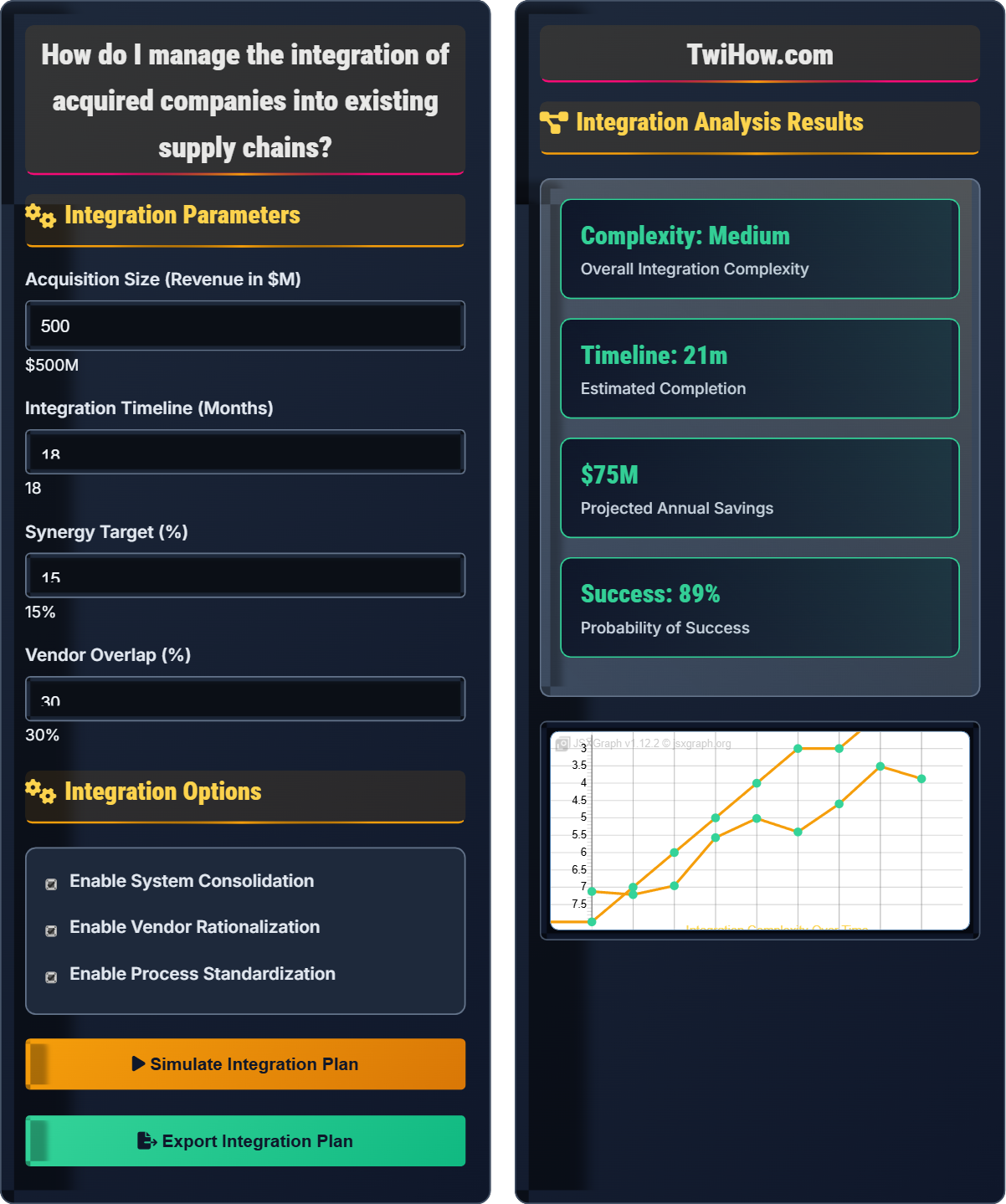
Integration Parameters
Integration Options
Integration Analysis Results
| Phase | Duration | Focus Area | Status |
|---|---|---|---|
| Due Diligence | 2m | Assessment | Complete |
| Planning | 3m | Strategy | In Progress |
| Execution | 10m | Implementation | Planning |
| Optimization | 3m | Synergies | Planning |
How Supply Chain Integration Works Explained
Supply chain integration is the systematic process of merging the procurement, manufacturing, distribution, and logistics operations of an acquired company with those of the acquiring organization. This involves harmonizing systems, processes, vendor relationships, and operational procedures to achieve operational efficiency, cost synergies, and strategic alignment.
Successful integration requires coordination across multiple dimensions:
Where:
- System Compatibility: Degree of technology alignment
- Process Alignment: Similarity of operational procedures
- Cultural Integration: Organizational compatibility
- Complexity Factors: Geographic, operational, and organizational challenges
Critical integration focus areas include:
- Technology Systems: ERP, WMS, TMS, and procurement platforms
- Vendor Management: Supplier consolidation and contract harmonization
- Inventory Management: Stock optimization and warehouse integration
- Procurement: Sourcing strategy and purchasing process alignment
- Logistics: Transportation networks and distribution optimization
- Quality Management: Standards and compliance harmonization
- Early Involvement: Engage operations teams during due diligence
- Change Management: Address cultural and organizational factors
- Phased Approach: Execute integration in manageable stages
- Clear Governance: Establish dedicated integration leadership
- Communication: Maintain transparency with all stakeholders
- Continuous Monitoring: Track progress against integration metrics
Integration Fundamentals
M&A integration, due diligence, system consolidation, vendor rationalization, process standardization, synergy realization.
Success Rate = (Technology Readiness × Process Compatibility × Change Readiness) / Risk Factors
Where Technology Readiness = system compatibility level, Process Compatibility = operational alignment.
- Integration begins during due diligence
- Technology integration drives operational efficiency
- Cultural alignment is critical for success
Applications
Manufacturing consolidation, retail expansion, pharmaceutical acquisitions, automotive integration, technology mergers, industrial services.
- Horizontal integration strategies
- Vertical integration moves
- Market expansion acquisitions
- Technology acquisition integrations
- Regulatory compliance requirements
- Customer retention priorities
- Employee retention strategies
- Operational continuity needs
Supply Chain Integration Learning Quiz
Which area should receive the highest priority during due diligence for supply chain integration?
Technology systems and data are critical for supply chain integration success. Understanding the acquired company's ERP, WMS, and other systems, along with data quality and structure, directly impacts the integration approach and timeline. Poor system compatibility can derail integration efforts.
The answer is B) Technology systems and data.
While all due diligence areas are important, technology systems form the backbone of supply chain operations. Early assessment of system compatibility, data quality, and integration complexity allows for realistic planning and resource allocation. This knowledge directly influences the integration strategy and success probability.
ERP Systems: Enterprise Resource Planning platforms
WMS: Warehouse Management Systems
Data Quality: Accuracy and completeness of information
• Technology assessment starts early
• Data compatibility affects integration
• System gaps require planning
• Document all systems and interfaces
• Assess data migration complexity
• Identify critical integration points
• Underestimating system integration
• Not assessing data quality early
• Ignoring legacy system challenges
Explain the process of vendor rationalization during supply chain integration and describe how to handle overlapping supplier relationships.
Vendor Rationalization Process:
1. Mapping: Create comprehensive lists of all suppliers from both companies
2. Analysis: Identify overlaps, evaluate performance, and assess contracts
3. Selection Criteria: Price, quality, reliability, geographic coverage
4. Negotiation: Consolidate volumes for better terms
5. Transition: Manage supplier changes without disruption
Handling Overlaps:
• Retain best performers from each company
• Negotiate improved terms with consolidated volumes
• Maintain backup suppliers for critical items
• Respect existing contract obligations
• Consider regional preferences and capabilities
Vendor rationalization offers significant cost savings through consolidation, but requires careful management to avoid supply disruptions. The goal is to optimize the supplier base while maintaining quality and service levels. Success depends on thorough analysis and strategic negotiations.
Vendor Rationalization: Process of optimizing supplier base
Supply Consolidation: Combining purchases with fewer suppliers
Contract Obligations: Existing supplier agreements
• Maintain supply continuity
• Honor existing contracts
• Evaluate supplier performance
• Create detailed supplier matrices
• Negotiate early for better terms
• Plan transition timelines carefully
• Cutting suppliers too quickly
• Not considering geographic factors
• Ignoring supplier capabilities
A manufacturing company acquires a competitor with 80% similar operations but different ERP systems. The acquired company has 200 suppliers, with 60% overlap with the acquiring company's supplier base. Calculate the integration timeline considering: 3 months for system assessment, 6 months for ERP consolidation, 4 months for vendor rationalization, and 5 months for process standardization. Include 20% buffer for unexpected challenges.
Calculations:
Base timeline = 3 + 6 + 4 + 5 = 18 months
Buffer = 18 × 20% = 3.6 months
Total timeline = 18 + 3.6 = 21.6 months ≈ 22 months
Considerations:
With 80% operational similarity and 60% vendor overlap, the integration complexity is moderate. The 20% buffer accounts for potential challenges in system integration, change management, and operational adjustments. The timeline assumes parallel execution of some activities.
Integration timelines depend on operational complexity, system compatibility, and organizational factors. The buffer accounts for unforeseen challenges that commonly arise during integration. Parallel execution of activities can reduce total time, but requires careful coordination and resource allocation.
Integration Timeline: Duration for completing integration activities
Parallel Execution: Running activities simultaneously
Buffer Time: Extra time for unexpected challenges
• Assess complexity early
• Include buffer for challenges
• Coordinate parallel activities
• Break timeline into phases
• Identify critical path activities
• Plan for resource constraints
• Underestimating complexity
• Not planning for parallel execution
• Ignoring resource constraints
Two companies with different procurement cultures are integrating: Company A emphasizes cost minimization with quarterly reviews, while Company B prioritizes quality partnerships with annual evaluations. Propose a strategy to harmonize these approaches while maintaining both cost discipline and quality focus.
Harmonization Strategy:
1. Framework Development: Create balanced scorecards incorporating both cost and quality metrics
2. Review Schedule: Implement monthly cost reviews with quarterly quality assessments
3. Supplier Segmentation: Apply different approaches based on item criticality
4. Training Program: Educate teams on combined approach
5. Performance Metrics: Track both cost savings and quality improvements
6. Leadership Alignment: Ensure executive support for new approach
This blended approach captures the benefits of both cultures while addressing their respective concerns.
Cultural differences in procurement can create conflicts during integration. Rather than imposing one culture over another, successful integration creates a hybrid approach that incorporates the strengths of both. This requires careful change management and clear communication of benefits.
Cultural Integration: Harmonizing different organizational approaches
Supplier Segmentation: Differentiating approaches by supplier importance
Balanced Scorecards: Metrics combining multiple criteria
• Respect both cultures
• Focus on shared objectives
• Maintain employee engagement
• Involve employees in design
• Communicate benefits clearly
• Celebrate early wins
• Imposing one culture over another
• Not involving key stakeholders
• Rushing cultural changes
Which metric provides the most comprehensive view of supply chain integration success?
A combined operational efficiency index provides the most comprehensive view as it incorporates multiple dimensions: cost, quality, service, and responsiveness. This holistic metric captures the integrated performance across all supply chain functions rather than focusing on a single dimension.
The answer is C) Combined operational efficiency index.
Supply chain integration success cannot be measured by a single metric. A comprehensive index that balances cost, quality, service, and innovation provides a more accurate picture of integration effectiveness. This approach prevents optimization of one area at the expense of others.
Operational Efficiency Index: Composite measure of multiple metrics
Holistic Metrics: Measures incorporating multiple dimensions
Balance Scorecards: Multi-criteria performance measures
• Use multiple metrics
• Balance different dimensions
• Track leading and lagging indicators
• Include both quantitative and qualitative metrics
• Monitor customer satisfaction
• Track employee engagement
• Focusing only on cost metrics
• Not tracking operational performance
• Ignoring customer impact
FAQ
Q: How do we maintain operational continuity during supply chain integration?
A: Maintaining continuity requires careful planning and execution:
1. Parallel Operations: Run systems alongside each other during transition
2. Phased Migration: Move functions incrementally rather than all at once
3. Backup Plans: Maintain fallback options for critical processes
4. Change Control: Manage modifications systematically
5. Communication: Keep customers and suppliers informed
6. Resource Redundancy: Have additional staff during transition periods
Success depends on detailed planning and maintaining focus on customer service throughout.
Q: What's the difference between system integration and process standardization in supply chain integration?
A: These represent different integration approaches:
System Integration: Technical consolidation of software platforms, databases, and IT infrastructure. This involves merging ERP systems, connecting databases, and ensuring data flow between previously separate systems.
Process Standardization: Operational harmonization of procedures, workflows, and business practices. This involves aligning how work gets done, standardizing procedures, and ensuring consistent execution across organizations.
Both are necessary but address different aspects: systems enable processes, while standardized processes ensure consistent execution on integrated systems.