What are the best practices for demand sensing and responsive supply chains?
Complete demand sensing guide • Step-by-step explanations
Demand Sensing Fundamentals:
Show Demand Sensing SimulatorDemand sensing is the practice of using real-time data and advanced analytics to accurately predict and respond to customer demand. It involves collecting signals from multiple sources including point-of-sale data, social media, weather patterns, and economic indicators to create more accurate forecasts and responsive supply chains.
At its core, demand sensing combines data from various sources to create a comprehensive view of market conditions. This enables companies to anticipate demand changes and adjust their supply chains accordingly. Responsive supply chains are designed to quickly adapt to these demand fluctuations while maintaining efficiency and cost-effectiveness.
Key demand sensing concepts:
- Real-time Data Collection: Gathering information from multiple sources instantly
- Advanced Analytics: Using AI and ML to process and interpret data
- Signal Processing: Filtering noise from meaningful demand indicators
- Responsive Planning: Adjusting supply chains based on insights
Modern demand sensing systems use big data platforms, predictive analytics, and machine learning to provide accurate forecasts and enable agile supply chain responses. This helps companies reduce inventory costs, improve customer satisfaction, and optimize operations.
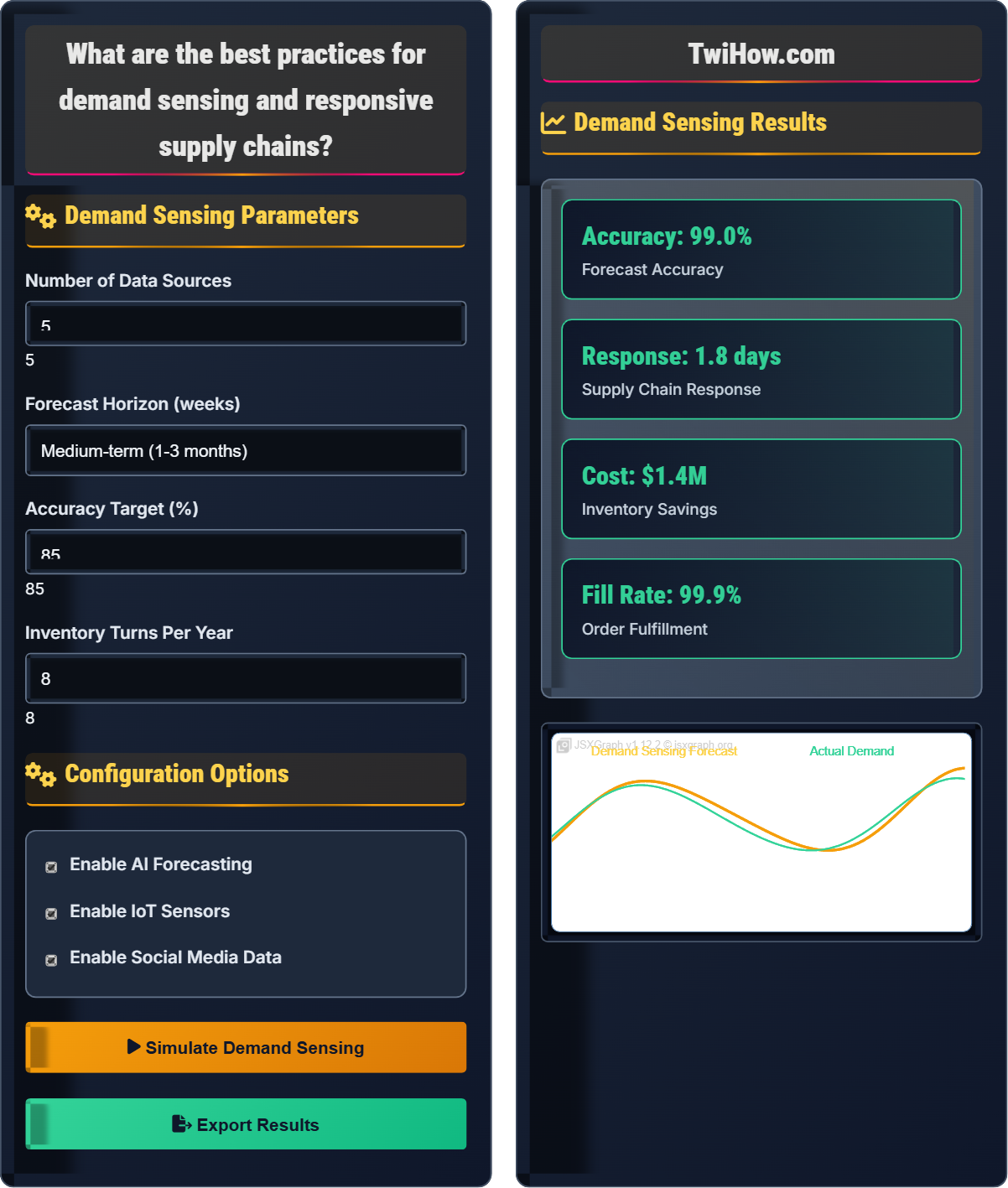
Demand Sensing Parameters
Configuration Options
Demand Sensing Results
| Source | Contribution | Accuracy | Impact |
|---|---|---|---|
| Sales Data | 35% | 92% | High |
| POS Data | 25% | 88% | High |
| Social Media | 15% | 75% | Medium |
| Weather | 10% | 70% | Medium |
| Economic | 15% | 65% | Low |
Demand Sensing and Responsive Supply Chains
Demand sensing is the practice of using real-time data and advanced analytics to accurately predict and respond to customer demand. It involves collecting signals from multiple sources including point-of-sale data, social media, weather patterns, and economic indicators to create more accurate forecasts and responsive supply chains.
Key components of demand sensing systems:
Where:
- Data Sources: Sales, POS, social media, weather, economic indicators
- Weights: Importance assigned to each source
- Reliability: Accuracy and trustworthiness of source
- Analytics: Processing and interpretation algorithms
Key advantages of implementing demand sensing:
- Improved Accuracy: More precise demand forecasts
- Reduced Inventory: Lower carrying costs and waste
- Enhanced Responsiveness: Quicker reactions to market changes
- Cost Savings: Reduced stockouts and overstock
- Customer Satisfaction: Better product availability
- Competitive Advantage: Market leadership through agility
- Big Data Platforms: Processing large volumes of data
- AI/ML Algorithms: Predictive analytics and pattern recognition
- IoT Sensors: Real-time data collection
- Cloud Computing: Scalable processing power
- APIs: Integration with external data sources
Demand Sensing Fundamentals
Demand sensing, responsive supply chains, forecasting accuracy, signal processing, real-time analytics.
Accuracy = (1 - |Actual - Forecast| / Actual) × 100%
Where Accuracy = forecast precision, Actual = real demand, Forecast = predicted demand.
- More data sources improve accuracy
- Real-time processing is essential
- Response time affects effectiveness
Applications
Retail, manufacturing, automotive, consumer goods, electronics, pharmaceuticals.
- Seasonal demand planning
- New product launches
- Promotion planning
- Inventory optimization
- Data quality and integration
- System complexity
- Change management
- Cost of implementation
Demand Sensing Learning Quiz
Which of the following is NOT a core component of demand sensing?
Demand sensing relies on real-time data collection, advanced analytics, and signal processing to create dynamic, responsive forecasts. Static forecasting models are traditional approaches that don't adapt to real-time changes, which is the opposite of what demand sensing aims to achieve.
The answer is C) Static Forecasting Models.
The key difference between traditional forecasting and demand sensing is adaptability. Traditional forecasting uses historical data to create static models that don't adjust to real-time changes. Demand sensing continuously incorporates new information to update forecasts, making it much more responsive to market dynamics.
Real-time Data: Information collected and processed instantly
Signal Processing: Filtering meaningful data from noise
Static Models: Fixed forecasting algorithms
• Adaptability is key to demand sensing
• Dynamic models outperform static ones
• Start with high-quality data sources
• Focus on actionable signals
• Balance complexity with usability
• Using outdated forecasting methods
• Not filtering data noise
• Ignoring external factors
Explain the main benefits of implementing demand sensing in supply chain management, and how these benefits translate into measurable improvements in business performance.
Main Benefits: Demand sensing provides improved forecast accuracy, reduced inventory levels, enhanced responsiveness to market changes, cost savings through reduced stockouts and overstock, better customer satisfaction through product availability, and competitive advantage through market agility.
Measurable Improvements: Forecast accuracy can improve by 15-30%. Inventory levels can be reduced by 10-25%. Stockout incidents can decrease by 20-40%. Customer satisfaction scores can increase by 5-15%. Overall supply chain costs can be reduced by 5-15%.
Demand sensing creates a feedback loop that continuously improves supply chain performance. As forecasts become more accurate, companies can reduce safety stock, respond more quickly to demand changes, and optimize their operations. The measurable improvements compound over time, leading to significant competitive advantages.
Forecast Accuracy: Precision of demand predictions
Stockouts: Running out of inventory to meet demand
Overstock: Excess inventory beyond demand
• Accuracy drives efficiency
• Responsiveness improves customer satisfaction
• Data quality affects outcomes
• Start with the most reliable data sources
• Focus on high-impact areas first
• Measure and track improvements
• Not measuring baseline performance
• Overcomplicating initial implementations
• Ignoring data quality issues
A retail company currently maintains 20% safety stock across all SKUs due to uncertain demand forecasts with 70% accuracy. They plan to implement demand sensing to improve forecast accuracy to 85% and reduce safety stock to 12%. If their current inventory value is $50 million, calculate the potential cash savings from reduced safety stock and estimate the potential annual cost savings if carrying costs are 20% of inventory value.
Current Safety Stock Value: $50M × 20% = $10M
Projected Safety Stock Value: $50M × 12% = $6M
Cash Savings: $10M - $6M = $4M
Annual Carrying Cost Savings: $4M × 20% = $800,000
Additional Benefits: Improved forecast accuracy may also reduce stockouts and obsolescence, providing additional savings. The improved responsiveness can lead to better customer satisfaction and sales.
This example demonstrates the financial impact of improved demand sensing. By reducing safety stock through better forecasting, companies can free up significant cash that was tied up in inventory. The carrying cost savings alone can be substantial, but the real value often comes from improved customer service and reduced risk of obsolescence.
Safety Stock: Extra inventory to buffer against demand uncertainty
Carrying Costs: Expenses associated with holding inventory
SKU: Stock Keeping Unit, individual product type
• Accuracy improvements directly impact safety stock
• Cash savings compound over time
• Reduced inventory improves cash flow
• Quantify potential savings upfront
• Consider carrying cost rates
• Plan for implementation timeline
• Not calculating carrying costs
• Underestimating implementation complexity
• Ignoring cash flow impact
A consumer goods company wants to implement demand sensing using POS data, social media sentiment, weather data, and economic indicators. Identify three major challenges they might face and propose solutions for each challenge.
Challenge 1: Data Integration: Combining data from different sources with varying formats and frequencies. Solution: Implement data lakes and standardization protocols.
Challenge 2: Signal Noise: Separating meaningful demand signals from irrelevant data. Solution: Use advanced filtering algorithms and machine learning.
Challenge 3: Organizational Adoption: Getting employees to trust and act on new forecasting methods. Solution: Provide training and demonstrate early wins.
Success requires technical capabilities and organizational change management.
Implementing demand sensing involves both technical and organizational challenges. The technical challenges include data integration, processing, and modeling, while the organizational challenges involve change management and adoption. Both aspects must be addressed for successful implementation.
Data Lake: Repository for raw data in its native format
Signal Noise: Irrelevant information mixed with useful data
Organizational Adoption: Employee acceptance of new processes
• Technical and organizational challenges both matter
• Data quality affects outcomes
• Change management is essential
• Start with pilot programs
• Focus on data quality
• Communicate benefits clearly
• Underestimating data integration complexity
• Not addressing organizational resistance
• Ignoring data quality issues
Which technology combination best supports effective demand sensing?
Effective demand sensing requires big data platforms to handle large volumes of data, AI/ML for advanced analytics and pattern recognition, and cloud computing for scalable processing power. These technologies work together to process real-time data and generate accurate forecasts.
The answer is A) Big data platforms, AI/ML, cloud computing.
Traditional tools like spreadsheets, emails, and manual calculations are insufficient for demand sensing. Modern demand sensing requires sophisticated technology platforms that can handle large volumes of real-time data, apply advanced analytics, and scale to meet business needs.
Big Data Platforms: Systems for processing large datasets
AI/ML: Artificial Intelligence/Machine Learning
Cloud Computing: Internet-based processing services
• Technology enables scale and speed
• Integration is critical
• Scalability supports growth
• Choose integrated solutions
• Plan for scalability
• Consider cloud options
• Using inadequate technology tools
• Not planning for data growth
• Ignoring integration requirements
FAQ
Q: What's the difference between demand forecasting and demand sensing?
A: The key differences are:
Demand Forecasting: Traditional approach using historical data to predict future demand. It's often static and updated periodically (monthly/quarterly).
Demand Sensing: Modern approach using real-time data from multiple sources to detect and respond to demand changes instantly. It's dynamic and continuously updated.
Demand sensing provides much higher accuracy and responsiveness compared to traditional forecasting, enabling proactive rather than reactive supply chain management.
Q: What are the main challenges in implementing demand sensing?
A: The main challenges in demand sensing implementation include:
1. Data Integration: Combining data from multiple sources with different formats and frequencies.
2. Data Quality: Ensuring accuracy, completeness, and timeliness of data sources.
3. Technology Infrastructure: Building scalable platforms for real-time processing.
4. Organizational Change: Getting employees to trust and act on new forecasting methods.
5. Cost Management: Balancing investment with expected returns.
Success requires addressing both technical and organizational challenges systematically.