Best Practices for Supplier Diversity and Inclusive Sourcing
Complete guide • Step-by-step explanations
Supplier Diversity Fundamentals:
Show Supplier Diversity SimulatorSupplier diversity and inclusive sourcing involve strategically procuring goods and services from diverse suppliers, including businesses owned by minorities, women, veterans, LGBTQ+ individuals, and other underrepresented groups. This practice creates economic opportunities while strengthening supply chains and driving innovation.
Key benefits include enhanced innovation through diverse perspectives, improved risk management through supplier base diversification, competitive advantages, and stronger community relationships. Organizations implementing effective supplier diversity programs often see increased revenue, reduced costs, and improved market access.
Core principles:
- Intentional Sourcing: Actively seeking diverse suppliers
- Equitable Opportunities: Providing fair access to procurement processes
- Mentorship & Development: Supporting supplier growth
- Measurable Goals: Setting and tracking diversity targets
Successful supplier diversity programs require leadership commitment, comprehensive policies, dedicated resources, and systematic measurement of outcomes. They create win-win scenarios by supporting economic inclusion while delivering business value.
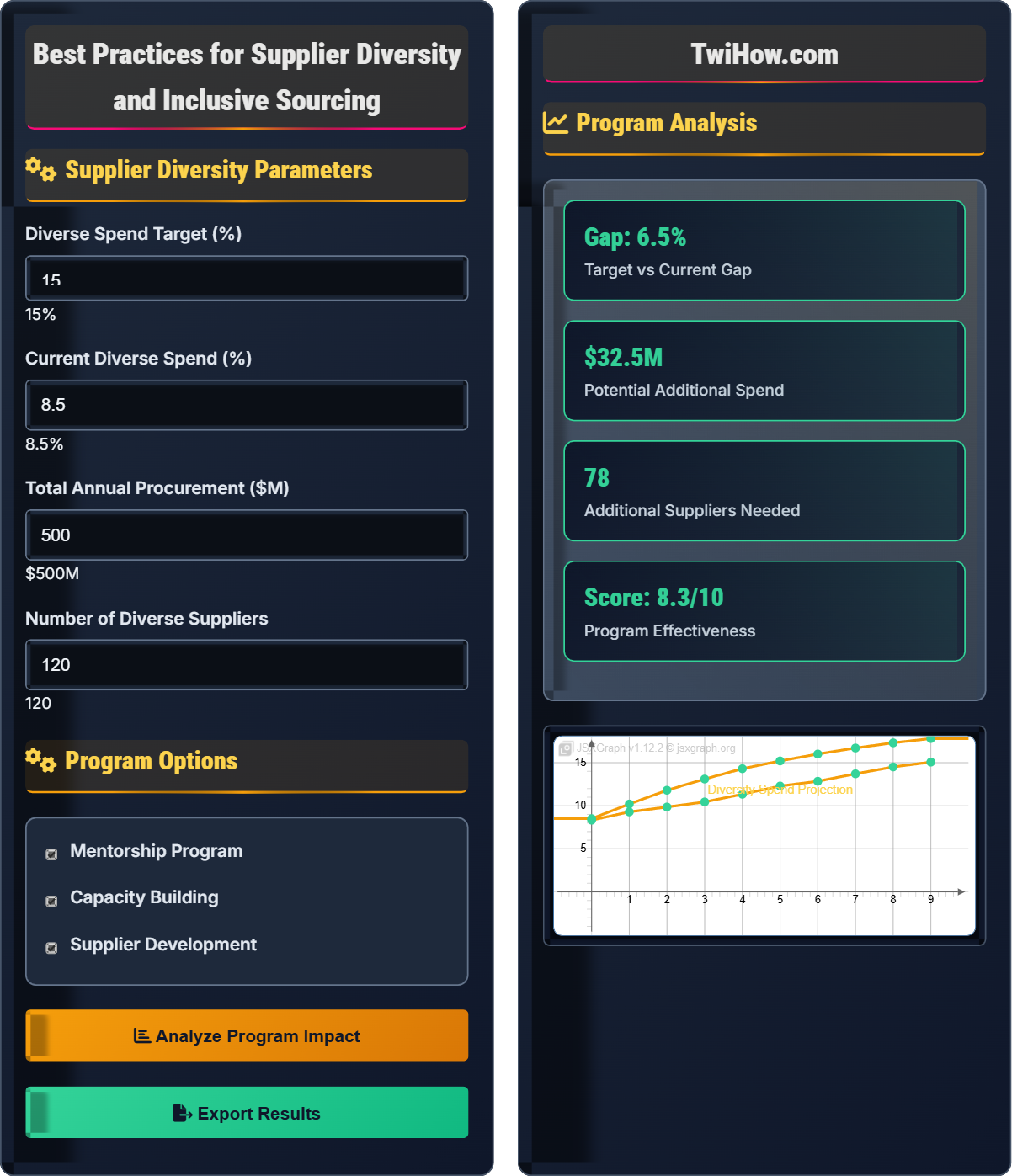
Supplier Diversity Parameters
Program Options
Program Analysis
| Category | Current % | Target % | Gap |
|---|---|---|---|
| Minority-Owned | 4.2% | 8.0% | 3.8% |
| Women-Owned | 2.1% | 5.0% | 2.9% |
| Veteran-Owned | 1.5% | 3.0% | 1.5% |
| LGBTQ+-Owned | 0.7% | 2.0% | 1.3% |
Supplier Categories
- MBE: Minority Business Enterprise
- WBE: Women Business Enterprise
- VBE: Veteran Business Enterprise
- DBE: Disadvantaged Business Enterprise
- LGBTQ+ BE: LGBTQ+ Business Enterprise
Supplier Diversity Best Practices Explained
Supplier diversity is a strategic business practice that involves purchasing goods and services from businesses owned by historically underrepresented groups, including minorities, women, veterans, people with disabilities, and LGBTQ+ individuals. It goes beyond simple compliance to create meaningful economic opportunities and drive business value.
A successful supplier diversity program follows a structured approach:
Where:
- Leadership Commitment: Executive support and resource allocation
- Strategic Integration: Embedding diversity goals into procurement processes
- Measurable Outcomes: Tracking spend, supplier development, and business impact
Key advantages for organizations:
- Innovation: Diverse suppliers bring unique perspectives and solutions
- Risk Management: Reduced dependency on single supplier sources
- Market Access: Enhanced relationships with diverse customer segments
- Reputation: Improved brand image and stakeholder trust
- Competitive Advantage: Differentiation through responsible practices
- Economic Impact: Contribution to local community development
- Supplier Capacity: Limited scale or capability of diverse suppliers
- Compliance Issues: Ensuring genuine diversity certification
- Integration: Incorporating diverse suppliers into existing processes
- Measurement: Tracking and reporting accurate diversity metrics
- Cultural Differences: Navigating varying business practices
Best Practices
Supplier diversity, inclusive sourcing, vendor management, procurement optimization, business enterprise certification.
Diversity Score = (Diverse Spend / Total Spend) × 100
Where Diverse Spend = purchases from certified diverse suppliers.
- Set realistic yet ambitious targets
- Provide meaningful support to suppliers
- Maintain transparent processes
Implementation
Executive sponsorship, dedicated program staff, supplier development initiatives, performance measurement, continuous improvement.
- Establish governance framework
- Create supplier outreach strategy
- Develop certification processes
- Implement tracking systems
- Quality and performance standards
- Cost competitiveness
- Scalability and reliability
- Legal and compliance requirements
Supplier Diversity Learning Quiz
Which of the following is NOT a standard certification category for diverse suppliers?
Standard certification categories for diverse suppliers include MBE (Minority Business Enterprise), WBE (Women Business Enterprise), VBE (Veteran Business Enterprise), DBE (Disadvantaged Business Enterprise), and LGBTQ+ BE (LGBTQ+ Business Enterprise). CBE (Corporate Business Enterprise) is not a recognized certification category as it refers to traditional corporate structures rather than diverse ownership.
The answer is C) CBE (Corporate Business Enterprise).
Understanding supplier certification categories is crucial for effective supplier diversity programs. These certifications provide standardized ways to verify diverse ownership and control of businesses. Each certification has specific requirements and verification processes managed by various organizations like the National Minority Supplier Development Council (NMSDC) or Women's Business Enterprise National Council (WBENC).
MBE: Minority Business Enterprise - business majority-owned by racial/ethnic minorities
WBE: Women Business Enterprise - business majority-owned by women
VBE: Veteran Business Enterprise - business majority-owned by veterans
• Certifications must be verified by authorized bodies
• Ownership and control requirements must be met
• Recertification is required periodically
• Maintain updated certification databases
• Verify certifications regularly
• Support suppliers through certification process
• Accepting unverified certifications
• Mixing certification categories
• Not tracking expiration dates
Explain the key differences between compliance-driven and value-driven supplier diversity programs. Which approach is more sustainable and why?
Compliance-Driven Programs: Focus primarily on meeting regulatory requirements or customer mandates. These programs often emphasize minimum spending targets and documentation to satisfy external obligations. The emphasis is on avoiding penalties rather than achieving business outcomes.
Value-Driven Programs: Emphasize the business benefits of supplier diversity, including innovation, risk mitigation, market access, and competitive advantage. These programs integrate diversity into strategic planning and measure success through both diversity metrics and business performance indicators.
Value-driven programs are more sustainable because they create genuine business value that supports continued investment. They align with organizational goals, generate internal support, and demonstrate measurable returns on investment.
The approach to supplier diversity significantly impacts program success and longevity. Compliance-driven programs often face challenges with internal resistance, limited budgets, and minimal executive engagement. Value-driven programs create champions within the organization by demonstrating tangible business benefits. Understanding this distinction helps in designing programs that achieve both diversity goals and business objectives.
Compliance: Meeting external requirements or regulations
Value Creation: Generating measurable business benefits
Sustainability: Long-term program viability and effectiveness
• Programs should deliver measurable value
• Metrics should align with business objectives
• Connect diversity metrics to business outcomes
• Communicate success stories internally
• Demonstrate ROI to executives
• Focusing only on compliance requirements
• Not measuring business impact
• Lacking executive sponsorship
A manufacturing company with $2 billion in annual procurement spend currently sources 6% of its materials from diverse suppliers. The company aims to increase this to 15% within 3 years. Calculate the additional spend required and describe a phased implementation plan to achieve this goal, considering potential challenges and mitigation strategies.
Current Diverse Spend: $2B × 6% = $120M
Target Diverse Spend: $2B × 15% = $300M
Additional Spend Required: $300M - $120M = $180M over 3 years
Phased Implementation:
Year 1: Increase to 8% ($160M) - Focus on high-volume, low-complexity categories
Year 2: Increase to 12% ($240M) - Expand to mid-tier suppliers and specialty categories
Year 3: Reach 15% ($300M) - Include complex, high-value categories
Challenges & Mitigation:
• Supplier capacity: Develop supplier readiness programs
• Quality concerns: Implement rigorous qualification processes
• Cost premiums: Negotiate competitive pricing through volume commitments
Effective supplier diversity implementation requires careful planning and realistic timelines. The phased approach allows organizations to build capability, address challenges incrementally, and maintain quality standards while expanding diverse supplier utilization. Success depends on balancing diversity goals with operational requirements and cost considerations.
Procurement Spend: Total amount spent on purchased goods and services
Phased Implementation: Gradual rollout over defined time periods
Supplier Readiness: Capability of suppliers to meet requirements
• Set realistic, achievable targets
• Consider supplier capacity constraints
• Maintain quality standards throughout
• Start with non-critical categories
• Build supplier development programs
• Establish clear communication channels
• Setting unrealistic targets
• Ignoring supplier capacity limitations
• Compromising quality for diversity
A company relies heavily on a single large supplier for critical components. The procurement team suggests diversifying by incorporating diverse suppliers to reduce risk. Explain how supplier diversity contributes to supply chain resilience and what factors should be considered when evaluating diverse suppliers for critical components.
Supply Chain Resilience Through Diversity: Diversifying suppliers reduces dependency on single sources, provides alternative supply routes during disruptions, and creates redundancy in critical supply paths. Diverse suppliers often have different geographic footprints, operational models, and risk profiles, which enhances overall supply chain stability.
Factors for Critical Component Evaluation:
1. Technical Capability: Ability to meet specifications and quality standards
2. Financial Stability: Capacity to invest in equipment and maintain operations
3. Production Capacity: Ability to scale to required volumes
4. Quality Systems: Robust quality control and assurance processes
5. Delivery Reliability: Consistent on-time delivery performance
6. Geographic Location: Proximity to facilities and logistics considerations
7. Compliance: Adherence to industry standards and regulations
Supplier diversity serves dual purposes: promoting economic inclusion while enhancing supply chain resilience. When applied to critical components, it requires careful evaluation of supplier capabilities beyond diversity credentials. The key is finding diverse suppliers who meet all technical, quality, and reliability requirements while contributing to diversity goals.
Supply Chain Resilience: Ability to withstand and recover from disruptions
Single Source Dependency: Risk from relying on one supplier
Redundancy: Backup supply options
• Never compromise quality for diversity
• Evaluate all suppliers equally
• Consider total cost of ownership
• Conduct thorough supplier audits
• Start with non-critical applications
• Implement pilot programs
• Rushing supplier qualification
• Ignoring financial stability
• Skipping technical validation
Which metric is most important for demonstrating the business value of a supplier diversity program?
While all metrics provide valuable insights, the percentage of spend with diverse suppliers is often considered the primary metric for demonstrating business value. This metric directly correlates with procurement dollars invested in diverse suppliers and can be linked to cost savings, innovation benefits, and market access improvements. However, a comprehensive measurement approach includes all metrics to provide a complete picture of program impact.
The answer is D) All of the above contribute to business value.
Effective supplier diversity programs require multi-dimensional measurement approaches. While spend percentage is often the primary metric, other metrics like supplier count, innovation contributions, and market access provide important context. The key is selecting metrics that align with organizational objectives and can demonstrate both compliance and business value creation.
Business Value: Measurable benefits to the organization
ROI: Return on Investment for diversity programs
Stakeholder Impact: Effects on various parties
• Align metrics with business objectives
• Measure both quantitative and qualitative outcomes
• Report consistently and transparently
• Use balanced scorecards
• Benchmark against industry standards
• Share success stories
• Focusing only on compliance metrics
• Not measuring business impact
• Inconsistent reporting
FAQ
Q: How do we ensure diverse suppliers meet our quality and delivery requirements?
A: Maintaining quality standards with diverse suppliers requires the same rigorous processes used for all suppliers:
1. Standard Qualification Process: Apply identical criteria to all suppliers regardless of diversity status
2. Capability Assessment: Evaluate technical skills, financial stability, and production capacity
3. Performance Monitoring: Track quality, delivery, and cost metrics consistently
4. Development Support: Provide resources to help diverse suppliers meet requirements
5. Gradual Integration: Start with non-critical items before moving to critical components
The key is never compromising standards while providing appropriate support for supplier development.
Q: What ROI can we expect from a supplier diversity program?
A: Supplier diversity programs deliver both direct and indirect returns on investment:
Direct Benefits: Often 2-5% cost savings through competitive bidding, innovative solutions, and reduced supply chain risks.
Indirect Benefits: Enhanced brand reputation, improved access to diverse markets, increased innovation, stronger community relationships, and potential access to contracts with companies requiring diverse supplier utilization.
Typical ROI: Studies suggest 3-8% return on investment when properly implemented, though benefits can be difficult to quantify due to intangible outcomes like risk reduction and innovation.
Success depends on program design, execution quality, and alignment with business strategy.