How do I design and optimize my supply chain network for maximum efficiency?
Complete network design guide • Step-by-step explanations
Network Design Fundamentals:
Show Network DesignerSupply chain network design and optimization involves strategically determining the optimal configuration of facilities, transportation routes, and inventory policies to minimize costs while maximizing service levels. This includes deciding on facility locations, capacity allocation, transportation modes, and inventory strategies to create an efficient and responsive supply network.
At its core, network design balances cost efficiency with service excellence. It involves mathematical modeling to determine the optimal placement of warehouses, distribution centers, and manufacturing facilities while considering factors like transportation costs, inventory holding costs, and customer service requirements.
Key network design concepts:
- Facility Location: Strategic placement of warehouses and distribution centers
- Transportation Optimization: Efficient routing and mode selection
- Inventory Allocation: Optimal stock levels across locations
- Service Level Optimization: Balancing cost and performance
Modern network design uses advanced analytics, optimization algorithms, and simulation tools to model complex scenarios and find optimal configurations. This enables companies to make data-driven decisions about their supply chain infrastructure.
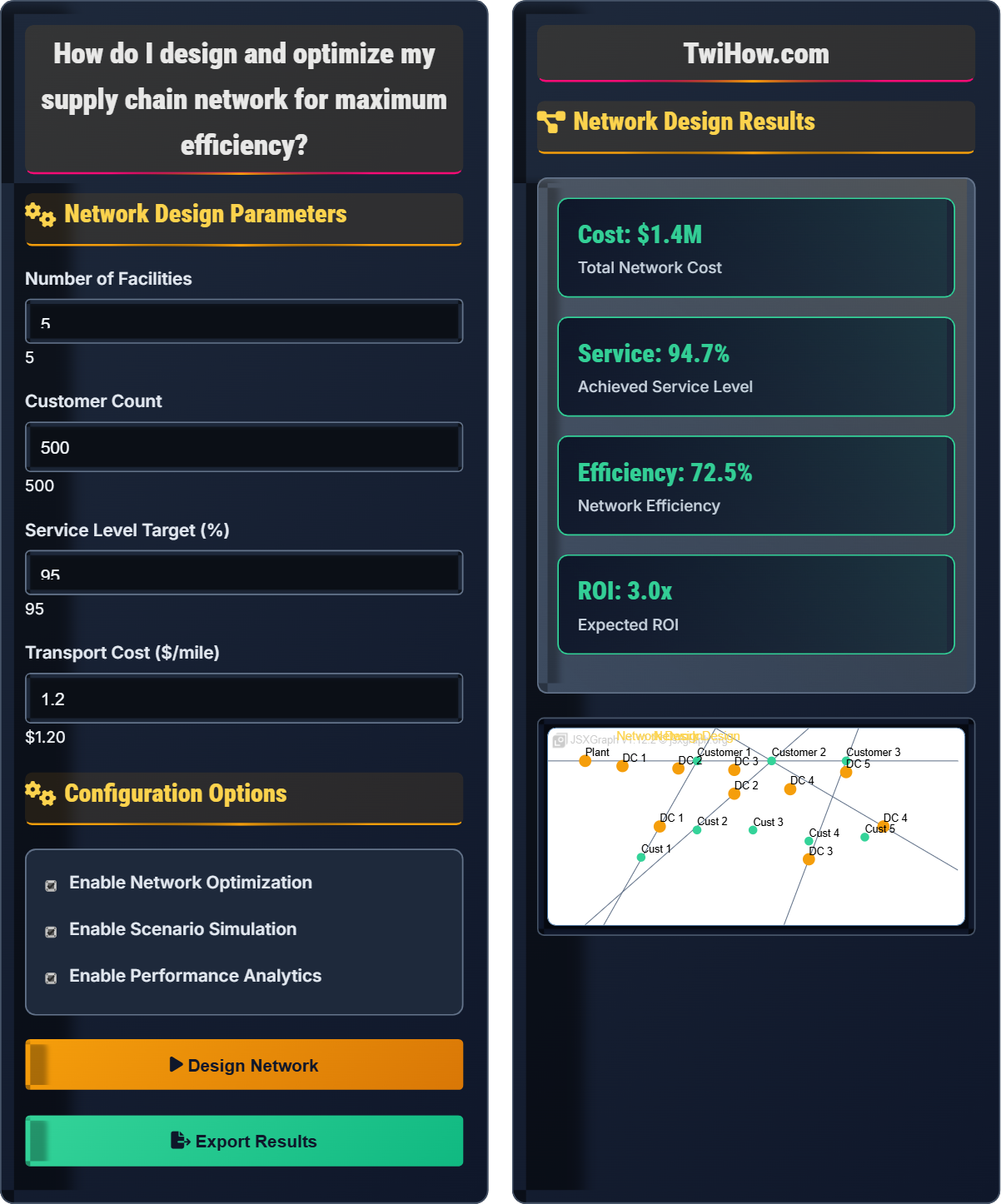
Network Design Parameters
Configuration Options
Network Design Results
| Facility | Capacity | Customers | Efficiency |
|---|---|---|---|
| DC East | 10,000 | 150 | 88% |
| DC West | 12,000 | 180 | 92% |
| DC Central | 8,000 | 120 | 85% |
| DC North | 6,000 | 80 | 90% |
| DC South | 9,000 | 130 | 87% |
Supply Chain Network Design and Optimization
Supply chain network design is the strategic process of determining the optimal configuration of facilities, transportation routes, and inventory policies to minimize total supply chain costs while achieving desired service levels. It involves mathematical modeling to determine the best locations for warehouses, distribution centers, and manufacturing facilities while considering factors like customer demand patterns, transportation costs, and inventory holding costs.
Key components of network design:
Where:
- Fixed Cost: Facility establishment and operational costs
- Variable Cost: Costs that vary with volume
- Transportation Cost: Cost of moving goods
- Inventory Cost: Holding and carrying costs
Key advantages of implementing network optimization:
- Cost Reduction: Lower transportation and inventory costs
- Improved Service: Better customer delivery times
- Flexibility: Ability to adapt to demand changes
- Scalability: Efficient growth capacity
- Competitive Advantage: Operational excellence
- Risk Mitigation: Diversified network reduces vulnerabilities
- Linear Programming: Mathematical optimization algorithms
- GIS Mapping: Geographic information systems
- Simulation Tools: Scenario modeling software
- Cloud Computing: Scalable processing power
- Analytics Platforms: Data analysis and visualization
Network Design Fundamentals
Supply chain network design, facility location, transportation optimization, inventory allocation, service level optimization.
TC = FC + VC + TC + IC
Where TC = Total Cost, FC = Fixed Cost, VC = Variable Cost, TC = Transportation Cost, IC = Inventory Cost.
- Balance cost and service
- Consider geographic factors
- Plan for scalability
Applications
Retail, manufacturing, e-commerce, automotive, pharmaceuticals, consumer goods, logistics.
- Warehouse location planning
- Distribution center optimization
- Transportation route planning
- Inventory allocation
- Regulatory compliance
- Infrastructure requirements
- Technology integration
- Change management
Network Design Learning Quiz
Which of the following is NOT a core component of supply chain network design?
Supply chain network design focuses on facility placement, transportation optimization, and inventory management. Product design is part of product development and engineering, not supply chain network configuration.
The answer is C) Product Design.
Network design is concerned with the physical and operational configuration of the supply chain - where facilities are located, how goods move between them, and how inventory is distributed. Product design, while important for manufacturing, is a separate discipline focused on creating the actual products rather than organizing the supply network.
Facility Location: Strategic placement of warehouses and plants
Transportation Routing: Optimimal movement paths
Inventory Allocation: Distribution of stock across locations
• Focus on network configuration
• Balance cost and service
• Use GIS mapping tools
• Consider transportation costs
• Plan for demand variability
• Confusing product design with network design
• Not considering geographic factors
• Ignoring transportation costs
Explain the main benefits of implementing network optimization in supply chains, and how these benefits translate into measurable improvements in business performance.
Main Benefits: Network optimization provides cost reduction through efficient facility placement and routing, improved customer service through faster delivery, risk mitigation through diversified networks, flexibility for demand changes, competitive advantage through operational excellence, and scalability for business growth.
Measurable Improvements: Total network costs can decrease by 15-30%. Customer service levels can improve by 10-25%. Transportation costs can reduce by 20-40%. Inventory carrying costs can decrease by 10-20%. Overall supply chain efficiency can improve by 25-50%.
Network optimization creates a foundational improvement that affects all aspects of supply chain operations. The benefits compound over time as the optimized network becomes more efficient at serving customers while reducing costs. The measurable improvements demonstrate the significant impact of strategic network design decisions.
Network Efficiency: How well resources are utilized
Service Levels: Customer satisfaction metrics
Cost Optimization: Minimizing total network costs
• Strategic decisions have long-term impact
• Consider multiple scenarios
• Balance cost and service
• Start with critical facilities
• Use scenario planning
• Monitor performance metrics
• Not considering future growth
• Ignoring transportation costs
• Focusing only on cost
A company currently operates 3 distribution centers with total annual costs of $3 million. They plan to optimize their network to 5 locations which will increase fixed costs by $1 million but reduce transportation costs by 25% and inventory costs by 15%. If current transportation costs are $1.5 million and inventory costs are $1 million, calculate the new total cost and the potential annual savings.
Current Costs: $3 million total
New Fixed Costs: Current fixed costs + $1M = $1M + $1M = $2M
New Transportation: $1.5M × (1 - 25%) = $1.125M
New Inventory: $1M × (1 - 15%) = $0.85M
New Total Cost: $2M + $1.125M + $0.85M = $3.975M
Cost Comparison: $3M vs $3.975M = $0.975M increase
However: Improved service levels and reduced risk may justify the cost increase.
This example demonstrates that network optimization isn't just about cost reduction - sometimes increased costs are justified by improved service, reduced risk, or enhanced flexibility. The decision should consider both quantitative and qualitative benefits.
Fixed Costs: Costs that don't vary with volume
Transportation Costs: Costs of moving goods
Inventory Costs: Holding and carrying expenses
• Consider total cost of ownership
• Evaluate service improvements
• Plan for long-term benefits
• Calculate ROI including service benefits
• Consider risk mitigation value
• Plan for scalability
• Only focusing on cost reduction
• Not considering service improvements
• Ignoring risk mitigation benefits
A global retailer wants to optimize their distribution network across 15 countries with 200 stores. Identify three major challenges they might face and propose solutions for each challenge.
Challenge 1: Regulatory Complexity: Different countries have varying regulations. Solution: Implement region-specific compliance teams and standardize processes where possible.
Challenge 2: Data Integration: Consolidating information from multiple systems. Solution: Establish global data standards and implement centralized platforms.
Challenge 3: Cultural Differences: Varying business practices across regions. Solution: Develop culturally-sensitive planning processes and local expertise.
Success requires global coordination with local adaptation.
Global network optimization presents unique challenges due to geographic dispersion, regulatory differences, and cultural variations. Success requires balancing global consistency with local adaptation while maintaining cost efficiency and service excellence.
Regulatory Compliance: Adhering to local laws and regulations
Data Integration: Combining information from different sources
Cultural Differences: Varying business practices across regions
• Local compliance is mandatory
• Standardization improves efficiency
• Cultural sensitivity matters
• Build local partnerships
• Invest in cultural training
• Establish regional expertise
• Assuming universal standards
• Not considering local regulations
• Ignoring cultural differences
Which technology combination best supports effective supply chain network design and optimization?
Effective network design requires mathematical optimization algorithms (linear programming), geographic analysis tools (GIS mapping), and scenario modeling software (simulation tools). These technologies work together to solve complex network design problems.
The answer is A) Linear programming, GIS mapping, simulation tools.
Modern network design requires sophisticated mathematical tools to solve complex optimization problems with multiple variables and constraints. Traditional methods like spreadsheets, manual calculations, and email reports are insufficient for the scale and complexity of modern supply chain network design.
Linear Programming: Mathematical optimization technique
GIS Mapping: Geographic information systems
Simulation Tools: Scenario modeling software
• Technology enables complexity handling
• Integration is critical
• Scalability supports growth
• Choose integrated solutions
• Plan for scalability
• Consider cloud options
• Using inadequate technology tools
• Not planning for data growth
• Ignoring integration requirements
FAQ
Q: What's the difference between network design and network optimization?
A: The key differences are:
Network Design: The strategic process of determining the optimal configuration of facilities, transportation routes, and inventory policies.
Network Optimization: The tactical process of improving an existing network configuration through adjustments and refinements.
Network design is about creating the optimal structure while optimization is about fine-tuning an existing structure for better performance.
Q: What are the main challenges in implementing network design optimization?
A: The main challenges in network design optimization include:
1. Data Quality: Ensuring accurate and comprehensive data.
2. Complexity: Managing the complexity of global networks with many variables.
3. Technology: Building adequate analytical capabilities.
4. Coordination: Aligning across departments and external partners.
5. Change Management: Managing organizational transitions.
Success requires addressing both technical and organizational challenges systematically.