What are the best practices for supply chain talent development and retention?
Complete talent guide • Step-by-step explanations
Talent Development Fundamentals:
Show Talent SimulatorEffective supply chain talent development and retention requires a comprehensive approach that addresses the unique challenges of the industry. This includes developing technical competencies in areas like logistics, procurement, and demand planning, while also building leadership capabilities and soft skills. Retention strategies must focus on career advancement opportunities, competitive compensation, work-life balance, and recognition of contributions to the organization's success.
Modern talent practices in supply chain emphasize continuous learning, cross-functional exposure, mentorship programs, and succession planning. Organizations must adapt to the evolving skill requirements brought about by digitization, sustainability initiatives, and changing customer expectations. The competition for skilled supply chain professionals has intensified, making retention strategies critical for maintaining competitive advantage.
Core components:
- Skills Development: Technical competencies, leadership training, digital literacy
- Career Advancement: Clear progression paths, cross-functional opportunities
- Compensation & Benefits: Competitive packages, performance incentives
- Work Environment: Culture, flexibility, recognition programs
Success depends on aligning talent strategies with business objectives while creating an engaging workplace that attracts and retains top performers.
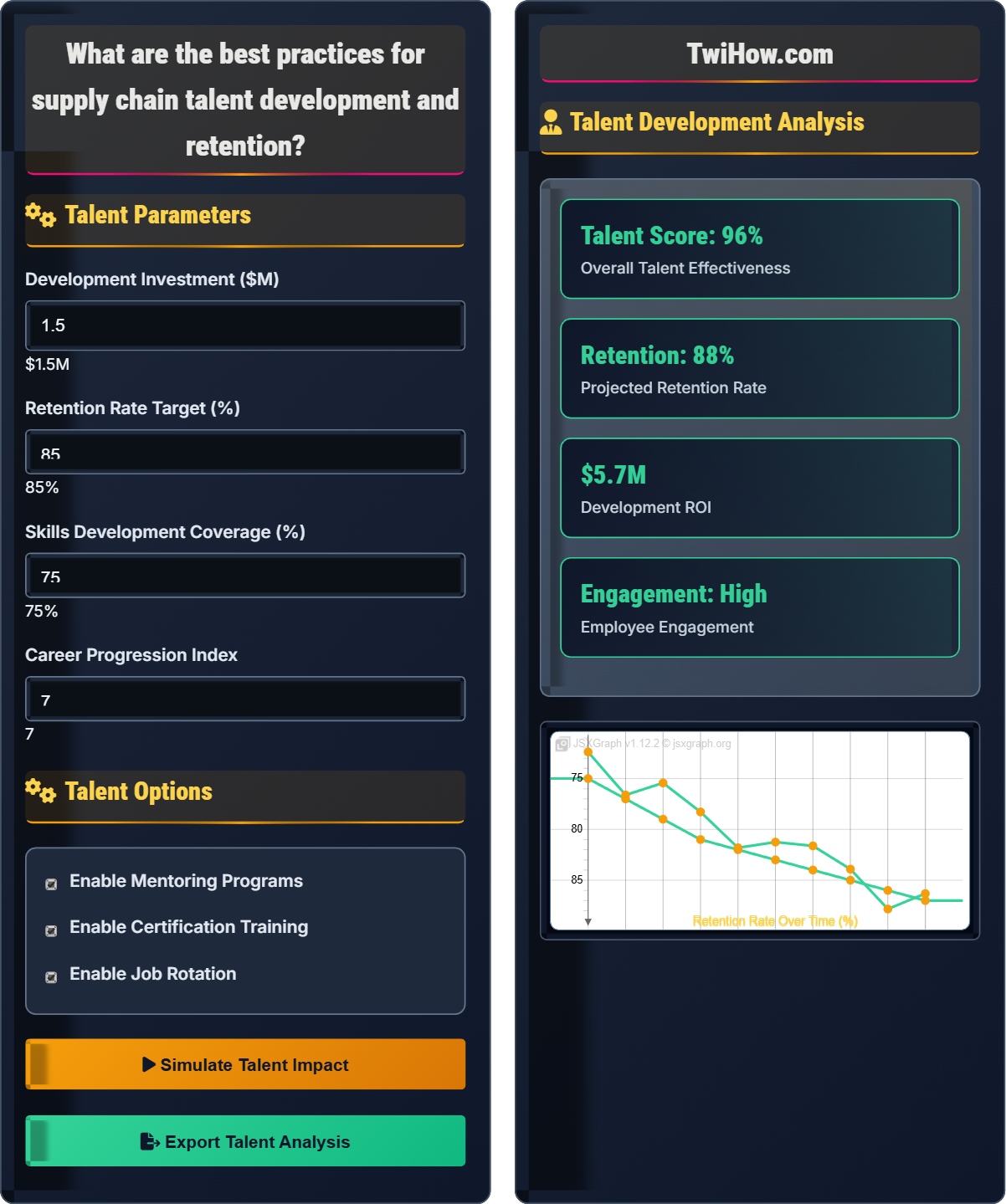
Talent Parameters
Talent Options
Talent Development Analysis
| Program | Investment | Effectiveness | ROI |
|---|---|---|---|
| Mentoring | $200K | 85% | 3.2x |
| Training | $500K | 78% | 2.8x |
| Certification | $300K | 90% | 4.1x |
How Supply Chain Talent Development Works
Supply chain talent development is the systematic approach to building and enhancing the capabilities of professionals working in supply chain management. This encompasses both technical skills related to logistics, procurement, inventory management, and demand planning, as well as leadership and soft skills necessary for effective cross-functional collaboration and strategic decision-making.
Effective talent development integrates multiple components:
Where:
- Development Investment: Resources allocated to training and development
- Engagement Level: Employee satisfaction and commitment
- Career Progression: Opportunities for advancement and growth
- Turnover Costs: Expenses associated with employee departure and replacement
Critical talent development areas for supply chain professionals include:
- Technical Skills: Digital tools, analytics, procurement, logistics optimization
- Leadership Capabilities: Change management, team leadership, strategic thinking
- Cross-Functional Collaboration: Communication, negotiation, project management
- Emerging Technologies: AI, IoT, blockchain, automation
- Sustainability Practices: ESG integration, circular economy principles
- Global Perspective: Cultural competency, international trade, geopolitics
- Personalized Development: Customize programs to individual career aspirations
- Continuous Learning: Foster ongoing skill development and adaptation
- Internal Mobility: Promote from within and offer cross-functional opportunities
- Technology Integration: Leverage digital platforms for learning and development
- Mentorship Programs: Pair experienced professionals with developing talent
- Performance Recognition: Reward achievements and career milestones
Talent Fundamentals
Talent development, retention strategies, skills training, career advancement, employee engagement, succession planning, performance management.
Talent Score = (Development × Engagement × Progression) / Turnover Costs
Where Development = training investment, Engagement = satisfaction level.
- Investment in talent pays dividends
- Retention is more cost-effective than recruitment
- Continuous learning is essential
Applications
Supply chain operations, procurement management, logistics coordination, demand planning, inventory management, vendor relations.
- Technical certification programs
- Leadership development tracks
- Cross-functional rotations
- Succession planning initiatives
- Budget allocation for development
- Time investment requirements
- Measuring program effectiveness
- Aligning with business needs
Supply Chain Talent Development Learning Quiz
Which talent development strategy typically has the highest ROI in supply chain organizations?
Internal mentoring programs typically have the highest ROI in supply chain organizations because they leverage existing institutional knowledge, provide personalized guidance, and create strong organizational bonds. Mentoring programs are relatively low-cost but deliver significant benefits in terms of retention, skill transfer, and career development.
The answer is B) Internal mentoring programs.
Mentoring programs provide high ROI because they utilize existing organizational knowledge and create strong emotional bonds between mentors and mentees. The personalized nature of mentoring allows for tailored development that directly addresses individual needs and career aspirations, making it particularly effective for complex fields like supply chain management.
Return on Investment (ROI): Benefit gained relative to investment made
Internal Mentoring: Guidance provided by experienced internal staff
Institutional Knowledge: Expertise embedded within the organization
• Leverage existing expertise
• Personalized development is more effective
• Relationships enhance retention
• Match mentors and mentees carefully
• Provide structure to mentoring programs
• Measure mentoring effectiveness
• Not matching mentor-mentee pairs effectively
• Lacking program structure
• Not measuring program outcomes
Explain the key components of an effective supply chain talent retention strategy and describe how to measure its success.
Key Components:
1. Competitive Compensation: Market-aligned salaries, bonuses, and benefits
2. Career Development: Clear progression paths and advancement opportunities
3. Work-Life Balance: Flexible schedules and remote work options
4. Recognition Programs: Acknowledgment of achievements and contributions
5. Meaningful Work: Projects that align with employee interests and values
6. Strong Culture: Positive work environment and team dynamics
Success Measurement:
• Annual retention rate
• Voluntary vs. involuntary turnover
• Time to fill positions
• Employee satisfaction surveys
• Performance ratings of retained vs. departed employees
• Cost per hire and replacement costs
Retention strategies must address both extrinsic factors (compensation, benefits) and intrinsic factors (meaningful work, growth opportunities). Success requires a balanced approach that meets diverse employee needs while aligning with organizational goals. Regular measurement ensures strategies remain effective and relevant.
Retention Strategy: Plan to keep valued employees
Voluntary Turnover: Employee-initiated departures
Replacement Costs: Expenses to fill vacant positions
• Address both extrinsic and intrinsic factors
• Regular measurement is essential
• Strategies must evolve with employee needs
• Conduct exit interviews to understand reasons
• Survey employees regularly
• Benchmark against industry standards
• Only focusing on compensation
• Not measuring program effectiveness
• One-size-fits-all approaches
A company invests $500,000 in supply chain training for 100 employees. After training, the average productivity increase is 15%, and the retention rate improves from 75% to 85%. If the average salary is $80,000 and the cost to replace an employee is $40,000, calculate the ROI of the training program after one year.
Calculations:
Before training:
Turnover = 100 × (1 - 0.75) = 25 employees
Replacement cost = 25 × $40,000 = $1,000,000
After training:
Turnover = 100 × (1 - 0.85) = 15 employees
Replacement cost = 15 × $40,000 = $600,000
Savings from reduced turnover = $1,000,000 - $600,000 = $400,000
Productivity gain = 100 × $80,000 × 0.15 = $1,200,000
Total benefit = $400,000 + $1,200,000 = $1,600,000
ROI = ($1,600,000 - $500,000) / $500,000 × 100% = 220%
This example demonstrates how training programs can generate substantial ROI through both direct productivity gains and indirect benefits like improved retention. The compounding effect of reduced turnover costs can significantly enhance the overall return on investment, making talent development a strategic business imperative.
Return on Investment (ROI): Financial return relative to investment
Turnover Cost: Expense of replacing departing employees
Productivity Gain: Increased output from training
• Consider all benefits, not just direct ones
• Include retention benefits in calculations
• Measure productivity improvements
• Track both direct and indirect benefits
• Use multiple years for accurate ROI
• Consider intangible benefits
• Only measuring direct productivity gains
• Not including retention benefits
• Short-term measurement periods
A supply chain organization wants to develop a career advancement program for procurement specialists. Design a structured career path that includes required skills, training, and progression criteria for advancement from entry-level to senior director level.
Career Path Structure:
Entry Level (0-2 years): Procurement Specialist
• Required: Bachelor's degree, basic procurement knowledge
• Training: Company orientation, procurement fundamentals
• Criteria: Performance reviews, basic certification
Mid-Level (2-5 years): Senior Procurement Specialist
• Required: Advanced analytical skills, supplier management
• Training: Advanced procurement courses, leadership training
• Criteria: Project leadership, cost savings achievements
Senior Level (5-8 years): Procurement Manager
• Required: Team leadership, strategic thinking
• Training: MBA or advanced degree, management certification
• Criteria: Team performance, strategic initiatives
Executive Level (8+ years): Senior Director
• Required: Strategic vision, stakeholder management
• Training: Executive development, industry conferences
• Criteria: Organizational impact, revenue growth
Structured career paths provide clear direction and motivation for employees while ensuring skill development aligns with organizational needs. Each level should have specific requirements and advancement criteria that build upon previous achievements, creating a logical progression that benefits both the employee and the organization.
Career Path: Structured progression through job levels
Advancement Criteria: Requirements for promotion
Progressive Development: Skills building on previous levels
• Clear progression criteria
• Aligned with business needs
• Regular updates to requirements
• Include cross-functional opportunities
• Provide stretch assignments
• Regular career discussions
• Unclear advancement criteria
• Not updating requirements regularly
• Lack of mentorship support
Which skill area is becoming increasingly critical for supply chain professionals?
Data analytics and interpretation skills are becoming increasingly critical for supply chain professionals as organizations rely more heavily on data-driven decision making. The ability to analyze supply chain data, identify patterns, and derive actionable insights is essential for optimizing operations and responding to market changes.
The answer is B) Data analytics and interpretation.
As supply chains become more complex and data-rich, professionals must be able to extract value from information. This includes understanding predictive analytics, demand forecasting, and performance metrics. Traditional manual processes are being replaced by digital tools that require analytical capabilities.
Data Analytics: Examination of data for insights
Data-Driven Decision Making: Using data to inform choices
Predictive Analytics: Using data to forecast trends
• Stay current with technology trends
• Develop analytical capabilities
• Focus on digital skills
• Learn relevant software tools
• Practice data interpretation
• Attend analytics training
• Neglecting digital skill development
• Not embracing new technologies
• Focusing only on traditional skills
FAQ
Q: How do we balance talent development investment with short-term business pressures?
A: Balancing investment with business pressures requires strategic thinking:
1. Link to Business Outcomes: Demonstrate direct impact on performance
2. Phased Investment: Start with high-impact, low-cost initiatives
3. ROI Measurement: Quantify benefits to justify spending
4. Internal Promotion: Focus on developing current talent
5. Technology Leverage: Use digital platforms for scalable training
6. Partnerships: Collaborate with educational institutions
The key is showing that talent investment drives immediate business results.
Q: What's the difference between talent development and performance management?
A: These represent different aspects of talent management:
Talent Development: Focuses on building future capabilities and long-term career growth. Emphasizes learning, skill acquisition, and potential realization.
Performance Management: Addresses current job performance and goal achievement. Focuses on meeting current expectations and correcting deficiencies.
Both are necessary: development builds future capacity while performance management ensures current effectiveness.