Strategic Decision Making: Nearshoring vs Offshoring Production
Supply chain strategy guide • Step-by-step explanations
Nearshoring vs Offshoring:
Show Location Strategy CalculatorThe decision between nearshoring and offshoring production is one of the most critical strategic choices in modern supply chain management. Nearshoring involves relocating production closer to the home market, typically within the same region or continent, while offshoring moves production to distant locations, often in countries with lower labor costs. Both strategies offer distinct advantages and challenges that must be evaluated based on cost, quality, risk, and strategic objectives.
Key considerations include:
- Cost Structure: Labor, materials, transportation, and tariffs
- Quality Control: Oversight capabilities and standards alignment
- Supply Chain Risk: Geographic concentration and disruption vulnerability
- Time-to-Market: Lead times and responsiveness to market changes
- Regulatory Environment: Trade policies, compliance requirements
- Strategic Flexibility: Ability to pivot in response to market shifts
The optimal choice depends on the specific product characteristics, market requirements, and organizational capabilities. Many companies now adopt a hybrid approach, balancing nearshore operations for high-value, fast-moving products with offshore production for commodity items.
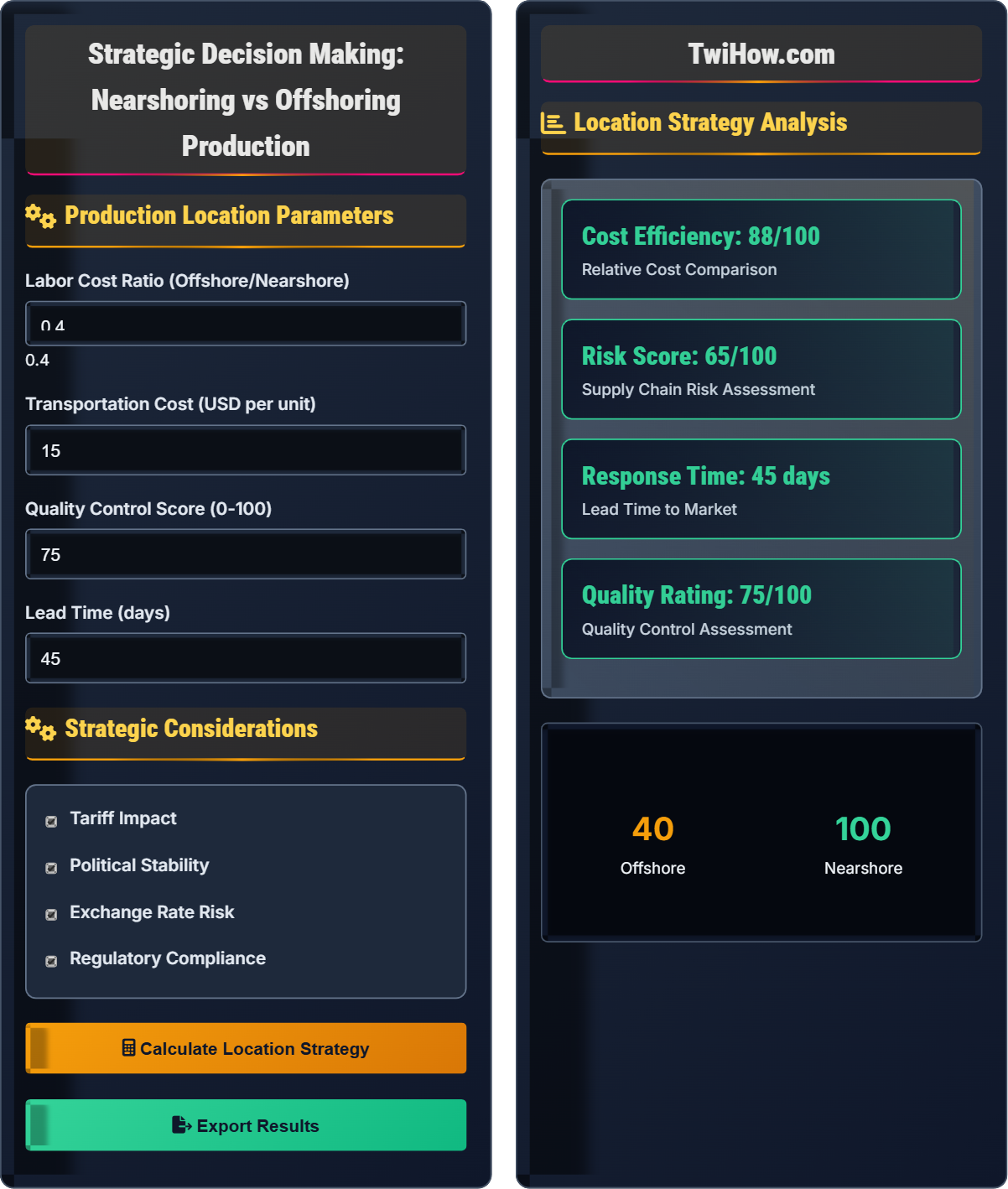
Production Location Parameters
Strategic Considerations
Location Strategy Analysis
| Factor | Offshore | Nearshore | Comparison |
|---|---|---|---|
| Labor Costs | $1.20/unit | $3.00/unit | 60% higher |
| Transportation | $15.00/unit | $5.00/unit | $10 savings |
| Lead Time | 60 days | 15 days | 45 days faster |
| Quality Score | 70/100 | 85/100 | 15 pts higher |
| Risk Level | High | Low | Significant difference |
Recommendation
Based on your parameters, nearshoring appears more favorable for products requiring:
- Quick response to market changes
- High quality standards
- Lower supply chain risk tolerance
- Lower transportation costs
Offshoring may be better for:
- Commodity products with stable demand
- High volume, low value items
- Products with long life cycles
Implementation Considerations
- Hybrid approach for different product categories
- Gradual transition to minimize disruption
- Supplier development in chosen location
- Technology transfer and training programs
Nearshoring vs Offshoring Explained
Nearshoring: Relocating production to nearby countries, typically within the same region or continent.
Offshoring: Moving production to distant countries, often in different continents with lower labor costs.
Reshoring: Bringing back production from overseas to domestic facilities.
The decision matrix evaluates:
Cost Impact = (Labor Savings × Volume) - (Transportation + Tariff + Risk Costs)
Strategic Score = (Cost Efficiency × 0.3) + (Quality × 0.25) + (Risk × 0.2) + (Time × 0.15) + (Flexibility × 0.1)
- Match location strategy to product lifecycle
- Consider total cost of ownership, not just labor
- Factor in geopolitical and trade risks
- Align with customer proximity requirements
Case Studies
Nearshoring Success: Companies like Ford and BMW moved production closer to North American and European markets respectively, reducing lead times and improving responsiveness.
Offshoring Success: Apple's iPhone production in China leveraged lower labor costs and specialized manufacturing capabilities.
Hybrid Approach: Many electronics companies use offshore manufacturing for commodity components and nearshore for final assembly and customization.
- Conduct comprehensive cost-benefit analysis
- Plan for supply chain disruptions
- Maintain supplier relationships
- Invest in quality control systems
Location Strategy Quiz
Which factor has the greatest impact on total cost of ownership in location decisions?
Total cost of ownership includes direct labor, transportation, tariffs, inventory carrying costs, quality costs, and risk mitigation expenses. Focusing only on labor costs can lead to poor decisions. Hidden costs like inventory financing, quality issues, and supply disruptions often exceed initial labor savings.
The answer is C) Total cost including hidden expenses.
Location decisions require a comprehensive view of all costs across the entire supply chain. The "hidden costs" of offshoring often include inventory carrying costs (due to longer lead times), quality control expenses, expediting fees, and supply chain risk premiums. These costs can easily exceed the initial labor savings, making nearshoring more attractive despite higher direct labor costs.
Total Cost of Ownership: All costs associated with a decision over its lifecycle
Hidden Costs: Expenses not immediately apparent in cost analysis
Inventory Carrying Cost: Cost of holding inventory over time
• Always calculate total cost of ownership
• Include risk premiums in cost calculations
• Consider intangible costs
• Use cost models that include all factors
• Regularly update cost comparisons
• Factor in exchange rate volatility
• Focusing only on direct labor costs
• Ignoring quality and risk costs
• Not updating analysis regularly
Explain the key risks associated with offshoring and how they can be mitigated. What are the advantages of nearshoring in terms of risk management?
Key Risks of Offshoring:
1. Geopolitical Risk: Political instability, trade wars, sanctions
2. Supply Chain Disruption: Natural disasters, pandemics, transportation issues
3. Quality Control: Difficulty monitoring and maintaining standards
4. Intellectual Property: Risk of theft or unauthorized use
5. Currency Fluctuation: Exchange rate volatility affecting costs
Mitigation Strategies: Diversification of suppliers, quality audits, IP protection agreements, hedging strategies
Nearshoring Advantages: Reduced travel time for oversight, similar regulatory frameworks, cultural alignment, shorter supply chains
Risk management in location decisions requires understanding both the probability and impact of potential disruptions. Nearshoring reduces many risks by bringing production closer to the home market, enabling better oversight and faster response times. However, it may not always provide the same cost advantages as offshoring. The key is finding the right balance based on product characteristics and market requirements.
Geopolitical Risk: Political and economic instability affecting business
Supply Chain Disruption: Interruption of normal supply operations
Risk Mitigation: Strategies to reduce potential negative impacts
• Assess both probability and impact of risks
• Implement multiple mitigation strategies
• Regularly review risk exposure
• Develop supplier scorecards including risk metrics
• Create contingency plans for major risks
• Consider political risk insurance
• Underestimating supply chain risks
• Not having contingency plans
• Concentrating too much production in one location
FAQ
Q: Should we consider a hybrid approach combining both nearshoring and offshoring?
A: Yes, a hybrid approach often provides the best balance of cost, quality, and risk management:
1. High-value products: Nearshore for quick response and quality control
2. Commodity items: Offshore for cost optimization
3. Seasonal products: Nearshore for demand responsiveness
4. Stable demand: Offshore for cost efficiency
This approach allows companies to leverage the advantages of both strategies while managing risks effectively.
Q: How do recent global events affect nearshoring vs offshoring decisions?
A: Recent events have shifted the balance toward nearshoring:
1. COVID-19: Highlighted supply chain vulnerabilities and the importance of resilience
2. Trade tensions: Increased tariffs and trade barriers affecting offshore locations
3. Geopolitical conflicts: Demonstrated risks of over-dependence on specific regions
4. Consumer expectations: Growing demand for sustainable and locally-produced goods
However, cost pressures continue to support offshoring for certain product categories.