What are the considerations for supply chain finance and working capital optimization?
Complete supply chain finance guide • Step-by-step explanations
Supply Chain Finance Fundamentals:
Show Finance SimulatorSupply chain finance and working capital optimization involve managing the financial flows between buyers, suppliers, and financiers to improve cash flow, reduce costs, and enhance liquidity. This includes optimizing payment terms, inventory management, and financing arrangements to create efficient financial flows throughout the supply chain.
At its core, supply chain finance connects operational efficiency with financial performance. It balances the need for inventory and production with cash flow requirements, ensuring that companies can meet their obligations while maintaining operational excellence.
Key supply chain finance concepts:
- Cash Conversion Cycle: Time from paying suppliers to receiving payment from customers
- Accounts Payable Optimization: Managing payment terms with suppliers
- Accounts Receivable Management: Accelerating customer payments
- Inventory Financing: Leveraging inventory as collateral
Modern supply chain finance implementations use advanced analytics, trade finance solutions, and collaborative platforms to optimize working capital across the entire supply network. This enables companies to improve cash flow, reduce financing costs, and strengthen supplier relationships.
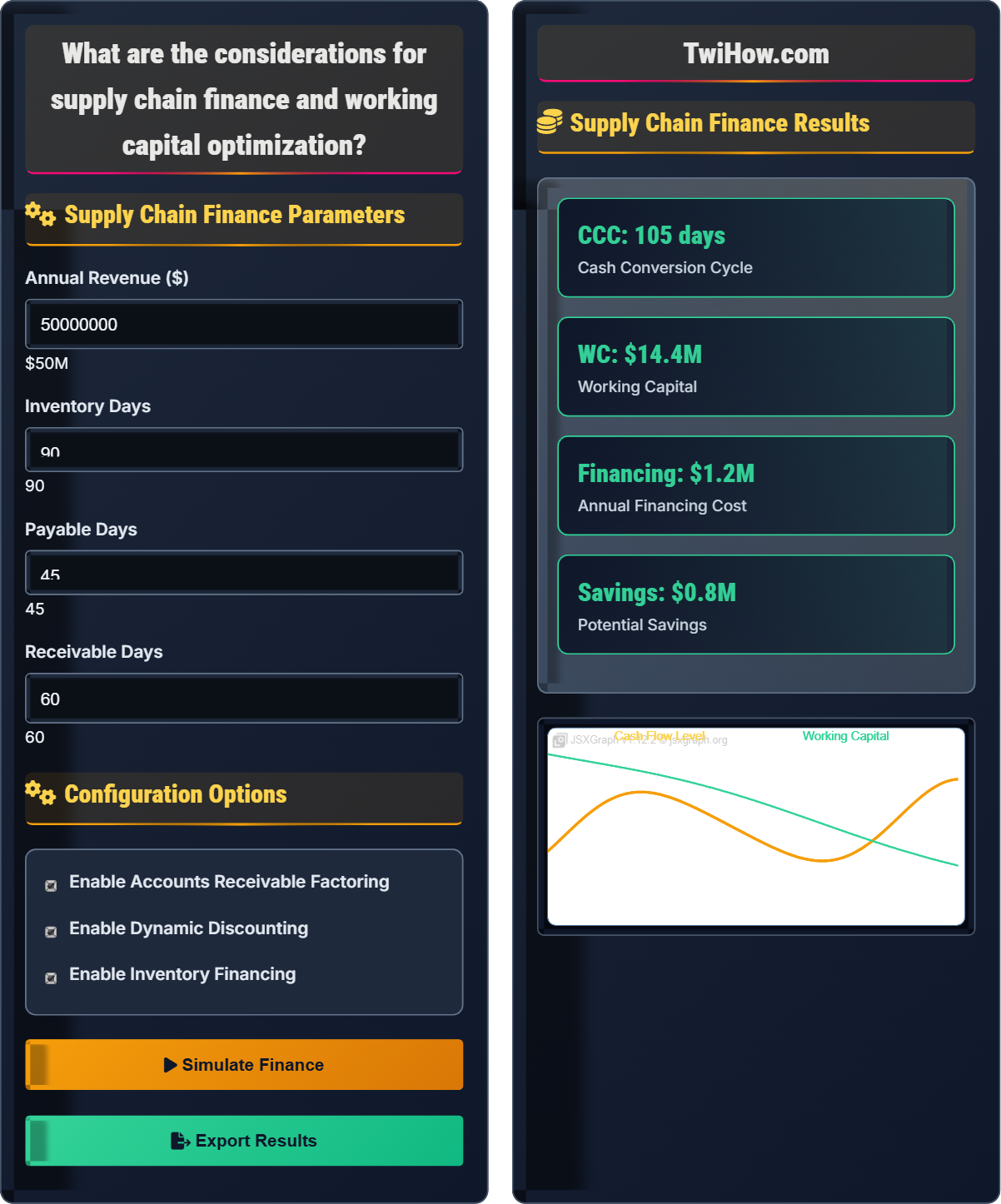
Supply Chain Finance Parameters
Configuration Options
Supply Chain Finance Results
| Metric | Current | Optimized | Improvement |
|---|---|---|---|
| Inventory Days | 90 | 75 | -15 |
| Payable Days | 45 | 50 | +5 |
| Receivable Days | 60 | 50 | -10 |
| CCC | 105 | 75 | -30 |
Supply Chain Finance and Working Capital Optimization
Supply chain finance involves managing the financial flows between buyers, suppliers, and financiers to improve cash flow, reduce costs, and enhance liquidity. It encompasses various financial instruments and processes that optimize working capital across the entire supply network, balancing operational efficiency with financial performance.
Key components of supply chain finance:
Where:
- Inventory: Value of stock held
- Receivables: Money owed by customers
- Payables: Money owed to suppliers
- Cash Conversion Cycle: Time to convert resources to cash
Key advantages of implementing supply chain finance:
- Improved Cash Flow: Better liquidity and cash management
- Reduced Costs: Lower financing and operational expenses
- Enhanced Relationships: Stronger supplier partnerships
- Increased Efficiency: Streamlined financial processes
- Competitive Advantage: Better financial position
- Supply Chain Resilience: Financial stability during disruptions
- Trade Finance Platforms: Digital transaction management
- Blockchain: Transparent and secure transactions
- AI/ML: Predictive analytics for cash flow
- ERP Integration: Financial and operational systems
- Payment Systems: Automated clearing and settlement
Supply Chain Finance Fundamentals
Supply chain finance, working capital, cash conversion cycle, accounts payable, accounts receivable, inventory management.
CCC = Inventory Days + Receivable Days - Payable Days
Where CCC = Cash Conversion Cycle, representing time to convert resources to cash.
- Shorter cycles improve cash flow
- Balance efficiency with relationships
- Consider cost of capital
Applications
Automotive, retail, manufacturing, electronics, pharmaceuticals, food & beverage.
- Vendor managed inventory
- Dynamic discounting programs
- Supply chain factoring
- Inventory financing
- Relationship management
- Technology integration
- Regulatory compliance
- Counterparty risk
Supply Chain Finance Learning Quiz
Which of the following is NOT a core component of the cash conversion cycle?
The cash conversion cycle (CCC) is calculated as Inventory Days + Receivable Days - Payable Days. Profit margin is a profitability metric unrelated to the timing of cash flows in the supply chain cycle.
The answer is D) Profit Margin.
The cash conversion cycle measures the time it takes for a company to convert resource inputs into cash flows from sales. It specifically tracks the timing of inventory purchases, customer payments, and supplier payments. Profit margin, while important, measures profitability rather than cash flow timing.
Inventory Days: Average time inventory is held
Receivable Days: Average time to collect from customers
Payable Days: Average time to pay suppliers
• CCC measures cash flow timing
• Profit measures earnings
• Focus on timing metrics
• Consider all three components
• Monitor trends over time
• Confusing profitability with cash flow
• Ignoring all three components
• Not tracking changes over time
Explain the main benefits of implementing supply chain finance optimization, and how these benefits translate into measurable improvements in business performance.
Main Benefits: Supply chain finance optimization provides improved cash flow through better liquidity, reduced costs via lower financing expenses, enhanced supplier relationships, increased operational efficiency, competitive advantage through stronger financial position, and supply chain resilience during disruptions.
Measurable Improvements: Cash conversion cycle can be reduced by 10-30%. Financing costs can decrease by 15-40%. Working capital requirements can be lowered by 10-25%. Supplier payment terms can be extended by 5-15 days. Customer payment acceleration can reduce receivables by 10-20%.
Supply chain finance optimization creates a virtuous cycle where improved cash flow enables better operational decisions, which further improve financial performance. The measurable improvements demonstrate the direct impact on business performance, from reduced financing costs to enhanced supplier relationships.
Cash Flow: Movement of money in and out of business
Liquidity: Ability to meet short-term obligationsWorking Capital: Short-term assets minus liabilities
• Timing affects cash flow
• Relationships matter for success
• Technology enables optimization
• Start with quick wins
• Focus on high-impact areas
• Measure and track improvements
• Not measuring baseline performance
• Ignoring supplier relationships
• Underestimating implementation complexity
A manufacturing company has annual revenue of $100 million, with inventory worth $20 million, accounts receivable of $15 million, and accounts payable of $10 million. Their current cash conversion cycle is 120 days. If they implement supply chain finance optimization that reduces inventory by 15%, receivables by 10%, and extends payables by 5 days, calculate the new working capital and the potential cash flow improvement.
Current Working Capital: $20M + $15M - $10M = $25M
After Optimization:
Inventory: $20M × 0.85 = $17M
Receivables: $15M × 0.90 = $13.5M
Payables: $10M (unchanged, but cycle extended by 5 days)
New Working Capital: $17M + $13.5M - $10M = $20.5M
Working Capital Improvement: $25M - $20.5M = $4.5M
Additional Benefit: The 5-day extension in payables provides an additional $1.37M in cash flow (calculated as $100M ÷ 365 × 5 days × $10M/$100M proportion).
This example demonstrates how supply chain finance optimization can significantly impact working capital. By reducing inventory and receivables while extending payables, the company can free up substantial cash. The improvement in working capital represents immediate financial benefits that can be reinvested in the business or used to reduce debt.
Working Capital: Current assets minus current liabilities
Cash Flow Improvement: Additional cash generated
Payables Extension: Longer time to pay suppliers
• Balance efficiency with relationships
• Consider counterparty impact
• Monitor cash flow timing
• Focus on high-value items first
• Negotiate win-win terms
• Use technology for visibility
• Extending payables too aggressively
• Not considering supplier impact
• Ignoring seasonal variations
A global retailer wants to implement supply chain finance optimization across multiple countries with different banking systems. Identify three major challenges they might face and propose solutions for each challenge.
Challenge 1: Regulatory Compliance: Different countries have varying financial regulations. Solution: Establish local compliance teams and standardize processes where possible.
Challenge 2: Banking Infrastructure: Varying levels of digital banking adoption. Solution: Partner with local banks and implement hybrid solutions.
Challenge 3: Currency Fluctuation: Exchange rate volatility affecting cash flows. Solution: Implement hedging strategies and netting arrangements.
Success requires global coordination with local adaptation.
Global supply chain finance implementations face unique challenges due to varying regulatory environments, banking systems, and economic conditions. The key is developing capabilities that work across different contexts while maintaining financial efficiency and compliance standards.
Regulatory Compliance: Adhering to local financial laws
Banking Infrastructure: Local financial system capabilities
Currency Hedging: Managing exchange rate risk
• Local compliance is mandatory
• Infrastructure varies globally
• Risk management is essential
• Start with pilot programs
• Build local partnerships
• Implement risk management
• Assuming universal banking systems
• Not considering regulatory differences
• Ignoring currency risks
Which technology combination best supports effective supply chain finance optimization?
Effective supply chain finance requires ERP systems for integration, payment platforms for efficient transactions, and analytics tools for optimization. This combination enables real-time visibility, automated processes, and data-driven decision making for optimal financial performance.
The answer is A) ERP systems, payment platforms, analytics tools.
Modern supply chain finance requires sophisticated technology that can handle complex financial flows, provide real-time visibility, and enable automated optimization. Traditional methods like spreadsheets, manual processes, and paper-based transactions are insufficient for the scale and complexity of modern supply chain finance.
ERP Systems: Enterprise Resource Planning platforms
Payment Platforms: Automated transaction systems
Analytics Tools: Data analysis and optimization software
• Integration enables efficiency
• Real-time visibility is essential
• Automation improves accuracy
• Choose integrated solutions
• Plan for scalability
• Invest in training
• Using disconnected systems
• Not planning for integration
• Ignoring user adoption
FAQ
Q: What's the difference between supply chain finance and traditional corporate finance?
A: The key differences are:
Supply Chain Finance: Focuses on financial flows between trading partners, optimizes payment terms and working capital across the network, considers operational and financial efficiency together.
Traditional Corporate Finance: Focuses on internal financial management, capital structure, and investment decisions within the company.
SCF extends financial management to the entire supply ecosystem, creating value through collaboration rather than just internal optimization.
Q: What are the main challenges in implementing supply chain finance optimization?
A: The main challenges in implementing supply chain finance optimization include:
1. Relationship Management: Balancing cash flow benefits with supplier relationships.
2. Technology Integration: Connecting different systems and platforms.
3. Regulatory Compliance: Adhering to financial regulations in different jurisdictions.
4. Data Quality: Ensuring accurate and timely financial data.
5. Cultural Change: Shifting from traditional payment practices.
Success requires addressing both technical and organizational challenges systematically.