What are the considerations for supply chain resilience in the face of geopolitical risks?
Complete resilience guide • Step-by-step explanations
Supply Chain Resilience Fundamentals:
Show Resilience SimulatorSupply chain resilience in the face of geopolitical risks involves designing and managing supply networks that can withstand and rapidly recover from disruptions caused by political events, trade disputes, sanctions, conflicts, and regulatory changes. This requires proactive risk assessment, diversification strategies, and contingency planning to maintain business continuity despite external political pressures.
Key resilience considerations include geographic diversification, supplier portfolio management, inventory buffering, and alternative logistics pathways. Modern approaches emphasize early warning systems, scenario planning, and adaptive capabilities that allow organizations to pivot quickly when geopolitical conditions change.
Core components:
- Risk Assessment: Identifying and evaluating geopolitical threats
- Diversification: Spreading suppliers and operations across regions
- Contingency Planning: Developing alternative scenarios and responses
- Monitoring: Real-time tracking of geopolitical developments
Successful resilience strategies balance cost efficiency with risk mitigation, creating robust yet flexible supply networks that can adapt to changing political landscapes.
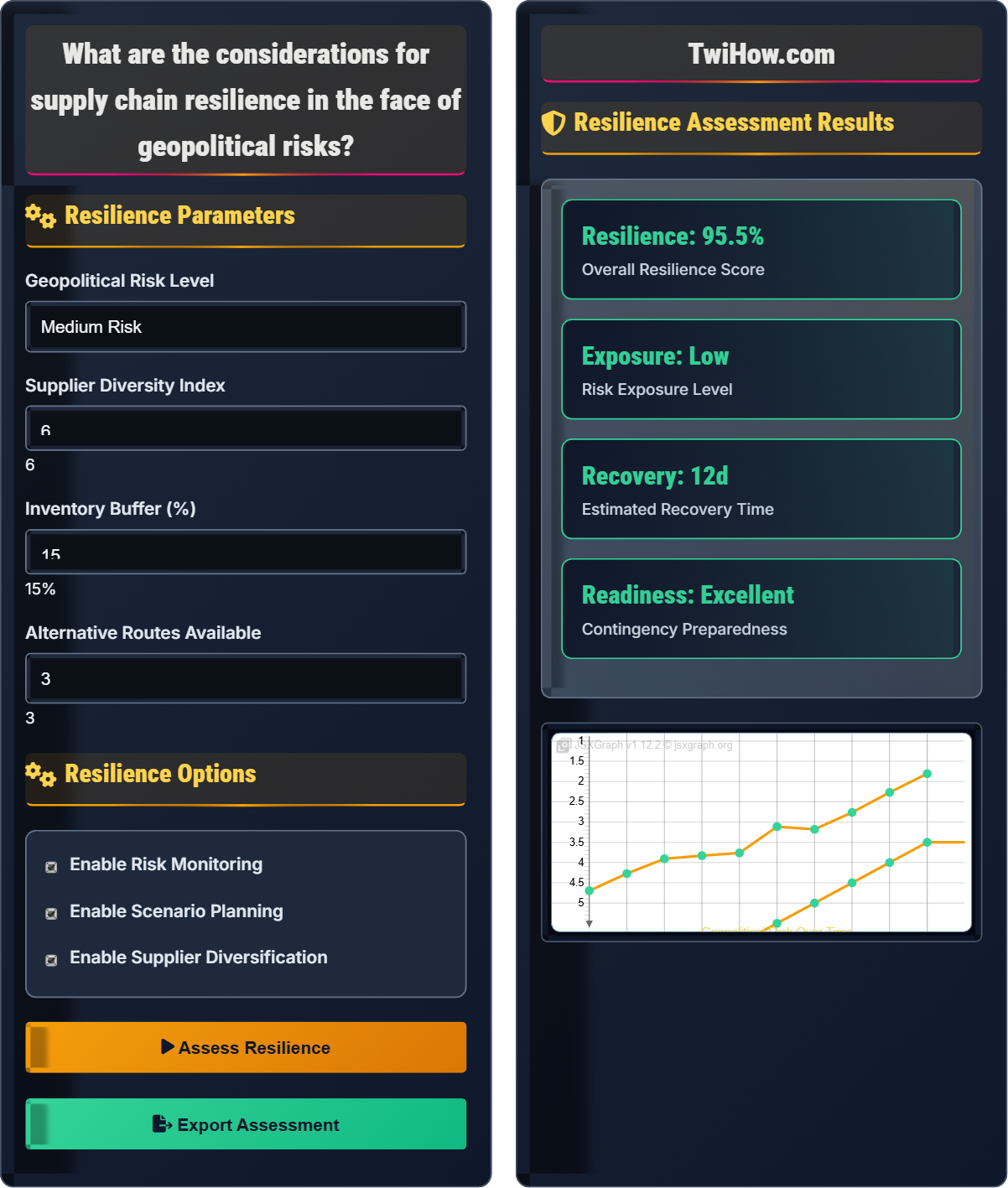
Resilience Parameters
Resilience Options
Resilience Assessment Results
| Risk Type | Severity | Likelihood | Impact |
|---|---|---|---|
| Trade Disputes | High | Medium | High |
| Sanctions | Medium | Low | High |
| Conflict Zones | Medium | Low | Medium |
| Regulatory Changes | Low | High | Medium |
How Supply Chain Resilience Works Explained
Supply chain resilience is the ability of a supply network to anticipate, prepare for, respond to, and adapt to disruptions while maintaining operational continuity. In the context of geopolitical risks, it involves designing supply chains that can withstand political events, trade disputes, sanctions, conflicts, and regulatory changes without significant impact on business operations.
Effective resilience strategies incorporate multiple dimensions:
Where:
- Diversification Score: Geographic and supplier spread
- Contingency Readiness: Alternative plans and resources
- Monitoring Capability: Real-time risk awareness
- Risk Exposure: Vulnerability to disruptions
Effective resilience strategies include:
- Geographic Diversification: Spread operations across multiple regions
- Supplier Portfolio Management: Multiple suppliers per category
- Inventory Buffering: Strategic stockpiling of critical items
- Alternative Pathways: Backup logistics and transportation routes
- Scenario Planning: Prepare for various disruption scenarios
- Early Warning Systems: Monitor geopolitical developments
- Proactive Monitoring: Track political developments continuously
- Flexible Contracts: Include force majeure clauses
- Relationship Building: Cultivate supplier partnerships
- Technology Integration: Use AI for risk prediction
- Regular Testing: Validate plans through exercises
- Stakeholder Communication: Maintain transparency
Resilience Fundamentals
Geopolitical risk, supply chain resilience, diversification, contingency planning, risk assessment, business continuity.
Resilience Score = (Diversification × Contingency × Monitoring) / (Risk × Vulnerability)
Where Diversification = geographic spread, Contingency = alternative plans available.
- Resilience requires proactive planning
- Diversification reduces single points of failure
- Monitoring enables early response
Applications
Global manufacturing, international trade, automotive supply chains, pharmaceutical distribution, technology hardware, energy sector.
- Trade dispute mitigation strategies
- Sanction compliance planning
- Conflict zone avoidance
- Regulatory change adaptation
- Cost-benefit trade-offs
- Regulatory compliance requirements
- Supplier relationship management
- Customer service maintenance
Supply Chain Resilience Learning Quiz
Which of the following represents the most critical step in developing supply chain resilience against geopolitical risks?
Identifying and mapping geopolitical risks is the foundational step in resilience planning. Without understanding potential threats, organizations cannot develop appropriate mitigation strategies. Risk mapping provides the intelligence needed to make informed decisions about diversification, contingency planning, and resource allocation.
The answer is B) Identifying and mapping geopolitical risks.
Effective risk management starts with comprehensive risk identification. Organizations must map their exposure to geopolitical risks by analyzing supplier locations, transportation routes, and market dependencies. This intelligence forms the basis for all subsequent resilience strategies and ensures resources are allocated appropriately.
Risk Mapping: Visual representation of risk exposure across supply chain
Geopolitical Risk: Political events affecting business operations
Supply Chain Exposure: Degree of vulnerability to disruptions
• Risk identification comes first
• Map all supply chain touchpoints
• Consider cascading effects
• Use GIS mapping tools
• Include transportation corridors
• Consider political stability indices
• Only considering direct suppliers
• Ignoring transportation routes
• Not updating risk maps regularly
Explain the concept of supply chain diversification and describe how to implement it effectively in the face of geopolitical risks.
Supply Chain Diversification: The strategy of spreading suppliers, manufacturing sites, and logistics routes across multiple geographic regions and supplier bases to reduce dependence on any single source or location.
Implementation Strategy:
1. Geographic Mapping: Identify suppliers across different political jurisdictions
2. Supplier Qualification: Ensure alternatives meet quality and capacity requirements
3. Volume Allocation: Distribute orders among qualified suppliers
4. Capability Development: Ensure suppliers can scale during disruptions
5. Relationship Management: Maintain strong partnerships with all suppliers
6. Performance Monitoring: Track supplier performance across all locations
Diversification is the cornerstone of geopolitical risk mitigation. It transforms single points of failure into multiple, independent sources of supply. Effective diversification requires careful supplier qualification and relationship management to ensure alternatives can perform when needed.
Supply Chain Diversification: Spreading risk across multiple sources
Single Points of Failure: Critical dependencies on one source
Geographic Distribution: Location diversity across regions
• Maintain supplier quality standards
• Ensure sufficient capacity
• Monitor supplier performance
• Start with critical components first
• Develop local suppliers as backups
• Use tier-2 supplier mapping
• Diversification without capability
• Not testing backup suppliers
• Over-diversification complexity
A company relies on a single supplier in a geopolitically unstable region for 40% of its critical components. The supplier has a 3-week lead time, and the company maintains 2 weeks of inventory. Calculate the minimum contingency inventory needed to maintain operations for 30 days if the supplier becomes unavailable, and propose alternative mitigation strategies.
Calculations:
Current inventory = 2 weeks
Supplier lead time = 3 weeks
Required coverage = 30 days (4.3 weeks)
Minimum contingency inventory = 4.3 - 2 = 2.3 weeks
However, since the supplier has 3-week lead time, the company needs 3 weeks of inventory to maintain operations until new supply arrives.
Alternative Strategies:
1. Develop alternative suppliers in stable regions
2. Increase inventory to 5 weeks (current + lead time)
3. Negotiate shorter lead times with current supplier
4. Identify substitute components from other suppliers
5. Implement early warning systems for supplier monitoring
This example illustrates the critical relationship between supplier reliability, lead times, and inventory requirements. When dealing with geopolitical risks, companies must account for extended disruption periods and plan accordingly. The calculation shows that inventory alone may not be sufficient, necessitating multiple mitigation strategies.
Lead Time: Time from order to delivery
Contingency Inventory: Emergency stock for disruptions
Supply Security: Assurance of reliable supply
• Inventory must cover lead time
• Consider extended disruption periods
• Multiple strategies provide better protection
• Calculate worst-case scenarios
• Factor in transportation delays
• Consider storage costs
• Underestimating disruption duration
• Not accounting for lead time
• Relying on single strategies
A multinational corporation operates in 15 countries with complex supply chains. Propose a comprehensive early warning system for geopolitical risks that includes monitoring sources, alert thresholds, and response protocols.
Monitoring Sources:
• Government advisory services and embassies
• International relations think tanks and research institutions
• News feeds and social media monitoring tools
• Trade publications and industry associations
• Supplier communications and local contacts
• Financial markets and currency movements
Alert Thresholds:
• Level 1: Potential risk identified (monitor closely)
• Level 2: Moderate risk confirmed (prepare contingency)
• Level 3: High risk imminent (activate plan)
Response Protocols:
• Immediate assessment of supply chain impact
• Notification of key stakeholders
• Activation of contingency plans
• Communication with customers and suppliers
• Coordination with government agencies if needed
Early warning systems provide the intelligence needed to respond proactively to geopolitical developments. The key is aggregating information from multiple sources and establishing clear escalation procedures. Effective systems balance sensitivity with accuracy to avoid false alarms while ensuring critical threats are identified.
Early Warning System: Proactive risk monitoring and alerting
Alert Thresholds: Trigger points for action levels
Response Protocols: Predefined action sequences
• Use multiple information sources
• Establish clear escalation procedures
• Test protocols regularly
• Automate monitoring where possible
• Create incident command structure
• Information overload without focus
• Not updating monitoring systems
• Unclear escalation procedures
Which metric provides the best indication of supply chain resilience to geopolitical risks?
The geographic diversification index directly measures the spread of supply chain operations across different political jurisdictions, which is the primary defense against geopolitical risks. While other metrics may be affected by geopolitical events, diversification is the key structural element that reduces exposure.
The answer is B) Geographic diversification index.
Resilience metrics must measure the structural elements that provide protection against specific risks. For geopolitical risks, geographic diversification is the most direct measure of resilience. Other metrics may reflect the impact of disruptions but don't measure the protective capacity of the supply chain structure.
Geographic Diversification: Spread across different regions
Resilience Metrics: Measures of protective capacity
Risk Mitigation: Structural protections against threats
• Measure structural resilience
• Link metrics to specific risks
• Track leading indicators
• Combine multiple resilience metrics
• Include supplier diversification
• Track contingency readiness
• Measuring only operational metrics
• Not linking to specific risks
• Ignoring structural measures
FAQ
Q: How do we balance cost efficiency with supply chain resilience?
A: Balancing cost and resilience requires strategic thinking:
1. Smart Diversification: Focus on critical components and high-risk areas
2. Phased Implementation: Gradually build resilience over time
3. Shared Services: Pool resources with industry partners
4. Technology Solutions: Use data analytics for targeted improvements
5. Insurance: Transfer risks where appropriate
6. Scenario Planning: Quantify potential losses to justify investments
The key is investing in resilience where it provides the most protection for the cost.
Q: What's the difference between risk management and resilience planning in supply chains?
A: These represent different approaches to supply chain protection:
Risk Management: Focuses on identifying, assessing, and mitigating specific risks to prevent disruptions. It's primarily defensive and aims to avoid problems before they occur.
Resilience Planning: Emphasizes the ability to absorb disruptions and continue operations. It accepts that some disruptions will occur and focuses on recovery and adaptation capabilities.
Both are necessary: risk management prevents problems while resilience planning ensures survival when prevention fails.