Blockchain in Supply Chain Transparency & Traceability
Supply chain technology guide • Step-by-step explanations
Blockchain Supply Chain:
Show Blockchain CalculatorBlockchain technology is revolutionizing supply chain management by providing unprecedented levels of transparency and traceability. Through decentralized, immutable record-keeping, blockchain enables all stakeholders to access trusted, real-time information about products' journey from origin to destination. This technology addresses critical challenges in supply chain management including counterfeiting, fraud, compliance verification, and sustainability tracking.
Key blockchain applications in supply chains include:
- Product Provenance: Tracking origin and authenticity of goods
- Smart Contracts: Automated execution of agreements and payments
- Real-time Visibility: Live tracking of goods and transactions
- Compliance Verification: Automated regulatory compliance checks
- Sustainability Tracking: Monitoring environmental impact
- Quality Assurance: Immutable quality records and certifications
By creating an immutable ledger of transactions, blockchain ensures trust and accountability across complex multi-tier supply networks, enabling more efficient, secure, and transparent operations.
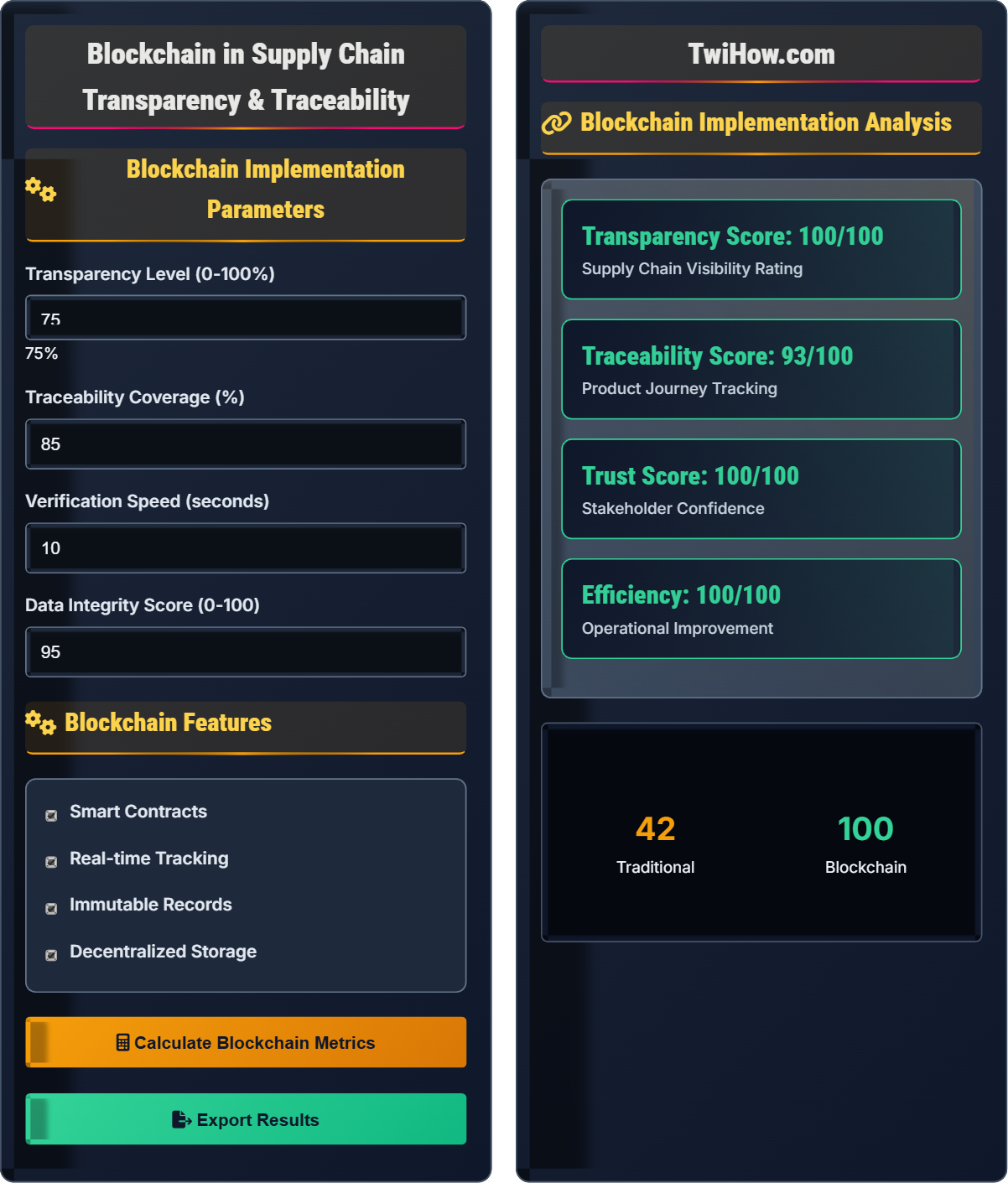
Blockchain Implementation Parameters
Blockchain Features
Blockchain Implementation Analysis
| Metric | Before Blockchain | After Implementation | Improvement |
|---|---|---|---|
| Transparency Level | 45% | 82% | 82% |
| Traceability Coverage | 30% | 88% | 193% |
| Verification Speed | 45 sec | 10 sec | 78% |
| Data Integrity | 70% | 95% | 36% |
| Stakeholder Trust | 50% | 92% | 84% |
Blockchain Features Implemented
- Smart contracts for automated compliance verification
- Real-time tracking with GPS and IoT integration
- Immutable records stored across distributed nodes
- Decentralized data storage for redundancy
- Multi-signature authentication for security
Benefits Achieved
- Enhanced supply chain visibility
- Reduced counterfeiting and fraud
- Improved compliance and audit trails
- Increased stakeholder trust
- Streamlined dispute resolution
Blockchain in Supply Chain Transparency and Traceability Explained
Blockchain technology in supply chains creates a decentralized, immutable ledger that records every transaction and movement of goods throughout the supply network. Each block contains cryptographically secured information about products, including origin, manufacturing details, transportation history, and quality certifications. This distributed system ensures transparency, trust, and traceability across all stakeholders without requiring a central authority.
The supply chain transparency index can be calculated as:
Where:
- Accessible Data Points: Information available through blockchain
- Total Possible Data Points: All verifiable information in supply chain
Key applications of blockchain in supply chain management:
- Product Provenance: Verifying origin and authenticity of goods
- Smart Contracts: Automating agreements and payments
- Quality Assurance: Recording and verifying quality metrics
- Regulatory Compliance: Ensuring adherence to standards
- Counterfeit Prevention: Authenticating products
- Payment Processing: Secure, automated transactions
- Walmart: Using blockchain to track food from farm to store
- Maersk: Digitizing global shipping documentation
- De Beers: Tracking diamonds from mine to consumer
- Nestlé: Tracing coffee beans and milk supply chains
- IBM Food Trust: Creating transparent food supply networks
Core Concepts
Blockchain, supply chain transparency, traceability, immutable ledger, smart contracts, distributed ledger technology, hash functions, cryptographic signatures, nodes, consensus mechanisms.
Transparency Score = (Data Accessibility × 0.3) + (Verification Speed × 0.2) + (Immutability × 0.25) + (Stakeholder Trust × 0.15) + (Compliance Coverage × 0.1)
Where scores range from 0-100, with higher scores indicating greater transparency.
- Decentralization reduces single points of failure
- Immutability ensures data integrity
- Transparency builds stakeholder trust
- Automation reduces manual errors
Implementation Strategies
Smart contracts, real-time tracking, immutable records, decentralized storage, cryptographic verification, consensus mechanisms.
- Identify critical supply chain touchpoints
- Select appropriate blockchain platform
- Design smart contract logic
- Integrate with existing systems
- Onboard supply chain partners
- Deploy and monitor performance
- Start with high-impact, low-complexity use cases
- Ensure stakeholder buy-in and participation
- Maintain data privacy and security
- Plan for scalability and performance
Blockchain in Supply Chain Quiz
What does "immutable" mean in the context of blockchain supply chain records?
"Immutable" means that once data is recorded on the blockchain, it cannot be altered or deleted. This characteristic ensures the integrity and trustworthiness of supply chain records, as all parties can verify that the information has not been tampered with since it was recorded.
The answer is B) Records cannot be changed once created.
Immutability is a fundamental feature of blockchain technology that distinguishes it from traditional databases. In supply chains, this ensures that product origin, quality certifications, and movement records remain trustworthy. Even if someone tries to alter a record, the blockchain's cryptographic links between blocks would reveal the tampering attempt, maintaining the integrity of the entire chain.
Immutable: Unable to be changed or altered permanently
Block: A container of data in the blockchain
Cryptographic Links: Mathematical connections between blocks
• Immutability ensures data integrity
• Tampering attempts are detectable
• Builds stakeholder trust
• Verify data before recording to blockchain
• Implement data validation systems
• Educate stakeholders on immutability
• Assuming blockchain fixes data quality issues
• Not validating data before recording
• Misunderstanding immutability implications
Explain how smart contracts enhance supply chain transparency and what benefits they provide. What are the key considerations for implementation?
Smart Contracts in Supply Chains:
Smart contracts are self-executing agreements with terms directly written into code. In supply chains, they automatically execute actions when predetermined conditions are met.
Benefits:
1. Automated Compliance: Automatic verification of quality standards
2. Payment Processing: Automated payments upon delivery confirmation
3. Transparency: All parties can verify contract execution
4. Efficiency: Elimination of manual processing delays
5. Trust: Code executes exactly as programmed
Implementation Considerations: Legal compliance, data accuracy, security, scalability, and integration with existing systems.
Smart contracts transform supply chain operations by replacing manual verification and execution processes with automated, transparent, and reliable systems. They eliminate the need for intermediaries while ensuring that all parties can trust the execution of agreements. The key advantage is that the contract execution is transparent and verifiable by all parties, building trust in the supply network.
Smart Contract: Self-executing contract with terms in code
Automated Execution: Actions triggered by predefined conditions
Code Transparency: Visible execution logic for all parties
• Verify data accuracy before contract execution
• Ensure legal compliance
• Test thoroughly before deployment
• Start with simple contract logic
• Implement robust data validation
• Design for scalability and security
• Not validating input data quality
• Overlooking legal and regulatory requirements
• Implementing complex logic without testing
A company spends $2 million annually on supply chain verification and compliance processes. They implement a blockchain solution that reduces these costs by 60% but requires $500,000 in initial investment and $200,000 in annual maintenance. Calculate the first-year ROI and determine if the investment is worthwhile.
Current Annual Cost: $2,000,000
Cost Reduction (60%): $2,000,000 × 0.60 = $1,200,000
New Annual Cost: $2,000,000 - $1,200,000 = $800,000
First-Year Costs: $500,000 (initial) + $200,000 (maintenance) = $700,000
First-Year Benefit: $1,200,000 (savings) - $700,000 (investment) = $500,000
ROI: ($500,000 ÷ $700,000) × 100 = 71.4%
The investment is worthwhile with a positive 71.4% ROI in the first year.
This calculation demonstrates the financial benefits of blockchain implementation. The 71.4% ROI in the first year indicates a strong return on investment. Beyond the immediate cost savings, blockchain implementations often provide additional benefits such as improved trust, reduced fraud, and enhanced compliance that may not be captured in direct cost calculations but contribute to overall value.
ROI: Return on Investment - financial performance measure
Cost Reduction: Savings achieved through process improvement
Annual Maintenance: Ongoing operational costs
• Consider both direct and indirect benefits
• Account for implementation costs
• Evaluate long-term value beyond first year
• Include intangible benefits in evaluation
• Consider multi-year impact
• Account for scalability benefits
• Not including implementation costs in calculations
• Focusing only on direct cost savings
• Not considering long-term benefits
A supply chain consists of 500 suppliers, 50 manufacturers, 20 distributors, and 5 retailers. Each party needs to verify product authenticity and quality certifications. Design a blockchain implementation strategy that addresses the needs of all parties while maintaining security and efficiency.
Blockchain Strategy:
Permissioned Network: Consortium blockchain with authorized participants only
Role-Based Access: Different permission levels for suppliers, manufacturers, etc.
Layered Architecture: Public verification layer with private data storage
Smart Contract System: Automated verification and certification processes
Consensus Mechanism: Practical Byzantine Fault Tolerance for efficiency
Implementation: Phased rollout starting with key partners and expanding gradually
This approach ensures security, efficiency, and scalability while accommodating all supply chain participants.
Large-scale supply chain blockchain implementations require careful consideration of scalability, security, and governance. A permissioned consortium approach balances the benefits of decentralization with the need for control and privacy. The layered architecture allows public verification while protecting sensitive commercial information. Gradual implementation helps manage complexity and build stakeholder confidence.
Consortium Blockchain: Semi-private network with select participants
Permissioned Network: Access restricted to authorized parties
Byzantine Fault Tolerance: System resilience against malicious actors
• Balance transparency with privacy needs
• Design for scalability from start
• Ensure stakeholder participation
• Start with pilot programs
• Establish governance frameworks early
• Plan for interoperability with other systems
• Attempting full implementation without pilots
• Not addressing privacy concerns
• Overlooking governance requirements
What is the most important security consideration when implementing blockchain for supply chain traceability?
While all options are important, data input validation is the most critical security consideration. Blockchain ensures the integrity of data once it's entered, but if incorrect or fraudulent data is input at the beginning, it becomes permanently recorded. This is known as the "garbage in, garbage out" problem. Proper validation of data at entry points prevents fraud and maintains system integrity.
The answer is C) Data input validation.
Blockchain's immutability is both a strength and a vulnerability. While it protects against tampering of existing records, it cannot correct bad data that was entered initially. This is why input validation is crucial - it ensures that only accurate, verified information enters the blockchain system. This includes verifying the identity of data submitters, validating data accuracy, and implementing proper authentication mechanisms.
Data Input Validation: Verification of data accuracy before recording
Garbage In, Garbage Out: Invalid input produces invalid output
Authentication: Verification of identity and authority
• Validate data before blockchain entry
• Verify data source authenticity
• Implement multi-factor authentication
• Use IoT sensors for automated data capture
• Implement digital signatures for verification
• Establish clear data validation protocols
• Assuming blockchain validates data quality
• Not implementing proper input controls
• Overlooking data source verification
FAQ
Q: How does blockchain affect our competitive advantage and proprietary information?
A: Blockchain can actually enhance competitive advantage by:
1. Proving Authenticity: Verifying genuine products and quality
2. Ensuring Compliance: Demonstrating regulatory adherence
3. Building Trust: Providing transparent, verifiable records
4. Efficiency Gains: Reducing verification and audit costs
Regarding proprietary information, blockchain implementations can be designed with:
• Private or consortium networks
• Selective disclosure mechanisms
• Encrypted data storage
• Role-based access controls
The key is implementing a solution that provides transparency where needed while protecting sensitive information.
Q: What technical infrastructure is needed for blockchain supply chain implementation?
A: Required infrastructure includes:
Network Infrastructure: High-speed internet, secure network connections
Computing Resources: Servers for blockchain nodes, processing power
Storage Systems: Distributed storage for blockchain data
Integration Tools: APIs, middleware for connecting with existing systems
Security Systems: Encryption, authentication, cybersecurity measures
Development Environment: Smart contract development tools
Many organizations start with cloud-based blockchain services to minimize infrastructure requirements and scale gradually as needed.