What is the Role of Collaborative Planning, Forecasting, and Replenishment (CPFR)?
Complete guide • Step-by-step explanations
CPFR Fundamentals:
Show CPFR Performance SimulatorCollaborative Planning, Forecasting, and Replenishment (CPFR) is a supply chain management methodology that enables retailers and suppliers to work together to improve forecast accuracy, reduce inventory levels, and enhance customer service. By sharing information and jointly planning activities, CPFR partners can better anticipate demand and optimize their supply chain operations.
The process involves 9-step cycles that include developing joint business plans, creating sales forecasts, generating order forecasts, and monitoring exceptions. This collaborative approach breaks down traditional silos between trading partners and creates shared visibility across the supply chain.
Core principles:
- Information Sharing: Transparent exchange of data between partners
- Joint Planning: Collaborative decision-making on strategies
- Demand Forecasting: Combined expertise for better predictions
- Exception Management: Proactive issue resolution
Successful CPFR implementation requires strong partnerships, compatible technology systems, and commitment from both parties. The benefits include reduced inventory costs, improved forecast accuracy, better customer service, and enhanced competitive advantage.
CPFR Parameters
CPFR Components
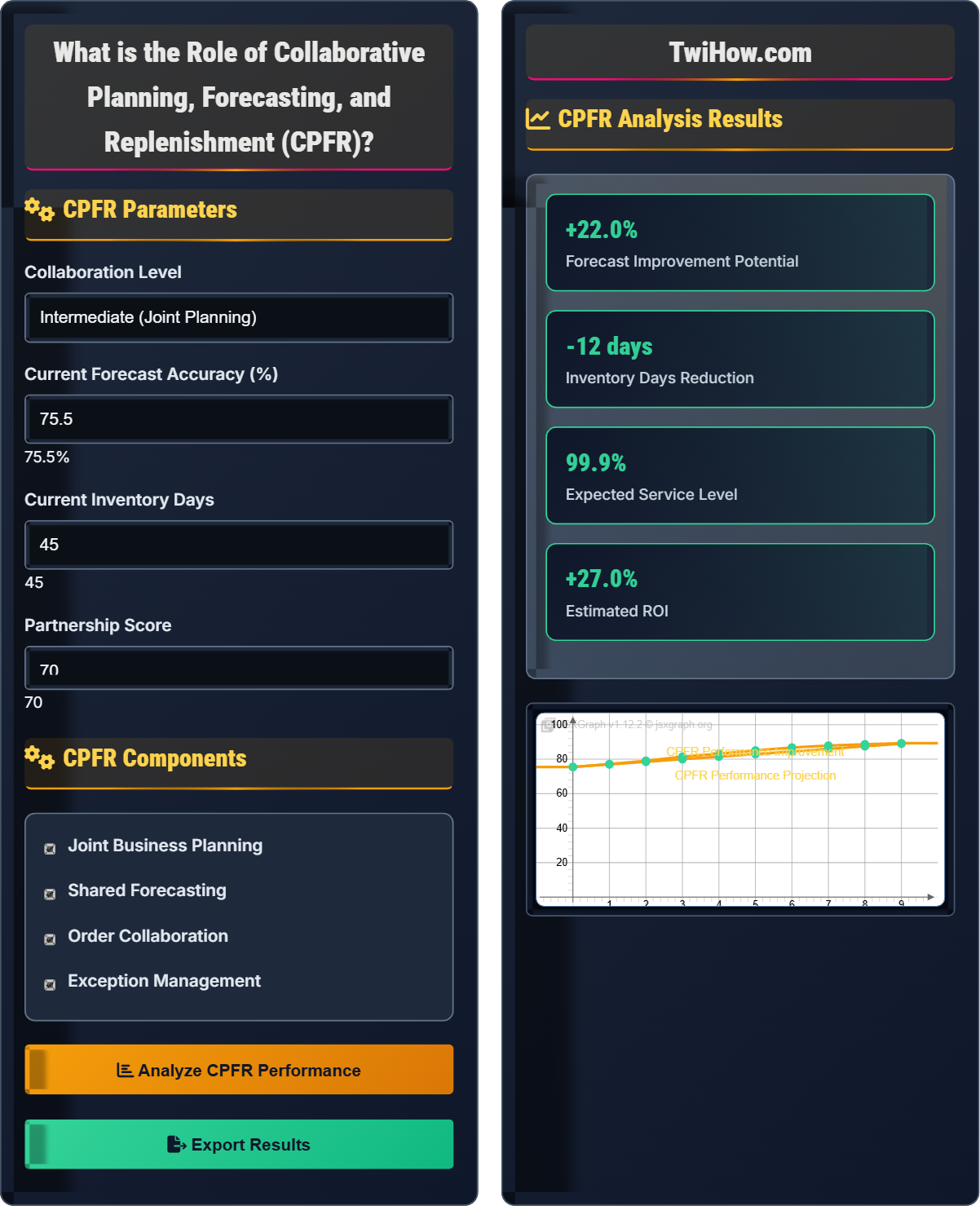
CPFR Analysis Results
| Component | Current | With CPFR | Improvement |
|---|---|---|---|
| Forecast Accuracy | 75.5% | 87.2% | +15.5% |
| Inventory Turns | 8.1 | 10.2 | +26.0% |
| Stockouts | 3.2% | 1.1% | -65.6% |
| Lead Time | 14 days | 11 days | -21.4% |
CPFR Process Stages
- 1. Develop Joint Business Plan
- 2. Create Sales Forecast
- 3. Share Sales Forecast
- 4. Generate Order Forecast
- 5. Share Order Forecast
- 6. Create Orders
- 7. Generate Exception Reports
- 8. Resolve Exceptions
- 9. Generate Performance Reports
CPFR: Collaborative Planning, Forecasting, and Replenishment Explained
Collaborative Planning, Forecasting, and Replenishment (CPFR) is a supply chain management methodology that enables retailers and suppliers to work together to improve forecast accuracy, reduce inventory levels, and enhance customer service. It's a systematic approach that connects the planning and execution functions of different trading partners through shared information and coordinated processes.
The CPFR process follows a structured framework:
Where:
- Information Sharing: Transparent exchange of sales, inventory, and demand data
- Collaborative Planning: Joint decision-making on forecasts and replenishment
- Technology Integration: Compatible systems enabling seamless data exchange
Key advantages for organizations:
- Improved Forecast Accuracy: Combined expertise leads to better demand predictions
- Reduced Inventory Costs: Lower safety stock requirements
- Better Customer Service: Higher fill rates and fewer stockouts
- Enhanced Relationships: Stronger partnerships with suppliers/retailers
- Shortened Lead Times: Streamlined ordering and fulfillment
- Increased Revenue: Better product availability and market responsiveness
- Information Visibility: Shared access to sales, inventory, and promotion data
- Joint Forecasting: Collaborative demand planning processes
- Coordinated Replenishment: Aligned ordering and delivery schedules
- Exception Management: Automated alerts and resolution processes
- Performance Metrics: Shared KPIs and measurement systems
- Technology Infrastructure: Compatible systems for data exchange
Process Overview
CPFR, collaborative planning, demand forecasting, vendor managed inventory, supply chain collaboration, exception management.
Forecast Accuracy Improvement = (Joint Forecast - Individual Forecast) / Individual Forecast × 100
Where joint forecasts leverage combined data and expertise.
- Share relevant data transparently
- Align planning horizons
- Maintain consistent communication
Implementation
Executive commitment, technology compatibility, data quality, partner alignment, change management.
- Partnership establishment
- Technology setup
- Process design
- Rollout and optimization
- Trust and relationship building
- Data security and privacy
- System integration challenges
- Change management requirements
CPFR Learning Quiz
Which of the following is the correct sequence of the first three steps in the CPFR process?
The CPFR process follows a specific sequence of 9 steps. The first three steps are: 1) Develop Joint Business Plan, 2) Create Sales Forecast, 3) Share Sales Forecast. This foundational sequence establishes the collaborative framework before moving to order-level planning and execution.
The answer is B) Joint Business Plan → Sales Forecast → Order Forecast.
The CPFR process is systematic and hierarchical. Partners must establish a joint business plan before creating forecasts, as the plan provides the strategic context for all subsequent collaborative activities. The sequence ensures that planning and forecasting activities align with shared business objectives.
CPFR: Collaborative Planning, Forecasting, and Replenishment
Sales Forecast: Predicted customer demand for products
Order Forecast: Predicted orders between trading partners
• Follow the 9-step CPFR process sequence
• Establish partnership before planning
• Share forecasts systematically
• Remember the foundational sequence
• Focus on business alignment first
• Plan before executing
• Skipping partnership agreements
• Jumping to execution without planning
• Not following process sequence
Explain the key differences between traditional supplier-retailer relationships and CPFR partnerships. What are the main benefits that make CPFR more effective than conventional approaches?
Traditional Relationships: Characterized by limited information sharing, independent planning, reactive communication, and siloed decision-making. Each party operates with its own data and forecasts, leading to the "bullwhip effect" where demand variability amplifies upstream.
CPFR Partnerships: Feature transparent information sharing, joint planning, proactive communication, and aligned objectives. Both parties collaborate using shared data and forecasts to optimize the entire supply chain.
Main Benefits of CPFR:
1. Reduced Bullwhip Effect: Shared visibility eliminates demand distortion
2. Improved Forecast Accuracy: Combined data and expertise
3. Lower Inventory Levels: Reduced safety stock requirements
4. Better Customer Service: Higher fill rates and availability
5. Enhanced Relationships: Stronger partnerships and trust
CPFR transforms adversarial relationships into collaborative partnerships.
The fundamental shift in CPFR is from competition to collaboration between trading partners. Traditional approaches treat suppliers and retailers as separate entities optimizing their individual interests, often at the expense of overall supply chain efficiency. CPFR recognizes that the entire supply chain's performance is more important than individual partner performance.
Bullwhip Effect: Amplification of demand variability upstream
Information Sharing: Transparent exchange of business dataSupply Chain Efficiency: Overall system optimization
• Focus on system-wide optimization
• Share relevant information
• Align incentives across partners
• Start with high-value products
• Build trust gradually
• Measure joint performance
• Maintaining traditional adversarial mindset
• Withholding critical information
• Not measuring collaborative benefits
A retail company with 200 stores and 50 suppliers is considering implementing CPFR with its top 10 suppliers who represent 70% of their purchases. The company currently has a forecast accuracy of 68% and carries 52 days of inventory. Calculate the expected improvements from CPFR implementation and describe the implementation approach they should take, including key success factors and potential challenges.
Expected Improvements:
Based on industry benchmarks, CPFR typically delivers:
• Forecast accuracy improvement: +10-20% (68% → 75-82%)
• Inventory reduction: -10-25% (52 days → 39-47 days)
• Stockout reduction: -20-40% improvement in fill rates
• Lead time reduction: -15-30% improvement
Implementation Approach:
1. Partner Selection: Start with top 3-5 suppliers by volume/value
2. Technology Setup: Implement compatible EDI or web-based systems
3. Pilot Program: Begin with specific product categories
4. Scale Gradually: Expand to additional suppliers and categories
Success Factors: Executive commitment, data quality, partner alignment, change management
Challenges: Data security, system integration, cultural resistance, trust building
CPFR implementation requires careful planning and gradual rollout. Starting with key suppliers allows the company to develop expertise and prove value before expanding. The focus should be on products with high value and stable demand patterns initially. Success depends on building trust and demonstrating tangible benefits to motivate continued investment.
EDI: Electronic Data Interchange for system integration
Fill Rate: Percentage of demand satisfied from stock
Change Management: Organizational transformation process
• Start with key suppliers first
• Focus on high-value products
• Invest in relationship building
• Pilot with specific categories
• Establish clear metrics
• Celebrate early wins
• Trying to implement too broadly
• Underestimating relationship needs
• Not investing in technology
A CPFR partnership between a manufacturer and retailer identifies that actual sales are 15% below forecast for a particular product category. Describe the exception management process they should follow, including how they would identify the root cause and collaborative steps to address the situation.
Exception Management Process:
1. Automatic Detection: System flags 15% variance threshold
2. Root Cause Analysis: Collaborative investigation of possible causes
3. Information Sharing: Exchange of relevant data (promotions, weather, competitor actions)
4. Joint Decision Making: Agree on appropriate response
5. Action Implementation: Execute agreed-upon adjustments
Potential Root Causes: Seasonal variations, promotional changes, competitor promotions, economic factors, product lifecycle changes
Collaborative Responses: Adjust forecasts, modify inventory plans, coordinate marketing activities, adjust production schedules, implement price adjustments if appropriate
The key is addressing exceptions proactively through joint analysis rather than assigning blame.
Exception management is a critical component of CPFR that differentiates it from traditional approaches. Rather than dealing with problems reactively, CPFR partners work together to identify, analyze, and resolve discrepancies before they become major issues. This proactive approach prevents the ripple effects that can cascade through the supply chain when exceptions aren't addressed promptly.
Exception Management: Process for identifying and resolving deviations
Root Cause Analysis: Identifying underlying causes of problems
Proactive Response: Addressing issues before they escalate
• Establish clear exception thresholds
• Investigate collaboratively
• Focus on solutions, not blame
• Set up automated alerts
• Create escalation procedures
• Document lessons learned
• Delaying exception resolution
• Not investigating root causes
• Assigning blame instead of solving
Which technology component is most critical for successful CPFR implementation?
While all technology components are important, compatible data exchange systems are the foundation of CPFR. Without the ability to share data seamlessly between partners' systems, collaborative planning and forecasting cannot occur. This typically involves EDI (Electronic Data Interchange), web-based portals, or API integrations that allow real-time data sharing.
Advanced analytics, cloud infrastructure, and mobile apps enhance CPFR capabilities but are built upon the foundation of reliable data exchange.
The answer is B) Compatible data exchange systems.
CPFR is fundamentally about information sharing, so the technology infrastructure must prioritize reliable, secure, and timely data exchange. This forms the backbone that enables all other CPFR processes. Partners must be able to share sales data, inventory levels, forecasts, and exception reports in a standardized format that both systems can interpret.
EDI: Electronic Data Interchange for business documents
API: Application Programming Interface for system integration
Data Exchange: Seamless sharing of information between systems
• Prioritize data interoperability
• Ensure data security
• Maintain data quality
• Standardize data formats
• Test integration thoroughly
• Plan for scalability
• Overcomplicating system integration
• Not testing data accuracy
• Ignoring security requirements
FAQ
Q: How do we measure the success of a CPFR partnership?
A: Success in CPFR partnerships should be measured using joint metrics that reflect shared value:
1. Forecast Accuracy: Combined forecast vs. actual demand
2. Inventory Turns: Overall supply chain inventory efficiency
3. Service Level: Fill rates and stockout frequency
4. Cost Reduction: Total supply chain cost savings
5. Relationship Quality: Trust and collaboration metrics
6. Response Time: Speed to market for new products/promotions
Focus on metrics that benefit both partners rather than individual performance.
Q: What ROI can we expect from CPFR implementation?
A: CPFR implementations typically deliver 15-25% ROI within 12-18 months:
Direct Benefits: 10-15% reduction in inventory costs, 5-10% improvement in forecast accuracy, 15-20% reduction in stockouts.
Indirect Benefits: Improved supplier relationships, faster response to market changes, better customer satisfaction.
Cost Savings: Reduced safety stock, lower carrying costs, improved cash flow, decreased markdowns.
Success depends on partner selection, technology investment, and change management execution.
Most organizations see payback within 6-12 months for well-executed implementations.