What is the role of public-private partnerships in supply chain infrastructure?
Complete PPP guide • Step-by-step explanations
Public-Private Partnership Fundamentals:
Show PPP SimulatorPublic-private partnerships (PPPs) in supply chain infrastructure involve collaboration between government entities and private sector companies to finance, design, build, operate, and maintain critical logistics and transportation systems. These partnerships leverage the strengths of both sectors to deliver infrastructure projects that would be difficult for either party to accomplish independently. PPPs enable governments to access private capital and expertise while allowing private companies to participate in long-term, stable revenue-generating projects.
The role of PPPs in supply chain infrastructure includes developing ports, highways, railways, warehouses, distribution centers, and digital logistics platforms. These collaborations address capacity constraints, improve efficiency, and enhance connectivity across supply networks while sharing risks and rewards between public and private partners.
Core components:
- Financing Mechanisms: Shared investment and risk allocation
- Project Management: Coordinated planning and execution
- Operations & Maintenance: Long-term asset management
- Performance Standards: Quality and efficiency benchmarks
Successful PPPs require clear governance structures, well-defined contracts, and aligned incentives that benefit both public interests and private returns.
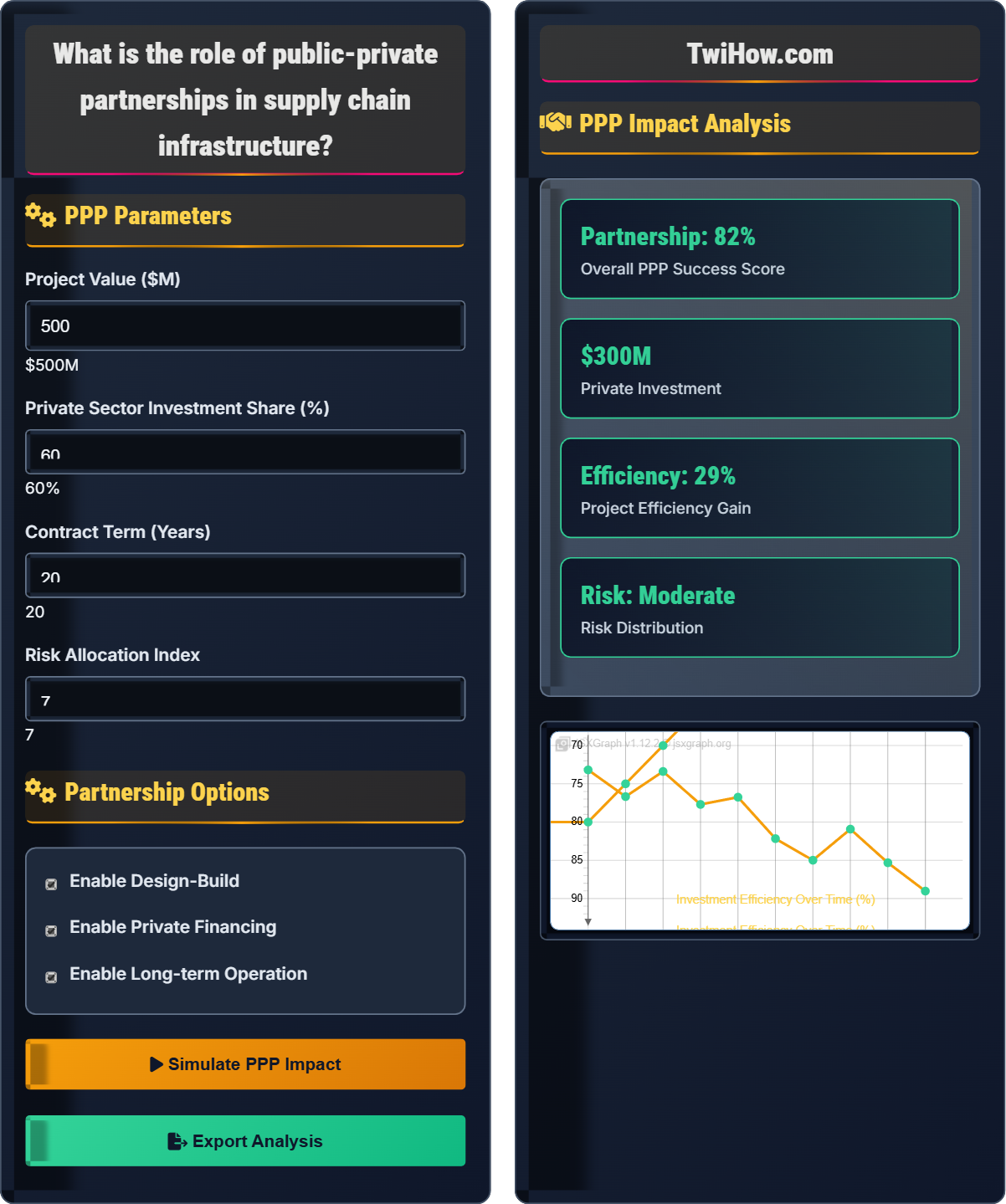
PPP Parameters
Partnership Options
PPP Impact Analysis
| Partner | Role | Investment | Risk |
|---|---|---|---|
| Government | Regulator | $200M | Policy |
| Private Sector | Operator | $300M | Market |
| Joint Venture | Manager | $150M | Operational |
How Public-Private Partnerships Work in Supply Chain Infrastructure
Public-private partnerships in supply chain infrastructure involve contractual arrangements between government entities and private sector companies to deliver and maintain infrastructure projects. These partnerships combine public oversight with private sector efficiency, innovation, and capital to develop critical logistics and transportation systems that support supply chain operations.
Effective PPPs incorporate multiple interconnected elements:
Where:
- Public Value: Benefits to citizens and society
- Private Returns: Financial returns for investors
- Risk Sharing: Equitable distribution of project risks
- Transaction Costs: Administrative and coordination expenses
Common PPP models for supply chain infrastructure include:
- Design-Build-Operate (DBO): Private partner handles design, construction, and operations
- Build-Operate-Transfer (BOT): Private partner builds and operates for fixed term before transfer
- Design-Build-Finance-Operate (DBFO): Comprehensive private sector involvement
- Asset Recycling: Government sells existing assets to fund new projects
- Joint Ventures: Shared ownership between public and private partners
- Management Contracts: Private partner manages operations under government ownership
- Clear Governance: Establish transparent decision-making structures
- Risk Allocation: Assign risks to parties best able to manage them
- Performance Metrics: Define measurable outcomes and standards
- Stakeholder Engagement: Involve community and industry participants
- Transparency: Maintain open communication and reporting
- Long-term Perspective: Plan for entire project lifecycle
PPP Fundamentals
Public-private partnerships, infrastructure development, supply chain logistics, risk sharing, financing mechanisms, collaboration models.
PPP Score = (Public Value × Private Returns × Risk Sharing) / Transaction Costs
Where Public Value = societal benefits, Private Returns = investor compensation.
- Align public and private interests
- Allocate risks appropriately
- Maintain long-term focus
Applications
Port development, highway construction, railway systems, airport expansion, logistics hubs, digital infrastructure, cross-border facilities.
- Container terminal development
- Freight rail corridors
- Logistics parks
- Smart port systems
- Regulatory compliance requirements
- Community impact assessment
- Environmental considerations
- Financial sustainability
PPP in Infrastructure Learning Quiz
Which PPP model is most suitable for long-term operation of supply chain infrastructure?
The Design-Build-Finance-Operate (DBFO) model is most suitable for long-term operation of supply chain infrastructure because it provides comprehensive private sector involvement throughout the entire project lifecycle. This model ensures the private partner has incentives to maintain high performance over the long term since they are responsible for financing, building, and operating the facility.
The answer is C) Design-Build-Finance-Operate (DBFO).
PPP models differ in the scope of private sector involvement. DBFO provides the most comprehensive engagement, giving the private partner incentives to optimize performance throughout the project lifecycle. The private partner bears the financial risk and has long-term operational responsibility, creating alignment between investment decisions and long-term performance.
DBFO Model: Design-Build-Finance-Operate partnership
Long-term Operation: Extended operational responsibility
Private Sector Involvement: Private partner engagement scope
• More comprehensive models increase alignment
• Long-term responsibility creates incentives
• Risk allocation affects performance
• Match model to project characteristics
• Consider operational complexity
• Evaluate private sector capabilities
• Choosing models without considering operations
• Not evaluating private sector capacity
• Misaligning incentives and responsibilities
Explain the principles of risk allocation in PPPs for supply chain infrastructure and describe how to determine appropriate risk distribution between public and private partners.
Principles of Risk Allocation:
1. Assign to Best Party: Allocate risks to the party best able to manage them
2. Cost Efficiency: Consider which party can bear risks at lowest cost
3. Incentive Alignment: Ensure risk assignment motivates optimal behavior
4. Control and Influence: Assign risks to parties with control over outcomes
Determining Appropriate Distribution:
• Market Risks: Private sector (demand, competition, commercial)
• Construction Risks: Private sector (cost, schedule, quality)
• Political Risks: Public sector (policy changes, regulations)
• Force Majeure: Shared between parties
• Operational Risks: Private sector (maintenance, performance)
Effective risk allocation is fundamental to PPP success. The goal is to assign risks to parties with the greatest ability to manage them efficiently while maintaining appropriate incentives. This approach optimizes overall project outcomes by ensuring each party bears risks they can control or mitigate most effectively.
Risk Allocation: Distribution of project risks between parties
Market Risks: Commercial uncertainties affecting revenue
Force Majeure: Unforeseeable circumstances beyond control
• Assign risks to those who can manage them
• Align incentives with risk assignment
• Consider cost and control factors
• Conduct detailed risk assessment
• Consider historical data and trends
• Evaluate party capabilities
• Inappropriate risk assignment
• Not considering party capabilities
• Misaligned incentives
A port development project costs $800M with a 25-year contract term. The government contributes 30% of capital, and the private sector finances the remainder. If the private partner expects a 12% annual return and the project generates $60M in annual revenue, calculate the net present value (NPV) of the project for the private partner and determine if the investment is financially viable.
Calculations:
Government contribution: $800M × 30% = $240M
Private investment: $800M × 70% = $560M
Annual revenue: $60M
Discount rate: 12%
Present value of revenues: $60M × PVIFA(12%, 25 years)
PVIFA(12%, 25) ≈ 7.84
Present value of revenues = $60M × 7.84 = $470.4M
Net Present Value = $470.4M - $560M = -$89.6M
Conclusion: The NPV is negative, indicating the investment is not financially viable at the current revenue projections. The private partner would need higher revenues or better terms to achieve the desired return.
This example demonstrates the importance of financial feasibility in PPPs. The negative NPV indicates that the projected revenues are insufficient to provide the required return on the private investment. This highlights the need for careful financial modeling and potentially renegotiating terms to achieve mutual viability.
Net Present Value (NPV): Present value of cash flows minus investment
Present Value Interest Factor: Factor to discount future cash flows
Financial Feasibility: Economic viability of investment
• NPV must be positive for viability
• Consider all cash flows over term
• Use appropriate discount rate
• Include all project costs
• Consider inflation adjustments
• Factor in risk premiums
• Not considering entire project lifecycle
• Underestimating costs
• Using inappropriate discount rate
A PPP highway project involves multiple stakeholders including federal, state, and local governments, private construction firms, logistics companies, and community groups. Propose a stakeholder engagement strategy that ensures all parties' interests are considered while maintaining project momentum and public value.
Stakeholder Engagement Strategy:
1. Stakeholder Mapping: Identify all parties and their interests, influence, and impact
2. Communication Plan: Develop tailored communication for each stakeholder group
3. Governance Structure: Create formal bodies with representation from key stakeholders
4. Feedback Mechanisms: Establish regular consultation and feedback processes
5. Conflict Resolution: Define processes for addressing disagreements
Specific Approaches:
• Federal/state: Regular briefings on national importance
• Private contractors: Performance-based incentives
• Logistics companies: Consultation on operational requirements
• Community groups: Public meetings and environmental impact discussions
Successful PPPs require managing diverse stakeholder interests with varying priorities and influence levels. The key is creating structured engagement mechanisms that allow all voices to be heard while maintaining project focus and momentum. Effective stakeholder management builds trust and reduces opposition to the project.
Stakeholder Mapping: Identifying and analyzing stakeholder interests
Engagement Strategy: Planned approach to stakeholder communication
Public Value: Benefits to citizens and society
• Early and continuous engagement
• Transparent communication
• Address concerns proactively
• Identify key influencers early
• Use multiple communication channels
• Document all interactions
• Not identifying all stakeholders
• Inadequate communication
• Ignoring community concerns
Which performance metric is most critical for measuring success in PPP supply chain infrastructure projects?
Service level performance is the most critical metric because PPPs are designed to deliver specific services to users. While cost, compliance, and returns are important, the ultimate success of supply chain infrastructure PPPs is measured by their ability to provide reliable, efficient services that meet user needs and support economic activity.
The answer is B) Service level performance.
PPP success must be evaluated based on the value delivered to end users and society. Service level metrics capture the operational effectiveness that directly impacts supply chain efficiency. These metrics ensure that the partnership delivers on its fundamental purpose of providing better infrastructure services.
Service Level Performance: Quality and reliability of infrastructure services
End User Value: Benefits delivered to infrastructure users
Operational Effectiveness: Efficiency of service delivery
• Focus on user outcomes
• Measure operational performance
• Balance multiple metrics
• Include user satisfaction metrics
• Track reliability and efficiency
• Monitor cost-effectiveness
• Focusing only on financial metrics
• Not tracking service quality
• Ignoring user experience
FAQ
Q: How do we ensure PPPs deliver public value while providing private returns?
A: Achieving balance requires careful structuring:
1. Performance-Based Contracts: Tie payments to service delivery outcomes
2. Revenue Sharing: Allow private partners to benefit from efficiency gains
3. Regulatory Oversight: Maintain government authority over public interests
4. Transparency: Public reporting on performance and costs
5. Competition: Encourage competitive bidding for future contracts
6. Flexibility: Allow contract adjustments when circumstances change
The key is aligning private incentives with public outcomes through smart contract design.
Q: What's the difference between traditional procurement and PPPs in infrastructure development?
A: These represent different approaches to infrastructure delivery:
Traditional Procurement: Government funds, owns, and operates infrastructure. Private contractors are hired for specific tasks with limited long-term responsibility.
PPPs: Private partners take greater responsibility for design, financing, construction, and long-term operation. They share risks and rewards with government over extended periods.
PPPs shift focus from inputs to outcomes and align incentives for long-term performance.