What is the role of scenario planning and stress testing in supply chain risk management?
Complete supply chain risk management guide • Step-by-step explanations
Supply Chain Risk Management Fundamentals:
Show Risk Management SimulatorScenario planning and stress testing are critical components of supply chain risk management. They involve creating hypothetical situations to evaluate how disruptions might impact operations and preparing contingency plans to mitigate potential risks. These practices help organizations identify vulnerabilities, assess potential impacts, and develop robust response strategies.
At their core, scenario planning and stress testing provide a structured approach to understanding and preparing for potential disruptions. They simulate various risk events such as natural disasters, supplier failures, geopolitical tensions, or market shifts to evaluate the resilience of supply chains and develop appropriate mitigation strategies.
Key risk management concepts:
- Scenario Planning: Creating hypothetical situations to evaluate potential impacts
- Stress Testing: Subjecting supply chains to extreme conditions
- Risk Assessment: Identifying and evaluating potential threats
- Contingency Planning: Developing alternative strategies
Modern risk management systems use advanced analytics, simulation tools, and historical data to create realistic scenarios and stress tests. This enables companies to proactively identify vulnerabilities, optimize their supply chains for resilience, and maintain business continuity during disruptions.
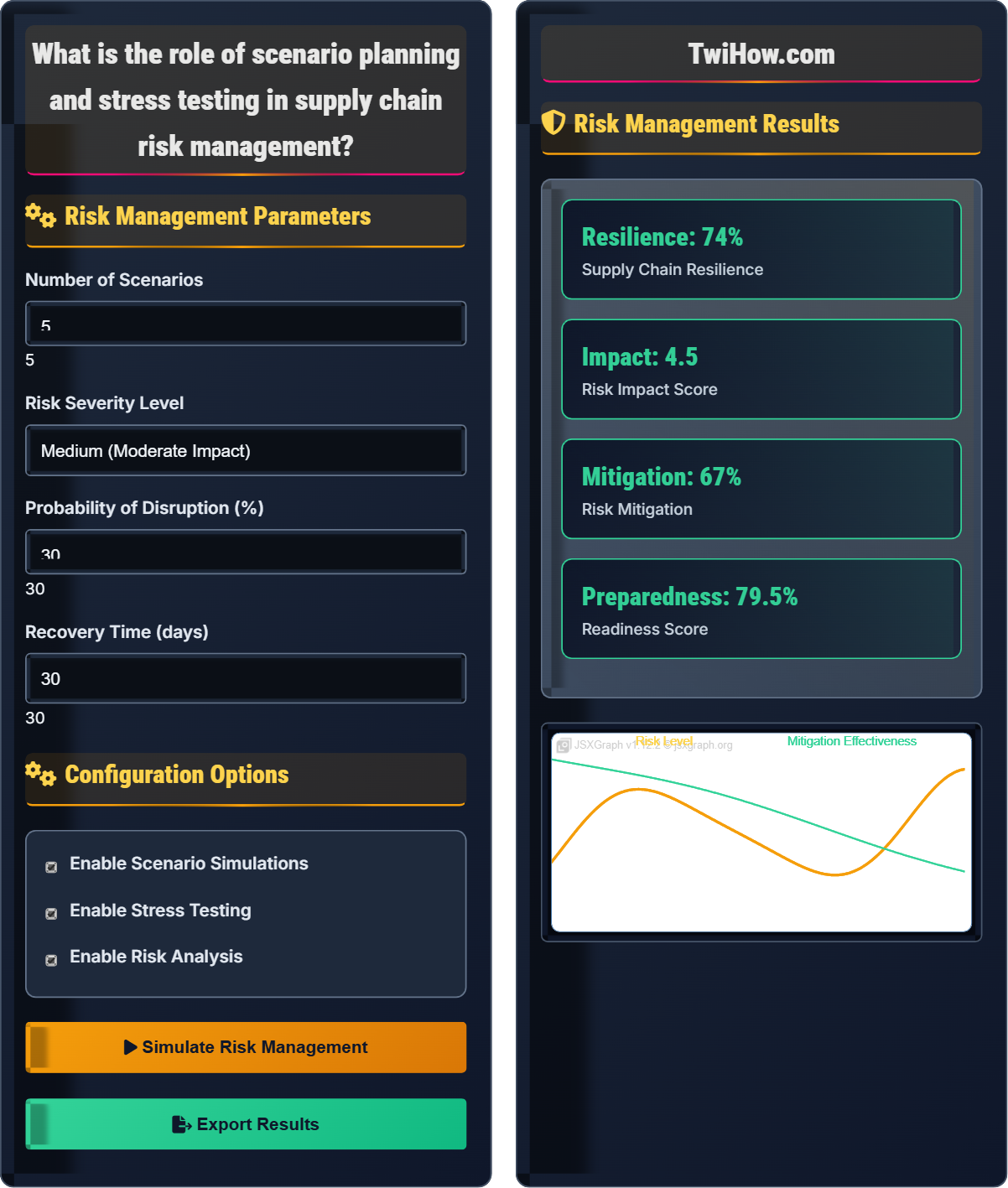
Risk Management Parameters
Configuration Options
Risk Management Results
| Scenario | Probability | Impact | Mitigation |
|---|---|---|---|
| Supplier Failure | 15% | High | 80% |
| Natural Disaster | 5% | Very High | 60% |
| Transport Disruption | 20% | Medium | 70% |
| Demand Spike | 25% | Medium | 75% |
| Geopolitical | 10% | High | 55% |
Scenario Planning and Stress Testing in Supply Chain Risk Management
Supply chain risk management involves identifying, assessing, and mitigating potential risks that could disrupt the flow of goods, services, and information from suppliers to end customers. Scenario planning and stress testing are key methodologies that help organizations prepare for potential disruptions by creating hypothetical situations and testing the resilience of their supply chains.
Key components of scenario planning and stress testing:
Where:
- Probability: Likelihood of risk occurrence
- Impact: Severity of potential consequences
- Mitigation: Effectiveness of risk reduction measures
- Scenarios: Hypothetical situations for evaluation
Key advantages of implementing scenario planning and stress testing:
- Proactive Risk Identification: Discover vulnerabilities before they cause disruptions
- Business Continuity: Maintain operations during disruptions
- Cost Reduction: Minimize losses from unexpected events
- Competitive Advantage: Outperform competitors during crises
- Customer Satisfaction: Maintain service levels during disruptions
- Strategic Planning: Make informed decisions about supply chain design
- Simulation Software: Modeling and scenario analysis tools
- AI/ML Algorithms: Predictive analytics and pattern recognition
- Real-time Monitoring: IoT sensors and tracking systems
- Cloud Platforms: Scalable processing and storage
- Analytics Dashboards: Visualization and reporting tools
Risk Management Fundamentals
Scenario planning, stress testing, risk assessment, mitigation strategies, supply chain resilience, business continuity.
Risk = Probability × Impact × (1 - Mitigation Effectiveness)
Where Risk = potential exposure, Probability = likelihood of occurrence, Impact = severity of consequences.
- Prepare for multiple scenarios
- Test extreme conditions
- Update plans regularly
Applications
Manufacturing, retail, healthcare, automotive, electronics, food & beverage, pharmaceuticals.
- Supplier risk assessment
- Disruption planning
- Inventory optimization
- Transportation routing
- Cost of preparation vs. potential losses
- Complexity of scenarios
- Resource allocation
- Stakeholder coordination
Risk Management Learning Quiz
Which of the following is NOT a core component of scenario planning and stress testing?
Scenario planning and stress testing involve dynamic, forward-looking assessments that consider changing conditions and multiple variables. Static risk assessment is a traditional approach that doesn't adapt to changing circumstances, which is the opposite of what scenario planning aims to achieve.
The answer is C) Static Risk Assessment.
Scenario planning and stress testing are dynamic processes that evaluate how supply chains respond to various conditions. They're designed to be flexible and adaptive, unlike static assessments which provide a snapshot at a single point in time. The dynamic nature allows organizations to prepare for a range of possible futures.
Scenario Planning: Creating hypothetical situations to evaluate risks
Stress Testing: Subjecting systems to extreme conditions
Static Assessment: Fixed evaluation at one point in time
• Flexibility is key to effective planning
• Scenarios should reflect reality
• Include multiple variables in scenarios
• Test extreme but plausible events
• Regularly update scenarios
• Using outdated risk assessments
• Not considering cascading effects
• Ignoring low-probability events
Explain the main benefits of implementing scenario planning and stress testing in supply chain risk management, and how these benefits translate into measurable improvements in business performance.
Main Benefits: Scenario planning and stress testing provide proactive risk identification, business continuity during disruptions, cost reduction through prevention, competitive advantage during crises, improved customer satisfaction, and strategic planning insights.
Measurable Improvements: Risk exposure can be reduced by 20-40%. Business continuity can be maintained at 80-95% during disruptions. Cost savings from prevented disruptions can reach 10-25% of potential losses. Customer satisfaction scores can improve by 5-15% during crisis periods.
Scenario planning and stress testing create a proactive approach to risk management. Instead of reacting to disruptions, organizations can prepare for them in advance. The measurable improvements demonstrate the value of investing in risk management, as the cost of preparation is typically much lower than the cost of dealing with actual disruptions.
Proactive Risk Identification: Finding risks before they occur
Business Continuity: Maintaining operations during disruptions
Cost Reduction: Minimizing losses from disruptions
• Preparation is cheaper than recovery
• Prevention is better than reaction
• Planning reduces uncertainty
• Include stakeholders in planning
• Test assumptions regularly
• Measure and track improvements
• Not updating plans regularly
• Overlooking low-probability events
• Failing to involve key stakeholders
A manufacturing company with a $100 million annual revenue faces supply chain disruptions. Historical data shows a 15% chance of major supplier disruption lasting 45 days with a $5 million impact. They plan to implement scenario planning and stress testing to reduce this risk by 60%. Calculate the expected annual savings from reduced risk exposure and estimate the maximum amount they should invest in risk management if they want a 2-year payback period.
Current Expected Loss: 15% × $5M = $750,000 per year
Reduced Expected Loss: $750,000 × (1 - 60%) = $300,000 per year
Annual Savings: $750,000 - $300,000 = $450,000 per year
Maximum Investment for 2-Year Payback: $450,000 × 2 = $900,000
Additional Benefits: Improved customer satisfaction, competitive advantage, and reduced business interruption during disruptions.
This example demonstrates the financial justification for risk management investments. The company can expect significant annual savings from reduced risk exposure. The payback calculation helps determine how much to invest in risk management initiatives while ensuring a reasonable return on investment.
Expected Loss: Probability × Impact
Payback Period: Time to recover investment costs
Risk Reduction: Percentage decrease in risk exposure
• Expected value calculations guide investment
• Risk reduction creates measurable savings
• Payback periods should be reasonable
• Calculate expected values for decision-making
• Consider intangible benefits
• Plan for multiple risk scenarios
• Not quantifying risk exposure
• Ignoring intangible benefits
• Underestimating disruption costs
A global retailer wants to implement scenario planning and stress testing for their supply chain with suppliers across 15 countries. Identify three major challenges they might face and propose solutions for each challenge.
Challenge 1: Data Integration: Consolidating information from multiple countries and systems. Solution: Implement global data platforms and standardization protocols.
Challenge 2: Cultural Differences: Varying business practices and risk perceptions. Solution: Develop culturally-sensitive planning processes and local expertise.
Challenge 3: Regulatory Complexity: Different regulations across countries. Solution: Establish compliance teams and scenario-specific legal reviews.
Success requires global coordination and local adaptation.
Global supply chains face unique challenges due to geographic dispersion, cultural differences, and regulatory complexity. Effective risk management requires balancing global consistency with local adaptation. The key is developing capabilities that work across different contexts while respecting local requirements.
Data Integration: Combining information from multiple sources
Cultural Differences: Varying business practices across regions
Regulatory Complexity: Different legal requirements by location
• Global consistency with local adaptation
• Cultural sensitivity matters
• Legal compliance is essential
• Build local partnerships
• Invest in cultural training
• Establish regional expertise
• Assuming one-size-fits-all approach
• Not considering local regulations
• Ignoring cultural differences
Which technology combination best supports effective scenario planning and stress testing?
Effective scenario planning and stress testing require simulation software for modeling, AI/ML for advanced analytics and pattern recognition, and cloud platforms for scalable processing power. These technologies work together to create realistic scenarios and analyze complex supply chain interactions.
The answer is A) Simulation software, AI/ML, cloud platforms.
Traditional tools like spreadsheets, emails, and manual calculations are insufficient for comprehensive risk management. Modern scenario planning requires sophisticated technology that can handle complex models, process large amounts of data, and simulate various conditions quickly and accurately.
Simulation Software: Tools for modeling hypothetical scenarios
AI/ML: Artificial Intelligence/Machine Learning
Cloud Platforms: Internet-based processing services
• Technology enables complexity handling
• Integration is critical
• Scalability supports growth
• Choose integrated solutions
• Plan for scalability
• Consider cloud options
• Using inadequate technology tools
• Not planning for data growth
• Ignoring integration requirements
FAQ
Q: What's the difference between scenario planning and stress testing?
A: The key differences are:
Scenario Planning: Creating hypothetical situations to evaluate potential risks and develop response strategies. It's about exploring "what if" questions and preparing for various possibilities.
Stress Testing: Subjecting the supply chain to extreme conditions to test its resilience and identify breaking points. It's about pushing systems to their limits to understand capacity.
Scenario planning is more about preparation and strategy, while stress testing is about testing actual capabilities under pressure. Both are complementary approaches to risk management.
Q: What are the main challenges in implementing scenario planning and stress testing?
A: The main challenges in implementing scenario planning and stress testing include:
1. Data Availability: Obtaining sufficient historical data and real-time information.
2. Complexity: Managing the complexity of global supply chains with many variables.
3. Technology: Building adequate simulation and analytics capabilities.
4. Organization: Coordinating across departments and external partners.
5. Cost: Balancing investment with expected returns.
Success requires addressing both technical and organizational challenges systematically.