What is the role of standards and certification in supply chain sustainability?
Complete sustainability standards guide • Step-by-step explanations
Sustainability Standards Fundamentals:
Show Standards SimulatorStandards and certification play a crucial role in supply chain sustainability by establishing common criteria, verification processes, and accountability mechanisms. These frameworks provide measurable benchmarks for environmental, social, and governance practices across supplier networks, ensuring consistent sustainability performance.
At their core, sustainability standards create uniform expectations for environmental protection, social responsibility, and ethical business practices. Certification processes validate compliance with these standards through independent audits and assessments, providing third-party verification of sustainability claims.
Key sustainability concepts:
- Environmental Standards: ISO 14001, carbon footprinting, resource efficiency
- Social Standards: Labor practices, human rights, community impact
- Verification Processes: Auditing, monitoring, compliance checks
- Reporting Frameworks: ESG reporting, sustainability metrics
Modern sustainability standards use digital platforms, blockchain technology, and real-time monitoring to provide transparent and verifiable sustainability credentials. This enables companies to demonstrate genuine commitment to sustainable practices and build stakeholder trust.
Sustainability Standards Parameters
Configuration Options
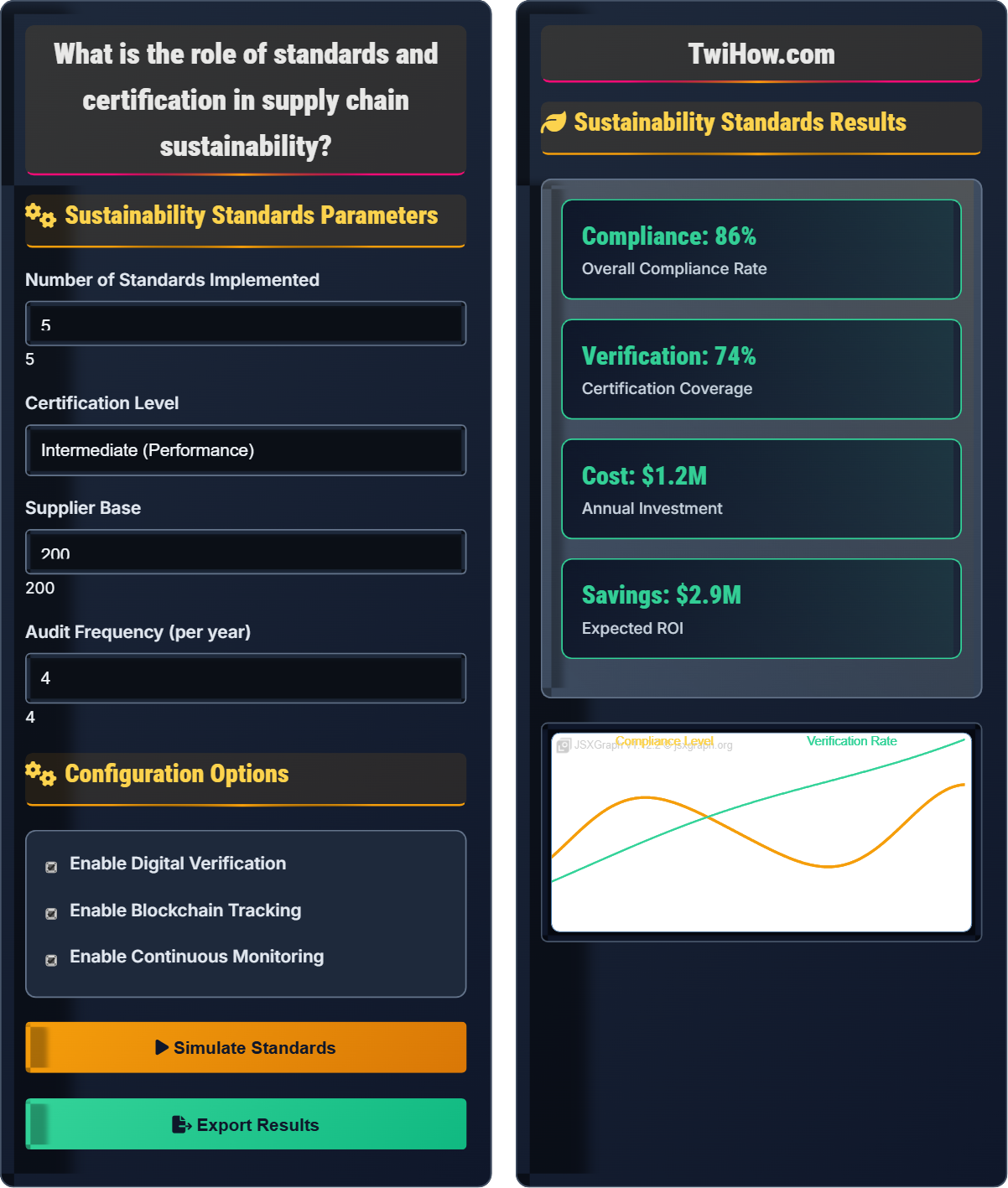
Sustainability Standards Results
| Standard | Compliance | Cost | Impact |
|---|---|---|---|
| ISO 14001 | 95% | $200K | High |
| SA8000 | 88% | $150K | Medium |
| ISO 26000 | 92% | $180K | High |
| EMAS | 85% | $220K | Medium |
Standards and Certification in Supply Chain Sustainability
Sustainability standards are established criteria and guidelines that define environmental, social, and governance (ESG) requirements for supply chain operations. These standards provide measurable benchmarks for sustainable practices, ensuring consistency and comparability across different organizations and sectors. Certification processes validate compliance with these standards through independent verification.
Key components of sustainability standards:
Where:
- Standards: Environmental, social, and governance criteria
- Weights: Importance assigned to each standard
- Compliance: Achievement level for each standard
- Certification: Third-party verification process
Key advantages of implementing sustainability standards:
- Consistency: Uniform expectations across supplier network
- Credibility: Third-party validation of sustainability claims
- Compliance: Meeting regulatory and customer requirements
- Risk Management: Identifying and mitigating sustainability risks
- Competitive Advantage: Demonstrating environmental leadership
- Stakeholder Trust: Building confidence with investors and consumers
- Digital Platforms: Supplier management and reporting systems
- Blockchain: Transparent and immutable record keeping
- IoT Sensors: Real-time environmental monitoring
- AI/ML: Predictive analytics for compliance
- Mobile Apps: Field verification and reporting
Sustainability Standards Fundamentals
Sustainability standards, certification, compliance, ESG, supply chain auditing, environmental management.
Compliance = (Certified Suppliers / Total Suppliers) × 100%
Where Compliance = achievement rate, Certified = verified compliant suppliers.
- Third-party verification is essential
- Continuous monitoring is required
- Transparency builds trust
Applications
Manufacturing, retail, agriculture, textiles, electronics, automotive, pharmaceuticals.
- Supplier onboarding
- Compliance monitoring
- Performance reporting
- Stakeholder communication
- Cost of certification
- Complexity of standards
- Global vs. local requirements
- Technology integration
Sustainability Standards Learning Quiz
Which of the following is NOT a core component of sustainability standards?
Sustainability standards focus on environmental, social, and governance (ESG) criteria. While financial reporting is important for business, it's not a core component of sustainability standards, which specifically address environmental impact, social responsibility, and governance practices.
The answer is C) Financial Reporting.
Sustainability standards specifically address the "Triple Bottom Line" of People, Planet, and Profit - but in a way that prioritizes environmental and social considerations alongside economic performance. Financial reporting is covered by separate accounting standards, while sustainability standards focus on the environmental and social impact of business operations.
Environmental Criteria: Standards for ecological impact
Social Responsibility: Standards for labor and community practices
Governance Practices: Standards for ethical business conduct
• ESG covers environmental, social, governance
• Third-party verification is essential
• Focus on ESG criteria
• Verify through independent audits
• Report transparently
• Confusing sustainability with financial standards
• Not verifying claims independently
• Ignoring social criteria
Explain the main benefits of implementing sustainability standards in supply chains, and how these benefits translate into measurable improvements in business performance.
Main Benefits: Sustainability standards provide consistency across supplier networks, credibility through third-party verification, regulatory compliance, risk mitigation, competitive advantage through environmental leadership, and stakeholder trust.
Measurable Improvements: Compliance rates can reach 85-95%. Regulatory violations can decrease by 40-70%. Brand reputation scores can improve by 15-30%. Stakeholder confidence can increase by 20-40%. Operational efficiency can improve by 10-25%.
Sustainability standards create a framework for consistent environmental and social practices across supply chains. The measurable improvements demonstrate the business value of sustainability investments, showing that environmental responsibility can align with financial performance. The benefits compound over time as sustainable practices become embedded in operations.
Compliance Rate: Percentage of suppliers meeting standards
Regulatory Violations: Breaches of environmental or social laws
Brand Reputation: Public perception of company values
• Consistency drives effectiveness
• Verification builds credibility
• Transparency creates trust
• Start with key suppliers
• Focus on material issues
• Communicate results
• Not measuring baseline performance
• Inadequate verification processes
• Ignoring supplier capabilities
A manufacturing company with 500 suppliers wants to implement sustainability standards. They estimate that 30% of suppliers already meet basic environmental standards, 20% meet social standards, and 15% meet governance standards. If they implement a comprehensive program that brings all suppliers to 80% compliance with each standard, calculate the potential improvement in overall sustainability performance and estimate the potential cost savings from reduced regulatory violations if current violations cost $500K annually.
Current Performance: Average of 21.7% (30% + 20% + 15% = 65% ÷ 3 = 21.7%)
Projected Performance: 80% compliance with all standards
Improvement: 80% - 21.7% = 58.3% increase in sustainability performance
Cost Savings: With 80% compliance, regulatory violations could decrease by 60-80%, saving $300K-$400K annually
Additional Benefits: Improved brand reputation, access to green financing, and stakeholder confidence.
This example demonstrates the significant improvement potential from implementing comprehensive sustainability standards. The calculation shows how moving from partial compliance to widespread adoption can dramatically improve sustainability performance. The cost savings from reduced violations provide a clear financial justification for sustainability investments.
Sustainability Performance: Achievement of environmental and social goals
Regulatory Violations: Breaches of environmental or social laws
Compliance Rate: Percentage of standards met
• Baseline performance matters
• Improvement creates value
• Cost savings justify investment
• Measure current state first
• Set realistic targets
• Track financial benefits
• Not establishing baseline metrics
• Setting unrealistic targets
• Ignoring financial impact
A global retailer wants to implement sustainability standards across 1,000 suppliers in 20 countries. Identify three major challenges they might face and propose solutions for each challenge.
Challenge 1: Cultural Differences: Varying interpretations of sustainability across cultures. Solution: Develop culturally-sensitive standards and local training programs.
Challenge 2: Verification Complexity: Difficulties in auditing suppliers across multiple countries. Solution: Implement digital verification platforms and local audit partners.
Challenge 3: Cost Management: High implementation and certification costs. Solution: Prioritize suppliers based on risk and impact, implement phased approach.
Success requires global coordination with local adaptation.
Global sustainability standard implementation faces unique challenges due to geographic dispersion, cultural differences, and regulatory variations. The key is developing capabilities that work across different contexts while maintaining standardization. A balanced approach of global consistency with local adaptation is essential.
Cultural Differences: Varying sustainability perspectives
Verification Complexity: Challenges in confirming compliance
Cost Management: Controlling implementation expenses
• Global consistency with local adaptation
• Cultural sensitivity matters
• Phased implementation is effective
• Build local partnerships
• Invest in cultural training
• Establish regional expertise
• Assuming universal standards
• Not considering local regulations
• Ignoring cultural differences
Which technology combination best supports effective sustainability standard implementation?
Effective sustainability standard implementation requires digital platforms for management, blockchain for transparency, and IoT sensors for real-time monitoring. These technologies work together to provide comprehensive tracking, verification, and reporting capabilities.
The answer is A) Digital platforms, blockchain, IoT sensors.
Modern sustainability standards require sophisticated technology platforms that can handle large volumes of data, provide real-time monitoring, and ensure transparent reporting. Traditional methods like paper systems, emails, and manual audits are insufficient for the scale and complexity of modern supply chain sustainability requirements.
Digital Platforms: Supplier management systems
Blockchain: Transparent record keeping
IoT Sensors: Real-time monitoring devices
• Technology enables scalability
• Transparency builds trust
• Real-time monitoring improves accuracy
• Choose integrated solutions
• Plan for scalability
• Ensure data security
• Using disconnected systems
• Not planning for data growth
• Ignoring security requirements
FAQ
Q: What's the difference between ISO 14001 and SA8000 sustainability standards?
A: The key differences are:
ISO 14001: Environmental management standard focusing on environmental impact, pollution prevention, and resource efficiency.
SA8000: Social accountability standard focusing on labor practices, human rights, and workplace conditions.
ISO 14001 addresses environmental aspects while SA8000 addresses social aspects of sustainability. Both are complementary and often implemented together for comprehensive ESG management.
Q: What are the main challenges in implementing sustainability standards?
A: The main challenges in sustainability standard implementation include:
1. Cost Management: High implementation and certification costs.
2. Complexity: Managing multiple standards across diverse supplier networks.
3. Verification: Ensuring accurate and consistent compliance monitoring.
4. Coordination: Aligning across departments and external partners.
5. Technology: Building adequate digital infrastructure.
Success requires addressing both technical and organizational challenges systematically.