How to Find Clients Online?
Complete client finding guide • Strategies • Platforms • Networking
Client Finding Overview:
Calculate PotentialFinding clients online involves using digital platforms, social media, and networking strategies to connect with potential customers or business partners. This process requires building an online presence, demonstrating expertise, and creating meaningful relationships with prospects. Success depends on consistent effort, quality content, and strategic positioning.
Key client finding components:
- Online Presence: Establishing visibility on relevant platforms
- Content Marketing: Creating valuable content to attract prospects
- Networking: Building relationships with potential clients
- Platform Strategy: Using appropriate channels for your industry
- Relationship Building: Developing trust and rapport
- Follow-up: Maintaining contact with prospects
Effective online client finding requires patience, authenticity, and consistent value delivery.
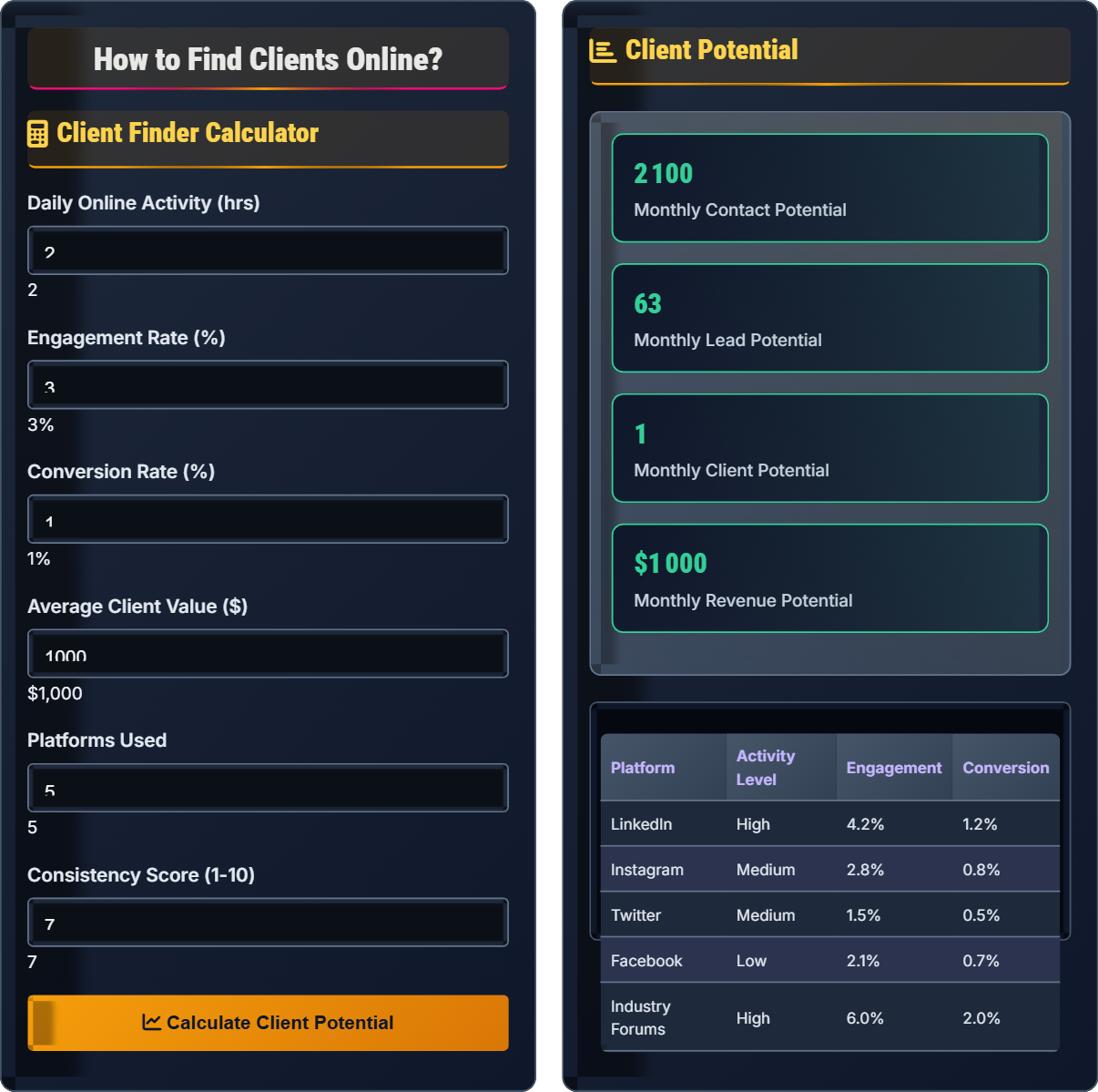
Client Finder Calculator
Client Potential
| Platform | Activity Level | Engagement | Conversion |
|---|---|---|---|
| High | 4.2% | 1.2% | |
| Medium | 2.8% | 0.8% | |
| Medium | 1.5% | 0.5% | |
| Low | 2.1% | 0.7% | |
| Industry Forums | High | 6.0% | 2.0% |
Online Client Finding Explained
Online client finding is the process of identifying, connecting with, and converting potential customers or business partners through digital platforms and strategies. This involves using social media, professional networks, content marketing, and other online channels to build relationships and generate business opportunities.
Key areas where online client finding provides value:
- Professional Services: Consulting, legal, accounting, marketing
- Creative Industries: Design, photography, writing, development
- Coaching & Training: Life coaching, business coaching, education
- Technology Services: IT, software development, digital marketing
- Business Development: Sales, partnerships, investments
- Product Sales: Direct-to-consumer and B2B sales
- Direct Outreach: Proactive contact with prospects
- Content Marketing: Attracting clients through valuable content
- Social Selling: Building relationships through social platforms
- Networking Events: Virtual events and conferences
- Referral Programs: Leveraging existing client relationships
- Platform-Based: Using specific platforms like LinkedIn or industry forums
Client Finding Strategies
Actively engage with prospects on social media platforms like LinkedIn, Twitter, and industry-specific platforms. Share valuable content, comment on posts, and participate in discussions.
- Identify relevant platforms for your industry
- Share valuable content regularly
- Engage meaningfully with prospects' posts
- Join industry-specific groups and communities
- Establish thought leadership through insights
- Track engagement metrics and adjust strategy
Create valuable content that attracts prospects and demonstrates your expertise. This includes blog posts, videos, podcasts, and other educational resources.
- Research topics relevant to your target audience
- Create high-quality, valuable content
- Optimize content for search engines
- Promote content across multiple channels
- Include clear calls-to-action
- Track performance and optimize
Build relationships with industry professionals and existing clients who can refer new business opportunities. Attend virtual events and join professional communities.
- Attend virtual conferences and webinars
- Join industry-specific online communities
- Participate in professional associations
- Ask satisfied clients for referrals
- Build strategic partnerships
- Maintain relationships with alumni networks
Platform-Specific Strategies
Client Finding Funnel
Funnel Optimization:
- Impressions: Increase visibility through content and ads
- Engagements: Create compelling, shareable content
- Connections: Build relationships and trust
- Leads: Provide value and demonstrate expertise
- Clients: Present solutions and close deals
Client Finding Methods
Method Selection Best Practices:
- Match methods to your target audience
- Combine multiple approaches for best results
- Focus on quality over quantity
- Track performance metrics for each method
- Adjust strategy based on results
- Maintain consistency across all methods
Client Finding Quiz
Which platform is most effective for B2B client finding?
LinkedIn is the most effective platform for B2B client finding. It's specifically designed for professional networking and business development. LinkedIn allows you to connect with decision-makers, join industry groups, share professional content, and build business relationships in a professional context.
The answer is B) LinkedIn.
Platform selection should align with your target audience's preferences and behavior. LinkedIn is where business professionals spend time looking for services and partnerships. Instagram and TikTok are more consumer-focused, while LinkedIn caters specifically to business relationships and professional development.
B2B: Business-to-business transactions
Decision-Makers: People with authority to make purchases
Professional Networking: Building business relationships
• Choose platforms where your audience spends time
• Match content to platform culture
• Maintain professional tone on business platforms
• Use LinkedIn Sales Navigator for targeted outreach
• Join industry-specific groups
• Share valuable insights and commentary
• Using consumer-focused platforms for B2B
• Being too sales-focused initially
• Not providing value before asking for business
Explain how to develop an effective content strategy for finding clients online, including content types, frequency, and platform-specific approaches.
Content Types: Mix of educational, entertaining, and promotional content. Include industry insights, case studies, tips, behind-the-scenes content, and client success stories.
Content Frequency: Post 3-5 times per week on most platforms. Consistency matters more than frequency. Create a content calendar to maintain regular posting.
Platform-Specific Approaches:
LinkedIn: Professional insights, industry news, case studies, thought leadership
Twitter: Real-time commentary, quick tips, industry news, engagement with others
Industry Forums: Helpful answers, expertise sharing, problem-solving
YouTube: Educational videos, tutorials, client testimonials, company culture
Blog: In-depth articles, case studies, industry analysis, how-to guides
An effective content strategy builds authority and trust with your audience. The key is providing value before asking for business. Educational content positions you as an expert, while case studies demonstrate your capabilities. Consistency in posting and messaging helps build audience trust and anticipation.
Thought Leadership: Positioning as industry expert
Content Calendar: Schedule for content creationValue Before Ask: Providing value before seeking business
• Focus on audience needs, not business goals
• Maintain consistent brand voice
• Track and analyze performance
• Repurpose content across formats
• Use trending topics strategically
• Include clear calls-to-action
• Posting without strategy
• Not understanding audience needs
• Inconsistent posting schedule
A service business with a $5,000 monthly marketing budget wants to find clients online. They can invest in content creation ($2,000), social media advertising ($1,500), networking events ($1,000), or lead generation tools ($500). How should they allocate their budget for maximum client acquisition, and why?
Recommended Allocation:
Content Creation: $2,000 - Builds authority and attracts organic leads
Social Media Advertising: $1,500 - Amplifies content and targets prospects
Networking Events: $1,000 - Builds relationships and generates referrals
Lead Generation Tools: $500 - Improves conversion and efficiency
Why This Approach: Content creates the foundation for all other activities. Social media advertising amplifies reach. Networking events build relationships that turn into referrals. Lead generation tools improve conversion rates. This combination provides both immediate and long-term results.
Alternative Strategy: If the business is new, they might invest more heavily in content and tools ($3,000 content, $1,000 tools, $1,000 networking) to build authority before scaling advertising.
Effective online client finding requires a balanced approach between attracting new prospects and converting them into clients. Content marketing builds long-term authority, while advertising provides immediate reach. Networking creates relationships that generate referrals, and tools improve efficiency. The key is finding the right balance for your business stage and goals.
Organic Reach: Natural visibility without paid promotion
Referral Generation: Getting clients from existing relationships
Conversion Rate: Percentage of leads that become clients
• Balance immediate and long-term investments
• Invest in relationship building
• Track ROI by channel
• Start with organic methods before paid advertising
• Use social proof in content
• Test different budget allocations
• Going all-paid without organic foundation
• Not tracking ad performance
• Ignoring relationship building
A marketing consultant wants to find clients online using multiple platforms. They have 15 hours per week for client finding activities. Propose a time allocation strategy across LinkedIn, industry forums, content creation, and virtual networking events.
Time Allocation Strategy:
LinkedIn Engagement: 6 hours/week - 2 hours daily for posting, commenting, and connecting
Industry Forums: 4 hours/week - Participating in discussions, answering questions
Content Creation: 3 hours/week - Creating weekly blog post and social content
Virtual Networking: 2 hours/week - Attending webinars and virtual events
Strategy: This allocation ensures consistent presence across key platforms while maintaining quality engagement. LinkedIn provides direct access to decision-makers, forums offer expert positioning, content builds authority, and networking creates relationship opportunities.
Weekly Schedule: Monday-Wednesday focus on content and LinkedIn, Thursday-Friday forum participation, weekends for networking events and planning.
Multi-platform client finding requires strategic time allocation to maintain consistent presence without spreading too thin. The key is choosing platforms where your target audience is most active and focusing on quality engagement over quantity. Each platform serves a different purpose in the client acquisition funnel.
Time Allocation: Distributing effort across platforms
Consistent Presence: Regular activity on platforms
Quality Engagement: Meaningful interactions vs. quantity
• Focus on platforms where your audience is active
• Maintain consistent engagement
• Quality over quantity in interactions
• Batch content creation sessions
• Use scheduling tools for efficiency
• Track engagement metrics by platform
• Spreading effort too thinly across platforms
• Not tracking platform performance
• Focusing on quantity over quality
Which engagement tactic typically generates the highest response rate when finding clients online?
Asking thoughtful questions typically generates the highest response rate because it directly invites interaction from prospects. Questions encourage comments and discussions, which boost engagement and increase content visibility in algorithms.
The answer is B) Asking thoughtful questions.
Interactive content performs better than passive content because it requires audience participation. Questions, polls, and calls-to-action create a two-way conversation, which social media algorithms favor. Engagement is crucial for building relationships and increasing visibility to potential clients.
Response Rate: Percentage of audience engaging
Algorithm Favor: Platform preference for engaging content
Two-Way Conversation: Interactive dialogue with audience
• Encourage audience participation
• Create interactive content
• Respond to all interactions
• Ask open-ended questions
• Use polls and surveys
• Create "this or that" scenarios
• Posting only promotional content
• Not encouraging interaction
• Not responding to comments
Client Finding FAQ
Q: How long does it typically take to find clients online?
A: Online client finding follows this typical timeline:
Months 1-3: Building presence, creating content, initial engagement
Months 4-6: Seeing first meaningful connections and inquiries
Months 7-12: Consistent lead generation and client acquisition
Year 2+: Established pipeline with referral generation
Realistic expectations include 1-3 clients in first 6 months, 5-10 in first year, with exponential growth after establishing authority and relationships.
Q: Should I focus on one platform or spread across multiple platforms?
A: Start with 1-2 platforms where your target audience is most active, then expand:
Beginner Strategy: Focus on 1-2 platforms to master them
Platform Selection: Choose based on your audience demographics and business type
Advanced Strategy: Once established, expand to 2-3 platforms maximum
Quality vs Quantity: It's better to excel on fewer platforms than to be mediocre everywhere
Resource Consideration: Each platform requires dedicated time and strategy. Spread yourself too thin, and you'll see poor results across all platforms.