How to Make Passive Income?
Complete passive income guide for side hustles • Step-by-step strategies
Passive Income Fundamentals:
Show Income CalculatorPassive income refers to money earned with minimal ongoing effort after the initial setup. It's a cornerstone of financial freedom, allowing you to generate revenue while sleeping, traveling, or focusing on other pursuits. Building passive income streams requires upfront investment of time, money, or both, but can eventually provide financial stability and independence.
Key passive income concepts:
- Investment Income: Earnings from stocks, bonds, real estate, and other assets
- Digital Products: E-books, courses, templates that sell repeatedly
- Automated Businesses: Systems that operate with minimal daily oversight
- Residual Earnings: Ongoing payments from past work or investments
Successful passive income creation combines strategic planning, initial effort, and patience to build systems that generate revenue over time.
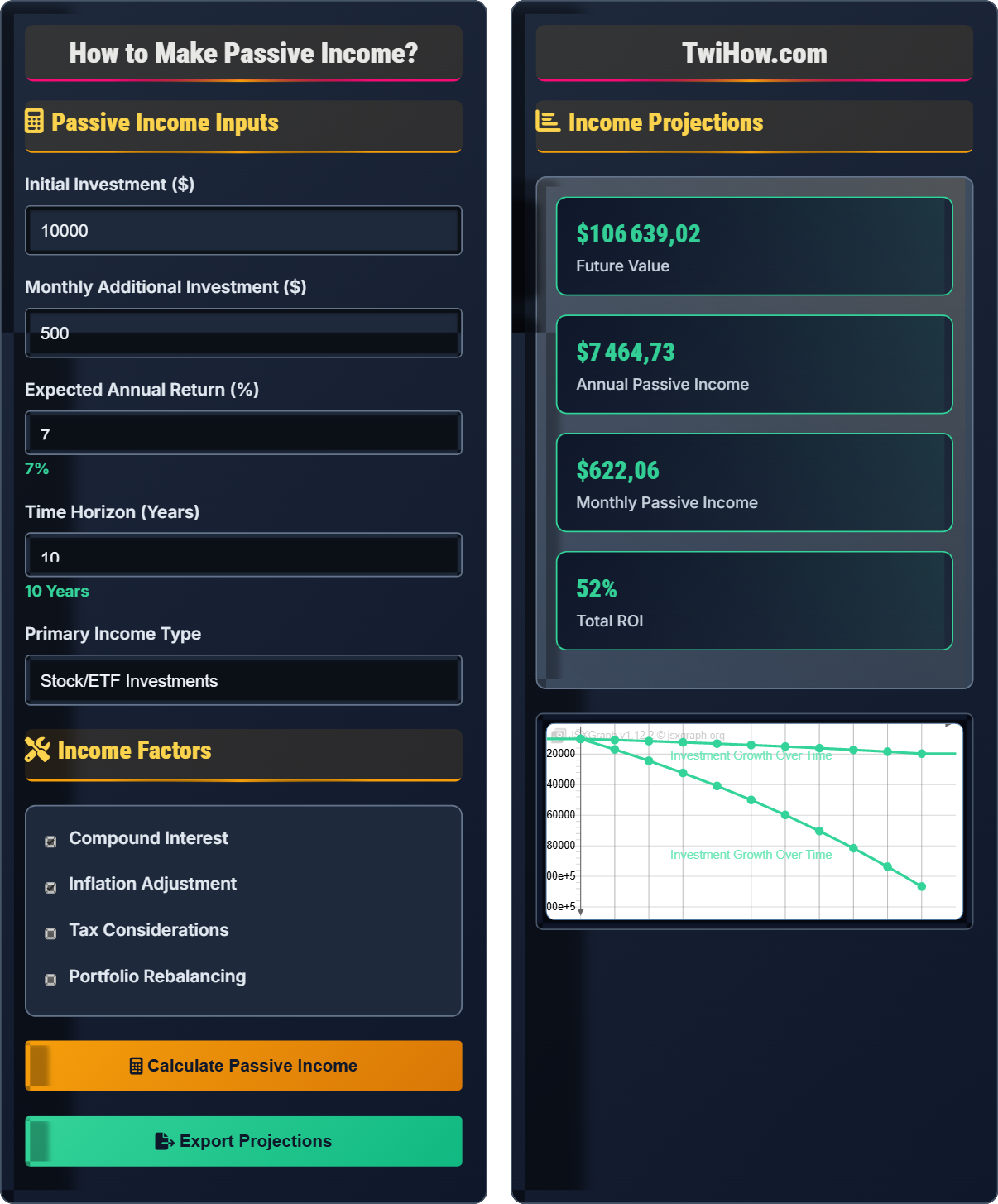
Passive Income Inputs
Income Factors
Income Projections
| Year | Value | Income | Total Invested |
|---|---|---|---|
| 1 | $10,700 | $749 | $10,500 |
| 2 | $11,449 | $801 | $11,000 |
| 3 | $12,250 | $858 | $11,500 |
| 4 | $13,108 | $918 | $12,000 |
| 5 | $14,025 | $982 | $12,500 |
$134/mo
$45/mo
$0/mo
Passive Income Explained
Passive income refers to money earned with minimal ongoing effort after the initial setup. Unlike active income (salary, wages), passive income doesn't require constant time investment. It's generated through systems, assets, or investments that continue producing returns even when you're not actively working. True passive income provides financial security and freedom, allowing you to pursue other interests while maintaining income flow.
Where:
- Future Value: Total value after time period
- Present Value: Initial investment amount
- r: Periodic interest rate
- t: Number of periods
- PMT: Regular contribution amount
Different approaches to generating passive income based on your resources and expertise:
- Investment Income: Dividends, interest, capital gains from stocks, bonds, REITs
- Rental Property: Monthly rent payments from real estate investments
- Digital Products: E-books, courses, software that sell repeatedly
- Business Ownership: Investing in businesses that operate independently
- Licensing: Royalties from intellectual property, patents, or content
- Peer-to-Peer Lending: Interest income from lending platforms
- Initial Capital: Having funds to invest in income-generating assets
- Time Investment: Upfront effort to create systems and assets
- Patience: Understanding that passive income takes time to build
- Knowledge: Understanding markets, investments, and business principles
- Diversification: Spreading income sources to reduce risk
- System Building: Creating processes that can operate without daily oversight
Income Fundamentals
Active vs passive income, compound growth, asset allocation, cash flow management, risk assessment.
Future Value = Principal × (1 + Rate)^Time + Contributions × [((1 + Rate)^Time - 1) ÷ Rate]
Where Principal = initial investment, Rate = periodic return rate, Time = number of periods.
- Start early to maximize compound growth
- Consistently contribute to your income streams
- Diversify across multiple income sources
- Reinvest earnings to accelerate growth
Income Strategies
Investment portfolios, digital entrepreneurship, real estate investing, licensing, automation.
- Dividend investing with reinvestment
- Creating and selling digital products
- Building affiliate marketing websites
- Real estate rental properties
- Developing SaaS products
- Licensing intellectual property
- Initial time and capital requirements
- Ongoing maintenance needs
- Market risk and volatility
- Scalability potential
Passive Income Quiz
Which of the following best describes true passive income?
True passive income requires minimal ongoing effort after the initial setup and creation of systems. While completely zero-effort income is rare, passive income streams should operate with very little day-to-day involvement once established. This distinguishes it from active income, which requires continuous time and effort.
The answer is B) Income that requires minimal ongoing effort after initial setup.
It's important to understand that truly "passive" income usually starts as active work. For example, creating a course requires significant upfront effort, but once published, it generates income with minimal ongoing maintenance. The key is creating systems and assets that continue producing returns with little daily oversight. This differs from traditional employment where you trade time for money.
Passive Income: Revenue earned with minimal ongoing effort after initial setup
Active Income: Money earned through direct time and labor investment
Portfolio Income: Earnings from investments like dividends and interest
• Most passive income requires significant initial effort
• Some ongoing maintenance is typically needed
• Building systems is key to true passivity
• Focus on scalable income systems
• Automate processes wherever possible
• Document systems for easy maintenance
• Expecting zero effort after initial setup
Explain the power of compound growth in building passive income and provide an example of how small differences in return rates can significantly impact long-term wealth accumulation. What factors enhance the compounding effect?
Compound Growth: Earnings generated on both the original principal and previously accumulated earnings. With compound growth, your money earns money, which then earns more money.
Example: $10,000 invested at 5% vs 8% for 20 years:
• 5%: $26,533
• 8%: $46,610
Enhancing Factors: Time (longer = more compounding), regular contributions, higher return rates, reinvesting earnings, tax-efficient accounts.
Compound growth is exponential, meaning returns accelerate over time. The longer money stays invested, the greater the impact of compounding. This is why starting early is crucial for passive income building. Small differences in return rates become massive differences over long periods due to the snowball effect of compounding. The key is patience and consistency in investing.
Compound Interest: Interest earned on both principal and accumulated interest
Time Value of Money: Money available now is worth more than the same amount later
Annual Return Rate: Percentage growth per year
• Start investing as early as possible
• Reinvest all earnings to maximize compounding
• Consistency beats timing in long-term investing
• Use tax-advantaged accounts to maximize compounding
• Automate regular contributions
• Minimize fees that erode compound growth
• Starting too late to benefit from compounding
• Withdrawing earnings instead of reinvesting
• Overlooking the impact of fees on long-term returns
You have $5,000 to start building passive income. You can either invest in dividend-paying stocks yielding 3% annually or create an online course that costs $2,000 to develop and could generate $500/month in recurring revenue. Assuming the stock investment grows at 7% annually and the course has a 5-year lifespan with no additional costs, which option provides better returns after 5 years? Consider both immediate and long-term income.
Stock Investment: $5,000 at 3% = $150/year in dividends. After 5 years at 7% growth = $5,000×(1.07)^5 = $7,013. The dividend income grows to $210/year.
Course Investment: $3,000 remaining after development. Course generates $500×12×5 = $30,000 over 5 years. Remaining $3,000 at 7% = $4,208.
Total from Course: $30,000 + $4,208 = $34,208
Total from Stocks: $7,013 + ($150×5) = $7,763
The course investment provides significantly higher returns over 5 years, but stock investment continues generating income indefinitely.
This scenario illustrates the trade-off between different passive income approaches. The course provides high returns initially but has a limited lifespan. Stock investments provide lower immediate returns but compound continuously. The optimal strategy often involves diversifying across multiple approaches - some income-generating assets with immediate returns and others with long-term growth potential.
Dividend Yield: Annual dividends as percentage of stock price
• Compare both immediate and long-term returns
• Consider the duration of income generation
• Factor in risk and maintenance requirements
• Diversify across different income durations
• Consider your timeline and risk tolerance
• Factor in ongoing maintenance costs
• Only considering immediate returns
• Not accounting for income stream duration
• Ignoring ongoing maintenance requirements
You're developing a passive income portfolio with $20,000. You're considering: 1) $10,000 in dividend stocks yielding 4%, 2) $5,000 in a peer-to-peer lending platform yielding 6%, 3) $3,000 in a rental property (net yield 8%), and 4) $2,000 in a course creation venture. How should you prioritize these investments and what risks should you consider? How would you adjust your strategy over time?
Priority Order: 1) Rental property (highest yield, tangible asset), 2) Peer-to-peer lending (good return, moderate risk), 3) Dividend stocks (stable, liquid), 4) Course creation (high potential, higher risk).
Risks: Market volatility, liquidity concerns, property management, platform risk, time commitment for course.
Adjustment Strategy: Rebalance annually based on performance, gradually increase allocation to best-performing assets, and reinvest earnings into new opportunities.
Diversification reduces risk while potentially optimizing returns. Different income streams have varying risk-return profiles and liquidity characteristics. When diversifying, consider correlation between investments, your risk tolerance, and the time required for management. The goal is to create a portfolio that provides steady growth while minimizing overall risk.
Diversification: Spreading investments across different asset types
Correlation: How closely related investments move together
Asset Allocation: Distribution of investments across categories
• Don't put all money in one income stream
• Balance risk and return across investments
• Regularly review and rebalance portfolio
• Start with lower-risk investments to build confidence
• Gradually increase allocation to higher-return assets
• Keep emergency funds separate from investment money
• Concentrating all investments in one area
• Not considering correlation between investments
• Failing to regularly rebalance portfolio
Which strategy is most effective for scaling passive income over time?
The most effective approach combines reinvesting earnings (compound growth) with adding new income streams (diversification). Reinvesting increases the size of existing income streams, while adding new streams reduces risk and opens additional growth avenues. This dual approach maximizes both growth potential and stability.
The answer is D) Both B and C combined.
Scaling passive income requires both growing existing streams and creating new ones. Reinvestment accelerates growth through compound effects, while diversification reduces risk and provides multiple growth channels. The combination creates a powerful engine for wealth building - your existing income generates more income, while new streams expand your earning potential. This approach balances growth with stability.
Compound Growth: Exponential growth from reinvesting earnings
Diversification: Spreading income across multiple sources
Reinvestment: Plowing earnings back into income-generating assets
• Reinvest early and often for maximum compounding
• Maintain balance between growth and risk
• Scale gradually to manage complexity
• Set up automatic reinvestment systems
• Track performance of each income stream
• Gradually increase investment in top performers
• Spending all passive income instead of reinvesting
• Not tracking individual stream performance
• Over-diversifying without proper management
FAQ
Q: How much money do I need to start generating meaningful passive income?
A: You can start with as little as $100 through fractional shares or micro-investing apps, but meaningful passive income typically requires larger amounts. A common rule of thumb is that you need 25x your annual income target (based on the 4% rule). For example, to generate $2,000/month ($24,000/year), you'd need approximately $600,000 invested at 4% yield. However, you can start small and build gradually through consistent investing and reinvestment of earnings.
Q: Is it realistic to quit my job and live off passive income?
A: It's possible but requires significant preparation and time. Most people need 15-25 years of consistent investing to build sufficient passive income to replace a full salary. The key is starting early, investing regularly, and being patient. Many successful passive income earners maintain some active income while building their passive streams. It's more realistic to think of passive income as supplementing your active income rather than replacing it immediately.