How to Start Freelancing?
Complete freelancing guide • Platforms • Pricing • Income
Freelancing Overview:
Calculate IncomeFreelancing is the practice of offering services to clients on a project basis without a long-term employment contract. Freelancers work independently, managing their own schedules, pricing, and client relationships. This career path offers flexibility, variety, and the potential for high earnings based on your skills and expertise.
Key freelancing components:
- Skills-Based: Leverage your professional abilities and expertise
- Project-Based: Work on specific tasks or deliverables
- Independent: Manage your own business operations
- Flexible: Set your own schedule and rates
- Client-Focused: Build relationships with diverse clients
- Self-Managed: Handle business aspects like taxes and marketing
Successful freelancing requires discipline, business acumen, and consistent quality delivery.
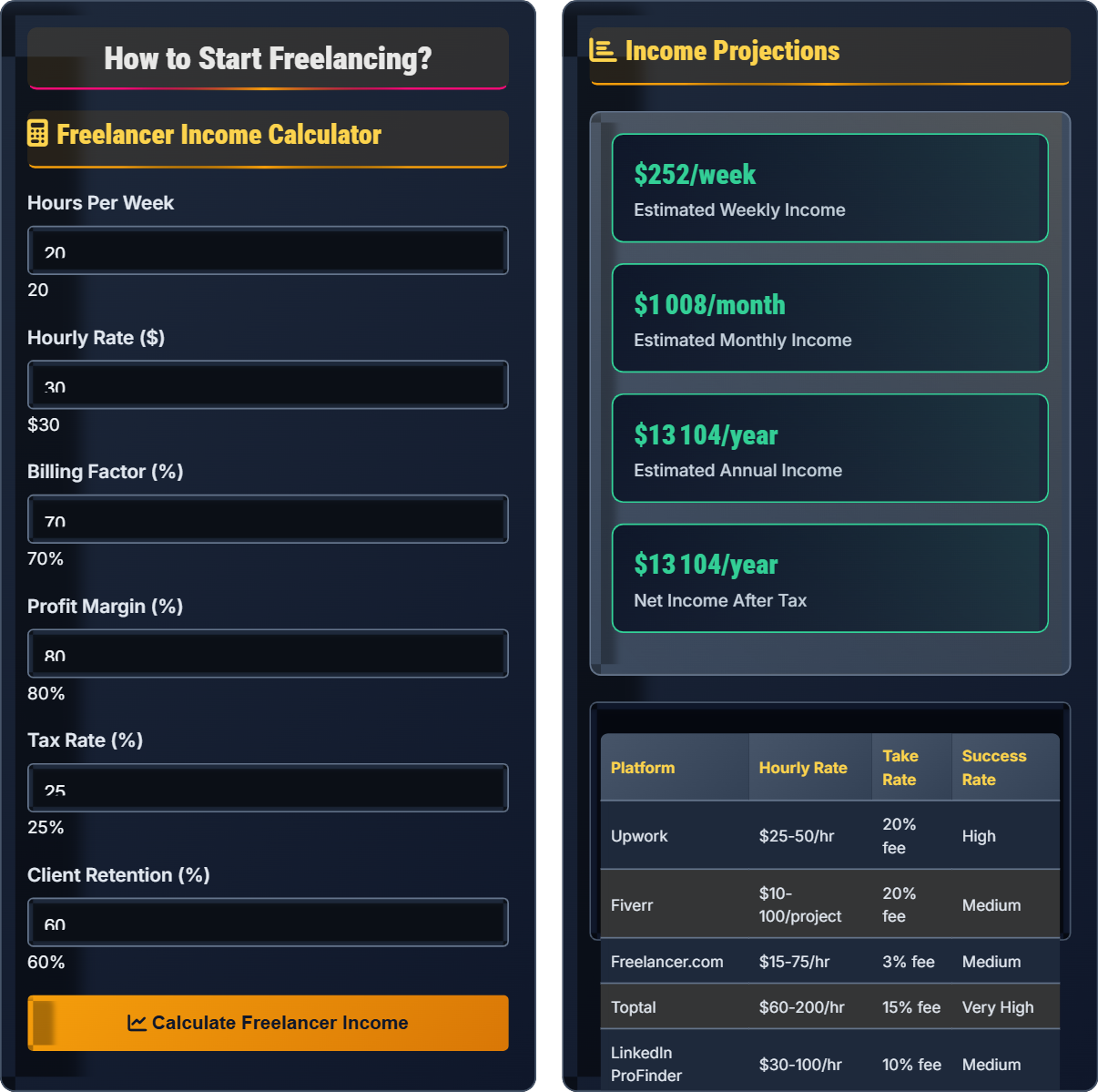
Freelancer Income Calculator
Income Projections
| Platform | Hourly Rate | Take Rate | Success Rate |
|---|---|---|---|
| Upwork | $25-50/hr | 20% fee | High |
| Fiverr | $10-100/project | 20% fee | Medium |
| Freelancer.com | $15-75/hr | 3% fee | Medium |
| Toptal | $60-200/hr | 15% fee | Very High |
| LinkedIn ProFinder | $30-100/hr | 10% fee | Medium |
Freelancing Explained
Freelancing is the practice of offering professional services to clients on a project basis without a long-term employment contract. Freelancers work independently, managing their own schedules, pricing, and client relationships. This career path offers flexibility, variety, and the potential for high earnings based on your skills and expertise.
Key areas where freelancing provides value:
- Professional Services: Writing, design, programming, consulting
- Administrative Support: Virtual assistance, data entry, scheduling
- Creative Work: Graphic design, video editing, music production
- Technical Services: Web development, software testing, IT support
- Marketing: Social media management, SEO, content creation
- Education: Tutoring, course creation, training
- Short-Term Projects: Fixed-duration assignments
- Long-Term Contracts: Extended client relationships
- Retainer Work: Ongoing monthly engagements
- One-Time Tasks: Specific, brief assignments
- Specialized Consulting: Expert advice and guidance
- Recurring Services: Regular ongoing tasks
Freelancing Strategies
Continuously improve your professional skills and learn new technologies to remain competitive. This includes both technical skills and business skills.
- Identify in-demand skills in your field
- Take online courses and certifications
- Practice regularly with personal projects
- Seek feedback from clients and peers
- Specialize in specific areas
- Stay updated with industry trends
Set competitive yet profitable rates that reflect your value and experience. Consider different pricing models for different types of projects.
- Research market rates for your skills
- Consider value-based pricing for complex projects
- Offer both hourly and fixed-price options
- Adjust rates based on experience and quality
- Factor in project complexity and scope
- Develop negotiation skills for rate discussions
Build and maintain strong relationships with clients to ensure repeat business and referrals. Communication and professionalism are key.
- Maintain clear and regular communication
- Always meet or exceed deadlines
- Deliver high-quality work consistently
- Follow up after project completion
- Handle conflicts professionally
- Request testimonials and referrals
Freelancing Platform Analysis
Freelancing Income Growth Path
Growth Milestones:
- Month 1-3: Learn platform basics, secure first clients, establish rates
- Month 4-6: Build portfolio, increase rates, develop client relationships
- Month 7-12: Specialize in niches, secure repeat clients, expand services
- Year 2+: Build premium client base, potentially transition to direct hiring
Freelancing Platforms
Platform Selection Best Practices:
- Start with 1-2 platforms to focus your efforts
- Choose platforms that match your skill level
- Read platform terms and fee structures carefully
- Build strong profiles on chosen platforms
- Gradually expand to additional platforms
- Consider transitioning to direct client relationships
Freelancing Quiz
What is the best approach for setting your initial freelancing rates?
The best approach is to research market rates and price competitively. This involves understanding what clients are willing to pay for your skills and experience level, then setting rates that are fair and sustainable. Starting too low can undervalue your work and make it difficult to raise rates later, while pricing too high without experience can make it difficult to secure initial clients.
The answer is B) Research market rates and price competitively.
Pricing strategy in freelancing requires balancing competitiveness with sustainability. Your rates should reflect your skill level, experience, and the value you provide to clients. Researching market rates helps you understand the going rate for similar services, allowing you to position yourself appropriately while building your portfolio and reputation.
Market Rate: Standard pricing for similar services
Competitive Pricing: Rates that match market standards
Value-Based Pricing: Pricing based on value delivered
• Research rates in your field
• Consider your experience level
• Factor in business expenses
• Start with competitive rates
• Increase rates gradually
• Consider value-based pricing for complex projects
• Pricing too low initially
• Not adjusting for experience
• Not considering business expenses
Explain how to choose the right freelancing platform for your skills and experience level.
Factors for Platform Selection:
1. Skill Level: New freelancers might start with platforms like Upwork or Fiverr that have more entry-level opportunities. Experienced professionals might prefer Toptal or direct hiring.
2. Skill Type: Creative skills work well on Fiverr and Upwork. Technical skills might find better opportunities on Toptal or specialized platforms.
3. Fee Structure: Consider platform fees and how they affect your earnings. Some platforms charge per transaction, others take a percentage.
4. Client Quality: Research the typical clients on each platform. Premium platforms often have higher-paying, more professional clients.
5. Competition Level: Some platforms are more saturated than others. Consider how you'll stand out among competitors.
6. Platform Features: Look for features that support your work style, such as time tracking, milestone payments, or dispute resolution.
The platform you choose significantly impacts your freelancing success. Different platforms cater to different skill levels and client types. The key is matching your current abilities and goals with the right platform ecosystem. Starting with platforms that have more opportunities for beginners allows you to build experience and portfolio.
Platform: Digital marketplace for freelancers
Fee Structure: Costs associated with using platform
Client Quality: Professionalism and budget of clients
• Research platform reputation
• Understand fee structures
• Consider long-term growth potential
• Start with one platform initially
• Diversify across multiple platforms
• Read terms and conditions carefully
• Not researching platform fees
• Choosing oversaturated platforms
• Ignoring platform policies
A freelancer charges $40/hour and works 30 hours per week. They have a billing factor of 70% (due to breaks, admin, etc.) and a profit margin of 80% after business expenses. After taxes (25%), what will be their monthly and annual net income?
Calculations:
Weekly gross income: 30 hours × $40/hour = $1,200
Actual billable income: $1,200 × 70% = $840/week
Profit after expenses: $840 × 80% = $672/week
Weekly net income after tax: $672 × (1 - 0.25) = $504
Monthly net income: $504 × 4 weeks = $2,016
Annual net income: $504 × 52 weeks = $26,208
Analysis: With 30 hours per week at $40/hour, 70% billing factor, 80% profit margin, and 25% tax rate, the freelancer generates $2,016 monthly and $26,208 annually in net income. This demonstrates the importance of considering all factors in income calculations.
Freelancer income calculations must account for multiple factors beyond simple hourly rates. The billing factor accounts for non-billable time, profit margin accounts for business expenses, and taxes reduce net income. Understanding these factors helps set realistic expectations and financial planning.
Billing Factor: Percentage of time that's billable
Profit Margin: Income after business expenses
Net Income: Earnings after all deductions
• Account for non-billable time
• Consider business expenses
• Factor in tax obligations
• Track actual vs. estimated hours
• Monitor tax implications
• Plan for irregular income
• Not accounting for business expenses
• Overestimating billing efficiency
• Ignoring tax obligations
A freelancer wants to build long-term client relationships. They have 20 current clients and want to achieve 80% client retention. Calculate their expected client base after 12 months and propose strategies to achieve this retention rate.
Client Retention Calculation:
Starting clients: 20
Retention rate: 80%
Expected retained clients: 20 × 0.8 = 16 clients
If they acquire 10 new clients during the year: 16 + 10 = 26 total clients
Retention Strategies:
1. Communication: Regular updates, clear expectations, prompt responses
2. Quality: Deliver exceptional work consistently
3. Value: Provide additional insights and recommendations
4. Reliability: Meet deadlines and honor commitments
5. Relationship: Build personal connections and understand client needs
6. Growth: Help clients achieve their business objectives
Client retention is crucial for sustainable freelancing income. Long-term clients provide predictable revenue and often pay premium rates. Building relationships based on trust, quality, and value creates strong foundations for ongoing partnerships. The cost of retaining existing clients is typically much lower than acquiring new ones.
Client Retention: Keeping existing clients for repeat work
Customer Lifetime Value: Total revenue from a client
Repeat Business: Continued work from same clients
• Exceed client expectations consistently
• Communicate proactively
• Focus on long-term relationships
• Follow up after project completion
• Request testimonials and referrals
• Offer maintenance or retainer services
• Poor communication after delivery
• Not following up for repeat business
• Focusing only on new clients
What is the primary advantage of specializing in a specific area as a freelancer?
The primary advantage of specialization is the ability to command premium prices. When you specialize in a specific area, you become an expert in that field, which allows you to charge higher rates than generalists. Clients are willing to pay more for specialized expertise because it reduces their risk and increases the likelihood of success.
The answer is C) Ability to command premium prices.
Specialization creates a competitive advantage by positioning you as an expert in a particular area. This expertise allows you to charge premium rates because clients recognize the value of specialized knowledge. While specialization may reduce the number of opportunities, it typically increases the value of each opportunity.
Specialization: Focusing on specific area of expertise
Expertise: Deep knowledge in specific field
Premium Pricing: Charging above-market rates
• Choose specialization based on market demand
• Develop deep expertise in chosen area
• Communicate your specialization clearly
• Build portfolio showcasing specialized skills
• Create content demonstrating expertise
• Network with other specialists
• Choosing oversaturated specializations
• Not developing deep expertise
• Failing to communicate specialization
Freelancing FAQ
Q: How much time should I dedicate to freelancing initially?
A: Start with 5-15 hours per week to test your concept without overwhelming your schedule. This allows you to learn the ropes, build initial clients, and gauge your interest level. As you become more efficient and see positive results, gradually increase your time investment. The key is consistency over intensity in the beginning.
Many successful freelancers start with just 5-10 hours per week while maintaining their day job, proving that significant results can come from consistent, small efforts.
Q: What's the difference between freelancing and entrepreneurship?
A: The main differences between freelancing and entrepreneurship:
Freelancing: Selling your time and skills directly to clients, typically project-based work
Entrepreneurship: Building a business that creates products or services, often with employees
Many entrepreneurs start as freelancers and evolve over time. The transition typically occurs when the freelancer begins building systems, hiring others, or creating products rather than just selling time.